With such a target-rich guy as Jones, why does Beck go with the least credible evidence possible? When the facts flow your way, why make stuff up? Beck’s bizarre claims about DDT offer more evidence the guy has just floated around the bend in the reality and ethical river. More on that later.
Millard Fillmore’s Bathtub said Little Green Footballs was right? Better spread that news!
Spread the word; friends don't allow friends to repeat history.
Sonar image of methane plumes rising from methane hydrates on the Arctic Ocean floor; image from National Oceanography Centre, Southampton (Britain)
It’s been predicted for years, and now it’s happening. Deep in the Arctic Ocean, water warmed by climate change is forcing the release of methane from beneath the sea floor.
Over 250 plumes of gas have been discovered bubbling up from the sea floor to the west of the Svalbard archipelago, which lies north of Norway. The bubbles are mostly methane, which is a greenhouse gas much more powerful than carbon dioxide.
The methane plumes were discovered by an expedition aboard the research ship James Clark Ross, led by Graham Westbrook of the University of Birmingham and Tim Minshull of the National Oceanography Centre, Southampton, both in the UK.
Fortunately, the methane is not making it out of the water — yet. The gases are absorbed before they get to the surface — but that increases ocean acidity. If, and when, the methane hits the atmosphere, it will contribute to greenhouse warming of the planet. This could create a runaway heat effect: Warmer waters cause hydrates to release methane to the atmosphere, which causes the atmosphere to warm more, faster.
Scientists have not dismissed all other possibilities, but methane hydrate melting is the most likely cause:
Cohen cautions that the Arctic methane may not be from hydrate, but could be coming from the methane’s primary source, which might be deep within the Earth.
If that was the case, the warming of the West Spitsbergen current may not be to blame.
He says that the large amounts of methane being released make this unlikely, however: “If the methane is all primary, it would be an unprecedented amount.” So the idea that the hydrates are at least partly to blame is more plausible. “It’s not definitively proven, but it’s certainly reasonable,” he says.
Spread the word; friends don't allow friends to repeat history.
From Reuters: "A sockeye salmon scurries through shallow water in the Adams River while preparing to spawn near Chase, British Columbia northeast of Vancouver October 11, 2006. REUTERS/Andy Clark"
“It’s quite the shocking drop,” said Stan Proboszcz, fisheries biologist at the Watershed Watch Salmon Society. “No one’s exactly sure what happened to these fish.”
Salmon are born in fresh water before migrating to oceans to feed. They return as adults to the same rivers to spawn.
Several theories have been put forward to try to explain the sockeye’s disappearance:
* Climate change may have reduced food supply for salmon in the ocean.
* The commercial fish farms that the young Fraser River salmon pass en route to the ocean may have infected them with sea lice, a marine parasite.
* The rising temperature of the river may have weakened the fish.
The Canadian government doesn’t know what’s killing the fish, but believes the sockeye are dying off in the ocean, not in fresh water, based on healthy out-migrations, said Jeff Grout, regional resource manager of salmon for the Department of Fisheries and Oceans.
In this case, even a small change in climate can have huge effects on ecosystems and specific populations of animals. It’s one of those climate change issues that climate change skeptics and denialists prefer not to talk about at all. If, as they allege, concern over climate change is entirely political, driven by bad information and false claims from over-active environmentalists, these problems should not exist at all.
But the problems do exist. A fishery that had been stable for 50 years previously, the entire time it was tracked so carefully, suddenly becomes fishless. Watch those rivers and fisheries.
“Not Evil, Just Wrong” is slated for release on October 18. This is the film that tried to intrude on the Rachel Carson film earlier this year, but managed to to get booked only at an elementary school in Seattle, Washington — Rachel Carson Elementary, a green school where the kids showed more sense than the film makers by voting to name the school after the famous scientist-author.
The film is both evil and wrong.
Errors just in the trailer:
Claims that Al Gore said sea levels will rise catastrophically, “in the very near future.” Not in his movie, not in his writings or speeches. Not true. That’s a simple misstatement of what Gore said, and Gore had the science right.
” . . . [I]t wouldn’t be a bad thing for this Earth to warm up. In fact, ice is the enemy of life.” “Bad” in this case is a value judgment — global warming isn’t bad if you’re a weed, a zebra mussel, one of the malaria parasites, a pine bark beetle, any other tropical disease, or a sadist. But significant warming as climatologists, physicists and others project, would be disastrous to agriculture, major cities in many parts of the world, sea coasts, and most people who don’t live in the Taklamakan or Sahara, and much of the life in the ocean. Annual weather cycles within long-established ranges, is required for life much as we know it. “No ice” is also an enemy of life.
“They want to raise our taxes.” No, that’s pure, uncomposted bovine excrement.
“They want to close our factories.” That’s more effluent from the anus of male bovines.
The trailer notes the usual claim made by Gore opponents that industry cannot exist if it is clean, that industry requires that we poison the planet. Were that true, we’d have a need to halt industry now, lest we become like the yeast in the beer vat, or the champagne bottle, manufacturing alcohol until the alcohol kills the yeast. Our experience with Rivers and Harbors Act of 1899, the CleanAirActs and the Clean Water Act is that cleaning the environment produces economic growth, not the other way around. A city choked in pollution dies. Los Angeles didn’t suffer when the air got cleaner. Pittsburgh’s clean air became a way to attract new industries to the city, before the steel industry there collapsed. Cleaning Lake Erie didn’t hurt industry. The claim made by the film is fatuous, alarmist, and morally corrupt.
When the human health, human welfare, and environmental effects which could be expressed in dollar terms were added up for the entire 20-year period, the total benefits of Clean Air Act programs were estimated to range from about $6 trillion to about $50 trillion, with a mean estimate of about $22 trillion. These estimated benefits represent the estimated value Americans place on avoiding the dire air quality conditions and dramatic increases in illness and premature death which would have prevailed without the 1970 and 1977 Clean Air Act and its associated state and local programs. By comparison, the actual costs of achieving the pollution reductions observed over the 20 year period were $523 billion, a small fraction of the estimated monetary benefits.
“Some of the environmental activists have not come to accept that the human is also part of the environment.” Fatuous claim. Environmentalists note that humans uniquely possess the ability to change climate on a global scale, intentionally, for the good or bad; environmentalists choose to advocate for actions that reduce diseases like malaria, cholera and asthma. We don’t have to sacrifice a million people a year to malaria, in order to be industrial and productive. We don’t have to kill 700,000 kids with malaria every year just to keep cars.
“They want to go back to the Dark Ages and the Black Plague.” No, that would be the film makers. Environmentalists advocate reducing filth and ignorance both. Ignorance and lack of ability to read, coupled with religious fanaticism, caused the strife known as “the Dark Ages.” It’s not environmentalists who advocate an end to cheap public schools.
The trailer shows a kid playing in the surf on a beach. Of course, without the Clean Water Act and other attempts to keep the oceans clean, such play would be impossible. That we can play again on American beaches is a tribute to the environmental movement, and reason enough to grant credence to claims of smart people like Al Gore and the scientists whose work he promotes.
“I cannot believe that Al Gore has great regard for people, real people.” So, this is a film promoting the views of crabby, misanthropic anal orifices who don’t know Al Gore at all? Shame on them. And, why should anyone want to see such a film? If I want to see senseless acts of stupidity, I can rent a film by Quentin Tarantino and get some art with the stupidity. [Update, November 23, 2009: This may be one of the most egregiously false charges of the film. Gore, you recall, is the guy who put his political career and presidential ambitions on hold indefinitely when his son was seriously injured in an auto-pedestrian accident; Gore was willing to sacrifice all his political capital in order to get his son healed. My first dealings directly with Gore came on the Organ Transplant bill. Gore didn’t need a transplant, didn’t have need for one in his family, and had absolutely nothing to gain from advocacy for the life-saving procedure. It was opposed by the chairman of his committee, by a majority of members of his own party in both Houses of Congress, by many in the medical establishment, by many in the pharmaceutical industry, and by President Reagan, who didn’t drop his threat to veto the bill until he signed it, as I recall. Gore is a man of deep, human-centered principles. Saying “I can’t believe Al Gore has great regard for real people” only demonstrates the vast ignorance and perhaps crippling animus of the speaker.]
That’s a whopper about every 15 seconds in the trailer — the film itself may make heads spin if it comes close to that pace of error.
Where have we seen this before? Producers of the film claim as “contributors” some of the people they try to lampoon — people like Ed Begley, Jr., and NASA’s James E. Hansen, people who don’t agree in any way with the hysterical claims of the film, and people who, I wager, would be surprised to be listed as “contributors.”
Here, see the hysteria, error and alarmism for yourself:
Ann McElhinney is one of the film’s producers. Her past work includes other films against protecting environment and films for mining companies. She appears to be affiliated with junk science purveyors at the Competitive Enterprise Institute, an astro-turf organization in Washington, D.C., for whom she flacked earlier this year (video from Desmogblog):
Climate change denialists (sorry, Mr. Watts – denialism is what it is) frequently argue that since the peak heat year of 1998, the planet has been cooling, and may be in a long-term trend to a much cooler planet.
But my trips to the mountains are always simultaneously joyful and mournful. The story I want to tell is about seeing the effects up close of the North American pine beetle outbreak. It’s devastating the Rocky Mountain forests in the U.S. and Canada and growing exponentially each year. The epidemic is occurring because our winters have not been cold enough to stop the beetles from multiplying. Bark beetles are good for the ecosystem, but not in this amount. The fall colors in our evergreen forests are telling us that global warming is no longer something our kids will face; it’s happening now. And it will accelerate if our forests disappear.
Mr. Watts, it’s not me you have to convince. There are several millions of beetles in Colorado who must be persuaded the climate is not warming — and they’ll be a tough sell, since a colder climate means death to their future generations.
A greater challenge for you, Mr. Watts: Not one of those beetles reads your blog. How will you reach them?
The Alverna Covenant was written by members of the Task Force on Christian Lifestyle and Ecology of the Christian Church (Disciples of Christ) while meeting at Alverna Retreat Center, a Franciscan retreat in Indianapolis, Ind. The name has added significance. Alverna is named for Mt. Alverna in Italy, the mountain retreat given to Francis of Assisi. Francis is honored for his concern for the care of and relatedness of all creation. The 800th anniversary of Francis’ birth was celebrated in 1981, the year the Alverna Covenant was first introduced at the General Assembly of the Christian Church (Disciples of Christ).
The Alverna Covenant
Whereas:
God has created the world with finite resources;
God has given to us the stewardship of the earth;
God has established order through many natural cycles.
And it is evident that:
We are consuming resources at a rate that cannot be maintained;
We are interrupting many natural cycles;
We are irresponsibly modifying the environment through consumption and pollution;
We are populating the earth at a rate that cannot be maintained;
As a member of the human family and a follower of Jesus Christ, I hereby covenant that:
I will change my lifestyle to reduce my contribution to pollution;
I will support recycling efforts;
I will search for sustainable lifestyles;
I will work for public policies which lead to a just and sustainable society;
I will share these concerns with others and urge them to make this Covenant.
What other denominations have statements on wise resource stewardship? What do they say?
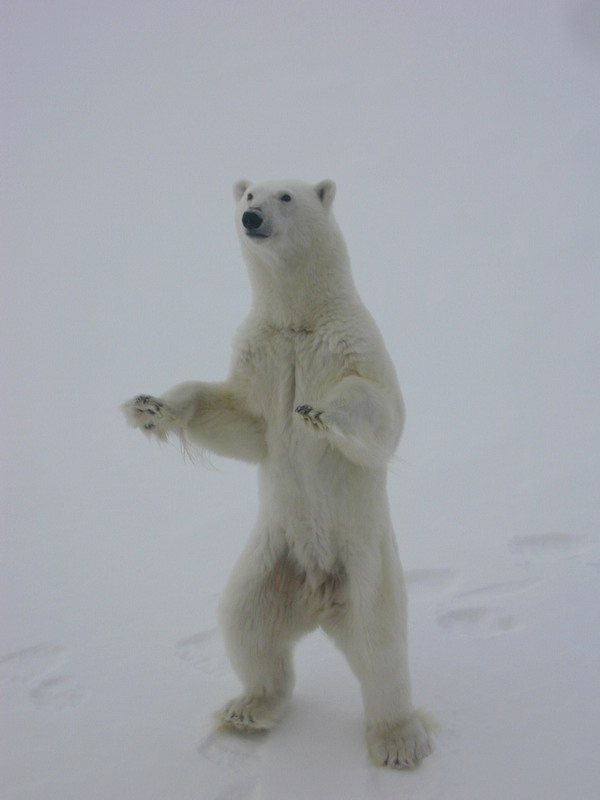
“Take it easy! Calm down, stick to the facts!” Polar bear photo by Kathy Crane, NOAA Arctic Research Office
There is no dramatic finding in the release. After you read it, you’ll probably wonder, too, why climate change skeptics don’t want you to read this press release:
The 15th meeting of the IUCN Polar Bear Specialist Group (PBSG), hosted by the Greenland Institute of Natural Resources, was held at the Greenland Representation in Copenhagen Denmark , June 29-July 3, 2009. The Polar Bear Specialist Group is composed of researchers and managers representing each of the five circumpolar nations that signed the International Agreement for the Conservation of Polar Bears of 1973. Since the late 1960s, the members of PBSG have met every 3 to 5 years under the umbrella of the Species Survival Commission of the IUCN (the International Union for the Conservation of Nature and Natural Resources) to review and exchange information, and make recommendations for research and management of polar bears throughout the Arctic.
The PBSG renewed the conclusion from previous meetings that the greatest challenge to conservation of polar bears is ecological change in the Arctic resulting from climatic warming. Declines in the extent of the sea ice have accelerated since the last meeting of the group in 2005, with unprecedented sea ice retreats in 2007 and 2008. The PBSG confirmed its earlier conclusion that unabated global warming will ultimately threaten polar bears everywhere.
The PBSG also recognized that threats to polar bears will occur at different rates and times across their range although warming induced habitat degradation and loss are already negatively affecting polar bears in some parts of their range. Subpopulations of polar bears face different combinations of human threats. The PBSG recommends that jurisdictions take into account the variation in threats facing polar bears.
The PBSG noted polar bears suffer health effects from persistent pollutants. At the same time, climate change appears to be altering the pathways by which such pollutants enter ecosystems. The PBSG encourages international efforts to evaluate interactions between climate change and pollutants.
The PBSG endorses efforts to develop non-invasive means of population assessment, and continues to encourage jurisdictions to incorporate capture and radio tracking programs into their national monitoring efforts. The members also recognized that aboriginal people are both uniquely positioned to observe wildlife and changes in the environment, and their knowledge is essential for effective management.
The PBSG recognizes that where habitats are stable, polar bears are a renewable resource, and reaffirmed its support of the right of aboriginal groups to harvest polar bears within sustainable limits. The PBSG noted that the population of polar bears in Baffin Bay, shared between Greenland and Canada, may simultaneously be suffering from significant habitat change and substantial over harvest, while at the same time interpretations by scientists and local hunters disagree regarding population status. Similarly, the Chukchi Sea polar bear population which is shared by Russia and the United States is likely declining due to illegal harvest in Russia and one of the highest rates of sea ice loss in the Arctic. Consistent with its past efforts to coordinate research and management among jurisdictions, the PBSG recommended that the polar bear populations in Baffin Bay and the Chukchi Sea be reassessed and that harvests be brought into balance with the current sustainable yield.
A variety of management changes have occurred since the PBSG last met in 2005. The PBSG members were particularly pleased that quotas for the harvest of polar bears in Greenland were implemented in January 2006, and that quota reductions have been implemented in some parts of Greenland. Also since the last meeting, the government of Nunavut reduced the harvest quota in Western Hudson Bay because of the documented population decline.
The PBSG reevaluated the status of the 19 recognized subpopulations of polar bears distributed over vast and relatively inaccessible areas of the Arctic. Despite the fact that much new information has been made available since the last meeting, knowledge of some populations is still poor. Reviewing the latest information available the PBSG concluded that 1 of 19 subpopulations is currently increasing, 3 are stable and 8 are declining. For the remaining 7 subpopulations available data were insufficient to provide an assessment of current trend. The total number of polar bears is still thought to be between 20,000 and 25,000. However, the mixed quality of information on the different subpopulations means there is much room for error in establishing that range. That potential for error, given the ongoing and projected changes in habitats and other potential stressors is cause for concern. Nonetheless, the PBSG is optimistic that humans can mitigate the effects of global warming and other threats to polar bears, and ensure that they remain a part of the Arctic ecosystem in perpetuity.
Dr. Erik Born from the Greenland Institute of Natural Resources was elected as the new chairman of the group after Dr. Andrew Derocher from the University of Alberta, who has been serving as chair since 2005.
Well, there is that proclamation of optimism in the penultimate paragraph, that humans can mitigate threats to bears, including global warming. Is that why they don’t want you to read it?
A new Dust Bowl? (Image updated January 2013; old links dead)
No, I’m not repeating the error of many who take every snowflake as bizarre evidence that global warming has ended.
I think we need to stick to the facts.
2009 may be cooler than 1998, one of the hottest years on record, but that in no way suggests an end to the climate crisis scientists have been tracking for the past couple of decades.
FIREBAUGH, Calif. — The road to Todd Allen’s farm wends past irrigation canals filled with the water that California‘s hot Central Valley depends on to produce vegetables and fruit for the nation. Yet not a drop will make it to his barren fields.
Three years into a drought that evokes fears of a modern-day dust bowl, Allen and others here say the culprit now isn’t Mother Nature so much as the federal government. Court and regulatory rulings protecting endangered fish have choked the annual flow of water from California’s Sierra mountains down to its people and irrigated fields, compounding a natural dry spell.
“This is a regulatory drought, is what it is,” Allen says. “It just doesn’t seem fair.”
For those like Allen at the end of the water-rights line, the flow has slowed to a trickle: His water district is receiving just 10% of the normal allocation of water from federal Bureau of Reclamation reservoirs. He says he’s been forced to lay off all his workers and watch the crops die on his 300 acres while bills for an irrigation system he put in are due.
“My payments don’t stop when they cut my water off,” Allen says.
Although some farmers with more senior water rights are able to keep going, local officials say 250,000 acres has gone fallow for lack of water in Fresno County, the nation’s most productive agriculture county. Statewide, the unplanted acreage is almost twice that.
Unemployment has soared into Depression-era range; it is 40% in this western Fresno County area where most everyone’s job is dependent on farming. Resident laborers who for years sweated in fields to fill the nation’s food baskets find themselves waiting for food handouts.
“The water’s cut off,” complains Robert Silva, 68, mayor of the farm community of Mendota. “Mendota is known as the cantaloupe capital of the world. Now we’re the food-line capital.”
Three years of dry conditions is being felt across much of the nation’s most populous state.
Gov. Arnold Schwarzenegger declared a water emergency in February and asked for 20% voluntary cuts in water use. The U.S. Department of Agriculture’s Drought Monitor lists 44% of the state as in a “severe” drought.
In arid Southern California, cities and water districts have raised rates to encourage conservation and imposed limits on use
AUSTIN – The drought that has gripped Central Texas is approaching the severity of Texas’ most famous drought, the 1950s dry spell that lasted several years, Lower Colorado River Authority officials say.
But the current drought, which began in the fall of 2007, has seen more intense concentrations of high temperatures and less rainfall than the majority of the earlier drought.
“It was hot, yes, it was dry” in the 1950s, said LCRA meteorologist Bob Rose, “but it wasn’t crazy hot like this year.” Soil moisture is negligible now. And with spotty precipitation, “we haven’t been able to generate any runoff” to replenish reservoirs, he said.
“What makes our current drought unique is not the duration but the severity,” Rose said this week at a drought briefing for meteorologists and reporters.
According to drought statistics released by the U.S. Department of Agriculture, 77 of Texas’ 254 counties are in extreme or exceptional drought, the most severe categories. No other state in the continental U.S. has even one area in those categories.
John Nielsen-Gammon, the Texas state climatologist at Texas A&M University, said he expects harsh drought conditions to last at least another month.
In the bone-dry San Antonio-Austin area, the conditions that started in 2007 are being compared to the devastating drought of the 1950s. There have been 36 days of 100 degrees or more this year in an area where the total usually is closer to 12.
Among the most obvious problems are the lack of water in Lake Travis and Lake Buchanan near Austin, two massive reservoirs along the Colorado River that provide drinking water for more than 1 million people and also are popular boating and swimming spots. Streams and tributaries that feed the lakes have “all but dried up,” according to the Lower Colorado River Authority.
San Antonio, which relies on the Edwards Aquifer for its water, is enduring its driest 23-month period since the start of recorded weather data in 1885, according to the National Weather Service. The aquifer’s been hovering just above 640 feet deep, and if it dips below that, the city will issue its harshest watering restrictions yet.
A lot of the problem has to do with timing. About half of the water that recharges the [Northeast] region’s aquifer is from spring snowmelt, said [USGS hydrologist Thomas] Mack, allowing it to be plentiful to residents for summer lawn watering and other uses.
But global warming is causing the snow to melt earlier by around two to four weeks. At the same time, more rain, instead of snow, is expected to fall in the winter. That means the aquifer is filling up earlier in the spring.
The problem is the region’s bedrock aquifer can’t hold water for a long time – filling it up when it is needed the least and draining before the busy summer.
All environmental problems are complex, and global “warming” is massively more complex than any other environmental issue humans have recognized and dealt with. Climate change deals with the entire Earth, and with the two great pools of fluids on the Earth, the oceans and the atmosphere, where the sheer physics of change are nearly impossible to understand, let alone predict.
Perhaps, as local conditions in more and more places demonstrate damages from climate change, skeptics can be brought around to understand that action is required even when we don’t have all the possible data points we’d like.
It was a minor note, really — USGS released a series of satellite photos of ice in the Arctic Ocean. The photos were taken with U.S. defense satellites (“spy” satellites, most likely) under an interesting agreement between the Department of Defense and science agencies to look at ice, essentially to look at the cold, not come in from it.
Part of that agreement is that the photos don’t get released until Defense says there is no reason to hold them secred anymore. For some reason — skullduggery? bureaucracy? — the photos weren’t released during the Bush years. The Obama administration hustled out a series of photos for scientists to study.
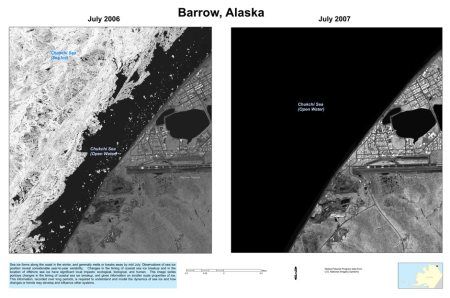
Very few news outlets picked up on the release of the photos. The Guardian ran the most provocative, prepared-for-public-consumption set of two photos of the sea just off of Barrow, Alaska, which showed a dramatic contrast between 2006 and 2007. The icy seas of July 2006 were replaced with miles of clear ocean in July 2007.
The Bathtub ran that poster. And yesterday there was a surge of hits on the article, most going to other posts claiming the photos had been photoshopped. A commenter here said the same. Viewers find it odd that there is a stark contrast between land and sea inthe arctic. Really. No, really.
Now, I had expected someone to defend Bush, to say that the Bush administration hadn’t really suppressed the photos, just didn’t release them.
But photo fraud?
Denialists resorted to that solution first.
Here are reasons mitigating against fraud.
The U.S. Geological Survey (USGS) released the poster with the photos. USGS has a long, long history of accurate science, outside political interference. On a few occasions, USGS reports have been delayed by political appointees — but the instances where one can say the data were corrupted on purpose are very few (if any — I can’t think of one off-hand). USGS would be unlikely as a source of doctored photos.
It is a crime to jigger the scientific results under U.S. law. A few scientists have been caught, tried and jailed. The reality is that most scientist strive to be well on the ethical side of the line of research laws — but it’s a federal crime for government or government-funded scientists to fake results. I’ll wager every scientist at USGS knows that.
USGS released four posters total, and a couple dozen other photos. For Barrow, there were 18 photos from 2005 and 2006, and another 8 photos from 2007-2008. While only four sites were chosen for poster, there are six sites with photos available for study. Were anyone to jigger one photo, others would need to be jiggered to make them match. Since Defense still has the originals, a fraud would probably be discovered.
Government scientists have been champing at the bit for eight years to get rid of the fetters of bureaucrats interfering with their research; they wouldn’t risk a fraud just six months in to the new administration, nor would they be likely to risk a fraud at any time, since they think that the truth is of very high value.
MacsMind jumped on the photos: “Almost so bad it’s laughable”. The blog offers no evidence of fraud, just the spiteful belief of the author. Well, he does offer photos of a January 2006 ice surge, as if to suggest that the ice from January of 2006 should have stayed hugging the coast near Barrow even through 2007, so any photo that shows clear sea must be false. Denialists will abandon all types of measure, even calendars and clocks, in their mad rush to cloak the science. MacsMind even goes so far as to invent a story that the photo was taken at night, and since it shows no lights of ships at sea, they must have been cut out (photos of ice cover generally don’t work well at night — where did he get that?).
Critics of climate change and plans to do something to slow climate change reveal themselves here as not basing their views on the science — here they don’t need the science to “know that it’s wrong.”
Sometimes I wonder if we could cure global warming simply by getting the critics to shut up.
Oh, let’s make them crazy. Here’s the poster showing the contrast in sea ice in the Beaufort Sea; the caption:
This site is near the edge of the ice pack. In summer, as shown here, ponds of meltwater form on the surface. These dark pools absorb more of summertime’s solar radiation than does the surrounding ice, enhancing melting. Observations of sea ice conditions reveal considerable year to year variability. These images, displaying the variability with regard to the amount of melting, are an example of the long term sequential record needed to support understanding and analysis of this dynamic system. Pond coverage monitored over time contributes to estimates of surface reflectivity that are needed to understand and model the dynamics of sea ice mass balance and temperature.
Radar images of sea ice around Barrow, Alaska -"The animation below is from the radar record of the last three days. The images used to produce this animation are from the 10 kW X-band marine radar mounted atop the 4-story ASRC building in downtown Barrow, Alaska, pointed north."
Help cool discussion on climate change; share this post:
Spread the word; friends don't allow friends to repeat history.
Look at the photos and see for yourself. From 2006 to 2007, did sea ice at Barrow, Alaska, increase or decrease?
A comparison of polar sea ice at Barrow, Alaska -- July 2006 on the left, July 2007 on the right - public domain photo from U.S. military satellites. Click for larger view from The Guardian.
Graphic images that reveal the devastating impact of global warming in the Arctic have been released by the US military. The photographs, taken by spy satellites over the past decade, confirm that in recent years vast areas in high latitudes have lost their ice cover in summer months.
The pictures, kept secret by Washington during the presidency of George W Bush, were declassified by the White House last week. President Barack Obama is currently trying to galvanise Congress and the American public to take action to halt catastrophic climate change caused by rising levels of carbon dioxide in the atmosphere.
One particularly striking set of images – selected from the 1,000 photographs released – includes views of the Alaskan port of Barrow. One, taken in July 2006, shows sea ice still nestling close to the shore. A second image shows that by the following July the coastal waters were entirely ice-free.
The photographs demonstrate starkly how global warming is changing the Arctic. More than a million square kilometres of sea ice – a record loss – were missing in the summer of 2007 compared with the previous year.
Spin, from the presidency? Who knew?
Climate change skeptics (read: deniers) say that ice has come back in record amounts in 2008. According to the news article, that isn’t exactly the case.
Nor has this loss shown any sign of recovery. Ice cover for 2008 was almost as bad as for 2007, and this year levels look equally sparse.
* Happy update, 8-2-2009: I’m happy to report I erred. Actually, Anthony Watts reported on the release of the photos on July 15. He didn’t use the Barrow photos, and he certainly did not claim that they are hoax photos. He noted that the previously classified data have been released, and he seemed to think that there is no monkeying around with them. It’ll be interesting to see how he deals with the photos from here on in.
Spread the news!
Spread the word; friends don't allow friends to repeat history.
It would be good news were it not so bad: India, usually considered a threat to U.S. dominance in science, has turned its back on climate science and instead, citing junk science claims, rejected overtures to reduce pollution that affects climate. India appears to have fallen victim to the hoaxters who claim climate change is no big deal.
A split between rich and poor nations in the run-up to climate-change talks widened on Thursday.
India rejected key scientific findings on global warming, while the European Union called for more action by developing states on greenhouse gas emissions.
Jairam Ramesh, the Indian environment minister, accused the developed world of needlessly raising alarm over melting Himalayan glaciers.
He dismissed scientists’ predictions that Himalayan glaciers might disappear within 40 years as a result of global warming.
“We have to get out of the preconceived notion, which is based on western media, and invest our scientific research and other capacities to study Himalayan atmosphere,” he said.
Deadly air pollution obscures the India Gate, New Delhi, India, November 2008 - NowPublic.com
It’s interesting to see these issues play out politically. India and China both understand that the U.S. and Europe have much more to lose from climate change than either of those nations. Climate damage to the U.S. wheat belt, for example, would chiefly close off U.S. production of wheat for export, opening markets for others — like India and China. Critically, such damage also hurts U.S. ability to offset balance of payments issues, providing economic and finance advantages to China’s banks. U.S. ports are much more vulnerable to climate change damage, from increase storms and changing ocean levels, than are ports in India and China — and there are more ports that are vulnerable in the U.S. and Europe.
India’s inaction and recalcitrance should not be used as justification for the U.S. to do nothing, thereby slitting its own patriotic throat.
But watch: Climate denialist blogs, “hate-America-first” outlets like World Net Daily, and Osama bin Laden will hail India’s inaction.
Let’s hope cooler heads prevail, lest we run out of cooler heads.
Years ago, in Virginia, I had learned that Virginia had only one natural lake, the Great Dismal Swamp. Accompanying that chunk of information in that lecture was that Texas had only two natural lakes.
But upon arriving in Texas, I could find reference to only one natural lake, Caddo, and it had ceased being fully natural when its maintenance fell to a dam.
I have found a second natural lake in Texas. It’s not a new discovery at all — it’s just a case of people not having the facts, and overlooking how to find the truth. It’s especially difficult when the lake hides itself.
Our testing coordinator at Molina High School, Brad Wachsmann, spins yarns that belie his youth. In the middle of one yarn last year, corroborated by other yarns, he mentioned that he has family in Big Lake, Texas; and he described visiting and having relatives urge people to run out and see the lake since it’s rebirth in torrential rains.
“A second natural lake in Texas?” I asked. Wachsmann knew the drill. Yes, Big Lake is a natural lake in Texas, and yes, people forget about it.
Texas teachers, listen to your testing coordinators, okay?
All of this came to mind reading the Austin American-Statesman, still a bastion of great journalism despite problems in the newspaper industry. On Monday, July 7, the paper ran a story and an editorial about the clean up of the oil industry refuse that killed the shoreline of part of the lake; the springs that once fed the lake have mostly gone dry, but that’s likely due to agricultural water mining.
It’s a story of boom and bust, environmental degradation for profit, and eventual recovery we hope.
Looking at the landscape that surrounds the Reagan County seat, you wonder whether the name Big Lake was somebody’s idea of joke. It’s dry and dusty, where the flora sprouts reluctantly and lives precariously.
Yet, the West Texas town of Big Lake got its name from a natural lake that was fed by springs that have long since gone dry. While the area may not fit everyone’s definition of photogenic, it has its own brand of charm – charm that could be enhanced if the damage done to the fragile ecosystem by salt spills were reversed or even minimized.
As the American-Statesman’s Ralph K.M. Haurwitz reported in Monday’s editions, the University of Texas and Texas A&M systems have benefited from the $4.4 billion in royalty payments and mineral income produced by its West Texas acreage since Santa Rita No. 1 well came in on May 28, 1923.
The salt water byproduct of oil and natural gas production, however, contaminated 11 square miles near Big Lake, killing most everything that grows. The lack of vegetation allows wind and water erosion.
Hey, it gets better. This is real Texas history, real American history — you can’t make this stuff up. Haurwitz’s article talks about the heritage of Texas education. Remember that old story about setting aside certain sections of townships to help fund education in lands on the American frontier? Texas wasn’t a public lands state as farther west, but it still reserved sections of land for the benefit of education.
Rose petals blessed by a priest? I’ll wager the priest didn’t make the trip to the top of the derrick. Haurwitz wrote:
BIG LAKE — Investors appealed to the patron saint of impossible causes when oil drilling began on University of Texas System land in 1921. It didn’t hurt.
Santa Rita No. 1 blew in on May 28, 1923, after rose petals blessed by a priest were scattered from the top of the derrick at the behest of some Catholic women in New York who had purchased shares in the Texon Oil and Land Co., which drilled that first well.
Since then, the UT System’s 2.1 million acres in West Texas have produced $4.4 billion in royalty payments and other mineral income for the Permanent University Fund, an endowment that supports the UT and Texas A&M University systems.
But this long-running bonanza for higher education exacted a price from the remote, semiarid landscape where it all began. Millions of barrels of salt water, a byproduct of oil and natural gas production, contaminated 11 square miles, or more than 7,000 acres, killing virtually all vegetation and leaving the land vulnerable to wind and water erosion. Hundreds of mesquite stumps with three feet of exposed roots testify to the dramatic loss of topsoil.
Where in Texas is Big Lake?
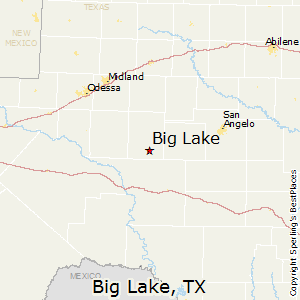
The town of Big Lake is just north of the lake itself, on State Highway 137 running north and south, and U.S. Highway 67 running east and west, approximately 65 miles west of San Angelo. Big Lake sits about 10 miles north of Interstate 10, and about 75 miles south of Interstate 20. Big Lake calls itself “the gateway to the Permian Basin.”
Big Lake is the home of Reagan County High School. Jim Morris was baseball coach for the Reagan High Owls when his team persuaded him to try out for a major league baseball team. His story was chronicled, with some artistic license, in the Disney movie “Rookie.”
Land managers are working to stop erosion on the often-dry shores of Big Lake using any trick they can find. One trick: Plant salt grass.
Salt grass? Along Texas’s Gulf Coast, there are a few species of grass that, while not halophytes, are at least salt tolerant. Salt grass. This grass made it profitable to graze cattle on what would otherwise have been unproductive land in the Texas cattle boom. This role in Texas history is memorialized in the Salt Grass Steakhouse chain, now found in five states.
And if planting salt grass works to control erosion, it will help clean up a large part of Texas other natural lake, Big Lake.
Big Lake’s being wet or dry is a whim of local climate. You could say that half of all of Texas’s natural lakes are now dry as a result of continued warming; you could say that two good gully-washers or toad-stranglers could restore water to half of Texas’s natural lakes.
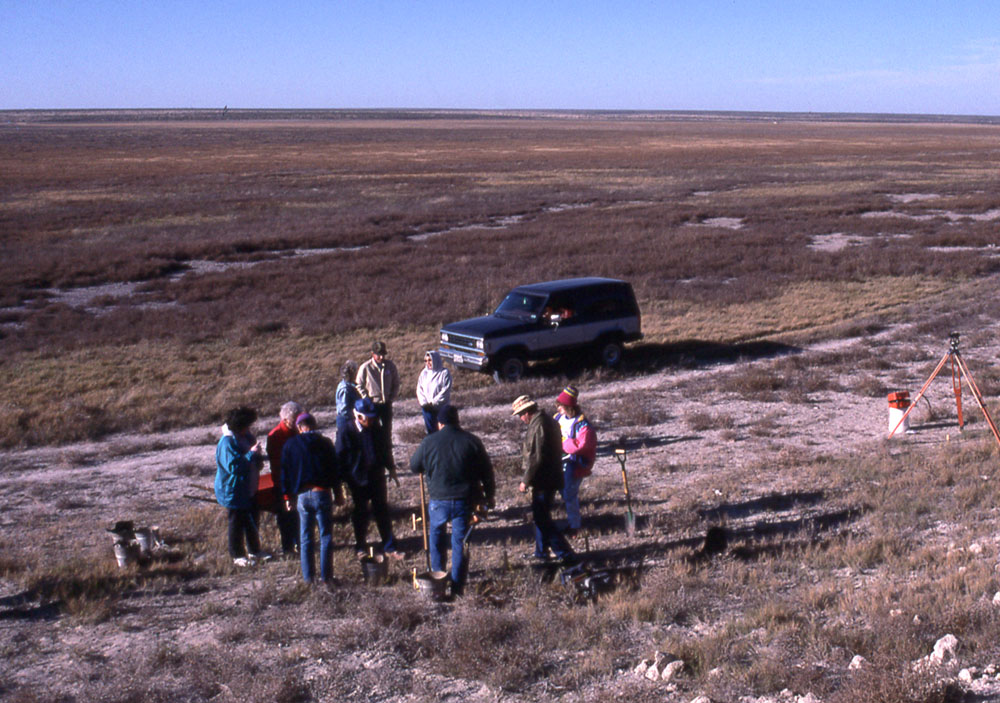
Field crew meeting at the outset of the 1992 excavations at the Big Lake Bison Kill site. The dry bed of Big Lake stretches for miles in the background. Big Lake is an intermittent saline lake or playa, an uncommon landform on the Edwards Plateau. Photo by Larry Riemenschneider, Concho Valley Archeological Society.
More details about Big Lake and prehistory, below the fold.
Or, until that account is unsuspended by the forces supporting Donald Trump: Follow @FillmoreWhite, the account of the Millard Fillmore White House Library
We've been soaking in the Bathtub for several months, long enough that some of the links we've used have gone to the Great Internet in the Sky.
If you find a dead link, please leave a comment to that post, and tell us what link has expired.
Thanks!
Retired teacher of law, economics, history, AP government, psychology and science. Former speechwriter, press guy and legislative aide in U.S. Senate. Former Department of Education. Former airline real estate, telecom towers, Big 6 (that old!) consultant. Lab and field research in air pollution control.
My blog, Millard Fillmore's Bathtub, is a continuing experiment to test how to use blogs to improve and speed up learning processes for students, perhaps by making some of the courses actually interesting. It is a blog for teachers, to see if we can use blogs. It is for people interested in social studies and social studies education, to see if we can learn to get it right. It's a blog for science fans, to promote good science and good science policy. It's a blog for people interested in good government and how to achieve it.
BS in Mass Communication, University of Utah
Graduate study in Rhetoric and Speech Communication, University of Arizona
JD from the National Law Center, George Washington University


 Posted by Ed Darrell









 Millard Fillmore's Bathtub