Suggested Tweet: Celebrate #WorldTurtleDay on May 23 with @TortoiseRescue
Malibu, CA – May 14, 2014 – American Tortoise Rescue (ATR) (www.tortoise.com), a nonprofit organization established in 1990 for the protection of all species of tortoise and turtle, is sponsoring its 14th annual World Turtle Day™ on May 23rd. The day was created as an observance to help people celebrate and protect turtles and tortoises and their disappearing habitats around the world. Susan Tellem and Marshall Thompson, founders of ATR, advocate humane treatment of all animals, including reptiles. Since 1990, ATR has placed about 3,000 tortoises and turtles in caring homes. ATR assists law enforcement when undersized or endangered turtles are confiscated and provides helpful information and referrals to persons with sick, neglected or abandoned turtles.
“We launched World Turtle Day to increase respect and knowledge for the world’s oldest creatures,” said Tellem. “These gentle animals have been around for 200 million years, yet they are rapidly disappearing as a result of smuggling, the exotic food industry, habitat destruction, global warming and the cruel pet trade,” says Tellem. “We are seeing smaller turtles coming into the rescue meaning that older adults are disappearing from the wild thanks to the pet trade, and the breeding stock is drastically reduced. It is a very sad time for turtles and tortoises of the world.” (See slide show here.)
Tellem added, “We are thrilled to learn that organizations and individuals throughout the world now are observing World Turtle Day, including those in Pakistan, Borneo, India, Australia, the UK and many other countries.” She recommends that adults and children do a few small things that can help to save turtles and tortoises for future generations:
Never buy a turtle or tortoise from a pet shop as it increases demand from the wild.
Never remove turtles or tortoises from the wild unless they are sick or injured.
If a tortoise is crossing a busy highway, pick it up and send it in the same direction it was going – if you try to make it go back, it will turn right around again.
Write letters to legislators asking them to keep sensitive habitat preserved or closed to off road vehicles, and to prevent off shore drilling that can lead to endangered sea turtle deaths.
Report cruelty or illegal sales of turtles and tortoises to your local animal control shelter.
Report the use of tiny turtles as prizes at carnivals and other events. It’s illegal.
Report the sale of any turtle or tortoise of any kind less than four inches. This is illegal to buy and sell them throughout the U.S.
“Our ultimate goal is to stop the illegal trade in turtles and tortoises around the world. Our first priority here in the U.S. is to ask pet stores and reptile shows to stop the sale of hatchling tortoises and turtles without proper information for the buyer,” says Thompson. “For example, many people buy sulcata tortoises as an impulse buy because they are so adorable when they are tiny. The breeders and pet stores frequently do not tell the buyers that this tortoise can grow to 100 pounds or more and needs constant heat throughout the year since they do not hibernate.”
He added, “We also need to educate people and schools about the real risk of contracting salmonella from water turtles. Wash your hands thoroughly every time you touch a turtle or its water, and do not bring turtles into homes where children are under the age of 12.”
For answers to questions and other information visit American Tortoise Rescue online at http://www.tortoise.com or send e-mail to info@tortoise.com; on Twitter @tortoiserescue; “Like” American Tortoise Rescue on Facebook; and follow World Turtle Day on Facebook.
Here’s to you Freddie, the Western Box Tortoise from Idaho, and Truck, the desert tortoise from Southern Utah, the friends of my youth. And all you others.
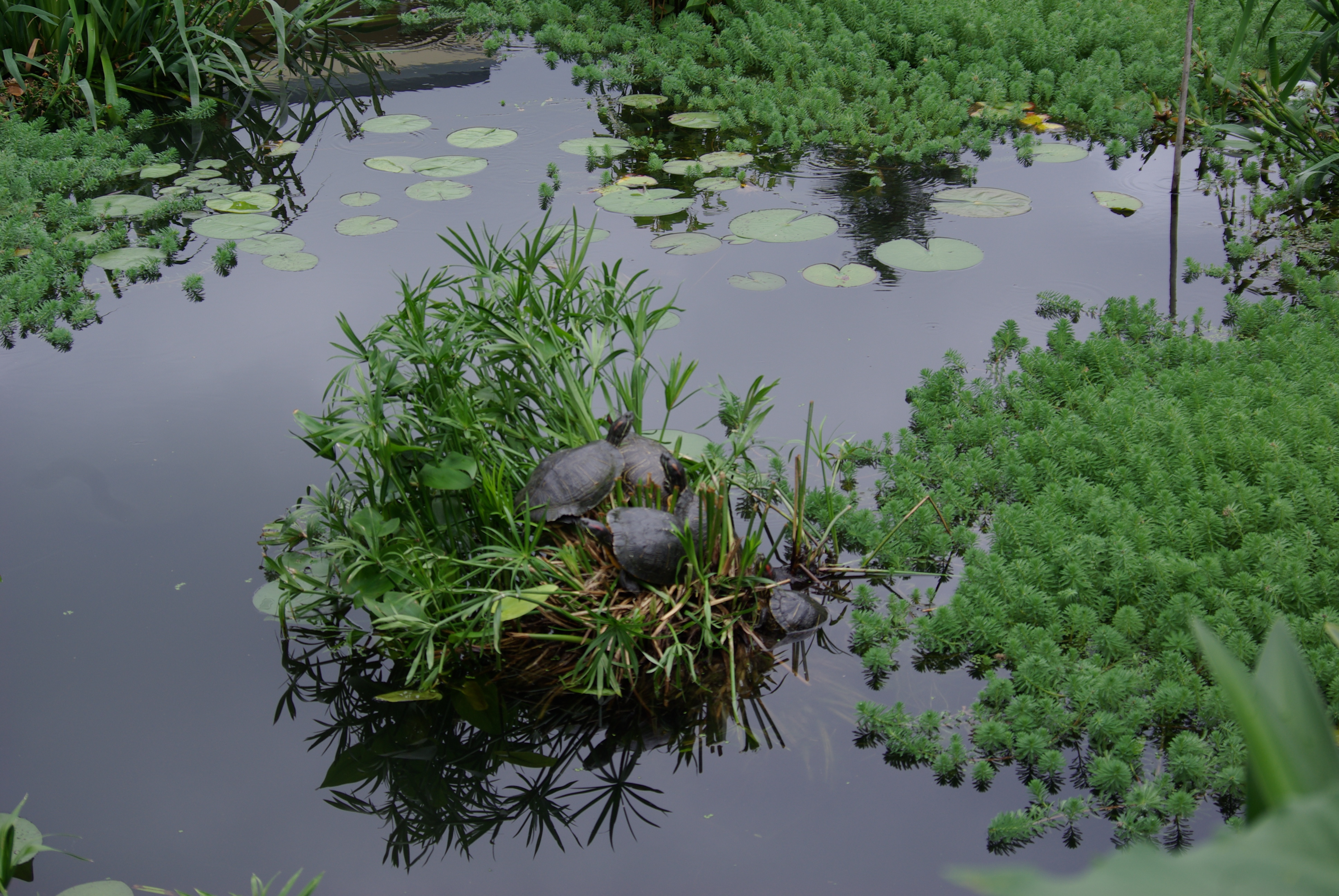
Red-eared sliders cluster together to catch the sun on a spring day at Texas Discovery Gardens at Fair Park in Dallas. Photo by Ed Darrell, 2010
Found a good infographic today, on how to identify poison ivy — the bane of every Boy Scout and Scouter west of the Mississippi, and east of the Mississippi, too.
From TreksInTheWild.com, via Daily Infographic
Poison ivy leaves turn a beautiful scarlet in the fall. This beauty prompted English ship captains dropping off colonists in New England to take the potted vines back to England.
It is my experience that, while everyone can become allergic and react to poison ivy, no one reacts on first serious exposure. If you’re in the woods, it’s good to know what this stuff is, and avoid it.
If you’re exposed, wash it off. Wash your clothes with some sort of oxidant (oxygen bleach for colors, or chlorine bleach if you don’t care); I use a 3:1 solution, water to chlorine bleach, to shower with after serious exposure. The active chemical, urushiol, remains active until it is reacted chemically or by ultraviolet light — and so a young Scout who gets some ivy sap under his fingernails can continue to spread the exposure everywhere he scratches, until his hands are really washed clean.
Study the poster, learn to identify the stuff. There’s a lot more to say.
Spread the word; friends don't allow friends to repeat history.
Milky Way over Monument Valley Navajo Tribal Park. Photo by Gavin Heffernan and Harun Mehmedinović, from the video (which also features Grand Canyon National Park)
And that they do. The Milky Way is the star of the show; the galactic bulge, disk, and dark fingers of vast dust lanes as clear as if this were taken from space. Well, sort of; I was impressed by the mix of clouds and sky, to be honest. The contrast was interesting, and it’s rather amazing the Milky Way could stand out so clearly above the cloud line.
One thing I want to point out specifically: At 2:10 in, a meteor flashes and leaves behind a curling wisp of what looks like smoke. This is called a persistent train, the vaporized remains of the meteoroid itself, and can glow for several minutes. The upper level winds from 60–100 km above Earth’s surface are what blow it into those curlicues.
More details, for more films from these guys:
Shot and Produced by: Gavin Heffernan and Harun Mehmedinović
Music: A Seated Night (Ambient) by Moby. Courtesy MobyGratis.com / Unknown Native Chant
Thanks: Northern Arizona University, Grand Canyon National Park, Monument Valley Tribal Park.
The man was such a champion of the environment that he was, at one time in the 1980s, prevented from traveling to the U.S., because he was listed with Immigration as a potential terrorist. He may be the only person so listed, simply for urging that we stop killing animals.
Mowat was unsurpassed as a pure curmudgeon in favor of the wild, wild animals, wilderness, and environmental protection. He was a story teller above all, understanding completely the powerful role that stories play in moving government policies — which his books frequently did. His first works, on indigenous peoples in Canada’s far north, wrought significant changes in Canada’s policies towards those now known as First Nations. When his signature book, Never Cry Wolf, was translated into Russian, Russia prohibited hunting wolves.
Victim of virus arcticus, Farley Mowat, probably in the 1970s; image from Econet.ca
From the Washington Post obit notice:
“I keep my optimism alive and revitalized by accepting the fact that we are a bad species, and probably haven’t got much time here,” he told The Washington Post in 1994, “and it’s not going to break my heart when Homo sap wanders offstage.”
Then he added, “Wanna get some more coffee?”
Barry Goldwater might say that extremism in pursuit of noble conservation is no vice. Mowat wouldn’t care what Goldwater thought.
Here’s just exactly the sort of thing that happens in nature that drives creationists nuts. How could this happen without God personally working to confuse and/or delight the photographer? Not to mention the physicist and mathematician.
Photo from the Twitter feed of Science Porn: “Go home waves you’re drunk. This is called cross sea btw pic.twitter.com/5Cv1UUo8QX”
Where? Somewhere in France, one might gather from the flag on the structure (lighthouse?).
Crossing swells, consisting of near-cnoidal wave trains. Photo taken from Phares des Baleines (Whale Lighthouse) at the western point of Île de Ré (Isle of Rhé), France, in the Atlantic Ocean. The interaction of such near-solitons in shallow water may be modeled through the Kadomtsev–Petviashvili equation.
Oh, you remember that one, don’t you? The Kadomtsev–Petviashvili equation?
At least we confirmed it was taken in France.
They do everything differently in France, don’t they?
Update:Got an e-mail suggestion that I include the equation itself. You may certainly click to Wikipedia to find it; here’s what it says over there:
where . The above form shows that the KP equation is a generalization to two spatial dimensions, x and y, of the one-dimensional Korteweg–de Vries (KdV) equation. To be physically meaningful, the wave propagation direction has to be not-too-far from the x direction, i.e. with only slow variations of solutions in the y direction.
From the U.S. Department of Interior: Friends come in all shapes & sizes in the Sacramento National Wildlife Refuge. #California #nature pic.twitter.com/CvUkY6HoxF
Watching the wildlife can be endlessly entertaining.
Spread the word; friends don't allow friends to repeat history.
Nice photo from the Great Smoky Mountains National Park:
Caption from the Tumblr of the Department of Interior: Sunset over Great Smoky Mountains National Park in Tennessee. Photo: Austin Leih (www.sharetheexperience.org)
Beautiful place, nice photographic capture.
Then I look, and I see a lot of necrotic tree tops. Acid Rain? Warming? Pine borers or some other insect?
Sometimes, Mark Twain’s lament is right. Sometimes you know too much to just sit back in awe. Feynman was right, too.
Tweet from the Department of Interior: 142 years ago today, @YellowstoneNPS became America’s first national park. RT to wish them a very happy birthday! pic.twitter.com/drka6iq0Tc
Ken Burns called the National Parks probably the best idea America has had.
Certainly a great idea — really born on this day, 142 years ago, with the designation of Yellowstone National Park.
Yellowstone NP contains the world’s largest collection of geysers. It is the heart of the largest, nearly-intact temperate zone ecosystem on Earth as well, contained in 3,468 square miles (8,983 km²), a laboratory and playground for geologists, geographers, botanists, zoologists, and almost anyone else who loves the nature and the wild.
Only 142 years old? In the U.S., we have more than 300 units in the National Park System, now, including National Historic Places as well as the best of the wild. Around the world, how much land has been saved, for the benefit of humanity, by this idea? Not enough.
What’s your favorite memory of Yellowstone? What’s your favorite feature?
From National Geographic: Great Fountain Geyser in Yellowstone, the first U.S. national park, erupts every 9 to 15 hours, shooting water up to 220 feet high. Photograph by Michael Melford
Spread the word; friends don't allow friends to repeat history.
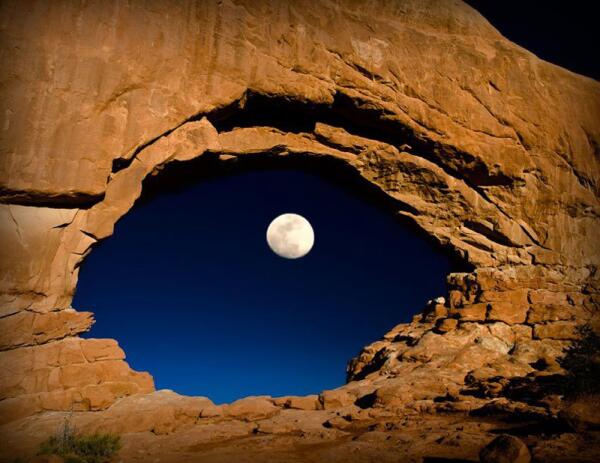
Photo by Lynn Sessions; “THE EYE OF THE #MOON: North Window arch at Arches National Park in #Utah. #NatGeo pic.twitter.com/XwHfdWK5Ft
It’s just a click of the shutter? Ha!
I’m assuming not a lot of post-photo processing on this. Lynn Sessions had to figure out when the Moon would be in the North Window Arch, calculate exposure, and shoot off enough of them to get a decent shot before the Moon moved. I suspect the rocks were “painted” with a flashlight during the exposure.
(Haven’t yet found the technical details of the shot. But I did find this about the photographer:
I’m a frustrated amateur photographer who is trying to visit every corner in Utah as well as hike/photograph every canyon in southern Utah. More at http://www.DreamBreeze.com )
Patience, planning, creativity — then just push the button.
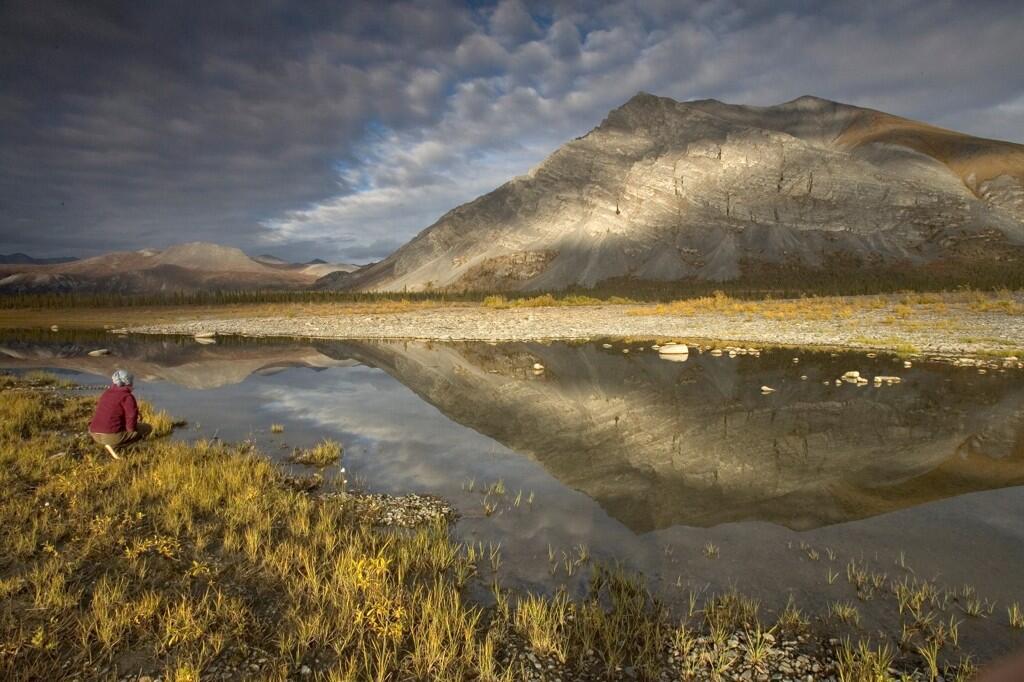
Photo probably not taken this week: From the US Department of Interior: Happy 53rd birthday to the Arctic National Wildlife Refuge! @USFWSHQ @USFWSRefuges #Alaska pic.twitter.com/2popb7EAvz
Odd that land so severely beautiful, so far out of the way and so difficult to master, has its fate decided in marble halls in Washington, D.C., 3,172 miles distant. The United States is a big, sprawling nation.
Information on the ANWR:
History and Culture
Refuge Establishment: Legislation and Purposes
The Arctic Refuge was established in 1960 and expanded in 1980.
The Arctic Refuge has been providing for the physical and emotional well-being of humans for many thousands of years. It remains an important resource to help sustain local Eskimo and Indian cultures. The Refuge continues to be valued, even by those who never travel within it’s borders, as a symbol of America’s vast and remote wilderness – a place of inspiration and beauty – a promise for the future for all Americans.
Malheur National Wildlife Refuge was established on August 18, 1908 by President Theodore Roosevelt as the Lake Malheur Bird Reservation. Roosevelt set aside unclaimed lands encompassed by Malheur, Mud and Harney Lakes “as a preserve and breeding ground for native birds.” The newly established “Lake Malheur Bird Reservation” was the 19th of 51 wildlife refuges created by Roosevelt during his tenure as president. At the time, Malheur was the third refuge in Oregon and one of only six refuges west of the Mississippi [six, then].
NASA has a different viewpoint: Harney Lake and Malheur Lake in Oregon, USA NASA NLT Landsat 7 image. Final image made using NASA World Wind. Via Wikipedia
Spread the word; friends don't allow friends to repeat history.
It’s a composite of 11 photographs to get the whole panoramic view — which just demonstrates that in photography it’s great to be lucky, but it usually takes great skill to get that amount of luck.
How much processing was involved, really?
Don’t worry, just check out the photo.
Double Moonbow, lava glow and fading Lunar Halo; 11-picture Panoramic taken on the rim of Kilauea’s Caldera On the Last Super Moon. Sean King, Atmospheric Phenomena
Or, until that account is unsuspended by the forces supporting Donald Trump: Follow @FillmoreWhite, the account of the Millard Fillmore White House Library
We've been soaking in the Bathtub for several months, long enough that some of the links we've used have gone to the Great Internet in the Sky.
If you find a dead link, please leave a comment to that post, and tell us what link has expired.
Thanks!
Retired teacher of law, economics, history, AP government, psychology and science. Former speechwriter, press guy and legislative aide in U.S. Senate. Former Department of Education. Former airline real estate, telecom towers, Big 6 (that old!) consultant. Lab and field research in air pollution control.
My blog, Millard Fillmore's Bathtub, is a continuing experiment to test how to use blogs to improve and speed up learning processes for students, perhaps by making some of the courses actually interesting. It is a blog for teachers, to see if we can use blogs. It is for people interested in social studies and social studies education, to see if we can learn to get it right. It's a blog for science fans, to promote good science and good science policy. It's a blog for people interested in good government and how to achieve it.
BS in Mass Communication, University of Utah
Graduate study in Rhetoric and Speech Communication, University of Arizona
JD from the National Law Center, George Washington University


 Posted by Ed Darrell



 . The above form shows that the KP equation is a generalization to two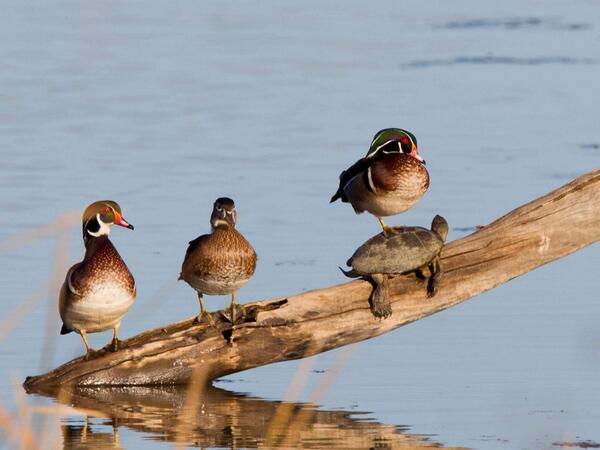








 Millard Fillmore's Bathtub