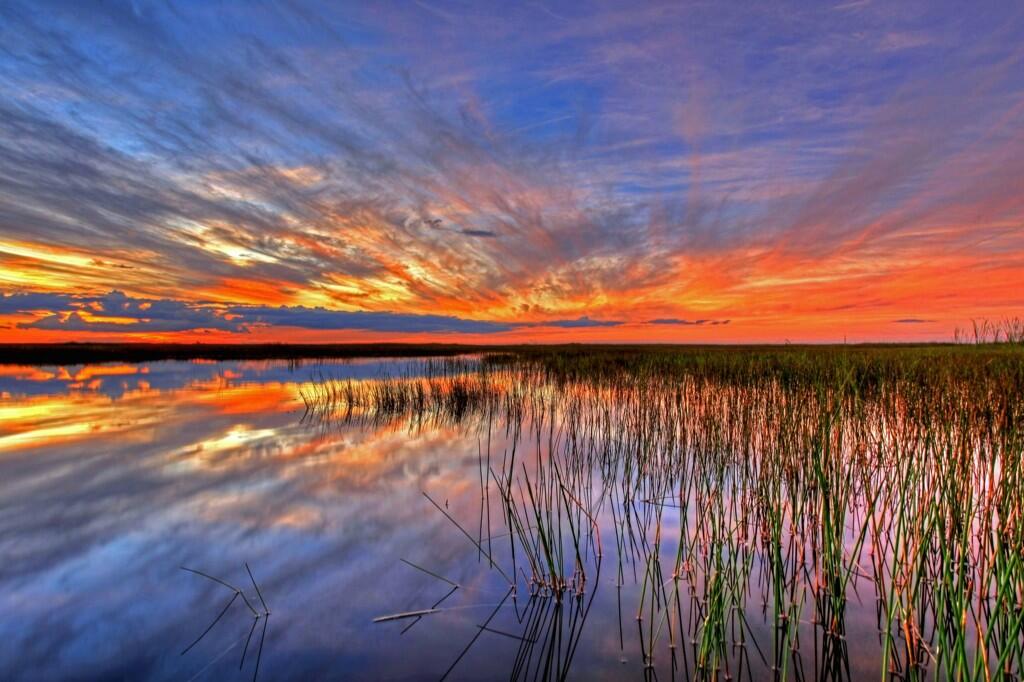
Caption from Interior’s Tweet: Sometimes there are no words to describe America’s public lands. This photo @EvergladesNPS proves it. #Florida pic.twitter.com/3l7fnrcfsG
Everglades National Park, in Florida, is a great example of wild lands that belong to all Americans, that we almost let slip away.
I’m not sure a painter could do a more stunning version of this view.
More:
Location map: Everglades National Park in red. Wikipedia photo
US Dept of Interior Photo @Interior: Rachel Carson NWR in #Maine is the perfect place to see the leaves change this time of year. #nature pic.twitter.com/5kL9EArPaA
Photo and press release from NASA’s Earth Observatory:
Image from the astronauts aboard the International Space Station, acquired August 18, 2013 — 50 mm lens. Looking to the west, over Idaho. See photo below for labels of fire sites.
Description of the photo:
Taken with a short lens (50 millimeters), this west-looking image from the International Space Station includes much of forested central Idaho. The oblique image highlights part of the largest single wilderness area in the contiguous United States, the Frank Church–River of No Return Wilderness.
Within this mountainous region (the dark areas are all wooded), several fires produced extensive smoke plumes. The densest smoke appeared to be generated by a combination of the Little Queens and Leggit fires (within the Salmon River Mountains [link added]). This image shows the common pattern of westerly winds carrying smoke in an easterly direction, as seen during the wildfire season of one year ago.
Named fires—most ignited by lightning—had burned 53,000 acres of forest south of the Salmon River by August 20, 2013; the number would be significantly higher if unnamed fires were included. The Gold Pan fire, north of the Salmon River, had burned 27,000 acres. For a sense of scale, Gold Pan lies about 125 miles (200 kilometers) north of the Little Queens fire.
Ten days before this image was taken, fires in central Idaho (near Boise) had been aggravated by southerly winds. Some of those fires began to burn in July, but were quelled and remain under observation for new flare-ups.
Astronaut photograph ISS036-E-32853 was acquired on August 18, 2013, with a Nikon D3S digital camera using a 50 millimeter lens, and is provided by the ISS Crew Earth Observations experiment and Image Science & Analysis Laboratory, Johnson Space Center. The image was taken by the Expedition 36 crew. It has been cropped and enhanced to improve contrast, and lens artifacts have been removed. The International Space Station Program supports the laboratory as part of the ISS National Lab to help astronauts take pictures of Earth that will be of the greatest value to scientists and the public, and to make those images freely available on the Internet. Additional images taken by astronauts and cosmonauts can be viewed at the NASA/JSC Gateway to Astronaut Photography of Earth. Caption by M. Justin Wilkinson, Jacobs/JETS at NASA-JSC.
Salmon River Mountains, Idaho, on the ground; notice the steep mountains on-the-ground firefighters must contend with. Wikipedia image
Instrument: ISS – Digital Camera
My older brother Dwight was a firefighter with the Bureau of Land Management in the early 1960s. There were some huge fires then — but not so many, so large, all at once. While we don’t have satellite photos to compare from way back then, this is just scary. Those were scary on the ground, and smaller than these — and fewer.
Notice in the photo below, some of these huge fires are not even big enough to be named. Wow.
Image from the International Space Station of Idaho fires, with names of larger fires overlayed. August 23, 2013
Compare with NASA photo from a month ago; Idaho’s been hammered by fire in 2013:
Photo of Idaho from about July 20, 2013, showing then-active fires in the state — north at top of photo. Notice Craters of the Moon National Monument, the dark area in the southeast section — this area is obscured by new fires in the photos above. Idaho’s borders are barely visible in a thin, black line. This photo from NASA/Goddard
Spread the word; friends don't allow friends to repeat history.
Normally I might just let this beautiful photo slide by without comment.
In this case, I find this particularly frustrating. See that creature? That’s the same goat that blocked my trail in Glacier National Park. I’m sure of it. I’d recognize those beady eyes and horns anywhere! (See the first story linked to in the “more’ section; maybe this goat stopped in Washington on the way to Alaska.)
He’s probably in Alaska now under the Federal Goat Protection Program.
Interior US Dept of Interior 6h Caption from the Department of Interior: That’s quite the hike to the top. Harding Icefield Trail @KenaiFjordsNPS. #alaska pic.twitter.com/yozsSLnrcD
He probably thinks he’s safe there at Kenai Fjords National Park. Ha! He’s farther away, but that just means I have farther to travel to find him!
I’m taking a longer telephoto, a wide angle, and a first aid kit, next time. I’ll be prepared!
It’s Eagle required, too — well, Scouts can choose either Environmental Science or Sustainability, but must earn one or the other to earn Eagle rank.
Image of the Sustainability merit badge, from MeritBadge.org
Requirements for the new Sustainability merit badge were released on July 16, concurrent with the 2013 National Scout Jamboree at the Summit. A lot of people missed the announcement, I’ll wager.
It’s good news. Conservation and nature-related merit badges have suffered a decline in Scouting, it seems to me. The conservation series was very much the keystone of a trek to Eagle when I was a Scout, at least as important as the citizenship series. But I don’t see that emphasis in Scouting today, sadly.
BSA recently created a Mining merit badge, which created some quiet grumbles among conservationists — this new, Eagle-path badge more than makes up for that, I think (though mining is a great topic for Scouts, especially in the western U.S., I think). This will not set well with the anti-conservation, anti-Agenda 21 crowd and their merry hoaxsters. But nothing BSA does is removed from political criticism from the right any more (see this odd photo choice for the Sustainability badge notice at the radical right-wing Daily Caller site).
Adelie penguins struggle to survive changes in their nesting and feeding sites caused by warming air and waters around Antarctica
New, very short film from the E. O. Wilson Biodiversity Foundation highlights threats to Adelie penguins from climate change, already. Actor and conservation activist Harrison Ford narrated “Ghost Rookeries, Climate Change and the Adelie Penguin.”
Details from the Biodiversity Foundation at their YouTube site:
Published on Jun 26, 2013
“Ghost Rookeries,” narrated by actor, conservationist, and member of the E.O. Wilson Biodiversity Foundation (EOWBF) Board of Advisors Harrison Ford, conveys the story of the Adelie Penguin, whose habitat—and thus the biodiversity of all of Antarctica—is being threatened by real-time environmental changes.
“The consequences of a loss of biodiversity could encompass everything from altering key Antarctic marine food chains to the loss of species that may hold cures to cancer,” writes Dr. James McClintock, whose recent book, ‘Lost Antarctica: Adventures in a Disappearing Land’ (Palgrave/MacMilllan, 2012), forms the basis of “Ghost Rookeries.”
The E.O. Wilson Biodiversity Foundation (EOWBF) and the Association of Zoos and Aquariums (AZA) will be embarking on an exciting new initiative beginning in the summer of 2013. Beginning with “Ghost Rookeries: Climate Change and the Adelie Penguin” (4 minutes, 2013), short videos produced by the EOWBF will be shown at select AZA-accredited zoos and aquariums located in the United States. With the vast reach of AZA-accredited zoos and aquariums, “Ghost Rookeries” and future videos will be seen by millions of visitors.
Dr. Paula Ehrlich, President and CEO of the EOWBF, calls “Ghost Rookeries” and the partnership with AZA “. . . a wonderful way to engage audiences about the importance of preserving our biological heritage through story. The Adelie Penguin is an iconic story, a symbol, of the real-time effect of climate change on biodiversity.”
This film looks at a small part of the Adelie penguin population, on Torgerson Island, near Palmer Station. This population symbolizes the difficulties of dealing with climate change, or even knowing what the effects will be. Critics of pollution control to stop climate change argue that populations of all animals and plants will adapt. Indeed the last decade saw a rise in total numbers of Adelies across Antarctic waters, and Gentoo penguins have set up new colonies to avoid warming air and waters.
More careful watchers note problems, though. Warming air, and decreasing hard ice, brings more snow — nominally good, if one assumes the snow turns to ice. In this case, the snows are brief, and they melt quickly. It’s the cold meltwater that kills the chicks, drowning them. This may be counterintuitive, or even ironic, that warming causes a cold water seabird to drown, or die of hypothermia. Nature is stranger than we can imagine, and often strange enough that it defies the understanding of scientifically-dilettante politicians.
Generally the loss of ice is the biggest problem for penguins; specific populations face entirely different threats, however, depending on the local effects of climate change.
Dr. Jim McClintock, in Antarctica. A professor at the University of Alabama-Birmingham, he wrote Antarctica Lost, upon which the film about the Adelie penguins is based.
The film is a short project based off of the work of Dr. Jim McClintock, an almost-legendary Antarctic researcher based out of the University of Alabama at Birmingham (UAB). McClintock published a book on his work last year that deals with many different aspects of climate change in the Southern Ocean and its continental land mass,Lost Antarctica, Adventures in a Disappearing Land.
Our move to Texas in 1987 offered as one amenity, local roadrunners.
Camp Wisdom road was mostly two lanes then — it’s six, now. Clark Road was two lanes. It’s expanded to six, with a direct link to the freeway Spur 408. Wheatland Road was two lanes. You guessed it: Six now.
Not sure about baseball fields any more, but with roads, if you build ’em, people will come. The empty prairie and cedar forests favored by golden-cheeked warblers, and favorable to lizard-eating roadrunners, gave way to bulldozers putting up apartment complexes, strip shopping centers (still mostly vacant), self-storage businesses, and more roads. Roads bring automobiles, and autos provide collision courses for roadrunners.
In the summer, I used to see a roadrunner at least weekly at the intersection of Camp Wisdom and Clark; once watched one hunt down a very large Texas fence lizard and dash off with the lizard dangling from either side of its beak. In the era before electronic cameras.
All that development takes the habitat of roadrunners, and that is the slow death of much wildlife. Roadrunners dwindled down. About 2009 we discussed how rare they were. In 2011 Kathryn and I saw one lone roadrunner along Old Clark Road in Cedar Hill, precariously living in a 50-yard swath between two roads (which are slated to be widened), sharing a railroad track. Nothing since.
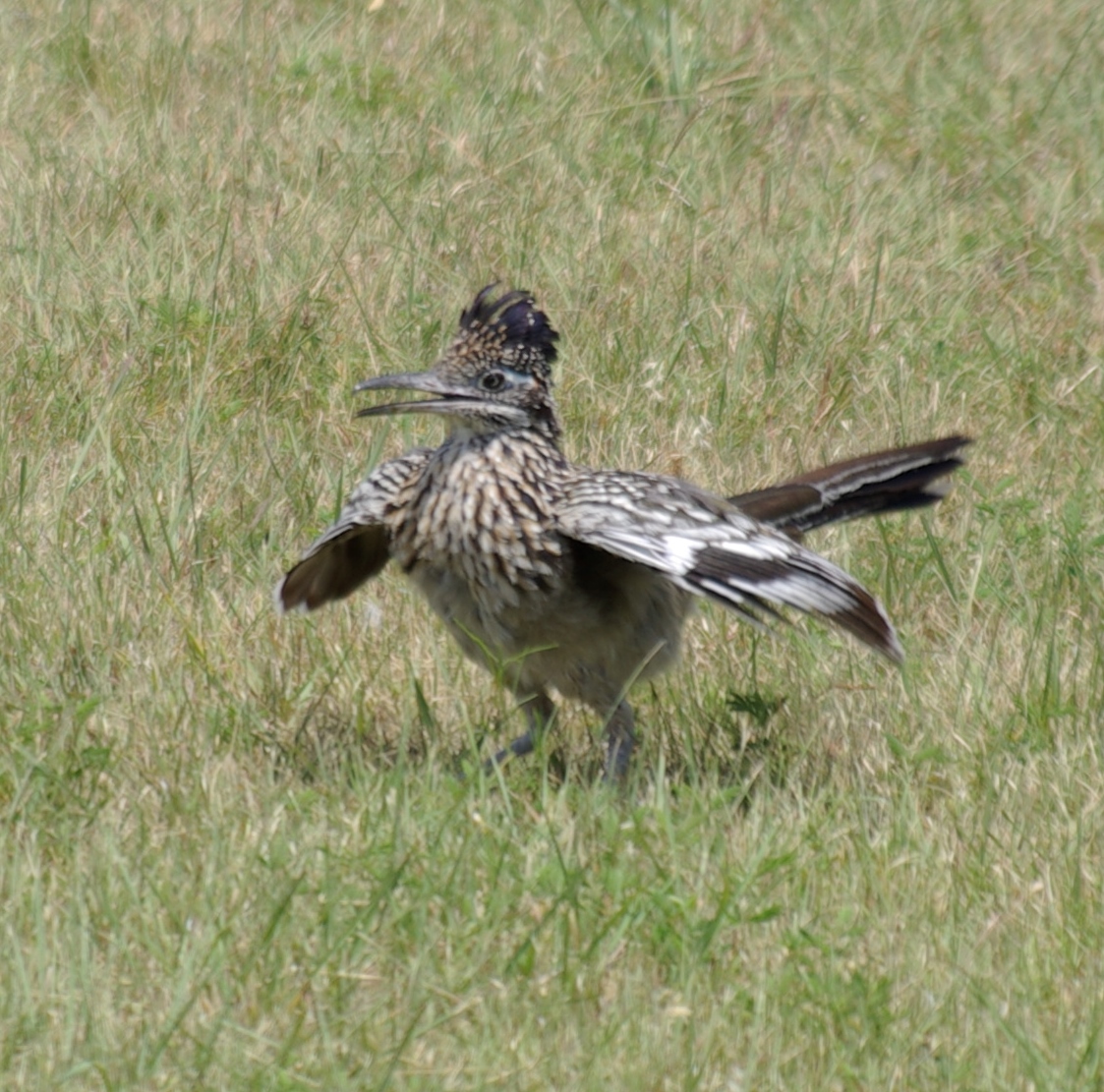
Mama roadrunner gives me the eyeball from the safety of the cedar tree, while the chick grooms. Is it safe to go out into the sun?
Until two weeks ago. Kathryn called me, excited that she’d seen a roadrunner crossing Mountain Creek Parkway, where Wheatland Road dead-ends into it. It’s good roadrunner weather. We were happy to know at least one survived.
Then, last Thursday I was driving along Old Clark Road. I brought along the Pentax K10D because I was hopeful of catching the hawk family living a block off of Wheatland and Cedar Ridge Roads. A roadrunner dashed across the road from a small ranchette into a “vacant” field of wild prairie grasses dotted with Ashe cedars. My experience is they are reclusive, and don’t like to be watched. I grabbed the camera and got a couple of shots of the bird, running under a tree and meeting up with another, smaller one — a chick!
I doubled back and u-turned, hoping they might at least dash. The larger one danced on the edge of the shadow of the tree for a minute, then uncharacteristically strutted out, hunting something to eat. She got something that looked like a lizard, or a fantastically large grasshopper, and a few other tidbits from the grass. She strutted around, and headed back to the shade, and to the younger one.
Mama Roadrunner flaps happily after ingesting a large something.
Roadrunners, the greater roadrunner, Geococcyx californianus (which means “Californian Earth-cuckoo,” a description of many politicians in the Golden State, perhaps).
I shot stills, with a 50-200 mm telephoto zoom, and I got a bunch of shots. I strung them together in Windows Moviemaker.
Are the roadrunners doing okay? Not really. They’re not gone, but much of their old habitat disappeared from this hill, the highest point in Texas between the Louisiana border and the Rockies — swallowed by human development, homes, suburban shopping, and the roads that go with that development.
(This is not a place to bolster creationist ideas. This is real science, looking at God’s handiwork first hand.)
A North Carolina university makes field trips to Yosemite? I’d love to take that class!
Watching this film, you get a sense of how important it can be to the education of our children to travel in the summers, to take vacations to our National Parks, and to places like Yosemite.
Where are you taking your kids this summer? Kids, where are you going?
Enjoy it. Geology lessons are often fun, and this one, on film, is more fun than most.
Still shot of the Supercell near Booker, Texas – photo by Mike Olbinski (copyright, rights reserved)
Photographer Mike Olbinski was on the road, near Booker, Texas, when the storm rolled in. According to him, he was on the wrong side of the storm to get great photos, and he set up at the wrong spot . . .
Technical deets: Canon 5D2, Rokinon 14mm 2.8…first three clips were at 1-second intervals = 880ish photos, the last sequence was around 90, 5-second exposures
A rotating supercell. And not just a rotating supercell, but one with insane structure and amazing movement.
I’ve been visiting the Central Plains since 2010. Usually it’s just for a day, or three, or two…but it took until the fourth attempt to actually find what I’d been looking for. And boy did we find it.
No, there was no tornado. But that’s not really what I was after. I’m from Arizona. We don’t get structure like this. Clouds that rotate and look like alien spacecraft hanging over the Earth.
We chased this storm from the wrong side (north) and it took us going through hail and torrential rains to burst through on the south side. And when we did…this monster cloud was hanging over Texas and rotating like something out of Close Encounters.
The timelapse was shot on a Canon 5D Mark II with a Rokinon 14mm 2.8 lens. It’s broken up into four parts. The first section ends because it started pouring on us. We should have been further south when we started filming but you never know how long these things will last, so I started the timelapse as soon as I could.
One thing to note early on in the first part is the way the rain is coming down on the right and actually being sucked back into the rotation. Amazing.
Mark Twain wrote about how too much knowledge can spoil beauty for a beholder. In Life on the Mississippi, Twain described how the natural beauty of the river changed for him once he started serious study to be a river pilot. That wonderful sunset revealed the river was high, hiding objects of danger. That beautiful little ripple told him a snag waited underwater to pierce his boat.
Cover via Amazon
. . . The face of the water, in time, became a wonderful book — a book that was a dead language to the uneducated passenger, but which told its mind to me without reserve, delivering its most cherished secrets as clearly as if it uttered them with a voice. And it was not a book to be read once and thrown aside, for it had a new story to tell every day. Throughout the long twelve hundred miles there was never a page that was void of interest, never one that you could leave unread without loss, never one that you would want to skip, thinking you could find higher enjoyment in some other thing. There never was so wonderful a book written by man; never one whose interest was so absorbing, so unflagging, so sparkingly renewed with every re-perusal. The passenger who could not read it was charmed with a peculiar sort of faint dimple on its surface (on the rare occasions when he did not overlook it altogether); but to the pilot that was an ITALICIZED passage; indeed, it was more than that, it was a legend of the largest capitals, with a string of shouting exclamation points at the end of it; for it meant that a wreck or a rock was buried there that could tear the life out of the strongest vessel that ever floated. It is the faintest and simplest expression the water ever makes, and the most hideous to a pilot’s eye. In truth, the passenger who could not read this book saw nothing but all manner of pretty pictures in it painted by the sun and shaded by the clouds, whereas to the trained eye these were not pictures at all, but the grimmest and most dead-earnest of reading-matter.
Now when I had mastered the language of this water and had come to know every trifling feature that bordered the great river as familiarly as I knew the letters of the alphabet, I had made a valuable acquisition. But I had lost something, too. I had lost something which could never be restored to me while I lived. All the grace, the beauty, the poetry had gone out of the majestic river! I still keep in mind a certain wonderful sunset which I witnessed when steamboating was new to me. A broad expanse of the river was turned to blood; in the middle distance the red hue brightened into gold, through which a solitary log came floating, black and conspicuous; in one place a long, slanting mark lay sparkling upon the water; in another the surface was broken by boiling, tumbling rings, that were as many-tinted as an opal; where the ruddy flush was faintest, was a smooth spot that was covered with graceful circles and radiating lines, ever so delicately traced; the shore on our left was densely wooded, and the somber shadow that fell from this forest was broken in one place by a long, ruffled trail that shone like silver; and high above the forest wall a clean-stemmed dead tree waved a single leafy bough that glowed like a flame in the unobstructed splendor that was flowing from the sun. There were graceful curves, reflected images, woody heights, soft distances; and over the whole scene, far and near, the dissolving lights drifted steadily, enriching it, every passing moment, with new marvels of coloring.
I stood like one bewitched. I drank it in, in a speechless rapture. The world was new to me, and I had never seen anything like this at home. But as I have said, a day came when I began to cease from noting the glories and the charms which the moon and the sun and the twilight wrought upon the river’s face; another day came when I ceased altogether to note them. Then, if that sunset scene had been repeated, I should have looked upon it without rapture, and should have commented upon it, inwardly, after this fashion: This sun means that we are going to have wind to-morrow; that floating log means that the river is rising, small thanks to it; that slanting mark on the water refers to a bluff reef which is going to kill somebody’s steamboat one of these nights, if it keeps on stretching out like that; those tumbling ‘boils’ show a dissolving bar and a changing channel there; the lines and circles in the slick water over yonder are a warning that that troublesome place is shoaling up dangerously; that silver streak in the shadow of the forest is the ‘break’ from a new snag, and he has located himself in the very best place he could have found to fish for steamboats; that tall dead tree, with a single living branch, is not going to last long, and then how is a body ever going to get through this blind place at night without the friendly old landmark.
No, the romance and the beauty were all gone from the river. All the value any feature of it had for me now was the amount of usefulness it could furnish toward compassing the safe piloting of a steamboat. Since those days, I have pitied doctors from my heart. What does the lovely flush in a beauty’s cheek mean to a doctor but a ‘break’ that ripples above some deadly disease. Are not all her visible charms sown thick with what are to him the signs and symbols of hidden decay? Does he ever see her beauty at all, or doesn’t he simply view her professionally, and comment upon her unwholesome condition all to himself? And doesn’t he sometimes wonder whether he has gained most or lost most by learning his trade? (FromLife on the Mississippi, Chapter 9; from the University of Virginia Library, Electronic Text Center)
Oh, it’s great literature. But I’ve always been troubled by the anti-science nature of Twain’s complaint, that if you know something really well, you’ll lose respect for its beauty. What better way to discourage a young person from learning science, from learning about the stars, the trees, the rivers and mountains?
It was not so for me. The more I learned about western trees, and grasses and wildflowers, the better I grew to love the dry, hot western desert mountains. The more I yearned to learn about the geology that carved spectacular canyons and isolated pinyon pines from ponderosa with a sea of sagebrush — and the more I learned, the more I appreciated how delicately balanced the whole thing was.
Then I found Feynman. He put into a few words what I felt. He described a continuing discussion he had with artists, about beauty and the relationship of science to the appreciation of it. He recorded an interview for the BBC in which he reiterated much of the story, with the added advantage of his wry delivery.
I have a friend who’s an artist, and he sometimes takes a view which I don’t agree with. He’ll hold up a flower and say, “Look how beautiful it is,” and I’ll agree. But then he’ll say, “I, as an artist, can see how beautiful a flower is. But you, as a scientist, take it all apart and it becomes dull.” I think he’s kind of nutty. […] There are all kinds of interesting questions that come from a knowledge of science, which only adds to the excitement and mystery and awe of a flower. It only adds. I don’t understand how it subtracts. (From What Do You Care What Other People Think? page 28)
What do you think? Can scientists appreciate beauty as well as artists? How about the rest of us?
Does learning improve our appreciation of beauty as we increase our understanding of nature, or is learning a barrier to awe?
Spread the word; friends don't allow friends to repeat history.
“If there is poetry in my book about the sea, it is not because I deliberately put it there, but because no one could write truthfully about the sea and leave out the poetry.”
Cover of The Gentle Subversive, by Mark Hamilton Lytle, for Oxford University Press.
Bug Girl spends the necessary time and space answering critics of Carson, of Silent Spring, and those few odd but incredibly active and loud advocates who claim we can conquer disease if we can only spread enough DDT poison around the Earth. Go see.
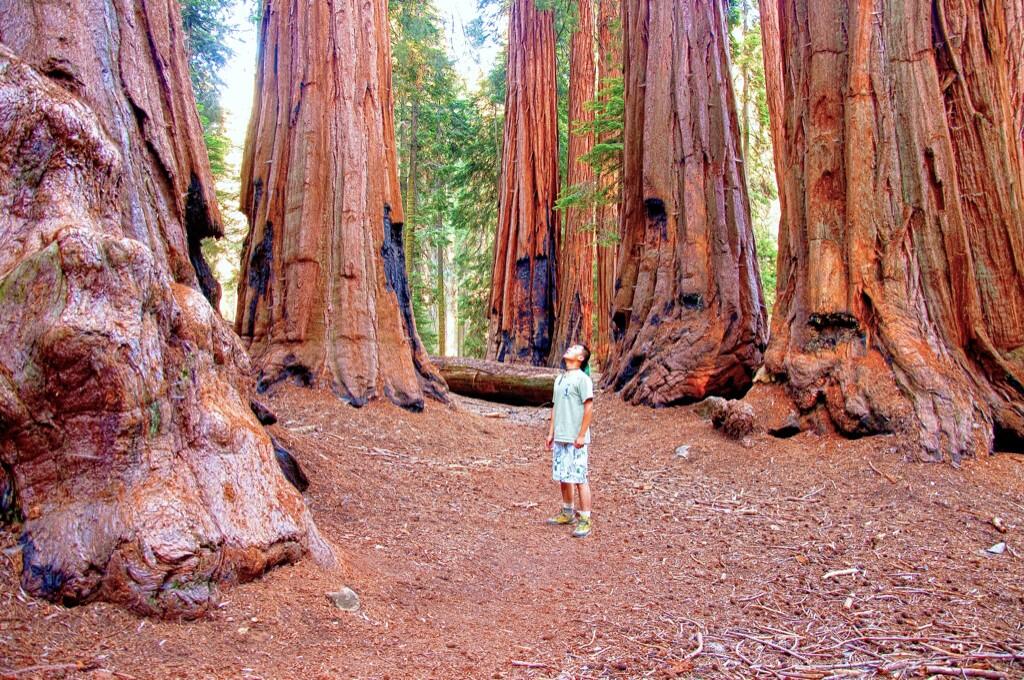
I find it impossible to stand in a place like Yosemite and not hear John Muir‘s voice — and it’s probably that John Muir found that, too. Or stand on the shores of Waldon Pond and not hear Henry David Thoreau, or stand on sandy soil in Wisconsin and not hear Aldo Leopold, or sit on a redrock outcropping in southern Utah and not hear Ed Abbey. They probably heard similar voices. But they had the presence of mind to write down what they heard.
Writing wonderful prose, or poetry, must be easier when the subject sings of itself in your ears, and paints itself in glory for your eyes.
If Carson’s prose borders on poetry, does that add to, or subtract from its science value?
U.S. President Theodore Roosevelt (left) and nature preservationist John Muir, founder of the Sierra Club , on Glacier Point in Yosemite National Park. In the background: Upper and lower Yosemite Falls. Wikipedia image
Spread the word; friends don't allow friends to repeat history.
Or, until that account is unsuspended by the forces supporting Donald Trump: Follow @FillmoreWhite, the account of the Millard Fillmore White House Library
We've been soaking in the Bathtub for several months, long enough that some of the links we've used have gone to the Great Internet in the Sky.
If you find a dead link, please leave a comment to that post, and tell us what link has expired.
Thanks!
Retired teacher of law, economics, history, AP government, psychology and science. Former speechwriter, press guy and legislative aide in U.S. Senate. Former Department of Education. Former airline real estate, telecom towers, Big 6 (that old!) consultant. Lab and field research in air pollution control.
My blog, Millard Fillmore's Bathtub, is a continuing experiment to test how to use blogs to improve and speed up learning processes for students, perhaps by making some of the courses actually interesting. It is a blog for teachers, to see if we can use blogs. It is for people interested in social studies and social studies education, to see if we can learn to get it right. It's a blog for science fans, to promote good science and good science policy. It's a blog for people interested in good government and how to achieve it.
BS in Mass Communication, University of Utah
Graduate study in Rhetoric and Speech Communication, University of Arizona
JD from the National Law Center, George Washington University


 Posted by Ed Darrell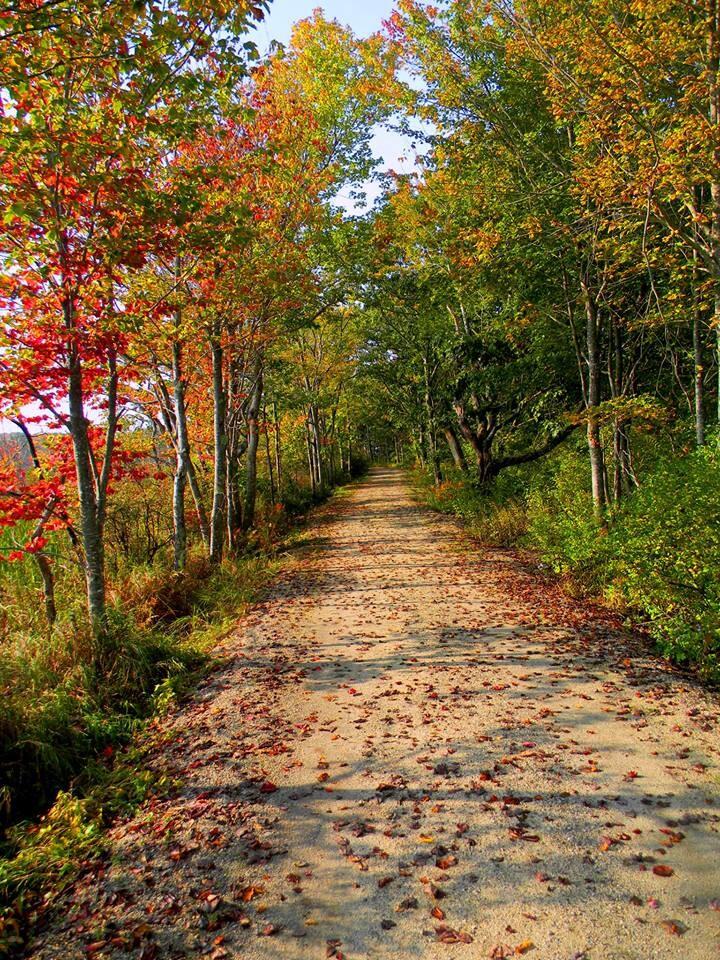









 Millard Fillmore's Bathtub