Did the PhotoShopper add anything of value to the picture? Of what use is a gilded lily?
(Please help — the original photo is identified as an award winner in 2003 — do you know the original photographer? We should give credit appropriately; I’ve not found the person’s name, yet.)
If you go today, vote before you go. This is one of the areas to be opened to energy exploration — oil and gas drilling or other mining — under Mitt Romney’s “energy plan” and the GOP National Platform.
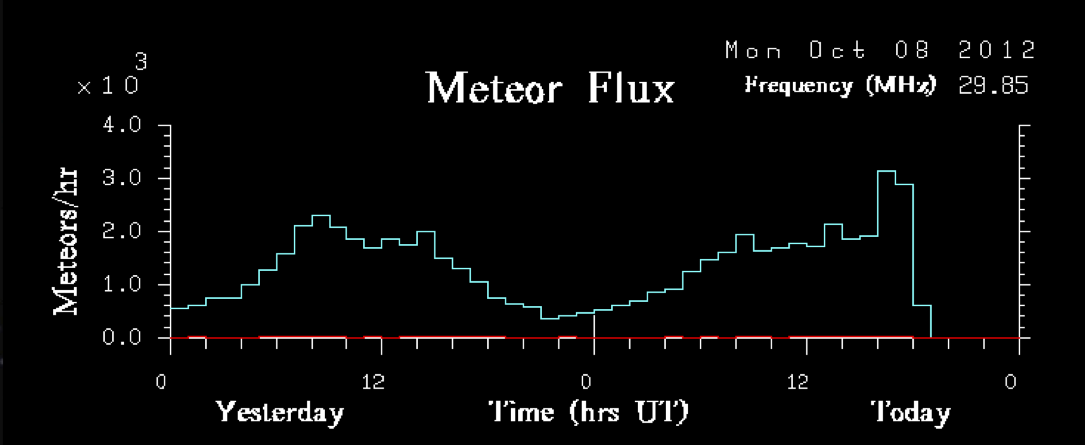
Space Weather says radar suggests a big show, already begun, with 1,000 meteoroids an hour:
DRACONID METEOR OUTBURST UNDERWAY: The CMOR radar in Canada is picking up a major outburst of Draconid meteors commencing at 16 UT on Oct. 8th. “Radar rates are at 1000 meteors per hour,” reports Bill Cooke of NASA’s Meteoroid Environment Office. “This is greater than last year’s outburst, and 5x the 2005 level.” Cooke encourages northern sky watchers, especially in Europe where night is falling, to be alert for Draconid activity. Because radars are sensitive to very small meteoroids, there is no guarantee that this radar outburst will translate into meteors visible to the human eye. On the other hand, a brilliant display could be in progress. The only way to know is to go outside and look. [CMOR radar data] [sky map] [Submit:reports or photos] Listen: Tune into Space Weather Radio to hear live Draconid radar echoes.
Can you see these rocks as they burn up? Or are they too small to make a visible “splash,” even though registering on radar?
Draconids are most active in the early evening (other showers tend to be active after midnight). Look toward the head of Draco the Dragon. EarthSky.org offers a skymap to help out:
Draconid meteor shower, October 8, 2012 – map from EarthSky.org
Yosemite’s vast acreage and remote location protect some of the darkest night skies in the country. Astronomers, photographers and city dwellers flock to the park to take advantage of this unique opportunity to view planets, stars, and galaxies.
For classroom use, some topics and questions to pursue:
For geography, where is Yosemite N.P.? Flying commercially, which airport is the best to get to the park?
President Teddy Roosevelt and conservationist John Muir pose at Overhanging Rock at the top of Glacier Point, near which the men camped in a hollow and awoke to five inches of snow in 1903. National Park Service image
Map reading and orientation: In the time-lapse sequences, you can frequently see lights streaking across the sky. Those are commercial airliners — can you tell what airport they are headed to, or from? Can you tell which ones are coming, which going?
Science: What star formations do you see in these photographs that you can see from your house? What star formations are not visible from your house?
Government: Who signs the checks that pay the rangers pictured in the film? For which agency do the work, in which branch of which government?
People in the film discuss light pollution from nearby cities. Is there an agency in the federal government who has jurisdiction over light pollution? How about an agency in the state government? What are the rules on light pollution for cities around Yosemite?
Can you identify the landmarks, the cliffs, rocks, mountains and rivers, portrayed in the film? (Students might use a USGS topographical map, California state tourist promotion maps and websites, National Park Service databases, Google Earth, Google, and a wide variety of other sources.
Who was president of the U.S. when Yosemite was set aside as a National Park, and what were the controversies surrounding it?
Who lived in Yosemite, if anyone, before the Spanish missions were established in California? When were the missions established? How did the U.S. gain possession of the Yosemite Valley?
Spread the word; friends don't allow friends to repeat history.
Interior Department photo, America’s Great Outdoors, at Denali National Park and Preserve; photo caption from AGO said, “We’re not sure it’s possible to take a bad photo up there!” Click for larger view.
Update: Interior tweeted another photo later today.
From the U.S. Department of Interior Tweet: This morning we gave you an amazing shot of #Denali. Would you believe this one is from the same place? Whether large or small, beauty in Denali is everywhere you look. #Alaska
Can someone identify the flower?
Spread the word; friends don't allow friends to repeat history.
Since he prefers a Kim Jong Il-style commenter policy –“only those who flatter the Premier need comment” — Anthony Watts‘s site doesn’t get the pleasure of my visits much, anymore. Consequently I missed the announcement he made last week that he was “suspending” his blog, at least temporarily, until some great news came out.
Anthony Watts, June, 2010. Speaking in Gold Coast, Australia, on a tour searching to find some place on Earth not affected by global warming. (Photo: Wikipedia)
Now the great news is out. I think. Watts may have been right to suspend blogging. He should have kept the suspension longer.
Watts says NOAA‘s temperature measurement in the U.S. is way off, and that if we ignore all the cities, and if we ignore sites that show the greatest increases in temperature over the past century or so, global warming doesn’t look so bad.
This pre-publication draft paper, titled An area and distance weighted analysis of the impacts of station exposure on the U.S. Historical Climatology Network temperatures and temperature trends, is co-authored by Anthony Watts of California, Evan Jones of New York, Stephen McIntyre of Toronto, Canada, and Dr. John R. Christy from the Department of Atmospheric Science, University of Alabama, Huntsville, is to be submitted for publication.
Wait a minute. “Prepublication draft paper?” ” . . . to be submitted for publication?”
Yes, Dear Reader, that claxon you hear is your and my Hemingway III Solid Gold [Excrement] Detectors™ going off. It may be a false alarm, but still — isn’t this how bogus science is done, isn’t this what Robert Park warns us about? Indeed, in the Seven Warning Signs of Bogus Science, Park says to pay attention to key indicators: “1. The discoverer pitches the claim directly to the media.” It is, indeed, a press release from Watts, about a paper he hopes to get through the peer review process at some point in the future — but it has not yet been pitched to the science journals. (Yes, that’s also one of the Seven Warning Signs of Bogus History . . . one discipline at a time, please.)
Same old stuff, new day. Watts has been arguing for years that NOAA’s temperature measurements err, but after the Berkeley Earth Surface Temperatures (BEST) Project determined that warming exists, even using Watts’s modified measurements and accounting for his claimed errors, some of us hoped Watts might turn to blogging about science, instead.
No, Watts turned to finding a hint of a methodology that might support his preconceived notions. He found one.
So, Watts’s big announcement is that he’s found a methdology which favors his criticisms of NOAA; so we should ignore temperature readings from cities, because cities are hot, and we should ignore temperature readings from suburbs of cities, because suburbs are warm; and if we do that, then warming in the U.S. doesn’t look so bad.
Were I allowed to ask questions at Watts’s blog, I’d ask why we should ignore warming in cities, because are they not part of the planet? Oh, well.
The Twitter version:
Watts: Ignore city temps (hot!) and ‘burbs (warm!), temps on farms don’t show so much global warming! Oops – did we say that before?
Anthony, how about you suspend your blog until you get the paper accepted at a good journal? Make sure you got the numbers right . . .
Details on the film, and how to track down the artists and see more, from Project Yosemite’s Vimeo site:
A collaborative project by Sheldon Neill and Colin Delehanty. What started as an idea turned into an ongoing adventure to timelapse Yosemite in an extreme way.
We were complete strangers before it all started, but after we met on Vimeo our idea came into sight, and then began the challenge to make numerous trips to YNP where we would capture the beautiful landscape it offers for visitors every year.
We invite you to watch our video in hopes you’ll witness Yosemite like never before.
Yosemite HD
This video is a collaboration between Sheldon Neill and Colin Delehanty. All timelapses were shot on the Canon 5D Mark II with a variety of Canon L and Zeiss CP.2 Lenses.
This whole project has been an amazing experience. The two of us became friends through Vimeo and explored a shared interest in timelapsing Yosemite National Park over an extended period of time. We’d like to expand this idea to other locations and would appreciate any suggestions for a future project.
Our hearts go out to the families of Markus Praxmarer who lost his life while climbing Half Dome on September 19th, 2011 and Ranger Ryan Hiller, who was crushed by a tree January 22nd 2012. They will be missed. (A photo of Ranger Ryan Hiller can be found to the right, above the statistics counter)
Generalized geologic map of the Yosemite area. (USGS image) (Photo credit: Wikipedia)
Yosemite National Park is spectacular, and much photographed than other great natural places of beauty. How much does it benefit from being in California, closer to many people with good cameras and great photographic skills, to an extent that more distant, spectacular parks like Glacier N.P., Yellowstone N.P and Big Bend N.P. do not benefit? How does that affect management of the parks? How does that affect how people view their own local adventure areas?
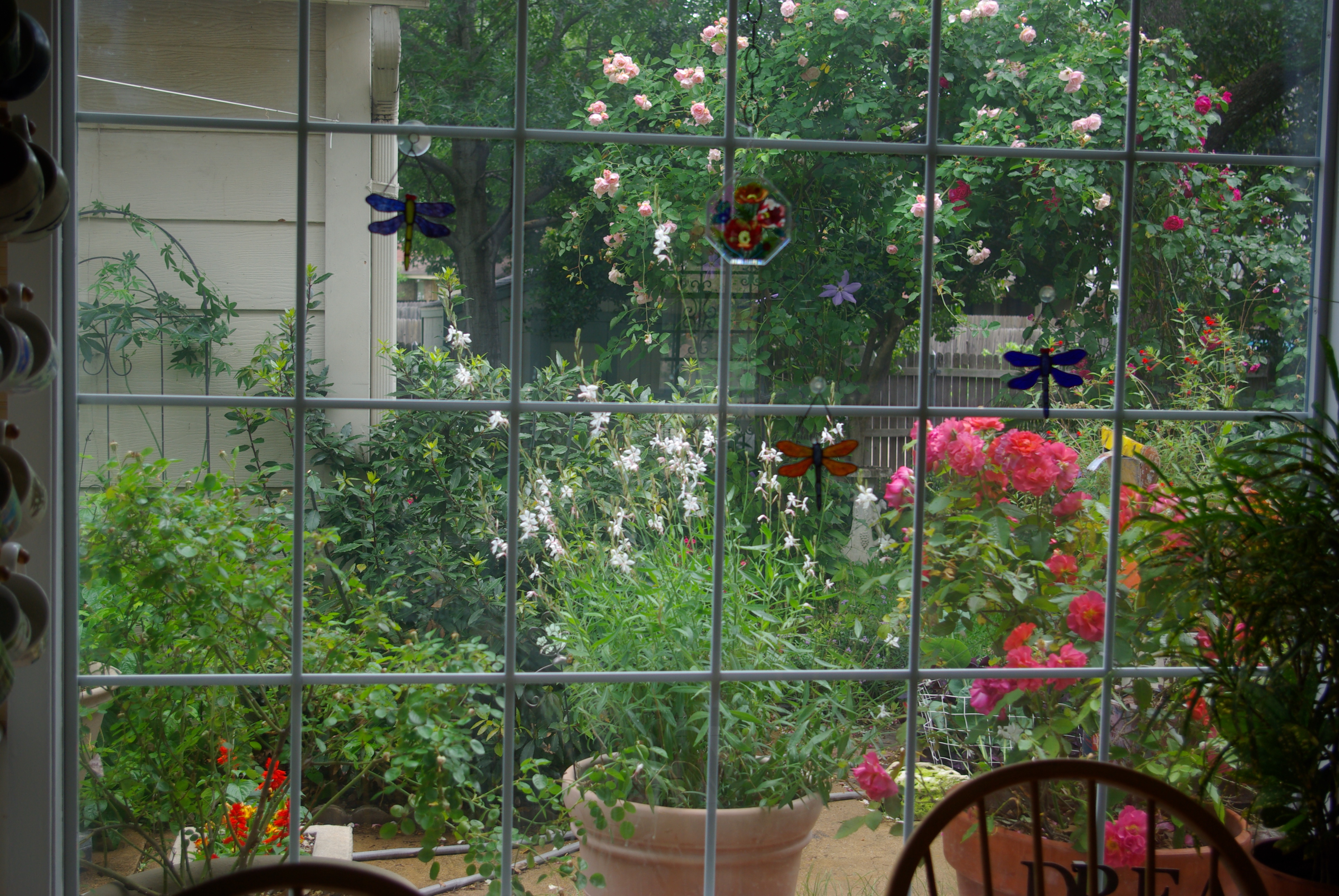
From our kitchen table, the view on April 15 of this year.
Colors muted by shooting through glass, but you see the advantages of having a flower-loving gardener for a spouse. Kathryn’s garden provides delights in every not-frigid month, with many stunning moments like this one.
Coffee is always better with a sweet view.
Spread the word; friends don't allow friends to repeat history.
Understanding the physics of the Earth’s atmosphere poses great problems — it is an astonishingly dynamic, fluid environment. Understanding the relationships between species in ecosystems is no less complex, and no less vexing.
Wise followers of science recognize that when findings in biology, chemistry and physics, point the same direction, something powerful creates the convergence, and is not to be ignored.
So it is with these findings from the University of Montana and the U.S. Geological Survey, demonstrating clear links between climate change and the changing life patterns of large animals like elk, small animals like birds, and the plants the animals live in and consume. This study is so complex that climate denialists haven’t figured out which part to deny, yet. (This press release came out in January.)
From the USGS, with no adornment from the Bathtub, a press release on a letter in Nature Climate Change:
Dramatic Links Found Between Climate Change, Elk, Plants, and Birds
Released: 1/9/2012 11:30:00 AM
U.S. Department of the Interior, U.S. Geological Survey
Office of Communications and Publishing
In partnership with the University of Montana
Missoula, MT – Climate change in the form of reduced snowfall in mountains is causing powerful and cascading shifts in mountainous plant and bird communities through the increased ability of elk to stay at high elevations over winter and consume plants, according to a groundbreaking study in Nature Climate Change.
Red-faced warblers are one of the species affected by climate change in the form of reduced snowpack in the Arizona Mountains, according to a USGS Montana Cooperative Wildlife Research Unit study. Photo by Tom Martin, USGS, May 1998, in the Coconino National Forest
The U.S. Geological Survey and University of Montana study not only showed that the abundance of deciduous trees and their associated songbirds in mountainous Arizona have declined over the last 22 years as snowpack has declined, but it also experimentally demonstrated that declining snowfall indirectly affects plants and birds by enabling more winter browsing by elk. Increased winter browsing by elk results in trickle-down ecological effects such as lowering the quality of habitat for songbirds.
The authors, USGS Montana Cooperative Wildlife Research Unit scientist Thomas Martin and University of Montana scientist John Maron, mimicked the effects of more snow on limiting the ability of elk to browse on plants by excluding the animals from large, fenced areas. They compared bird and plant communities in these exclusion areas with nearby similar areas where elk had access, and found that, over the six years of the study, multi-decadal declines in plant and songbird populations were reversed in the areas where elk were prohibited from browsing.
Hermit thrushes are a songbird species that was strongly affected by plant community changes in mountains because of reduced snowpack and cascading ecological effects, according to a USGS Montana Cooperative Wildlife Research Unit study. 2005 photo by Tom Martin, USGS, in the Coconino National Forest
“This study illustrates that profound impacts of climate change on ecosystems arise over a time span of but two decades through unexplored feedbacks,” explained USGS director Marcia McNutt. “The significance lies in the fact that humans and our economy are at the end of the same chain of cascading consequences.”
The study demonstrates a classic ecological cascade, added Martin. For example, he said, from an elk’s perspective, less snow means an increased ability to freely browse on woody plants in winter in areas where they would not be inclined to forage in previous times due to high snowpack. Increased overwinter browsing led to a decline in deciduous trees, which reduced the number of birds that chose the habitat and increased predation on nests of those birds that did choose the habitat.
When elk are excluded, aspen growth dramatically increases - Climate change in the form of reduced snowfall in mountains is causing powerful and cascading shifts in montane plant and bird communities through the increased ability of elk to stay at high elevations over winter and consume plants. Here, you can see an example of the difference in aspen growth inside versus outside a fence that excludes elk. Photo by Tom Martin, USGS, in Coconino National Forest
“This study demonstrates that the indirect effects of climate on plant communities may be just as important as the effects of climate-change-induced mismatches between migrating birds and food abundance because plants, including trees, provide the habitat birds need to survive,” Martin said.
The study, Climate impacts on bird and plant communities from altered animal-plant interactions, was published online on Jan. 8 in the journal Nature Climate Change.
Elk in winter at Camp Creek Feed Ground, Northwestern Wyoming - USGS photo
Greg Marley has a passion for mushrooms that dates to 1971, the year he left his native New Mexico and spent the summer in the verdant woods of central New York. Since then, he has become an avid student and teacher of mycology, as well as a mushroom identification consultant to the Northern New England Poison Control Center and owner of Mushrooms for Health, a company that provides education and products made with Maine medicinal mushrooms. Marley is the author of Mushrooms for Health: Medical Secrets of Northeastern Fungi. He lives and mushrooms in Rockland, Maine.
Greg and I met a couple of summers later, in “the verdant woods of central New York.” We struck it off as two westerners in the usually wet East (though it was very dry that summer). We worked together four summers, tramping the woods, canoeing the Adirondacks around Saranac Lake, singing (we were half of the barbershop quartet in a production of Meredith Willson’s “The Music Man” and joined around campfires on a hundred sparkling occasions), and sampling wild foods, in our work with the Louis August Jonas Foundation.
Nice to see a kid from the neighborhood doing good, and maybe well.
Spread the word; friends don't allow friends to repeat history.
I confess to being caught doing math instead, in English, in history — and in art we often made mathematical games to create patterns. From the stuff I see on walls in schools, that’s still popular.
Also true that in most of the disciplines that work into classes we call social studies, we do not have the ability to discern the cool patterns like Fibonacci numbers in pine cones, pineapples and sunflower blossoms. People look for those pattersn in history anyway, and that poses a key problem to policy makers. People want to see a pattern, expect to see a pattern, and historians cannot meet that expectation, other than quoting Santayana.
Maybe one of my students will be the one who discerns a key pattern. It’ll be one of the slackers, if it happens.
Spread the word; friends don't allow friends to repeat history.
Good teacher resource for National Environmental Week, April 15-21, 2012
December 20 Scenes from the beach
“To stand at the edge of the sea,” wrote Rachel Carson, “… is to have knowledge of things that are as eternal, as any earthly life can be.”* The things that we see this morning–a cerulean sea and sky, the shorebirds, the sun still near the horizon — are identically the same objects that could be seen in Cambrian times, eons ago. There is a sense of the eternal in the objects viewed today. And I suppose there will be little change in a faraway eon that lies in some future age. — Diary, autumn 2011
* At the Edge of the Sea by Rachel Carson; Signet Books, New York (1955)
One should read Rachel Carson to get closer to the universe, not for political reasons, not necessarily for the science. But being scientifically accurate, and being close to the pulse of the universe, Carson’s views will change your politics for the better if you really read and listen.
Spread the word; friends don't allow friends to repeat history.
New short from the Texas Parks and Wildlife people:
The smoke may be gone but the Bastrop fires of Labor Day weekend are still a smoldering concern for biologists. They’re keeping tabs on the Houston Toad. And with only an estimated 2,000 left in Texas, this endangered species is facing its next challenge as the drought continues. More on Houston toads at http://www.houstonzoo.org/HoustonToad/
For background, see this earlier reel from TPWS on the fires at Bastrop State Park:
Spread the word; friends don't allow friends to repeat history.
Or, until that account is unsuspended by the forces supporting Donald Trump: Follow @FillmoreWhite, the account of the Millard Fillmore White House Library
We've been soaking in the Bathtub for several months, long enough that some of the links we've used have gone to the Great Internet in the Sky.
If you find a dead link, please leave a comment to that post, and tell us what link has expired.
Thanks!
Retired teacher of law, economics, history, AP government, psychology and science. Former speechwriter, press guy and legislative aide in U.S. Senate. Former Department of Education. Former airline real estate, telecom towers, Big 6 (that old!) consultant. Lab and field research in air pollution control.
My blog, Millard Fillmore's Bathtub, is a continuing experiment to test how to use blogs to improve and speed up learning processes for students, perhaps by making some of the courses actually interesting. It is a blog for teachers, to see if we can use blogs. It is for people interested in social studies and social studies education, to see if we can learn to get it right. It's a blog for science fans, to promote good science and good science policy. It's a blog for people interested in good government and how to achieve it.
BS in Mass Communication, University of Utah
Graduate study in Rhetoric and Speech Communication, University of Arizona
JD from the National Law Center, George Washington University


 Posted by Ed Darrell









 Millard Fillmore's Bathtub