Wilderness Society Tweeted: Stars over Yosemite’s El Capitan (in honor of @kjorgeson & @tommycaldwell1). Have a good night! (Photo by Justin Kern, flickr)
Actually, this photo probably is not from the past few days, when Kevin Jorgeson and Tommy Caldwell worked to free climb the rock — but the Milky Way is there if they care to look!
Not just the whole world is watching — the whole universe shines down.
(Have you been following their climbing exploits?)
More:
Follow the climbers on Twitter, @kjorgeson and @tommycaldwell1
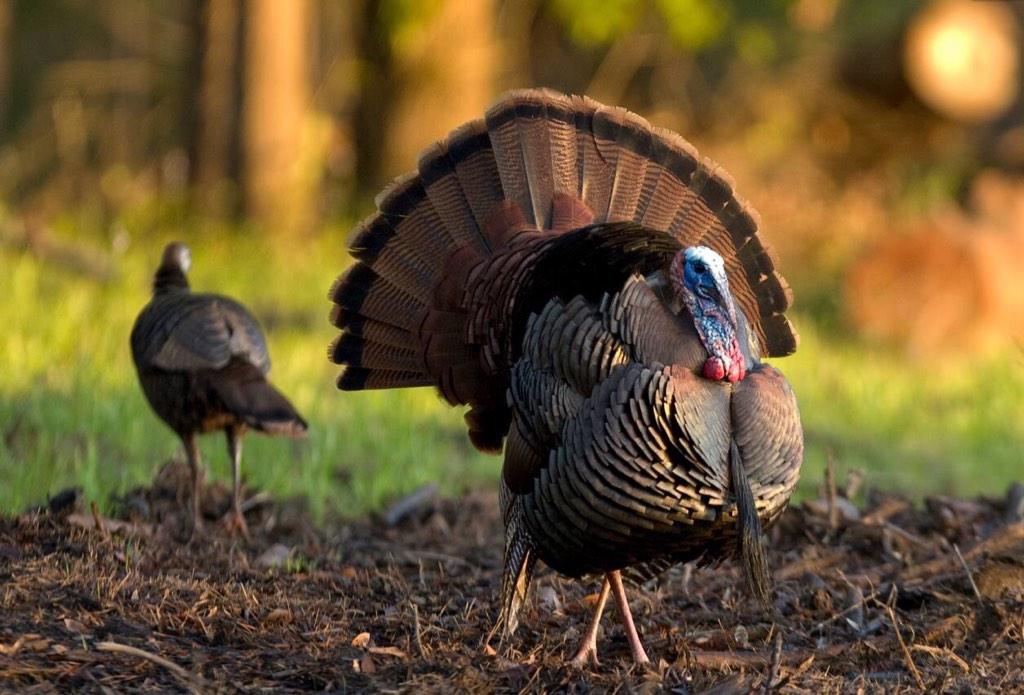
Turns out there are real turkeys in Alabama. They’ve expressed some concern that Judge Roy Moore impersonates a turkey in court.
A Thanksgiving salute from the denizens of our public lands.
From Interior Department’s Twitter feed: Here’s a handsome pair of wild turkeys to celebrate #Thanksgiving! Photo at Eufala NWR by Michael Padgett #Alabama
More:
Eufala National Wildlife Refuge: “The Eufaula National Wildlife Refuge was established in 1964 through community support and in cooperation with the U. S. Army Corps of Engineers. It is located on both banks of the Chattahoochee River in southeast Alabama and southwest Georgia. Named after the city of Eufaula, the refuge offers a variety of wetland and upland habitats for diverse fauna. A prominent feature of the abundant wetlands is Lake Eufaula (Walter F. George Reservoir) and several feeder streams”
Spread the word; friends don't allow friends to repeat history.
From our public lands, from the Twitter feed of the U.S. Department of Interior:
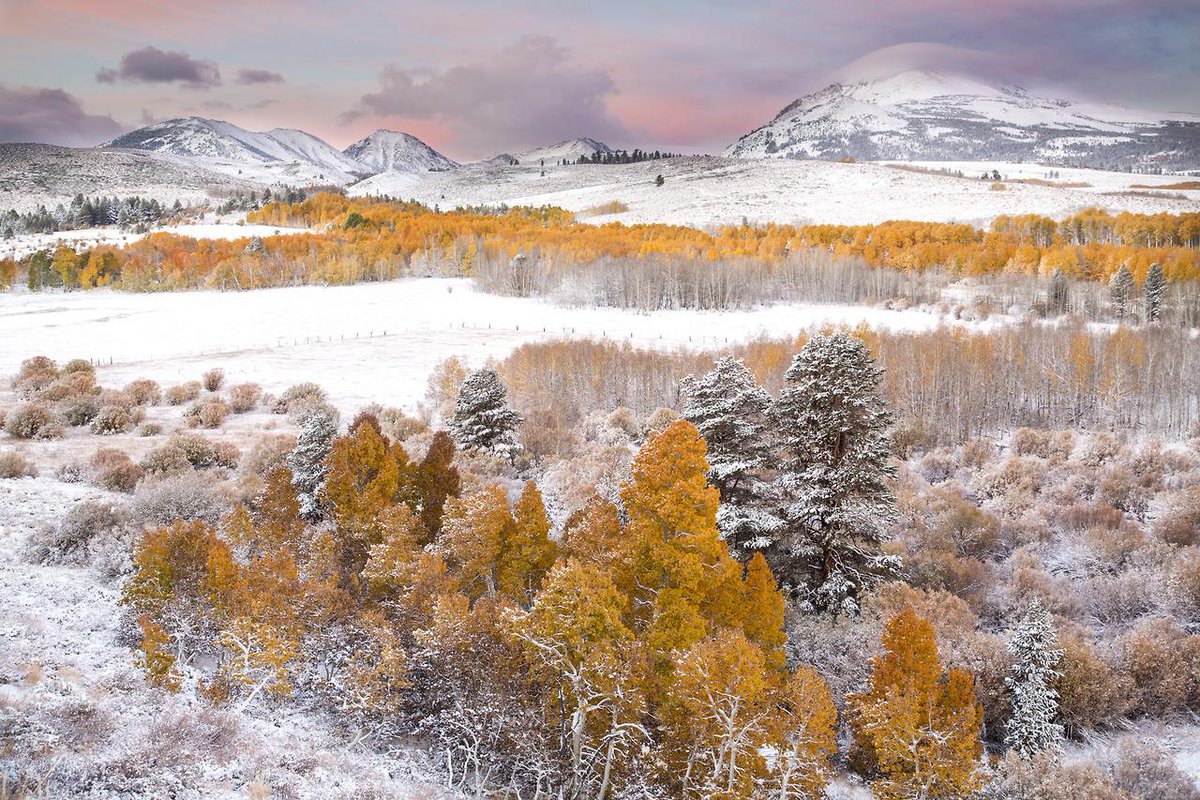
@Interior caption: Fall foliage and snow-capped peaks make for a stunning shot of Conway Summit #California @BLMca #nature
In my winter drives through the desert mountains of the Great Basin I often marveled at how a dusting of snow could turn a landscape generally painted in tones of brown with a little green into almost black and white. Then there are those black and white landscapes slashed by stunning gashes of color, or tinted subtley.
Conway Summit shows the stunning gashes of color this week. Grays, whites, blacks — and gold and pink. It’s in the western part of California, near Nevada and Mono Lake:
Conway Summit is named after John Andrew Conway, a settler in the area in 1880.[3][4] Geographically, it was formed from an upland plateau by the sinking of the land in the Mono basin area.[5] The Sawtooth Ridge of the eastern Sierra Nevada, topped by 12,279-foot (3,743 m) Matterhorn Peak, rise to the west of the pass; Green Creek and Virginia Lakes, in the Sierra Nevada to the west of the pass, are two local destinations for fishing, camping and aspen trees. The Bodie Hills and the infamous Bodie ghost town lie to the east.
This scene comes from our public lands, the undifferentiated lands held in trust by the Bureau of Land Management (BLM) and managed for multiple uses. You and I may look at this photo and marvel at the beauty of America, and say a little prayer of thanks for our public lands. Sens. Mike Lee and Ted Cruz see potential for high-dollar vacation residences throughout this scene, if only the land could be sold off.
Spread the word; friends don't allow friends to repeat history.
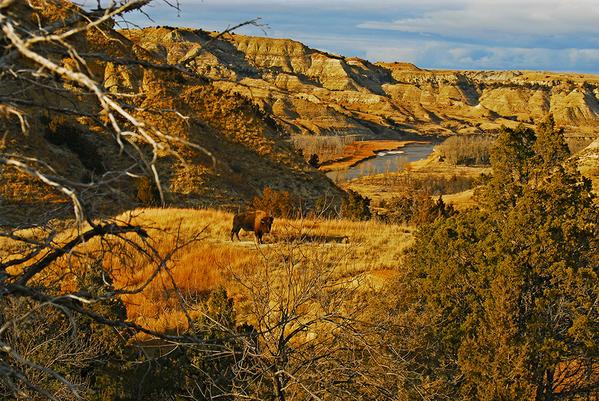
Among many other things in his life, he was for a time a cowboy in South Dakota, in the area where today resides the Theodore Roosevelt National Park.
Look closely at the picture. You can almost see Teddy. He was a powerful, guiding force behind the movement to protect precious, historic, scientifically valuable and beautiful lands, by the federal government.
Happy birthday, Theodore Roosevelt! Let’s celebrate with a great shot of @TRooseveltNPS #NorthDakota
Milky Way over Monument Valley Navajo Tribal Park. Photo by Gavin Heffernan and Harun Mehmedinović, from the video (which also features Grand Canyon National Park)
And that they do. The Milky Way is the star of the show; the galactic bulge, disk, and dark fingers of vast dust lanes as clear as if this were taken from space. Well, sort of; I was impressed by the mix of clouds and sky, to be honest. The contrast was interesting, and it’s rather amazing the Milky Way could stand out so clearly above the cloud line.
One thing I want to point out specifically: At 2:10 in, a meteor flashes and leaves behind a curling wisp of what looks like smoke. This is called a persistent train, the vaporized remains of the meteoroid itself, and can glow for several minutes. The upper level winds from 60–100 km above Earth’s surface are what blow it into those curlicues.
More details, for more films from these guys:
Shot and Produced by: Gavin Heffernan and Harun Mehmedinović
Music: A Seated Night (Ambient) by Moby. Courtesy MobyGratis.com / Unknown Native Chant
Thanks: Northern Arizona University, Grand Canyon National Park, Monument Valley Tribal Park.
From the U.S Department of Interior Twitter feed: To celebrate being named to the @TIME #Twitter140, here is an amazing photo from @JoshuaTreeNP. pic.twitter.com/F4DS5Xv9vq
From the Arches National Park Facebook page: photo of Pine Tree Arch and meteoroid by Andy Porter)
A few minutes before 9:00 p.m. Central on Tuesday, I saw a sizable fireball falling north to south, appearing from my vantage on the top of Cedar Hill to be over south Grand Prairie, Texas. Best meteoroid I’ve seen for a while.
“I want people to be able to see the wonder of the night sky without the effects of light pollution. The universe is our view into our past and our vision into the future . . . I want to help preserve its wonder.” – Jennifer Barlow
The International Dark Sky Association promotes activities worldwide to encourage star-gazing and sky-watching.
Passenger jet and Moon. Photo by Rodger Schmitt, from Lake Powell, Utah.
Handheld Nikon. Nikon stabilizing lens. Good hands, I’d say.
Third to last time I was out near Lake Powell, I was with Rodger (and about a dozen others) organizing hearings of the President’s Commission on Americans Outdoors. We flew into Page, Arizona, on an Otter II coming up from Phoenix flying low, looking for elk, and legally buzzing Rainbow Bridge (impressive from the air, too).
We had a luncheon meeting at Wahweap Marina, as I recall; no time for boating.
Then we were off to the South Rim of the Grand Canyon. There we inspected pine trees 30 feet tall, growing between the ties of the then-abandoned rail lines. (And did a lot of other stuff.)
Today trains carry tourists to the South Rim on those tracks, the trees gone. Progress, really.
Rodger carries on in the knowledge that use of the outdoors, especially these public lands, heals souls, and sometimes gives you great photos.
Rodger said I could borrow the photo. Thanks!
Spread the word; friends don't allow friends to repeat history.
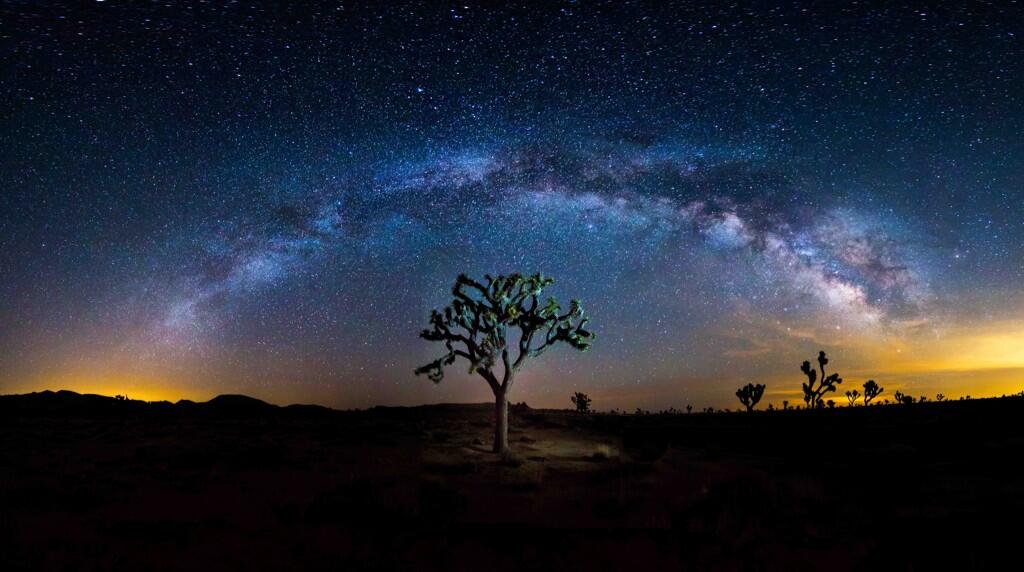
A long exposure, you can tell by the airplane streaks near the horizon. Walking that fine photography edge of long enough to get the exposure, but short enough not to distort the stars too much.
Long exposure of a Joshua tree, in Joshua Tree National Park. Photo: Sarah Chah (www.sharetheexperience.org)
Viewed from the road, this desert park only hints at its vitality. Closer examination reveals a fascinating variety of plants and animals that make their home in this land shaped by strong winds, unpredictable torrents of rain, and climatic extremes. Dark night skies, a rich cultural history, and surreal geologic features add to the attraction of this place. Come see Joshua Tree National Park for yourself!
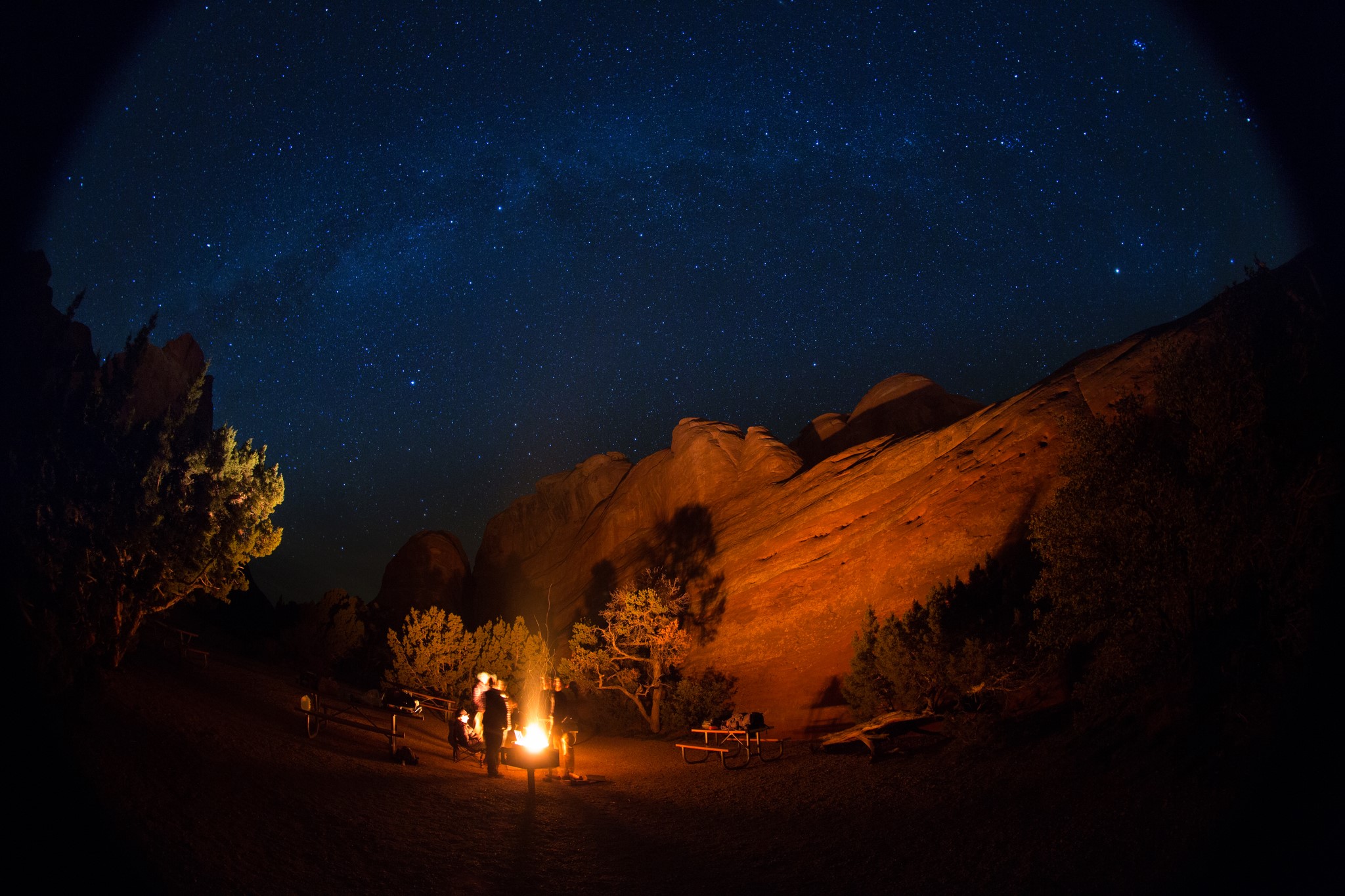
Photographer John Dale wrote: “We rolled in to Arches National Park to a beautiful sunset and got to our campsite just as it got dark, but that left us with a clear sky, plenty of stars, and a fire to warm up next to. Here’s a photo from the timelapse I took that night.”
Map of Arches National Park, Utah, United States showing predominant features such as arches, peaks, rivers and streams, mines, and roads. (Photo credit: Wikipedia)
Spread the word; friends don't allow friends to repeat history.
Or, until that account is unsuspended by the forces supporting Donald Trump: Follow @FillmoreWhite, the account of the Millard Fillmore White House Library
We've been soaking in the Bathtub for several months, long enough that some of the links we've used have gone to the Great Internet in the Sky.
If you find a dead link, please leave a comment to that post, and tell us what link has expired.
Thanks!
Retired teacher of law, economics, history, AP government, psychology and science. Former speechwriter, press guy and legislative aide in U.S. Senate. Former Department of Education. Former airline real estate, telecom towers, Big 6 (that old!) consultant. Lab and field research in air pollution control.
My blog, Millard Fillmore's Bathtub, is a continuing experiment to test how to use blogs to improve and speed up learning processes for students, perhaps by making some of the courses actually interesting. It is a blog for teachers, to see if we can use blogs. It is for people interested in social studies and social studies education, to see if we can learn to get it right. It's a blog for science fans, to promote good science and good science policy. It's a blog for people interested in good government and how to achieve it.
BS in Mass Communication, University of Utah
Graduate study in Rhetoric and Speech Communication, University of Arizona
JD from the National Law Center, George Washington University


 Posted by Ed Darrell









 Millard Fillmore's Bathtub