East side of Timpanogos, by the Heber Valley Convention and Visitors Bureau:

Timpanogos from the east – replacement for photo that originally nested here. Utah.com image
Tip of the old scrub brush to Susan Reeve Lewis.
Photo Tweeted from the National Park Service:

Horsetail Fall flows over the eastern edge of El Capitan in Yosemite Valley. It’s a small waterfall that many people don’t notice, but it has gained popularity as more and more people have noticed it can glow orange during sunset in mid to late February. The most popular place to see Horsetail Fall seemingly afire is El Capitan picnic area, west of Yosemite Lodge and east of El Capitan (see map below). The “firefall” effect generally happens during the second half of February. A clear sky is necessary for the waterfall to glow orange. Photo: Bethany Gediman, NPS
People living close to National Parks are lucky to do so; people who work in them luckier still, in the lifetime sweepstakes for seeing breathtaking sites. NPS employee (Ranger?) Bethany Gediman caught this image of Horsetail Fall in Yosemite National Park.
Be sure to see the video of Yosemite Nature Notes No. 14, posted here earlier. It shows Horsetail at sunset in full glory. Great photography.
How to get there:

Map of Yosemite National Park, showing Horsetail Falls and hiking trail to get to viewpoint in the photograph.
More:
A picture is worth a thousand words? For some pictures, no adequate words exist.

Photo by Ammar Awad, Reuters; caption from L’Express: De l’audace! – 17/03/2010 Afin de se rendre à l’école, une enfant traverse les lieux des affrontements entre les troupes israéliennes et les Palestiniens, dans le camp de réfugiés de Shuafat, près de Jérusalem.
L’Express caption in English:
The audacity! – 17/03/2010
To go to school, a child crosses the scene of clashes between Israeli troops and Palestinians in the refugee camp Shuafat, near Jerusalem.
Rather puts into a different perspective the whines of students about “having to go to school,” not bringing pencils or paper, and not making it to class on time, doesn’t it? What value does this girl and her family place on education?
To those who think the U.S. should in no case offer aid to Palestinians to build or operate schools, I ask: Who do you want to pay for this child’s schooling, and direct the curriculum?
Teachers, is this photo useful for studying human rights? Education? Middle Eastern human geography (AP), geography, or other issues? Contrast this girl’s path to school with that of Linda Brown in Topeka, Kansas, in 1951 (Brown vs. Topeka Board of Education).
Is education a civil right? Is education a basic human right?
Tip of the old scrub brush to James Kessler, who posted a slightly profanely-captioned version of this on Facebook.
Update: Amusing Planet has this photo (with a nice shout out) and several others, showing kids risking their lives to get to school in China, Vietnam, and Indonesia — it’s awe-inspiring, scary and encouraging at the same time.
More:
Stunning photograph posted by National Park Service people in Mount Ranier National Park:
Information from the Mount Ranier NPS site at Instagram:
Some images are just plain extraordinary — and often, the photographer has invested a great deal of time and effort to make that image happen. Photographer Dave Morrow describes the process of among this image from Mount Rainier National Park in October 2012. “I went up to Sunrise Point at Mt. Rainier last weekend with my buddy Keith. After a lame sunset, we waited for the Milky Way to come out. The placement was just perfect and the sky was pitch black! Time to jack up the ISO and shoot some stars . . . this was one of many from the night.”
See more of Mr. Morrow’s work, here: DaveMorrowPhotography.com
Difficult to know whether the streaks are airplanes or meteoroids. No doubt it was a long exposure.
(Links added here.)
[Update, June 2015: Morrow has protected his photo from linking in most places; go see this photo, and many others, at his site: http://www.davemorrowphotography.smugmug.com/]
More:

Caption from the NPS crew at Canyonlands National Park: View from the Maze: Millard Canyon’s winter mood. We are looking north. Note how the heat from the east to southeast facing cliffs has melted the snow below – even in this ultra-frigid time. Taking a break under a southeast facing cliff is a good way to warm up while on a Canyonlands hike. (GC) (via Facebook)
In a state where they once named the proposed state capital “Fillmore,” and the county in which that town sat, “Millard,” to try to curry favor with President Millard Fillmore for the state’s petition to gain statehood, one might logically think that a spectacular desert canyon not far away called Millard Canyon might also be named in honor of our 13th president.
Not so, in this case. According to John W. van Cott’s Utah Place Names (University of Utah Press, 1990):
MILLARD CANYON (Garfield County) originates at French Springs southeast of Hans Flat. The canyon drains north northeast into the Green River at Queen Anne Bottom. According to Baker, “They learned later that they had misunderstood this name; instead of honoring a president, it was named for an undistinguished `Miller’ who did nothing more than leave this small, mistaken mark on the map” (Baker, Pearl. Robbers Roost Recollections. Logan, UT: Utah State University Press, 1976, p. 33). The name was even misspelled Millard.
Millard Fillmore is off the hook on this one.
Garfield County, Utah, was named after President James Garfield.
So, who was this “Miller” guy?
(Post inspired by image from the Canyonlands NP Facebook site; temperature at the time of the photo was near 0°F.)
More:
Take a look at this sunset shot:

Sunset on BLM land near the Little Snake River, in northwest Colorado. Photo by Shannon Diszmang, via Royal Gorge National Recreation Area.
Note from America’s Great Outdoors blog:
Earlier this year, the Royal Gorge Recreation Area staff had a photo contest on their Facebook page and here is one of the great photos that was submitted. Here’s what photographer, Shannon Diszmang, had to say about it.
“This is BLM land in Northwest Colorado (Little Snake River district). I fell in love with this place. The red haze in this photo is the smoke coming from the wildfires on the west coast at the time. This is one of the lowest light pollution spots in our state which makes star gazing the absolute best.”
So, if you’re nearby, and you want a good place to look at the Geminid meteor shower tonight, odds are high there will be little light pollution here. If there aren’t many clouds, you’re in luck.
More:
P.S.: The stunningly beautiful photo above is NOT the winner of the photo contest(!). BLM wrote in a November press release:
CAÑON CITY, Colo. – Today the BLM Royal Gorge Field Office announced the winners of its BLM-sponsored photo contest. The two winners were decided by the public via the RGFO’s Facebook page: one winner is based on the most “likes” and the other is based on the most “shares.” Only those “likes” and “shares” that originated from the Royal Gorge Facebook page were tallied towards a winner.
Chris Nelson’s photo was the most “liked” and is a scenic shot taken from Chaffee County Road 175 between Cañon City and Salida. Nelson’s photo received 64 “likes.”
The most “shared” photo was submitted by David Madone and portrayed several deer in an alfalfa field near Cañon City. Madone’s photo received 20 shares.
Both photos will be featured on the RGFO’s Facebook page throughout November and may be featured in future BLM Colorado publications and social media sites.
The photo contest began Oct. 2 and ended Nov. 4 with more than 60 photos submitted. All the photos that were entered into the contest may be viewed via the “Photo Contest” album on the RGFO’s Facebook page: http://www.facebook.com/BLMRoyalGorge
Yeah, were I you, I’d go see what the winners looked like.
What’s for rent?

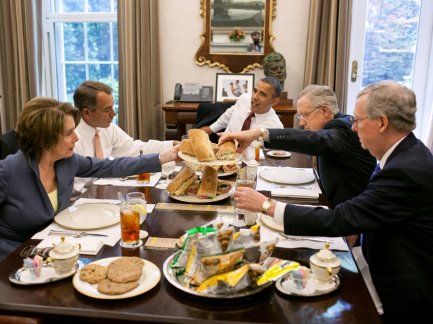
Republican Victory Center, for rent. Location and photographer unidentified so far — can you help identify them? Photo taken after November 6, 2012
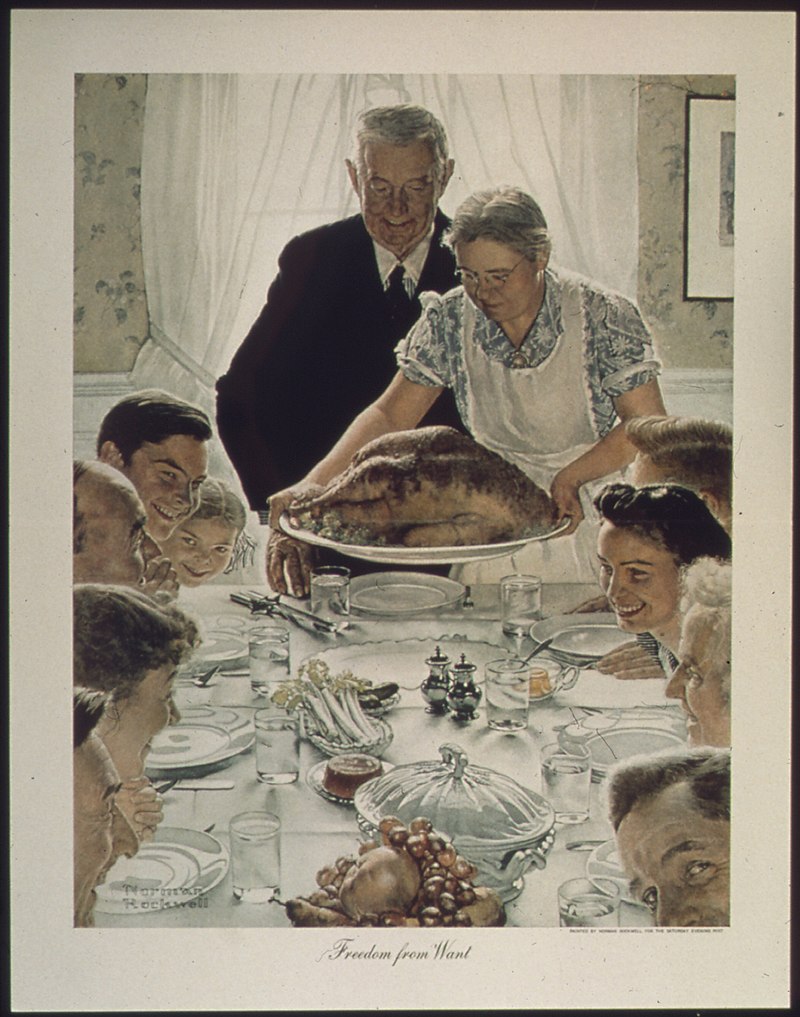
Not quite so good as Norman Rockwell’s famous painting, but real. “Republican Victory Center” probably isn’t the name it will be remembered by.
Can you help identify the location, and the photographer? Notice the photographer is portrayed in the reflection in the window.
More:
Historian Michael Beschloss Tweeted out a wonderful photo:

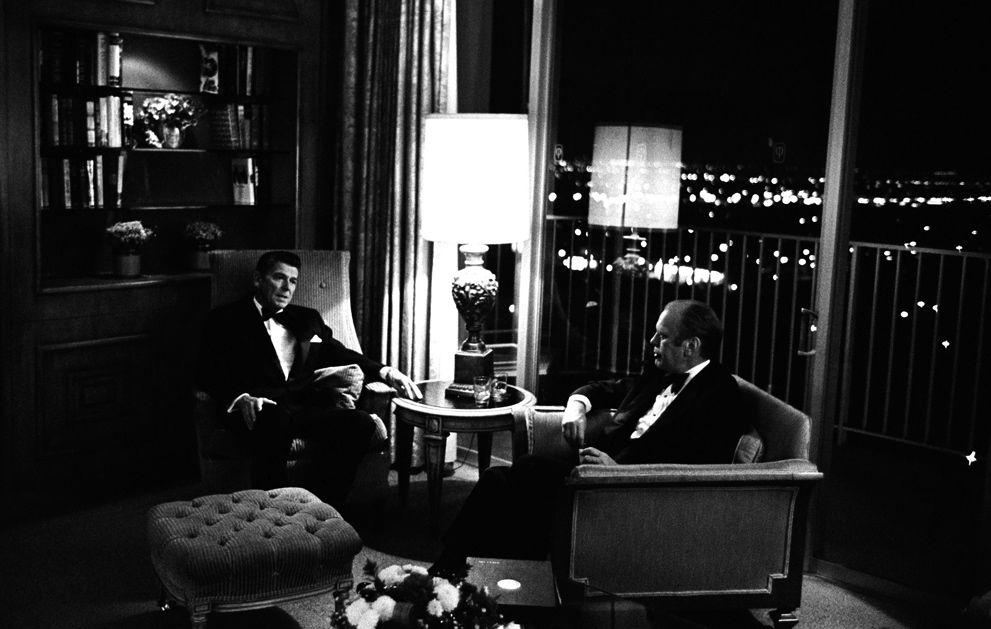
October 31, 1974: President Gerald Ford, right, met with former-California Gov. Ronald Reagan, at the Century Plaza Hotel, Los Angeles. Photo courtesy Micheal Beschloss.
Who took the photo? What was the event? Beschloss asks on Twitter, why two drinks on Ford’s side of the table, and none on Reagan’s?
Looks like it’s a photo by David Hume Kennerly, the White House photographer in the Ford administration. The photograph was taken with film, probably in black and white to save money and because it was the best way to get images for print media at the time. Few newspapers ran color photos as a regular feature. Electronic still photography at the time occurred in laboratories as tests. As a pragmatic matter, media to store such photographs electronically were impractical — a large mainframe computer might have 256 kilobytes of memory for such storage, or enough for photo of poor resolution.
Kennerly’s site said this meeting came around a black-tie Republican fund-raiser in Los Angeles, at the then-swanky Century Plaza Hotel.
Vanity Fair’s David Friend called it “L.A. Noir” in a 2007 article on a book of photos by Kennerly:
Today, the image conveys a touch of Rat Pack swagger, an architectural elegance, and a hint of the California glamour that Reagan would eventually import to Washington. At the time, however, Kennerly, who had won a Pulitzer for his work in Vietnam, considered the picture too dark and brooding; he almost overlooked the frame on his contact sheet. But that darkness captured something of the spirit of the time: less than three months before, Watergate had forced Richard Nixon from office; inflation, unemployment, and gas prices were on the rise; and the U.S. was facing defeat in Vietnam.
The picture also caught the sometimes frosty relationship between the two leaders. Both Reagan and Ford, after all, would nix the 1980 “dream ticket” idea, floated by some Republican mandarins, to draft Ford as Reagan’s vice president. And Ford, during his unsuccessful 1976 campaign against Jimmy Carter, resented Reagan’s political infighting. “Truthfully,” Ford confessed to Kennerly years later, “I was upset when he challenged me [for the ’76 Republican nomination]. I thought it was unwise for a Republican to challenge a sitting Republican president. We had a pretty bitter contest. It was a head-to-head, knock-down, drag-out affair.”
“I study this picture now,” says Kennerly, “and it looks like a scene from The Godfather”—which had won the best-picture Oscar the year before.
Were I to guess, with a bit of education, I’d say both glasses belonged to Ford, one a cocktail, one water. Reagan tended to avoid alcohol.
A great photograph, a tribute to the artistry and craftsmanship of Kennerly, especially with film; it also poses as a time capsule, freezing convention in GOP big-money fundraising, dress for men of influence and means, architecture, and so much more.

Pulitzer Prize-winning war photographer, and White House photographer, David Hume Kennerly; TEDxBend image
Not before the deluge, not after it, but during the storm. Nixon was three-months gone from the White House. Vietnam’s peace agreement was a year-old, but it was seven months to the final invasion of South Vietnam by the communist North that would force the U.S. retreat, and “reunify” Vietnam under communist rule. The Cold War still raged. Iran was considered a U.S. puppet. Mao Zedong still ruled in China. Elvis Presley still ruled in Memphis. AIDS was unknown. Computers were accounting machines taking floors of entire buildings. Portable telephones were expensive devices that hogged power and generally required at least an automobile to be attached to power the thing.
Barack Obama was 13.
It was a different time.
More:
Not Bigfoot:

Bear on the Misty Falls Trail, Sequoia and Kings Canyon National Parks – photo by Spencer Darrell, rights reserved
Assume that thing in the brush is a bear if it looks vaguely like a bear; if you’re filming, do so as you back up, and only through a very long telephoto lens (bears can sprint up to 30 mph; you want a 300-yard head start). A bear can do more damage to you than Big Foot; don’t mess up the bear’s thing with tourists looking for cryptofauna.
Tip of the old scrub brush to Spencer Darrell, one of Our Men in California.
More:
Here’s a good demonstration of why you don’t need PhotoShop, but a decent camera and a steady hand instead.

Utah’s Mt. Timpanogos in snow, by Craig Clyde, 2012 (rights probably reserved). Click for larger version.
Craig Clyde took this photo of Utah Valley‘s Mt. Timpanogos, probably from Saratoga Springs, on the west side of Utah Lake, after one of the first snows of 2012. (This area had a few farm fields when I grew up there.) It’s a great photo for several reasons.
It’s a formerly unusual view, there being so few people on the west side of the lake until recent development. It pictures all of Timpanogos, with American Fork Canyon on the left, Mahogany Mountain, Big Baldy, and Provo Canyon on the right. It’s an afternoon shot, you can tell from the angle of the sun (the mountain runs on a north-south axis), and the darkness on the lower mountains may be caused by the Sun’s setting behind the mountain range on the west side of the lake. Timpanogos in white, in the afternoon sunshine, is one of the greatest images of a mountain you’ll ever see.
Tip of the old scrub brush to Craig Clyde. Mr. Clyde and I attended high school together — haven’t seen him in more than 30 years; not sure, but I don’t think he’s the same Craig Clyde in the movie business.
More:
Long-time Scout friend Hal Rosen said he caught some good photos here, too — but none at this precise moment:
First you must get to Capitol Reef National Park, in Utah — one of Utah’s unfairly large number of five National Parks. Then you take your “high-clearance vehicle” (not necessarily 4-wheel drive) out on the dirt roads in Cathedral Valley, and you hope for a crystal blue sky like this one. Then you happen to get there just as the sun is right at the peak of the formation . . .
You had to be there. Mike Saemisch was there just over a week ago, on October 29, 2012, and fortunately caught this photograph with the Sun as part of a sparkling spire on a sandstone formation known as the Temple of the Sun.
Digital photography changes the way one tours these places. Fortunately. Take the kids, and make sure they find it on a map so they can use your trip as fodder for their 9th grade geography class.
More:
You got the Tweet?

Miter Basin, Sequoia and Kings Canyon National Parks, California; photo by Kristin Glover, NPS (public domain)
Photo from NPS employee Kristin Glover, at Miter Basin.
We should go see for ourselves, no?
If you go today, vote before you go. This is one of the areas to be opened to energy exploration — oil and gas drilling or other mining — under Mitt Romney’s “energy plan” and the GOP National Platform.
More:
Must be rare to get such a reflection of the sky in a calm Tidal Basin pool; from the Department of Interior‘s Instagram:

From Interior’s Instagram: Last night we posted an aerial photo of the #Washington #Monument, which everyone seems to really enjoy. So we are keeping it going today with a #photo of the #Jefferson #Memorial. #NationalMall #DC
One commenter noted the photo almost makes it appear that the Jefferson Memorial is floating in the clouds.
There are more than 300 units in the National Parks System. In the past two days we’ve had two spectacular photos from almost the same place, two memorials about a half-mile apart. How many thousands of great photos are possible from all of these properties? NPS’s job, caring for all of that stuff, is monumental.