Alma conference on DDT and human health calls for DDT phase out (Pine River statement)

May 5, 2009

Wheels of science grind carefully, accurately, and consequently, slowly.

The report from last year’s Alma College conference on DDT and human health has been published in .pdf form at Environmental Health Perspectives:  “The Pine River Statement:  Human Health Consequences of DDT Use.”

Carefully?  Check out the pages of references to contemporary studies of human health effects.  Each one of the studies cited is denied by the more wild advocates of DDT use, and each of those studies refutes major parts of the case against DDT restrictions.

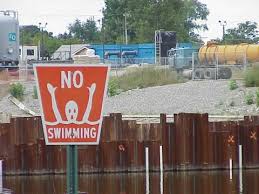
Warning sign near the old Velsicol plant where DDT was produced, on the Pine River, Michigan. The 1972 ban on DDT use in the U.S. was prompted by damage to wildlife and domestic animals; a 2009 conference noted that human health effects of DDT are also still of great concern, and perhaps cause alone for continuing the ban on DDT.

Warning sign near the old Velsicol plant where DDT was produced, on the Pine River, Michigan. The 1972 ban on DDT use in the U.S. was prompted by damage to wildlife and domestic animals; a 2009 conference noted that human health effects of DDT are also still of great concern, and perhaps cause alone for continuing the ban on DDT.

Accurately?  Notice how the conference marks those areas where we do not have good research, such as in the long-term health effects to people who live in the houses that are sprayed with DDT for indoor residual spraying (IRS).  While the conference report cites studies showing elevated DDT levels in the milk of women who live in those homes, they draw no unwarranted conclusions.  Alas, that leaves the field free for Paul Driessen to rush in and claim there are no ill effects — but read the paper for yourself, and you’ll see that’s far from what the research shows.  The paper exposes Steven Milloy’s claims to be almost pure, unadulterated junk science.

Slowly?  Well, it’s been more than a year.

The paper makes one powerful statement that is only implicit:  The claims that DDT is safe, and that use of the stuff should be increased, are wildly inflated.

The paper’s abstract:

Objectives: Dichlorodiphenyl trichloroethane (DDT) was used worldwide until the 1970s, when concerns about its toxic effects, its environmental persistence, and its concentration in the food supply led to usage restrictions and prohibitions. In 2001, more than 100 countries signed the Stockholm Convention on Persistent Organic Pollutants (POPs), committing to eliminate the use of 12 POPs of greatest concern. DDT use was however allowed for disease vector control. In 2006, the World Health Organization and the U.S. Agency for International Development endorsed indoor DDT spraying to control malaria. To better inform current policy, we reviewed epidemiologic studies published in the last five years which investigated the human health consequences of DDT and/or DDE exposure.

Data Sources and Extraction: We conducted a PubMed search in October 2008 and retrieved 494 studies.

Data Synthesis: Use restrictions have been successful in lowering human exposure to DDT, however, blood concentration of DDT and DDE are high in countries where DDT is currently being used or was more recently restricted. The recent literature shows a growing body of evidence that exposure to DDT and its breakdown product DDE may be associated with adverse health outcomes such as breast cancer, diabetes, decreased semen quality, spontaneous abortion, and impaired neurodevelopment in children.

Conclusions: Although we provide evidence to suggest that DDT and DDE may pose a risk to human health, we also highlight the lack of knowledge about human exposure and health effects in communities where DDT is currently being sprayed for malaria control. We recommend research to address this gap and to develop safe and effective alternatives to DDT.

Rachel Carson was right.

Tell other people about this conference report.  This is real science, and it deserves to be spread far and wide.

Tip of the old scrub brush to Ed Lorenz at Alma College, both for providing the news, and for his work to organize the original conference.

Other information:


Applying evolution theory to defeat malaria

May 3, 2009

If the theory works, why not use it, eh?

One of the most serious problems with the use of DDT is that it tends to drive insects to evolve defenses to pesticides very quickly.  Almost every mosquito on Earth today has alleles that allow it to digest DDT, rather than be poisoned by it.  These alleles arose shortly after DDT was put into use against mosquitoes, and by the mid-1960s had made fruitless the malaria eradication campaign worked by the World Health Organization.

Evolution can be used to the benefit of humans and the eradication of malaria, too.

Voice of America (remember that agency?) tells the story of Andrew Read, a researcher at Penn State University, who realized that the deadliest mosquitoes are old ones — malaria has to survive for about two weeks in the mosquito in its life cycle in order to be infectious to humans.  If the mosquito dies before that time, the malaria can’t be transmitted.

Read’s proposal?  He has a fungus that takes a couple of weeks to work, but which kills the mosquito once it gets going.

In other words, Read doesn’t worry about getting all the mosquitoes.  His method, if it works, will kill only the mosquitoes most likely to carry malaria.

Plus, since most of the breeding cycle of these mosquitoes will be completed, it won’t drive the mosquitoes to evolve around the problem.

“The good thing about just killing the old ones is that most mosquiotoes will have done most of their reproduction before you kill them, and that means the susceptible mosquitoes will indeed continue to breed, so you still have susceptible mosquitoes, and your insecticides then just work against the old guys, removing them, and they are the dangerous ones. So under those circumstances, you don’t get the evolution of insecticide-resistant mosquitoes.”

He and his colleagues have been testing a kind of fungus that makes mosquitoes sick over the course of several weeks. And it eventually kills the oldest and most infectious mosquitoes.

“The name of the game is not mosquito control. It’s actually malaria control,” Read explains. “So if you just remove the old ones, you still have lots of young, non-dangerous mosquitoes around, but you have controlled malaria.”

Read says this fungus is about 98 to 99 percent effective at killing old mosquitoes in the lab. Now he says he needs to test this fungal insecticide in villages areas where malaria is prevalent, to see whether fewer people get the disease, even if they’re still getting bitten by mosquitoes.

Read and his team propose a new concept of mosquito control, based on what we know about the life cycles of mosquitoes and how they evolve, rather than just looking for one more “new” pesticide to which the insects will soon become resistant.  Read’s article appears in the open-access Public Library of Science (PLoS), published April 7, 2009:  “How to Make Evolution-Proof Mosquitoes for Malaria Control.” His coauthors are Penelope A. Lynch and Matthew B. Thomas.

Summary

Insecticides are one of the cheapest, most effective, and best proven methods of controlling malaria, but mosquitoes can rapidly evolve resistance. Such evolution, first seen in the 1950s in areas of widespread DDT use, is a major challenge because attempts to comprehensively control and even eliminate malaria rely heavily on indoor house spraying and insecticide-treated bed nets. Current strategies for dealing with resistance evolution are expensive and open ended, and their sustainability has yet to be demonstrated. Here we show that if insecticides targeted old mosquitoes, and ideally old malaria-infected mosquitoes, they could provide effective malaria control while only weakly selecting for resistance. This alone would greatly enhance the useful life span of an insecticide. However, such weak selection for resistance can easily be overwhelmed if resistance is associated with fitness costs. In that case, late-life–acting insecticides would never be undermined by mosquito evolution. We discuss a number of practical ways to achieve this, including different use of existing chemical insecticides, biopesticides, and novel chemistry. Done right, a one-off investment in a single insecticide would solve the problem of mosquito resistance forever.

Among reasons you may want to bookmark that publication:  In the opening paragraphs the authors discuss how Indoor Residual Spraying drives mosquito resistance to pesticides, with citations to the most recent and most powerful studies.  This is the case against bringing back DDT in a big way.


Great discoveries at Four Stone Hearth 65

April 27, 2009

Okay, now Four Stone Hearth can apply for Social Security.  It has come of age.

Seriously, FSH 65, hosted by Primate of Modern Aspect, continues the tradition of that particular carnival with great links to great research, in anthropology, archaeology, and linguistics.

Hobbits?  Chimps?  Linguistics? Brains?   It’s all there.  Go see.


Polluted waters near your home, 6-legged frogs, and you

April 19, 2009

It was a reference to the “environmental movement” in government and politics — seniors take the class in Texas.  “What does that mean?”

We have maybe ten minutes in the block to stray.  No time for discovery learning to get this point across in government.

“The movement, the grass-roots political organizing to express concern for clean air, clean water, preservation of green space, preservation of endangered species, protection from toxic chemicals and poisons.  Things really took off after Rachel Carson’s book, Silent Spring. ”

“That’s a funny title.  What’s it about?”  I pause.  It’s dangerous territory to ask what high school kids don’t know these days.

“Is there anyone here who does not know about DDT and its role in threatening our national symbol, the bald eagle?”

Every hand went up.

How can children get to their senior year and not know about Rachel Carson, DDT, or “environmentalism?”

Comes Frontline on PBS this week.  Government and politics teachers, your students should watch and report.

FRONTLINE
http://www.pbs.org/frontline/

This Week: “Poisoned Waters” (120 minutes),
April 21st at 9pm on PBS (Check local listings)

———————-

For years, Pulitzer Prize-winning journalist Hedrick Smith has reported from the corridors of power in Washington, on Wall Street, and overseas.  But these days, he’s worried about something that he’s found much closer to home — something mysterious that’s appeared in waters that he knows well:  frogs with six legs, male amphibians with ovaries, “dead zones” where nothing can live or grow.

What’s causing the trouble? Smith suspects the answers might lie close to home as well.

This Tuesday night, in a special two-hour FRONTLINE broadcast –“Poisoned Waters”– Smith takes a hard look at a new wave of pollution that’s imperiling the nation’s waterways, focusing on two of our most iconic:  the Chesapeake Bay and Puget Sound.  He also examines three decades of environmental regulation that are failing to meet this new threat, and have yet to clean up the ongoing mess of PCBs, the staggering waste from factory farms, and the fall-out from unchecked suburban sprawl.

“The environment has slipped off our radar screen because it’s not a hot crisis like the financial meltdown, war, or terrorism,” Smith says.  “But pollution is a ticking time bomb. It’s a chronic cancer that is slowly eating away the natural resources that are vital to our very lives.”

Among the most worrisome of the new contaminants are “endocrine disruptors,” chemical compounds found in common household products that mimic hormones in the human body and cause freakish mutations in frogs and amphibians.

“There are five million people being exposed to endocrine disruptors just in the Mid-Atlantic region,” a doctor at the Johns Hopkins School of Public Health tells Smith.  “And yet we don’t know precisely how many of them are going to develop premature breast cancer, going to have problems with reproduction, going to have all kinds of congenital anomalies of the male genitalia that are happening at a broad low level so that they don’t raise the alarm in the general public.”

Can new models of “smart growth” and regulation reverse decades of damage?  Are the most real and lasting changes likely to come from the top down, given an already overstretched Obama administration?  Or will the greatest reasons for hope come from the bottom up, through the action of a growing number of grassroots groups trying to effect environmental change?

Join us for the broadcast this Tuesday night.  Online, you can watch “Poisoned Waters” again, find out how safe your drinking water is,  and  learn how you can get involved.

Ken Dornstein
Senior Editor

————————

Funding for FRONTLINE is provided through the support  of PBS viewers. Major funding for FRONTLINE is provided by The John D. and Catherine T. MacArthur Foundation. Additional funding is provided by the Park Foundation. Major funding for Poisoned Waters is provided by The Seattle Foundation, The Russell Family Foundation, The Wallace Genetic Foundation, The Morris and Gwendolyn Cafritz Foundation, The Keith Campbell Foundation for the Environment, The Merrill Family Foundation, The Abell Foundation, The Bullitt Foundation, the Park Foundation, and The Rauch Foundation.  Additional funding is provided by The Town Creek Foundation, The Clayton Baker Trust, The Lockhart Vaughan Foundation, The Curtis and Edith Munson Foundation, The Chesapeake Bay Trust, Louisa and Robert Duemling, Robert and Phyllis Hennigson, Robert Lundeen, The Eugene and Agnes E. Meyer Foundation, The Prince Charitable Trusts, Ron and Kathy McDowell, Valerie and Bill Anders, Bruce and Marty Coffey, The Foundation for Puget Sound, Janet Ketcham, Win Rhodes, The Robert C. and Nani S. Warren Foundation, Jim and Kathy Youngren, Vinton and Amelia Sommerville and Laura Lundgren.

————————

FRONTLINE is a registered trademark of the WGBH Educational Foundation.

See a preview, and read more, here.  Another preview below.  You can watch the entire program online after April 21.


Cold fusion at 20: Healthier than intelligent design, featured on 60 Minutes

April 18, 2009

Once in a while I get a physicist who argues biologists ought to teach intelligent design and “let the kids decide.”  I always ask whether they teach cold fusion “and let the kids decide,” and they always say there isn’t time to teach unproven science, or crank science.  I then point out to them that cold fusion’s advantage over intelligent design is that there are more than 100 times the scientific papers supporting or explaining cold fusion that there are for intelligent design.

So, with that perspective, maybe you’ll find as much humor in Bob Park’s Friday missive as I did:

4. COLD FUSION AT 20: IT WILL BE ON 60 MINUTES THIS SUNDAY.
The faithful, who regard themselves as martyrs, have endured the scorn of skeptics for 20 years.  An appearance on an evening entertainment program won’t make it science, and it’s unlikely to change the minds of many scientists, but it’s the most they’ve had to cheer about.  At least three well-known scientists who were interviewed by CBS will not appear on the show. I don’t know who will.

ID advocates would kill for such time on 60 Minutes.

To get on 60 Minutes, all ID advocates need to do is back their claims with research, like the the advocates of cold fusion have done . . .


Cognitive Science Network, new at SSRN

April 14, 2009

Unedited press release follows:

We are pleased to announce the creation of the Cognitive Science Network (CSN). It will provide a worldwide, online community for research in all areas of cognitive science, following the model of other subject matter networks within SSRN.

We expect CSN to become a comprehensive online resource for research in cognitive science, providing scholars with access to current work in their field and facilitating research and scholarship.

CSN’s founding director is Mark Turner, Institute Professor, Case Western Reserve University – Department of Cognitive Science.

Initially, CSN will begin with the following 7 subject matter eJournals, and subscriptions will be free during the start-up phase until October 2009.

COGNITION & CULTURE: CULTURE, COMMUNICATION, DESIGN, ETHICS, MORALITY, RELIGION, RHETORIC, & SEMIOTICS

View Papers: http://www.ssrn.com/link/Cognition-Culture.html
Subscribe: http://hq.ssrn.com/jourInvite.cfm?link=Cognition-Culture

Editor: Todd Oakley, Associate Chair, Associate Professor of Cognitive Science, Case Western Reserve University – Department of Cognitive Science

Description: Cognition & Culture focuses on the cognitive study of cultures as creations of human minds in environments. Its scope includes research on cultural manifestations, their differences and incommensurabilities, and their expressive and semantic regularities and universals. This eJournal announces working papers, meetings, and events associated with interdisciplinary research projects and aims at encouraging collaboration across disciplines. It presents research in cognitive science having to do with such fields as design, ethics, history, jurisprudence, morality, philosophy, politics, religion, sociality, science, and technology.

COGNITION & THE ARTS

View Papers: http://www.ssrn.com/link/Cognition-Arts.html
Subscribe: http://hq.ssrn.com/jourInvite.cfm?link=Cognition-Arts

Editor: Mark Turner, Institute Professor, Case Western Reserve University – Department of Cognitive Science

Description: A publication dedicated to the artful mind and its relationship to the full range of higher-order human cognition. All scientific approaches are welcome, including developmental, evolutionary, linguistic, and comparative. Cognition & the Arts construes artistic behavior broadly, to include not only the various recognized genres of the arts but also design, style, and performance, throughout the lifecourse.

COGNITION IN MATHEMATICS, SCIENCE, & TECHNOLOGY

View Papers: http://www.ssrn.com/link/Cognition-Math-Science-Tech.html
Subscribe: http://hq.ssrn.com/jourInvite.cfm?link=Cognition-Math-Science-Tech

Editors: Gilles Fauconnier, Professor, Department of Cognitive Science, University of California, San Diego, and Mark Turner, Institute Professor, Case Western Reserve University – Department of Cognitive Science

Description: Mathematical insight, scientific discovery, and technological innovation are hallmarks of higher-order human cognition. Cognition in Mathematics, Science, and Technology is dedicated to the cognitive science of mathematics, science, and technology – in phylogenetic descent, ontogenetic transformation, and historical action.

COGNITION LINGUISTICS: COGNITION, LANGUAGE, GESTURE

View Papers: http://www.ssrn.com/link/Cognitive-Linguistics.html
Subscribe: http://hq.ssrn.com/jourInvite.cfm?link=Cognitive-Linguistics

Editor: Mark Turner, Institute Professor, Case Western Reserve University – Department of Cognitive Science

Description:Cognitive linguistics goes beyond the visible structure of language and investigates the considerably more complex backstage operations of cognition that create grammar, conceptualization, discourse, and thought itself. The theoretical insights of cognitive linguistics are based on extensive empirical observation in multiple contexts, and on experimental work in psychology and neuroscience. Results of cognitive linguistics, especially from metaphor theory and conceptual integration theory, have been applied to wide ranges of nonlinguistic phenomena.” – Gilles Fauconnier. 2006. “Cognitive Linguistics.” Encyclopedia of Cognitive Science. John Wiley & Sons.

COGNITIVE NEUROSCIENCE

View Papers: http://www.ssrn.com/link/Cognitive-Neuroscience.html
Subscribe: http://hq.ssrn.com/jourInvite.cfm?link=Cognitive-Neuroscience

Editor: Mark Turner, Institute Professor, Case Western Reserve University – Department of Cognitive Science

Description: Cognitive Neuroscience is dedicated to research on the neurobiological substrate of higher-order human cognition. All methodologies are welcome – philosophical to physiological, modeling to mapping, statistical to individual case study – in forging a research initiative that transcends the limitations of any one discipline or paradigm.

COGNITIVE SOCIAL SCIENCE

View Papers: http://www.ssrn.com/link/Cognitive-Social-Science.html
Subscribe: http://hq.ssrn.com/jourInvite.cfm?link=Cognitive-Social-Science

Editors: Mathew D. McCubbins, Professor of Political Science, Chancellor’s Associates Chair, University of California, San Diego – Political Science, Adjunct Professor & Co-Director of the USC-CalTech Center for the Study of Law and Politics, University of Southern CaliforniaGould School of Law, and Mark Turner, Institute Professor, Case Western Reserve University – Department of Cognitive Science

Description: Mental events, however distributed, provide the defining problems of the social sciences. What are our basic cognitive operations? How do we use them in judgment, decision, action, reason, choice, persuasion, expression? Do voters know what they need to know? How do people choose? What are the best incentives? When is judgment reliable? Can negotiation work? How do cognitive conceptual resources depend on social and cultural location? How do certain products of cognitive and conceptual systems come to be entrenched as publicly-shared knowledge and method? Economists, political scientists, sociologists, anthropologists, and all other social scientists refer as a matter of course to mental events and typically must assume some general outline of what those mental events can be and how they can arise. They explore networks of mental events in social systems and in social cognition. Given this convergence of cognitive science and the social sciences at their intellectual cores, and the increasing body of research activity at their intersection, the Cognitive Science Network provides an eJournal to track and distribute new and classic research in the emerging field of cognitive social science.

EMERGENCE OF COGNITION

View Papers: http://www.ssrn.com/link/Emergence-Cognition.html
Subscribe: http://hq.ssrn.com/jourInvite.cfm?link=Emergence-Cognition

Editor: Mark Turner, Institute Professor, Case Western Reserve University – Department of Cognitive Science

Description: Dedicated to the study of the emergence of cognition, especially human higher-order cognition, phylogenetically and ontogenetically, in evolution and development.

HOW TO SUBSCRIBE
You can subscribe to the eJournals by clicking on the “subscribe” links listed above. You can also subscribe to all of the eJournals at once by clicking here: http://hq.ssrn.com/jourInvite.cfm?link=CSN-all-inclusive-journal

Individual subscriptions to the CSN eJournals will be free during the start-up phase, ending October 2009. After that, individual subscriptions, for all CSN eJournals, will be $40 per year. Organizational Site Subscriptions will also be available.

You can modify your subscriptions by going to the SSRN User HeadQuarters: http://hq.ssrn.com. If you have questions, please email UserSupport@SSRN.com or call 877-SSRNHelp (toll free 877.777.6435). If you are calling from outside of the United States, please call 00+1+585+4428170.

SUBMITTING PAPERS TO SSRN
Authors are invited to submit papers to the eLibrary without charge through SSRN’s User Headquarters at http://hq.ssrn.com.

Additionally, departments, centers, and other institutions may host their own institutional Research Paper Series to showcase and distribute faculty research. For more information, email Cathy_Blocher@ssrn.com.

SSRN’s eLIBRARY
SSRN’s searchable electronic library contains abstracts, full bibliographic data, and author contact information for more than 228,300 papers, over 110,700 authors, and full text for more than 187,000 papers. The eLibrary can be accessed at http://ssrn.com/search.

SSRN supports open access by allowing authors to upload papers to the eLibrary for free through the SSRN User HeadQuarters at http://hq.ssrn.com, and by providing free downloading of those papers.

Downloads from the SSRN eLibrary in the past 12 months total approximately 7.2 million, with approximately 27.6 million downloads since inception. Downloads are currently running at a rate of 7 million per year.

SSRN’s PROFESSIONAL DIRECTORY
Searching on an individual’s name in the author field on our search page at http://ssrn.com/search provides the best single professional directory of scholars in the social sciences and humanities. Complete contact information for authors, including email, postal, telephone, and fax information, is available there.

SSRN’s MISSION
SSRN’s objective is to provide rapid, worldwide distribution of research to authors and their readers and to facilitate communication among them at the lowest possible cost. In pursuit of this objective, we allow authors to upload papers without charge. And, any paper an author uploads to SSRN is downloadable for free, worldwide.

Sincerely,

Mark Turner
Director
Cognitive Science Network

Four Stone Hearth #64 at Quiche Moraine

April 12, 2009

Do you have to know geology to get the title of that blog?

Four Stone Hearth 64 is hosted by Quiche Moraine.  Lots of good stuff.  F’rinstance:

With a few hours, an ambitious teacher could get 20 or 30 good bell-ringers out of FSH.  Bell ringers based on real research — what a concept.

A modern version of an ancient hearth - State Cooking Pot of Utah, the Dutch oven - photo by Jason Slemons

A modern version of an ancient hearth - State Cooking Pot of Utah, the Dutch oven - photo by Jason Slemons


Four Stone Hearth #63: Bathing in the warm waters of ancient knowledge

March 25, 2009

Welcome to the 63rd edition of Four Stone Hearth (4SH), the only blog carnival on the planet dedicated entirely to the four stone foundations of modern anthropology. We’re happy to invite readers in for a soak at Millard Fillmore’s Bathtub.

It’s spring, and in spring a young anthropologist’s fancy turns to thoughts of . . . grading papers, maybe love, getting ready to dig over the summer, finishing up the term, love, getting the snow tires off the car, the Texas State Board of Education, if not love then maybe a good dinner companion, finishing the paper up for publication (where?), how to finance next semester, how to stretch the grant, love in the future, where to get the next grant . . . almost everything but submitting entries to that history and social studies guy at Millard Fillmore’s Bathtub.

Need some cowboy coffee?

Need some cowboy coffee?

Interesting entries this edition, but in onesies and twosies, not by dozens.  Trusting that the enterprise is blessed by the patron saints (St. Damasus I, or St. Helen, for archaeologists; is there a patron saint for anthropology or linguistics? In a pinch we can just invoke St. Francis de Sales, the patron saint of writers and authors), we push on.

The Four Stone Hearth name pays homage to four areas of anthro:  Archaeology, socio-cultural anthropology, bio-physical anthropology and linguistic anthropology.  Shorter form: What humans did, and a bit of what we do.

So, grab a cup of cowboy coffee (the favorite of diggers and backpackers, and sheep herders).  In no particular order, and in no particular theme, here’s what caught our fancies over the past couple of weeks:

Globalization — love it or hate it — how does it really affect us? The Spitoon comments on newly-published research that reveals people are choosing mates from farther abroad than before. At least, that’s what our genes show.  People don’t marry people from their own village so much.  Unanswered:  How does this affect human evolution?

Digital Archaeology: Colleen Morgan at Middle Savagery, demonstrates the clash between the earthen and the electronic — she spoke on a panel at SXSW (“South By Southwest”), the massive, hip music conference and riot in Austin, Texas.  Topic:  The Real Technology of Indiana Jones.  It starts out with a promising description:  “Archaeologists no longer rely on whips and fedoras . . .”  The panel also featured Bernard Frischer of the University of Virginia, and Adam Rabinowitz, University of Texas at Austin.  “Notes and tweets” from the panel.

Cover to Goldschmidts book, The Bridge to Humanity, Oxford Press

Cover to Goldschmidt's book, The Bridge to Humanity, Oxford Press

Does morality have any connection to evolution — Appropriate for the opening day of hearings and voting on Texas public school science standards, Greg Downey at Neuroanthropology looks at the evolution of altruism, with a review and commentary on Walter Goldschmidt’s book, The Bridge to Humanity. Goldschmidt notes that selfish genes don’t explain everything, and that there’s probably a good function to a baby’s being very cute.  (Goldschmidt must hang out at our PTA meetings:  “It’s a good thing the kid’s so cute, or he’d have been dead long ago.”)  “Affect hunger” is not a common phrase in daily conversations, and it deserves a solid explanation.  Altruism cannot form naturally, many education officials in Texas believe, and so they oppose teaching evolution in public schools.  They’ll be too busy to read this article before they vote on Friday — but they should read it, and maybe the book, too.

Martin Rundkvist at Aardvarchaeology offers a lighter but critical note, on putting ice cream sticks in museums. Archaeological museum weirdness.  What should a museum be?  In the past 14 months I’ve had the pleasure of spending time (on someone else’s dime!) at the Abraham Lincoln Presidential Library and Museum in Springfield, Illinois, and at the greatly expanded museum and visitor center at Mount Vernon, Virginia, George Washington’s estate.  In these places there is a concerted effort to make museums more informative, more inviting, and more focused on education missions.  Both museums feature multimedia presentations designed to kick off anyone’s visit with a punch, holographic images in Springfield, and theater seats that kick and get snowed on at Mount Vernon.

Tuamatuan Conception of the Cosmos, by Paiore. Inspiration for Margaret Meads fieldwork in American Samoa.  Running After Antelope

Tuamatuan Conception of the Cosmos, by Paiore. Inspiration for Margaret Mead's fieldwork in American Samoa. Running After Antelope

RafRaf Girls notes that someone is collecting images used to illustrate anthropology, linguistics and social theory.  It’s a form of on-line museum, and Martin’s concerns are well directed:  How much of this stuff should be preserved, especially if the preservation perpetuates odd ideas or misinformation?  Browse the images, see for yourself.  Nice to know it’s there, if you need it.   (Is all this stuff from Running After Antelope?)

Again at Neuroanthropology, Daniel Lende offers what a reader in comments calls “the best damn article on alcoholism” in “The Insidious, Elusive Becoming:  Addiction in Four Steps.” I thought it ironic that the post is illustrated with a diagram showing how to tie the famous knot, the bowline, in four steps.  Every Girl Scout and Boy Scout knows the bowline is the “lifesaving knot,” a knot that is used to tie loops used to hoist people from danger.  The bowline will not slip, and so will not suffocate the victim upon lifting.  Addiction is no bowline.  Falling into addiction involves four steps Lende outlines, basing the title on a line from Caroline Knapp’s Drinking:  A Love Story.

But we do know much more about the process of becoming than we used to. Here I will outline four important factors that shape the terrible becoming – vulnerability, training, intention, and meaning. My focus will be on understanding the subjective transformations, and I will use Knapp’s own words and experiences to help us grasp how this happens. In a forthcoming post, I will address a core biological process—competitive plasticity—that acts as the complement to this description, a process that has also helped me see the interactions in new light.

A Primate of Modern Aspect (formerly Zinjanthropus?) offers what I thought to be a fascinating story about studying the inner ears of fossilized primates, “Navigating the Bony Labyrinth.” It’s a continued exercise in pulling paleontology out of the usually-imagined realm of dusty reconstructions in badly-lighted corners of musty museums.

Fossil primates can pose some especially interesting questions to a paleoprimatologist.  Because they live in trees, many different kinds of locomotion are possible.  We can look at limb proportions to see if the little guys were clinging to vertical supports and then leaping from them, or perhaps walking on top of thick, horizontal branches, or maybe even swinging below these brances.   We can look at the shape of the scapula to see whether the animal kept its arms underneath itself or used them to reach out to the side or above itself.  We can look at the fingers to see if they were grasping branches or balancing above them.  In species known only from cranial bones, we can also look at the ear bones to see how these guys positioned themselves while in the trees.

It’s spring, I know, and we are hopeful.  Politics and war push on, however, and they push into the fields of science we love. Some things we would like to confine to dusty corners of musty museums, like war.

Afarensis notes that the coup d’etat in Madagascar threatens lemurs in the forests of the island.

It’s on the fringes of blogging, but well worth knowing about:  San Diego City Beat tells a story of guerrilla archaeology, beating the construction of the border fence between the U.S. and Mexico to get a dig done, “Hush hush archaeology.”

It’s spring, and students in American schools look forward (ha!) to the standardized tests they must take under the New Regime.  I was interested to see Kris Hirst has started a weekly quiz, this week about bog bodies — just the sort of stuff I need for my classroom to take out the tension and get kids to think.  Now, if only it were on PowerPoint, or in a form I could just print off to open a class . . .

Wish us luck here in Texas this week.  Science standards, especially evolution studies, are on the grill before the State Board of Education, where creationists hold sway. If  you know someone in Texas, you may want to persuade them to call their representative on the state board.  No scientist is an island, as John Donne would have said had he thought a bit longer about it.  How Texas goes will affect us all.

Four Stone Hearth #64 returns to the hands of people who know a bit about the topic, at Quiche Moraine.

Thanks for reading.  Remember to send your nominations for the next edition to Quiche Moraine, or to Martin.

Friends of Four Stone Hearth, sites that link to this edition (if you’ve linked and I missed it, please note it in the comments):


National History Day film on DDT

March 8, 2009

Student production from 2008:

The film’s credits say it was done by Michael Seltzer — it’s rather obviously a student production, but there is also a Dr. Michael Seltzer active in environmental protection.  Are they related?

Best I can tell is that this documentary didn’t win any national awards If the non-winners are this good, I wonder what the winners look like?

Why aren’t all the winners posted on the website of the National History Day organization, or on YouTube?


Global warming? First, get the facts

February 28, 2009

In a move that is likely to panic climate change denialists (and others who claim not to be denialists, but oppose acting because they claim to be “skeptical”), federal agencies working under the new Obama budget might actually do some of the necessary research.  Bob Parks told the story in his weekly missive.

3.  NASA: THINGS HAVE NOT GONE WELL IN CLIMATE OBSERVATIONS.
First there was the Bush Administration’s shameful cancellation of the Deep Space Climate Observatory (DSCOVR) launch in 2000.  The only fingerprints on the cancellation belong to Dick Cheney.  It would by now have settled the critical issue of the role of solar variation in global warming.  Then, on Tuesday, the $278 million Orbital Carbon Observatory, designed to measure greenhouse gas emissions, crashed shortly after launch.  The good news is that the Omnibus Appropriations Bill that passed on Wednesday provides $9 million for NASA to refurbish DSCOVR, which has been shut up in a Greenbelt, MD warehouse for 9 years.


All study for the tests and no play makes Jack and Jill perform worse on standardized tests

February 26, 2009

Newark Star-Ledger file photo of kids at recess at Newton Street School. Patti Sapone photo

Newark Star-Ledger file photo of kids at recess at Newton Street School. Patti Sapone photo

The old classroom teachers knew it.  The new, test-the-hell-out-of-the-little-brats administrators need to learn it.

Kids need physical activity to be good students.

A study published this month in the journal Pediatrics studied the links between recess and classroom behavior among about 11,000 children age 8 and 9. Those who had more than 15 minutes of recess a day showed better behavior in class than those who had little or none. Although disadvantaged children were more likely to be denied recess, the association between better behavior and recess time held up even after researchers controlled for a number of variables, including sex, ethnicity, public or private school and class size.

The lead researcher, Dr. Romina M. Barros, a pediatrician and an assistant clinical professor at the Albert Einstein College of Medicine, said the findings were important because many schools did not view recess as essential to education.

The article in the science section of the New York Times put it well:

The best way to improve children’s performance in the classroom may be to take them out of it.

A convicted murderer in prison gets an hour a day for exercise.  But our kids, the high-performing ones we depend on for our nation’s future?  We treat them worse than convicted felons?

Nota bene: Even just a little movement worksIt works for adults, too.

Resources:

  • PEDIATRICS Vol. 123 No. 2 February 2009, pp. 431-436 (doi:10.1542/peds.2007-2825) (subscription required for full text),  “School Recess and Group Classroom Behavior,” Romina M. Barros, MD, Ellen J. Silver, PhD and Ruth E. K. Stein, MD, Department of Pediatrics, Albert Einstein College of Medicine, Children’s Hospital at Montefiore and Rose F. Kennedy Center, Bronx, New York

    OBJECTIVES. This study examines the amount of recess that children 8 to 9 years of age receive in the United States and compares the group classroom behavior of children receiving daily recess with that of children not receiving daily recess.

  • See this year-old post at The Elementary Educator
  • Post in agreement from the venerable Trust for Public Lands, one of the best and best respected non-profits in America

Can’t fool the birds: Migratory birds in North America react to climatic warming

February 12, 2009

Generally it would be an insult to call someone a bird brain.  We may need to revise that thinking.  In contrast to climate change denialists, 177 species of migratory birds in North America have adjusted their migrations because of a warming climate.  The birds know something the denialists don’t.

The news comes from the National Audubon Society, after analysis of 40 years of bird count data.

Migrations has the story, along with the map that is appearing in U.S. newspapers this week.  Cornell University’s ornithology blog, Round Robin, provides history to the study and a couple more links to science reports.

How will denialists spin this?  It’s difficult for them to claim that the birds have been hornswoggled by inaccurate newspaper accounts, since these are not the birds whose cages are lined with newspapers.

Eastern Meadowlark, photo by FWS/John and Karen Hollingsworth

Eastern Meadowlark, photo by FWS/John and Karen Hollingsworth

We don’t have a canary in a mine warning us, this time.  It’s the meadowlark on the prairie. Will we listen, in time?

Eastern and Western Meadowlark: These popular robin-sized grassland birds form winter flocks and always feed on the ground. Neither species has been wintering farther north over the past 40 years, probably because the quality of northern grasslands is not sufficient to support these birds through the winter. The Eastern Meadowlark is one of Audubon’s Common Birds in Decline; its population has plummeted 72% in population over the last 40 years.

Also see this earlier post, “Plants refuse to listen to climate change skeptics.”


If science facts won’t improve reasoning, don’t study science, creationists say

February 8, 2009

If you saw the notice on the original study, you knew this one was coming.

A team of researchers checked two things in college freshman:  First, how much science they knew, sort of a trivia catalog; and second, how well they could use their reasoning powers.

The study showed Chinese students way ahead of U.S. students on simple knowledge of science facts.  But the study showed little difference in powers of reasoning of the two groups.

Wait, don’t jump to conclusions.  That’s what the creationists did.  Check out Ed Yong’s post and analysis of the study, at Not Exactly Rocket Science (with ensuing good discussion).

If knowing a lot of science doesn’t improve logic, why bother to learn science? the creationists asked.  Especially, why not teach creationism in biology, since teaching evolution seems to them rather authoritarian.

Could you make this stuff up?

Here’s the EurekAlert summary, and here’s a clip from the description:

The research appears in the January 30, 2009 issue of the journal Science.

Lei Bao, associate professor of physics at Ohio State University and lead author of the study, said that the finding defies conventional wisdom, which holds that teaching science facts will improve students’ reasoning ability.

“Our study shows that, contrary to what many people would expect, even when students are rigorously taught the facts, they don’t necessarily develop the reasoning skills they need to succeed,” Bao said. “Because students need both knowledge and reasoning, we need to explore teaching methods that target both.”

Bao directs Ohio State’s Physics Education Research Group, which is developing new strategies for teaching science, technology, engineering and mathematics (STEM) disciplines. For this study, he and his colleagues across the United States and in China decided to compare students from both countries, because the educational systems are so different.

In the United States, only one-third of students take a year-long physics course before they graduate from high school. The rest only study physics within general science courses. Curricula vary widely from school to school, and students can choose among elective courses.

In China, however, every student in every school follows exactly the same curriculum, which includes five years of continuous physics classes from grades 8 through 12. All students must perform well on a national exam if they hope to enter college, and the exam contains advanced physics problems.

“Each system has its strengths and weaknesses,” Bao said. “In China, schools emphasize a very extensive learning of STEM content knowledge, while in the United States, science courses are more flexible, with simpler content but with a high emphasis on scientific methods. We need to think of a new strategy, perhaps one that blends the best of both worlds.”

The students who participated in the study were all incoming freshmen who had just enrolled in a calculus-based introductory physics course. They took three multiple-choice tests: two which tested knowledge of physics concepts, and one which tested scientific reasoning.

Did you see anything there that suggested that NOT learning science facts is a good idea?

Tom Gilson at Thinking Christian used the study as a springboard to rail at evolution in biology curricula, and at the National Center for Science Education, calling the study (somewhat tongue in cheek, I think) “terribly dangerous.”  No, that doesn’t make sense, but it gets stranger as he explains in comments that he’s not advocating creationism or intelligent design, either.

But nothing in the study suggests any serious problem with the teaching of evolution theory.  Where did Tom get that idea?

Bao explained that STEM students need to excel at scientific reasoning in order to handle open-ended real-world tasks in their future careers in science and engineering.

Ohio State graduate student and study co-author Jing Han echoed that sentiment. “To do my own research, I need to be able to plan what I’m going to investigate and how to do it. I can’t just ask my professor or look up the answer in a book,” she said.

“These skills are especially important today, when we are determined to build a society with a sustainable edge in science and technology in a fast-evolving global environment,” Bao said.

He quickly added that reasoning is a good skill for everyone to possess — not just scientists and engineers.

“The general public also needs good reasoning skills in order to correctly interpret scientific findings and think rationally,” he said.

Telic Thoughts seized on it , too.

It’s a springboard to a new creationist meme, and here’s how it will come out of the mouths of creationists, speaking to school boards and writing letters to editorial pages: “Learning a lot of science doesn’t improve critical thinking skills, so let’s teach something other than evolution.”

That’s not what the study says.

First, the study says Chinese students know more science than U.S. students. This is worrisome for the U.S.  While the study shows that entering freshmen are no better at critical thinking than U.S. students, the fact remains that more Chinese students graduate with science degrees.  Then a lot of them come to the U.S. to get advanced degrees.  Even the radical right wing National Center for Policy Analysis worries about the number of Chinese engineers and scientists U.S. colleges and universities graduate.  We’re behind in this race for brains and skills.

Second, researchers showed that freshman science students need to improve their reasoning skills, in both China and the U.S. Look hard at any creationist claim — they won’t argue for more education to improve reasoning.  We need to note what this finding is not:  It’s not an indictment of science education.  It’s not a call to stop or slow down science education.  It defies “conventional wisdom,” but it’s not an endorsement of knocking down science education as a result.

Third, the study only identifies what might be a problem. High school graduates in their first year of studying science in Chinese and American universities are not very sophisticated in their science reasoning.  Is this a problem?  Is this a skill that should be learned in high school?  Or, is it a skill that is better taught after the freshman year, at college?  This study was a snapshot, not a longitudinal study.  It did not purport to show when or how to best instruct on the reasoning processes necessary for a successful career in science.

In particular, this is not an indictment of biology education in the U.S., nor especially an indictment of education in evolution theory.  It’s possible to suggest that Chinese students know more evolution than U.S. students.  That’s a far sight from saying education in evolution theory doesn’t work.

Resources:

Updates:


Scientists of a feather (& Big Bang resources)

January 15, 2009

Gamow and Myers.

From a report on Simon Singh’s presentation on Big Bang to the New York Academy of Sciences, reported by William Tucker:

There is much, much more to Singh’s chronicle. Did you know, for example, that helium was discovered in the sun before it was found on earth? Most terrestrial helium had long since drifted into space—hence the name, derived from “helios,” Greek for the sun. Then there is story of George Gamow’s first scientific experiment, when he took home the communion wafer in his cheek and put it under the microscope. He found no evidence of the Transubstantiation. “I think this was the experiment that made me a scientist,” he later wrote.

The report on Singh’s presentation is itself a good, concise history of Big Bang theory development, accompanied by this long list of top-notch, on-line resources about Big Bang.

Resources

Books:

The Structure of Scientific Revolutions, by Thomas S. Kuhn. 1996. University of Chicago Press.
Amazon | Barnes & Noble

Big Bang: The Origin of the Universe, by Simon Singh. 2005. Harper Collins, New York.
Amazon | Barnes & Noble

The Code Book, by Simon Singh. 2000. Anchor, New York.
Amazon | Barnes & Noble

Fermat’s Enigma, by Simon Singh. 1998. Anchor, New York.
Amazon | Barnes & Noble

Web Sites:

The Astronomy Cafe
Subtitled “The website for the astronomically disadvantaged,” Sten Odenwald’s site includes answers to many frequently asked questions about the universe and its origins and describes a number of books and articles he has written on the subject.

“Big Bang” on Wikipedia
An encyclopedic overview of the subject, including the history of the theory, problems it has faced, and questions remaining to be investigated. The essay includes extensive hyperlinks to other related topics.

Creation of a Cosmology: Big Bang Theory
A concise scientific explanation of the Big Bang theory.

Curious About Astronomy? Ask an Astronomer
This Web site for laypeople provides an archive of questions and answers about the Big Bang, and allows visitors to pose their own questions on the subject.

“A Day Without Yesterday”: Georges Lemaître & the Big Bang
Extensive biography of Georges Lemaître (1894-1966).

The First Three Minutes
Review of Steven Weinberg’s The First Three Minutes, a book about the very early development of the universe.

Sir Fred Hoyle
Extensive biography of astronomer, mathematician, and novelist Sir Fred Hoyle (1915-2001).

Great Debates in Astronomy
A series of debates held at the Smithsonian’s Museum of Natural History among leaders in the astronomical community. Features background information, educational material, and published proceedings for each debate.

The History Guide: Giordano Bruno
Links to resources about the life of philosopher and astronomer Giordano Bruno (1548-1600).

Hubble
Brief biography of Edwin Hubble.

Physics: Cosmology and Astronomy
A collection of links to popular information on the subject, from About.com.

Science & the Arts
A program organized by the City University of New York New Media Lab that bridges the two worlds. Expert speakers and performers—including recent participants like Laurie Anderson, Wallace Shawn, Michel Gondry, Brian Eno, and Todd Haynes, as well as Mighton and Greene—present examples of the interplay of science and the arts in dance, art, and theater. A calendar of upcoming events is available, as well as information about past offerings.

The Ten Big Questions: Big Bang Theory
This page ponders philosophical questions related to the Big Bang theory.

Theories Section—Big Bang
Concise article on the subject, written for educated non-astronomers, from Astronomy Today.

From the Academy:

What Caused the “Bang” of the Big Bang?, featuring Alan H. Guth, Massachusetts Institute of Technology. 2001. New York Academy of Sciences eBriefing.

A 50-50 Chance of Making It to the 22nd Century? Martin Rees Asks Scientists to Help Improve the Odds. 2003. New York Academy of Sciences eBriefing.

String Theory: A Conversation with Brian Greene. 2003. New York Academy of Sciences eBriefing, co-sponsored by NOVA.

Mirror, Mirror: Robin Kerrod and the Romance of Astronomy. Reported by William Tucker. Author: Robin Kerrod. 2004. New York Academy of Sciences Readers & Writers article.

Cosmic Questions
Annals of the New York Academy of Sciences
Volume 950, published Dec 2001
Edited by James B. Miller
description | full text

Faber, S. M. The Big Bang as Scientific Fact. 2001. Annals Online 950: 39-53 abstract | full text

Guth, A. H. Eternal Inflation. 2001. Annals Online 950: 66-82 abstract | full text

Russell, R. J. Did God Create Our Universe? Theological Reflections on the Big Bang, Inflation, and Quantum Cosmologies. 2001. Annals Online 950: 108-127 abstract | full text

George Gamow
Encyclopedia entry on the life of physicist George Gamow (1904-1968).

AstronomyLINKS
A small collection of annotated links on the big bang theory.

Also, see Simon Singh’s website.


Found, another missing link: Primitive feathers

January 13, 2009

Creationists must be brave indeed — or foolish, or non-comprehending — to steam on in the face of almost daily science discoveries.

Some discoveries are bigger than others.  Ed Yong at Not Exactly Rocket Science has a good, lay explanation of a recent paper documenting the discovery of a fossil with ancient, simple feathers –– a step in the evolution of feathers that was predicted but had not before been confirmed by fossils.

Until now, their existence was merely hypothetical – this is the first time that any have actually been found in a fossil. Other, more advanced stages in feather evolution have been described, so Beipaiosaurus provides the final piece in a series of structures that takes us from simple filaments to the more advanced feathers of other dinosaurs to the complex quills that keep modern birds aloft.

Beipaiosaurusfossil.jpg

The simple feathers were discovered by Xu Xing, the famous Chinese palaeontologist who discovered such species as Microraptor and Dilong, among many others. The filaments are longer and broader than those possessed by other dinosaurs and Xu calls them “elongated, broad, filamentous feathers” or EBFFs.

Each is about 10-15cm long and 2mm wide – not exactly thick, but still 10-20 times broader than the simple feathers of Sinosauropteryx. They are also unusually stiff, for despite the rigours of death and fossilisation, very few of them are curved or bent.

In other species of extinct dinosaur, simple feathers probably helped to insulate their bodies. But Beipaiosaurus’s feathers were too patchily distributed to have provided much in the way of insulation and they certainly weren’t complex enough for flight.

Instead, Xu thinks that the animal used them for display – their length and stiffness are well-suited for such a purpose, and they’re only found on parts of the body that bear display feathers in modern birds. They provide strong evidence that feathers were used for display long before they were co-opted for flight.

So, what’s that?  243,694 “missing links,” now found?  243,694 for science, 0 for creationism.  Isn’t there a five-inning rule in science?

It will be interesting to watch the next round of hearings at the Texas State Board of Education, to see what sort of excuse creationists will invent for why this chunk of science isn’t exactly what it seems to be.