Another blog, shocked — shocked! — at cold in Argentina in July

August 10, 2010

Unlike the blog discussed in an earlier post at first, this blog seems to understand that it’s winter in South America.  Still, the author can’t understand why record cold in one small spot doesn’t completely negate warming in the rest of the world:  Minnesotans for Global Warming.

One almost expects to find it has sister sites:  Minnesotans Love Cancer, Minnesotans for Child Abuse, and Self-Lobotomies R Us.

Maybe it’s not the concept of climate that confuses these people, but the entire notion of “average global temperature.”  People who spend their entire lives below average, probably expect that’s the way it is in temperatures, too.  (Is that nasty enough for today?  I’m feeling crabby about idiocy.)


Breitbart’s blog: Misanthropes, pathological psychoses

August 10, 2010

Is Andrew Breitbart’s blog the world’s largest collection of misanthropes and pathological sociopaths on the internet?

Is there any fool idea that crowd won’t celebrate?  Is there any fact they won’t ignore?  Is that the ultimate result of people whose ears are burned shut by listening to Limbaugh and O’Reilly?

Just curious, and appalled.


Texas Democrat candidate won’t shake Obama’s hand

August 9, 2010

Some e-mail is more entertaining than others.

Linda Chavez-Thompson, the firebrand candidate for Texas Lieutenant Governor who has incumbent David Dewhurst so rattled he can’t debate her, was scheduled to introduce President Obama at an appearance in Austin today.

Democratic candidate for Lieutenant Gov. Linda Chavez-Thompson

Democratic candidate for Lieutenant Gov. Linda Chavez-Thompson, on the view screen, addressing the Texas Democratic Convention in June - photo by Ed Darrell

Chavez-Thompson might be expected to shake his hand first, but she said no.  Let her explain it:

Friends,

As you may already know, President Obama came to Texas today. And no, I didn’t shake his hand.

I walked up straight to him, stared him in the eye, and greeted him with a warm abrazo (hug).  Because that’s the way you greet a fellow laborer.

And yes, I consider Barack Obama a laborer.  As I told the crowd while introducing the President at the DNC event:

“He’s taken on the economy.  He’s taken on health care.  He’s taken on Wall Street.  And he doesn’t back down.

What he does do, and Texans respect this, is extend his hand across the aisle in a spirit of bi-partisanship.  After all, the challenges Americans and Texas families face don ‘t come with a Party label on them.

But when his offer is not reciprocated, he does what any Texan would do. He does the work himself, because at the end of the day the work still has to get done.

There’s nothing brave about ignoring problems.  We had eight years of that.  Bravery is going out in the hot sun and doing the hard work it takes to make things grow.

And that’s coming from the daughter of a cotton sharecropper, so I know what I’m talking about.”

For too long Rick Perry and David Dewhurst have been ignoring the problems in Texas.  Today Texas has the highest share of minimum wage jobs in the country, and even the Texas Association Business has warned that we will not be able to compete for the higher paying jobs because too many students are walking out of high school without a diploma.

I’m traveling across Texas to hold Rick Perry and David Dewhurst accountable.  And believe me, this isn’t about politics — it’s a responsibility we all owe to our children and grandchildren.

I’ve never been afraid to go out into the hot sun and do the hard work it takes, but I need your help.  Your contribution of $25, $35, $50, or whatever you can afford will help me spread the word and let Texans  know what’s really at stake this election.

As I told the President when I welcomed him to Texas, I wasn’t just speaking for myself, but “for the millions of Texans who voices are too seldom heard.”

Please contribute what you can today and together we’ll make sure the voices of working Texans are heard.

Un abrazo a ti también,

Linda Chavez-Thompson

You might do well to send her campaign $5.00, or $500 if you can afford it.

Linda Chavez-Thompson wowed the 2010 Texas Democratic Convention - IMGP4286

Linda Chavez-Thompson wowed the 2010 Texas Democratic Convention in Corpus Christi - photo by Ed Darrell


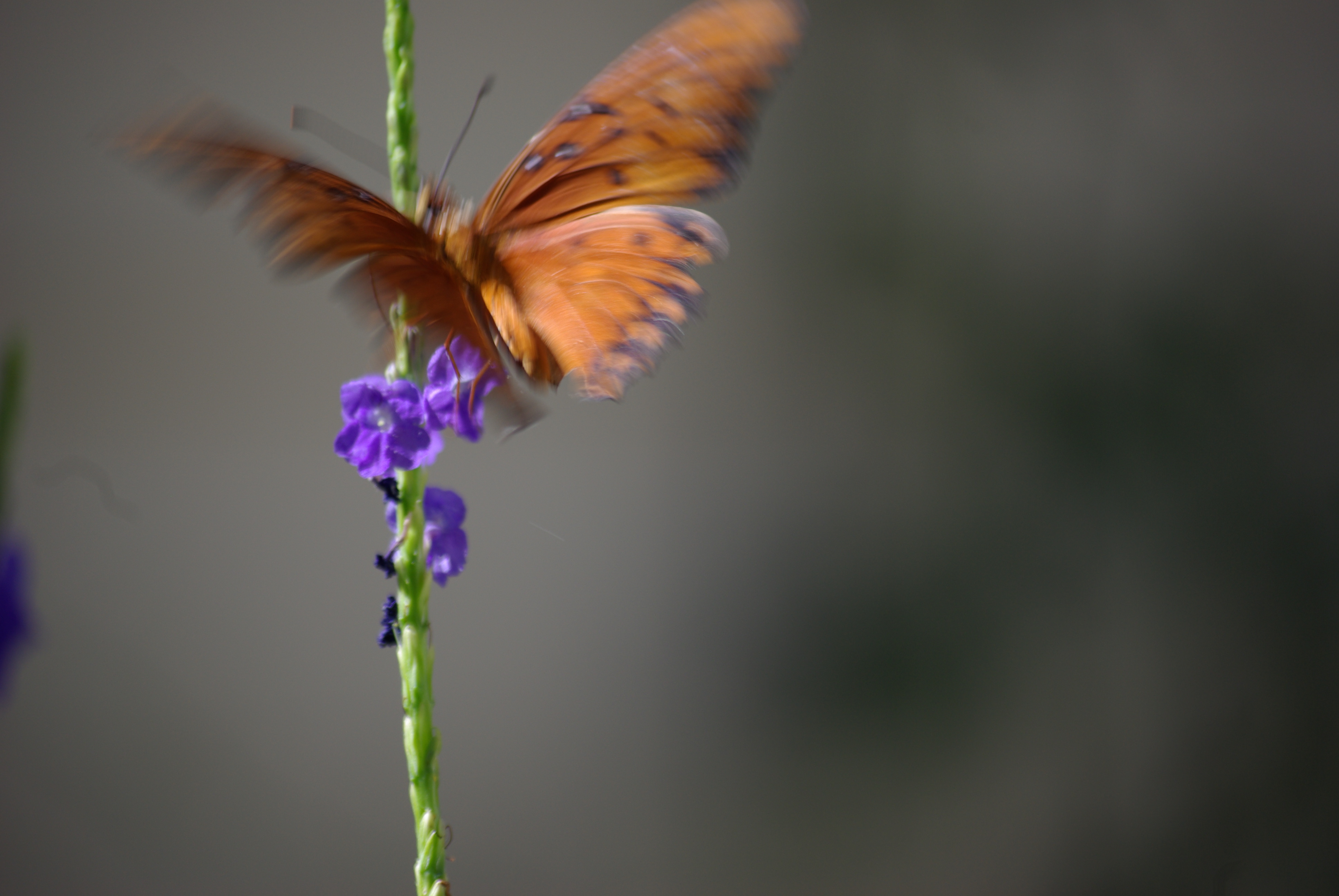
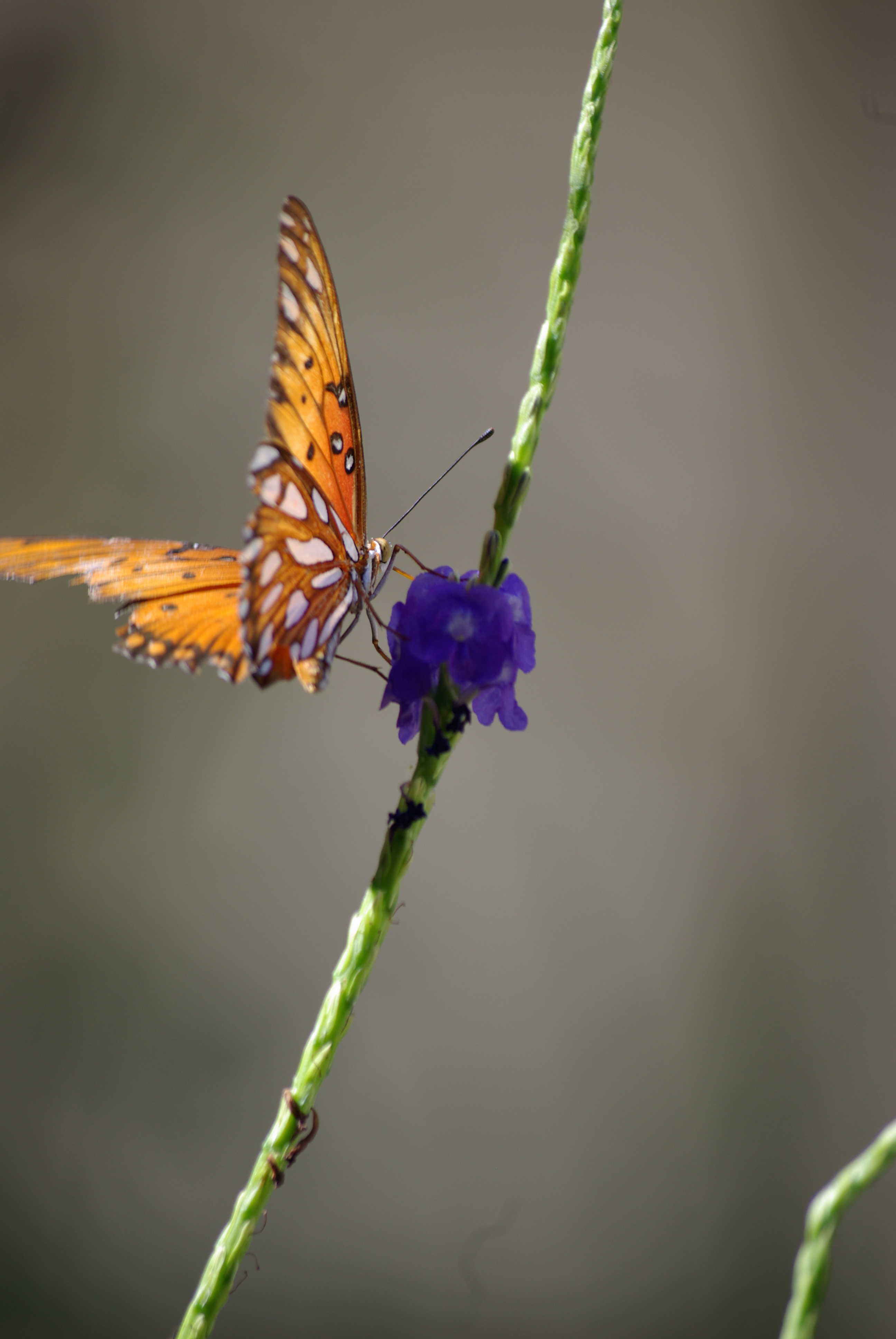
Gulf fritillary on blue porterweed

August 9, 2010

Gulf fritillary on blue porterweed - photo by Ed Darrell - copy free with attribution IMGP4824

Gulf fritillary butterfly on blue porterweed, Dallas, Texas — photo by Ed Darrell — use free with attribution

A gulf fritillary (Agraulis vanillae (Linnaeus, 1758)) on blue porterweed, Stachytarpheta urticifolia, also known as blue rats tail, or nettleleaf velvetberry.  Dallas, Texas, August 9, 2010.

Gulf fritillary on blue porterweed - photo by Ed Darrell, use permitted with attribution IMGP4820

This fritillary hung around for a few minutes.

Kathryn plants butterfly-attracting plants — a concept that was new to me when she introduced it at our home in Cheverly, Maryland, with several plants that acted like butterfly magnets, to my astonished delight.  We first ran into the brilliant orange gulf fritillaries in 1988 or 1989 here in Dallas.  For the past few summers, fritillaries have not been frequent visitors in our yard.

Kathryn stepped up the butterfly plantings this spring, including passion vine (Passiflora incarnata).  The passion vine twines toward one of the bird feeders, but in the past week or so has been losing leaves — to caterpillars of the gulf fritillary, it turns out.  Blue porterweed attracts all sorts of butterflies, but the fritillaries have been rather common, no doubt hoping to give their progeny a little boost with the passion vine, their favored food.

Butterfly afficianadoes in Dallas are urged to plant milkweed and butterfly bush to help the monarchs, whose populations are stressed by the recent cold winter, dramatic reductions in habitat, and destruction of their sanctuary trees in Mexico where they migrate each winter.  But all butterflies could use some habitat help, I think.  The rewards are great.

Gulf fritillary on blue porterweed - photo by Ed Darrell, use permitted with attribution - IMGP4822

Gulf fritillary on blue porterweed, catching the morning sun

Gulf fritillary butterfly on blue porterweed - photo by Ed Darrell, use permitted with attribution - IMGP4823

Butterfly plantings will attract butterflies, guaranteed. Gulf fritillary enjoys some blue porterweed nectar.


Geography quiz: Which Midwest city is this?

August 9, 2010

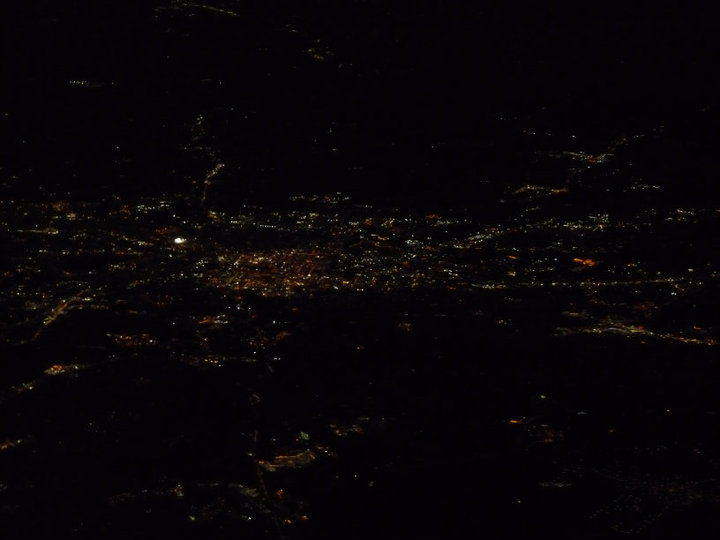
Quick quiz:  Can you identify this Midwest American city?

Mystery Midwest city from the air

Can you identify the city shown in this photo? Photo by James Darrell, flying to DFW from ATL. (Click for larger view)

Can you identify this Midwest city?  The photo was taken about an hour outside of DFW International, flying in from Atlanta Hartsfield.  North in on the right side of the photo.  My quick guess was Oklahoma City, but that was when I thought the departure city was Milwaukee (it could still be OKC).

Can you shed some light, and tell why you think it’s that city?

Night flying is cool.  While I enjoy flying any time, I really enjoy the views from an airplane at night.

Somewhere in the trunk of film-that-may-one-day-be-digitized, I have several photos of smaller cities along the Wasatch Front in Utah, taken during campaigns and business trips in the 1970s and 1980s.  At one time I had a list of the cities in the shots, but that list is long gone.  I wonder whether I could identify those cities today?

Historically, it would be interesting, since most of those small towns now are sizable suburb cities.

Chicago lays out in an orange grid of glowing citrine gemstones at night.  New York City dazzles from 2,000 feet, looking better than any movie you’ve ever seen, and glowing.  Dallas presents a colored outline against the black sky when you come in for a landing (or Fort Worth, with more white lights, if you’re on the west side of the aircraft coming in).  Salt Lake City sparkles and spreads up the mountains and canyons.  St. Louis is neat rows of lighted pathways broken by the snaking Mississippi and Missouri Rivers.  Washington, D.C. is a Shining City on a Hill spectacular when the weather is clear, coming down the Potomac River to National (now Reagan).

Which city is this one, above?

Add to FacebookAdd to NewsvineAdd to DiggAdd to Del.icio.usAdd to StumbleuponAdd to RedditAdd to BlinklistAdd to TwitterAdd to TechnoratiAdd to Furl


Republican vs Republican : Rachel Maddow sides with the Republicans, um, I think

August 7, 2010

A more clear demonstration of bad weather vane politics could not be imagined, could it?

Republicans’ relying on focus-groups to determine their positions, instead of doing what is right, is a major problem for us all — but especially in an election year.

As we were saying . . .

Vodpod videos no longer available.

Republican vs Republican : Dispatches from the …, posted with vodpod

One thing should be clear:  You can’t trust the Republicans to follow through on their campaign promises.  Words to the wise.

Tip of the old scrub brush to Ed Brayton at Dispatches from the Culture Wars.


One more indication the Tea Party and anti-Obama forces are genuinely out of touch with reality

August 7, 2010

The Tea Party hopes you never learn about this.

Friday, August 06, 2010

The U.S. Senate has passed S. 632 — the Firearms Excise Tax Improvement Act — co-sponsored by Senators Max Baucus (D-MT) and Mike Crapo (R-ID).

*     *     *     *     *

The bill now goes to the President for his signature.

[You may do better trying to track it under the number of the bill that really passed, H.R. 5552.]

Did your local newspaper cover the story?

Sam Adams is dead; we’re counting on modern patriots to spread the word:

Add to FacebookAdd to NewsvineAdd to DiggAdd to Del.icio.usAdd to StumbleuponAdd to RedditAdd to BlinklistAdd to TwitterAdd to TechnoratiAdd to Furl


Wow (in metaphor)

August 7, 2010

You should be using this tool, don’t you think?

(WordPress doesn’t support embedding this player — you’ll have to go see for yourself — it’s worth the click.)

One more way to make outstanding presentations; one more way to get students involved in rationally-active, brain-intensive, graphic organizers.

One tool I picked up in a session with Learning.com earlier this week.

(See also “Thoughts on using Prezi as a teaching tool.”)

Add to FacebookAdd to NewsvineAdd to DiggAdd to Del.icio.usAdd to StumbleuponAdd to RedditAdd to BlinklistAdd to TwitterAdd to TechnoratiAdd to Furl


Obama Blows Off the Boy Scouts? – ColbertNation report

August 6, 2010

Vodpod videos no longer available.

Obama Blows Off the Boy Scouts | July 28, 2010 …, posted with vodpod

How was your time at the Jamboree? Did you have time to miss Obama?

If you had time to miss him, you weren’t there.

Here’s Obama’s video address to the Scouts:

Earlier at Millard Fillmore’s Bathtub:

Add to FacebookAdd to NewsvineAdd to DiggAdd to Del.icio.usAdd to StumbleuponAdd to RedditAdd to BlinklistAdd to TwitterAdd to TechnoratiAdd to Furl


Some teachers had great summer experiences

August 6, 2010

One of our more adventurous teachers spent the summer on a Fulbright-Hays program in Senegal, in West Africa.

Lunch in Senegal, William Adkins photo

No, that's not William Adkins. That's his lunch one day in Senegal.

William Adkins’ African adventure blog is here.  Mine it for stuff you can use in economics, art, world history, world geography, or anything else.  He’ll probably give you free reign to use the photos for classroom presentations.

What did you do on your summer vacation?

Add to FacebookAdd to NewsvineAdd to DiggAdd to Del.icio.usAdd to StumbleuponAdd to RedditAdd to BlinklistAdd to TwitterAdd to TechnoratiAdd to Furl


Dan Valentine – Mexican balada

August 5, 2010

So I’m sitting on the back veranda of the hostel here having my first cup of coffee and my first cough from a cigarette—it’s what I do best—when a guest here for relaxation and rest joins me. Best, guest, rest. Perfect internal rhymes and, so far, a perfect morning.

I tell her what I’ve been writing about for the past week or two or so and she says, off the top of her head: “The gays of our lives.”

Now, if that’s not the greatest title for a book on such a topic, I don’t know what is.

In the beginning, I was merely going to write about my gay-bashing. But night after night, culling through my mind subconsciously, I sit straight up in bed and say to myself, “Oh, yeah! The two gay guys the manager at Trevi Towers in Salt Lake found nude in the sauna!” Or: “The time I was called a poof by a Glasgow taxi driver when I didn’t tip him enough!” Or . . . well, the list gets longer every night.

I think I have a book whatever it’s called. But I’m going to think on it for awhile, a day or three.

So, last night, instead of writing another pink-cigarette-lighter piece, I put the finishing touches on a Mexican balada.

In English, of course. I took two years of Spanish in high school, but my mom did my homework. She had spent half of World War II in Chile, Peru, and Boliva. Her first husband was a mining engineer, and back then she spoke fluent Spanish. She wanted to prove to herself that she still had the skill. So, not only did she help me with my homework, she did my homework! As a result, she got an A, I got a D—which averaged out to a C. And I didn’t learn a goddamn thing.

I told my sister this once and she said our mom had done her homework, too. As a result, my mom got another A and my sis, she got a—I didn’t have to ask.

Neither of us can speak Spanish, though she can speak fluent Dutch after living in Amsterdam for some-forty years.

My brother couldn’t speak a word of Spanish, either, though he died in Malaga, Spain, the birthplace of Picasso.

But back to my Mexican balado—a sad, Spanish ballad, sometimes called a tearjerker. In the background, picture mariachis. More than anything else, I guess, it’s a concert/nightclub/theater piece.

*   *   *   *   *

ISN’T THAT THE DUMBEST THING?
By Daniel Valentine (c) 2010

I’ve total recall
Of the summer we met.
That fall and that Christmas
I’ll never forget.

And now, close to Easter,
With thoughts of that year—
Spring break all but here—
Reminiscing, as ev’ryone does,
I remember the spring
That never was.

I imagine a flight and a window seat,
Waves dancing below in the shimmering heat,
Cancun just beyond the wing.
ISN’T THAT THE DUMBEST THING?

Sometimes late at night,
Quarter past one or two,
I’ll smile on those seasons
So sweet, oh-too few.

But round about three-ish
Or four-ish, I find,
What creeps into mind,
Uninvited, when slighted hearts stir,
Are the four days, three nights
That never were.

I imagine a towel for two in the sun,
Our bodies so snug passersby swear we’re one
Whenever we closely cling.
ISN’T THAT THE DUMBEST THING?

Mescal to consume!
Spring break in full swing!
While friends toured the tomb
Of some Mayan king,
I sat alone in my room
By a phone that didn’t ring.

My folks are concerned,
As our others, because:
What good is obsessing
On what never what?

But spring’s here and lovers,
They stroll hand-in-hand,
Barefoot on white sand,
And I can’t help but think of back when.
I remember the spring
That might have been.

I imagine a kiss on a moonlit beach,
Each star in the sky within fingertip reach.
Nearby mariachis sing.
ISN’T THAT THE DUMBEST THING?
The god-damnedest dumbest thing?

(spoken:)
Cancun is a spring break paradise, attracting some
200,000 college students. The 16-mile long island is
located on the tip of the Yucatan Peninsula, between
the Caribbean Sea and the lovely Nichupte Lagoon and
boasts all a spring breaker could ever hope to die
for: beach volleyball, beautiful people, spectacular
sunsets, and lots of other fun stuff, too, like
tequila shots and celebrity sightings. And, though,
I have never been there, I hate the place like I
never hated any place on the face of the Earth
before.

(sung:)
Mescal to consume!
Spring break in full swing!
While friends toured the tomb
Of some Mayan king,
I sat alone in my room
By a phone that didn’t ring.

My folks are concerned,
As are others, because:
What good is obsessing
On what never was?

But spring’s here and lovers,
They stroll hand-in-hand,
Barefoot on white sand,
And I can’t help but think of back when.
I remember the spring
That might have been.

I imagine a flight and a window seat,
Waves dancing below in the shimmering heat,
Cancun just beyond the wing.
ISN’T THAT THE DUMBEST THING?
The god-damnedest dumbest thing?

Send a balada to your friends:

Add to FacebookAdd to NewsvineAdd to DiggAdd to Del.icio.usAdd to StumbleuponAdd to RedditAdd to BlinklistAdd to TwitterAdd to TechnoratiAdd to Furl


Moral math of climate change, on Speaking of Faith

August 5, 2010

Speaking of Faith is carried on many public radio stations nationally, perhaps on one in your area.  If, as I do, you live in an area where the program is not carried, you can pick up a podcast or .mp3 at the program’s website.  (Here’s a list of stations that carry the broadcast.)

Host Krista Tippett posts a weekly message on the scheduled program — this week, an interview with Bill McKibben, whose book, The End of Nature, was a popular introduction to climate change, when it was published in 1989 (!).

Yes, this program is about woo and how we deal with it in our daily lives.  This particular program looks at how even woo followers may find it to their advantage to pay attention to the science, and act to protect their families and communities as a result.  This is a moral side of climate change that too many people simply deny.

Ms. Tippett wrote:

This week on public radio’s conversation about religion, meaning, ethics, and ideas:

The Moral Math of Climate Change

Bill McKibben’s first book, The End of Nature, was the first popular book on climate change, and he is one of the most insightful figures of our time on ecology and life. We’ll explore his hopeful sense that what is good for the environment also nourishes human relationship. And we’ll seek his perspective on knowledge we can trust as we orient our minds and lives to changing realities of the natural world.

Krista Tippett, host of Speaking of Faith

History Tends to Surprise Us
It’s been striking how, across the past few years, the environment has found its way inside my guests’ reflections on every subject, as they say, under the sun. And we do need fresh vocabulary and expansive modes of reflection on this subject that, we’ve come to realize, is not just about ecology but the whole picture of human life and lifestyle.

Here are some pieces of vocabulary and perspective I’ve loved and used in recent years.

Starting with the basics, Cal DeWitt — a scientist, conservationist, and Evangelical Christian living in Wisconsin — pointed out to me that “environment” was coined after Geoffrey Chaucer used the term “environing.” This was a turning point in the modern Western imagination — the first time we linguistically defined ourselves as separate from the natural world, known up until then as the Creation. This helps explain why the language of “creation care” is so animating for many conservative Christians — as a return to a sacred insight that was lost. But from quantum physics to economics, too, we are discovering new existential meaning in terms like interconnectedness and interdependence.

Many people, but most recently the wonderful geophysicist Xavier le Pichon, have made the simple yet striking observation that climate change is the first truly global crisis in human history. In other words, just as we make newfound discoveries about old realities, they are put to the ultimate test. It is easy to be overwhelmed by the signs that we are not up to this test as a species. So it was helpful for me to have Matthieu Ricard, a biologist turned Buddhist monk, remind me that evolutionary change, which is what we need now in our behavior, always comes precisely at the moment where survival — not just betterment — is at stake.

Such ideas can make the task of integrating, or reintegrating, environmental and human realities sound far away and abstract. But it’s not.

The most redemptive and encouraging commonality of all the people I’ve encountered who have made a truly evolutionary leap is that they have come to love the very local, very particular places they inhabit. They were drawn into environmentalism by suddenly seeing beauty they had taken for granted; by practical concern for illness and health in neighborhood children; by imagining possibilities for the survival of indigenous flora and fauna, the creation of jobs, the sustainability of regional farms. The catchword of many of our most ingenious solutions to this most planetary of crises is “local” — local food, local economies. Ellen Davis and Wendell Berry illuminate this with poetic, biblical wisdom, each in their way reminding us that the health of our larger ecosystem is linked to knowing ourselves as creatures — “placed creatures.”

There is so much in my most recent conversation about all of this with Bill McKibben that will frame and deepen my sense of the nature and meaning of climate change moving forward. Among them is an exceedingly helpful four minutes, a brief history of climate change that we’re making available as a separate podcast. But what has stayed with me most of all, I think, is a stunning equation he is ready to make after two decades of immersion in the scientific, cultural, and economic meaning of our ecological present. He points out that cheap fossil fuels have allowed us to become more privatized, less in need of our neighbor, than ever in human history. And he says that in almost every instance, what is good for the environment is good for human community. The appeal of the farmers market is not just its environmental and economic value but the drama, the organic nature, of human contact.

I also gained a certain bracing historical perspective from my conversation with Bill McKibben. He and I were both born in 1960. He was waking up to the environment in years in which I was in divided Berlin, on the front lines of what felt like the great strategic and moral battle of that age. He published The End of Nature in 1989, the year the Berlin Wall fell. And as I learned from that book, the science of climate change had already begun to emerge at the height of the Cold War. In 1957, two scientists at the Scripps Institution described their findings that humanity initiated an unprecedented “geophysical experiment” that it might not survive.

So I’ve been chewing on this thought lately: If humanity is around to write history in a century or two, what was happening with the climate in 1989 may dwarf what we perceived as the great geopolitical dramas of that time. Living through the fall of the wall and the reunification of Europe emboldened my sense that there is always more to reality than we can see and more change possible than we can begin to imagine. I draw caution as well as hope from the fact that history tends to surprise us. And I draw caution as well as hope from the knowledge that humanity often surprises itself on the edge of survival.

The End of Nature by Bill McKibben I Recommend Reading:
The End of Nature
by Bill McKibben

This was the first book to introduce the notion and science of climate change to a non-scientific audience. It is passionately and beautifully written. And while Bill McKibben’s updated introduction in recent printings adds relevant new knowledge, it also highlights just how prescient and powerful the original book remains.

Add to FacebookAdd to NewsvineAdd to DiggAdd to Del.icio.usAdd to StumbleuponAdd to RedditAdd to BlinklistAdd to TwitterAdd to TechnoratiAdd to Furl


Lies, damned lies, statistics, and Steve Goddard’s computer animation

August 5, 2010

Add this to the Heights of Hoaxiness files:  Steve Goddard (go here if you need to catch up) has made an astounding discovery, which he reveals with a .gif and YouTube animation of the Earth at Anthony Watts’s blog, Watts Up With That? (WUWT).

Goddard discovered that, if one ignores warming of small amounts, and counts it as not warming at all, the colors on a color-coded map change a lot, and look a lot cooler.

Shorter Goddard:  Hide the increase in temperatures, and it looks like temperatures don’t increase nearly as much.

Steve Goddard's map of a warming Pacific Ocean, hiding the small increases

Steve Goddard's map of a warming Pacific Ocean, hiding the small increases in temperature. (This should be a .gif that changes as you watch; if you see no animation, click on the image)

Goddard's cooler Pacific 3

Steve Goddard's map of a warming Pacific Ocean, hiding the small increases in temperature. (Another version, trying to get the .gif to display.) This should be a .gif that changes as you watch; if you see no animation, click on the image

You couldn’t make up such denialism if you tried.  If you submitted this stuff as fiction, it couldn’t get published.

Here’s an object warning about turning angry monkeys loose with graphics software:  Goddard’s YouTube:

Key unanswered question:  If we ignore rising temperatures, do they stop rising?  If we ignore rising temperatures, can glaciers, oceans, plants and animals be convinced to do the same?

How many polar bears read Steve Goddard’s posts at WUWT?  Can they be persuaded?

Somebody exhume Benjamin Disraeli.  He needs to update his stuff.

Add to FacebookAdd to NewsvineAdd to DiggAdd to Del.icio.usAdd to StumbleuponAdd to RedditAdd to BlinklistAdd to TwitterAdd to TechnoratiAdd to Furl


Too true for fiction: French fund creationism in U.S., to cripple U.S. science

August 5, 2010

Talk about your plots!

Could it possibly be real?  [Note to the gullible:  No, it couldn’t.]

Jason O’Mahony reports:

France to fund Creationism in US schools.

The French Ministry of Science and Technology has surprised many by announcing that it is to commit €50 million to a campaign to encourage anti-science teaching in American schools. A spokesman told us: ” This is a wonderful opportunity for France and Europe. We would like to help American conservatives turn a whole generation of American schoolchildren against science, and instead obsess about stuff in a 2,000 year old book. Today, it’s evolution, but we are confident that within five years we can have them teaching that gravity is a communist idea, and that bio-technology is something to do with the Devil and homosexuality. We have one schoolboard in Alabama voting tomorrow to teach that the Sun revolves around the United States. NASA aren’t happy, but the director of commercial satellite launching of the European Space Agency actually weed himself, he was laughing so much. Sent us a lovely hamper. It had cake.”

The ministry ruled out extending the policy to France. “Absolutely not. we’re building a modern economy here. We need kids who can write software and develop new medicines, not wonder if God designed Zebras to look like they’re wearing pyjamas.”

It must be true, according to Birther Standards of Truenessivity, and the Josh McDowell Rules of Specious Evidence — see the earlier documentation.

Besides, the release spelled “pyjamas” correctly.

Tip of the old scrub brush to correspondent Richard Thomas.

[Serious question:  Is there any way we could persuade O’Mahony to put together a pub guide to global warming?]

Add to FacebookAdd to NewsvineAdd to DiggAdd to Del.icio.usAdd to StumbleuponAdd to RedditAdd to BlinklistAdd to TwitterAdd to TechnoratiAdd to Furl


Return of the Aurora Borealis

August 4, 2010

Aurora Borealis, by Wiciwato (Yahoo Flickr compilation) - July-August 2010

Aurora Borealis, by Wiciwato (Yahoo Flickr compilation) - July-August 2010 - notice the Big Dipper in the photo?

A storm on the Sun last Sunday launched a wave of cosmic particles toward the Earth — the particles whose striking of the upper atmosphere causes ions to glow, creating the Northern Lights.

And so the Northern Lights, the Aurora Borealis, returned to the planet in spectacular fashion this week, after more than a year of relative solar dormancy.  According to the Christian Science Monitor, outstanding displays of the lights may continue through this week.

Yahoo’s Flicker editors put together a collection of photos from Flickr, from which the photo above is taken — there are a lot more spectacular shots there.

Resources, more:

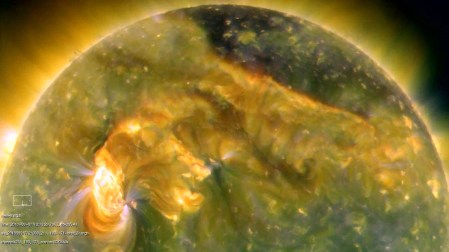
Pictures of the coronal mass ejection from the Sun dazzle, too:

Caption from NASA: On August 1st, almost the entire Earth-facing side of the sun erupted in a tumult of activity. There was a C3-class solar flare, a solar tsunami, multiple filaments of magnetism lifting off the stellar surface, large-scale shaking of the solar corona, radio bursts, a coronal mass ejection and more. This extreme ultraviolet snapshot from the Solar Dynamics Observatory (SDO) shows the sun's northern hemisphere in mid-eruption. Different colors in the image represent different gas temperatures ranging from ~1 to 2 million degrees K. Credit: NASA/SDO

Help someone else find the sky:

Add to FacebookAdd to NewsvineAdd to DiggAdd to Del.icio.usAdd to StumbleuponAdd to RedditAdd to BlinklistAdd to TwitterAdd to TechnoratiAdd to Furl