Fly your flag for Martin Luther King Day, 2014

January 20, 2014

I don’t really need to remind you to fly your flag today, right?  You’ve already got it waving.

The Martin Luther King, Jr. Memorial in Washington, D.C. Credit: architecture.about.com - See more at: http://saportareport.com/blog/2013/12/statue-of-martin-luther-king-jr-proposed-for-georgias-state-capitol/#sthash.TKrjYCX7.dpuf

The Martin Luther King, Jr. Memorial in Washington, D.C. Credit: architecture.about.com, via Saporta Report

Fly the U.S. flag today for the holiday for the birthday of Martin Luther King, Jr.  The holiday is celebrated on the third Monday in January.

Many Americans will celebrate with a day of service.

More:

2014 Google Doodle for Martin Luther King, Jr., Day

2014 Google Doodle for Martin Luther King, Jr., Day


Joshua Tree National Park at night

January 19, 2014

A long exposure, you can tell by the airplane streaks near the horizon.  Walking that fine photography edge of long enough to get the exposure, but short enough not to distort the stars too much.

Long exposure of a Joshua tree, in Joshua Tree National Park. Photo: Sarah Chah (www.sharetheexperience.org)

Long exposure of a Joshua tree, in Joshua Tree National Park. Photo: Sarah Chah (www.sharetheexperience.org)

Captioned at America’s Great Outdoors Tumblr, by the U.S. Department of Interior:

Viewed from the road, this desert park only hints at its vitality. Closer examination reveals a fascinating variety of plants and animals that make their home in this land shaped by strong winds, unpredictable torrents of rain, and climatic extremes. Dark night skies, a rich cultural history, and surreal geologic features add to the attraction of this place. Come see Joshua Tree National Park for yourself!

Photo: Sarah Chah (www.sharetheexperience.org)


January 18, 1919: Paris Peace Talks open, ending World War I

January 18, 2014

Coming just after World War I, stuck rather at the beginning of the end of the Progressive Era, the Paris Peace Conference that led to the Treaty of Versailles gets shorted in most history books.

The talks are difficult to explain easily.  And serious dipping of toes into these historical waters turns up the errors of the resulting treaty, including the onerous provisions saddled on Germany, and the oft-portrayed-as-betrayal of the Arabian allies of the Allies, whose lands were carved up with formal borders creating new nations where tribes previously didn’t bother with such formalities.  The treaty’s errors in Europe resulted in World War II, and the treaty’s errors in the Middle East plague the world still.

Woodrow Wilson took his 14 Points to France, won some  of them with the Europeans, but later lost the entire ballgame with the U.S. Senate.  His frantic, public campaign for ratification of the Treaty probably contributed to his stroke, which left him disabled for the remainder of his presidency and the rest of his life.

No wonder people want to forget it.

We’re coming up on the 100th anniversary of World War I, which started with the June 1914 assassination of  Austria’s Crown Prince, Archduke Franz Ferdinand, in Sarajevo, formerly in the Republic of Serbia but at the time under the captive thumb of the Austro-Hungarian Empire.

Maybe we should strive to understand the Paris Peace Conference better, to better understand how we got into those messes, and how we might yet get out of the remaining ones.

The Library of Congress’s Today in History feature carries this very nice, concise write-up:

The Paris Peace Conference

Portions of Territory Proposed to be taken from Germany,
December 31, 1919.
Newspaper Pictorials: World War I Rotogravures, 1913-1919

On January 18, 1919, a few months after the end of World War I, leaders from the Allied nations began a series of discussions that became known as the Paris Peace Conference to settle issues raised by the war and its aftermath. Preceded by a series of armistices in September, October, and November 1918, that ended World War I, the Paris Peace Conference brought together representatives from the victorious nations. Russia had withdrawn from the fighting and was not invited. Because Allied leaders held Germany responsible for the war, German leaders attended only the conclusion of the discussions.

Preliminary meetings between the leaders began on January 12, 1919, after British Prime Minister David Lloyd George arrived in Paris.  Lloyd George, President Woodrow Wilson of the United States, Premier Georges Clemenceau of France, and Premier Vittorio Orlando of Italy emerged as the leaders of the conference and became known as the Big Four. The conference ended approximately one year later when the League of Nations, an international organization adapted from one of President Woodrow Wilson‘s Fourteen Points plan for peace, was organized.

political cartoon showing two men, one gesturing towards the other
The seance that failed,
C. K. Berryman, artist,
circa 1918-19.
Prints & Photographs Online Catalog

group of four men standing outside a building

“Big Four” — Photo by Edward Jackson.
Photo shows “Big Four” world leaders at World War I Peace Conference in Paris, May 27, 1919. From left to right: Prime Minister David Lloyd George, Premier Vittorio Orlando, Premier Georges Clemenceau, and President Woodrow Wilson.
Forms part of: George Grantham Bain Collection (Library of Congress).  Prints & Photographs Online Catalog

political cartoon of a man looking at a large scroll of paper labeled peace treaty
At Last!,
C. K. Berryman,
July 10, 1919.
Prints & Photographs Online Catalog

Wilson’s idealistic Fourteen Points generated heated opposition from Clemenceau and Lloyd George in particular as each disagreed on the details of how to proceed. Eventually, however, the League of Nations was formed in 1919-20 as an alternative to traditional diplomacy. The United States did not join, in part because of opposition and disagreement among a group of powerful U.S. senators led by Foreign Relations Committee Chair Henry Cabot Lodge. The discussions also resulted in the 1919 signing of the Treaty of Versailles with Germany, the Treaty of Saint-Germain with Austria, and the Treaty of Neuilly with Bulgaria.

More:


Photograph, or painting of Paris?

January 17, 2014

And from what was this shot, if it’s a photo?

With everyone else,

I love
Paris in the
the springtime!

But I wonder what brain bending goes on in this image.  From Fascinating Pics:

Paris at Sunset, France pic.twitter.com/QnhtkUPKLn - Fascinating Pics

Paris at Sunset, France pic.twitter.com/QnhtkUPKLn Photo by Coolbiere.

What do you think? Painting?  Photo?  Manipulated photo?

Update: J.A. Higginbotham tracked down the original Flickr photo, by a Coolbiere.  Nikon D-800, 70-200 zoom telephoto, at 122mm; claims to have taken it from Mount Parnasse. Luck and preparedness.  Wow.


What if you don’t know enough even to cheat on the chemistry exam?

January 15, 2014

Brilliant work from Saturday Morning Breakfast Cereal.

This cartoon is witty and funny — and it is a wonderful illustration of how people need to know enough to see the humor, or cheat.

Don’t catch the gags?  See here.

Saturday Morning Breakfast Cereal, by Zach Weiner:  The exam on the Periodic Table of Elements

Saturday Morning Breakfast Cereal, by Zach Weiner: The exam on the Periodic Table of Elements

You may discuss the cartoon at the SMBC blog:

August 26, 2011

Well, this record may stand for a while. 57 panels, baby.

Also, Phil and I figured out some extended periodic table elements. Who can tell me the abbreviation for Element 5885?

Discuss this comic in the forum

Or discuss it here at the Bathtub.

The cartoon reminds me of so many lazy or not-up-to-par students who would stay up late inventing ways to cheat on an exam, when a bit of study would have paid so many more dividends.

It’s harder to cheat, most of the time, that to be honest and learn the stuff.


Grizzly on the Snake, in the Tetons

January 15, 2014

A Grizzly Bear crossing the Snake River at sunrise in the Grand Teton National Park.   Photo: Donald Higgs (www.sharetheexperience.org)

A Grizzly Bear crossing the Snake River at sunrise in the Grand Teton National Park. Photo: Donald Higgs (www.sharetheexperience.org)

From the U.S. Department of Interior’s Great American Outdoors Tumblr:

A Grizzly Bear crossing the Snake River at sunrise in the Grand Teton National Park.
Photo: Donald Higgs (www.sharetheexperience.org)

I was born on the Snake River, farther south and west, in Burley, Idaho.  It’s a grand river, not so much in the water it moves as the way it moves through the landscape and becomes a part of grander parts of the American west.  Kathryn and I honeymooned in Yellowstone, and stayed in Grand Teton on the way out.

There is nothing grander on Earth than a sunrise in the Tetons.  Do you think a grizzly appreciates that?

Yeah, gotta get back there.


Everybody comes to Casablanca? First presidential flight, January 14, 1943

January 15, 2014

Humphrey Bogart’s great turn in “Casablanca” got its start from an intended-for Broadway play, “Everybody Comes to Rick’s.

Rick’s Cafe Americain existed only in fiction, an invention of Murray Burnett and his playwright partner Joan Alison.  Casablanca was a rendezvous for people engages in some secret negotiations related to the war, however.

Historian Micheal Beschloss tweeted a photo of President Franklin Roosevelt on the airplane, flying to Casablanca to meet with Britain’s Prime Minister Winston Churchill, on January 14, 1943 — the first time a sitting president had flown in an airplane.  Roosevelt’s cousin Theodore flew in 1910, almost two years after he’d left the presidency.

More details! (Wasn’t that what you said?)

What kind of airplane was it?  Who are those other people? Smithsonian Air & Space Magazine already obliged with some details.  The airplane was a Boeing 314 flying boat, operated by TWA.

Photo from the FDR library, showing President Roosevelt in a happy conversation with the TWA pilot of the Boeing 314, Otis Bryan.

Photo from the FDR library, showing President Roosevelt in a happy conversation with the TWA pilot of the Boeing 314, Otis Bryan.

These photos may have been taken on a second flight Roosevelt took once he got to Africa; here are some more  details from Air & Space:

The Casablanca Conference, held 70 years ago this week [article from 2013], is remembered today for the agreement by Franklin D. Roosevelt and Winston Churchill to demand unconditional surrender from their Axis enemies. But even before the leaders sat down to talk, FDR made history. His trip across the Atlantic, in a Boeing 314 flying boat, was the first time a sitting U.S. president flew on an airplane.

Nobody was more impressed than his pilots. The flights had been planned in secrecy, and when Roosevelt and his entourage showed up at the Pan American airways base in Miami on the morning of January 11, 1943, to board the Dixie Clipper, “[the crew] were very much surprised to learn the identity of our guest,” recalled Pan Am pilot Howard M. Cone, Jr.  Cone, a 34-year-old veteran of transoceanic flights, flew Roosevelt, advisor Harry Hopkins and several military leaders on one Clipper, while another flying boat carried the presidential staff.

Cone said the President was an “excellent passenger” and a “good air sailor” on his 15,000-mile round-trip, displaying an impressive knowledge of geography on a journey that included stops in Trinidad and Brazil. Once in Africa, Roosevelt boarded a TWA C-54 piloted by 35-year-old Captain Otis F. Bryan, who flew him from Bathurst, Gambia to Morocco. The trip back from Casablanca included a flyover of the harbor at Dakar, Senegal, at an altitude of 3,000 feet.

In a War Department press conference following their return to the States, the two airline pilots couldn’t stop effusing about their VIP passenger’s ability to “make you feel perfectly at home. We felt at ease as long as he was,” said Bryan. Roosevelt even joined in the ritual of signing “short snorters” for the crew — dollar bills autographed by all the passengers on a flight.

The President also celebrated his 61st birthday on the way back, dining on caviar, olives, celery, pickles, turkey, dressing, green peas, cake, and champagne. (Captain Cone, reported the New York Times, drank coffee instead.)

It will take more sleuthing to identify all the people in the photos.  71 years ago this week.

More:


You should visit Yosemite National Park in winter

January 11, 2014

Here’s why, another video from the good people at Yosemite National Park:

Any of the National Parks is special, in winter.  What is your snow and cold experience in them?

More:

Winter photo of the Yosemite Valley, by Q T Luong -- a key photo used by the Ken Burns group in their series of films on the National Parks.

Winter photo of the Yosemite Valley, by Q T Luong — a key photo used by the Ken Burns group in their series of films on the National Parks.


How’s that “defund the EPA” working for you now? West Virginia edition

January 10, 2014

Rite-Aid store in Charleston, West Virginia, out of bottled drinking water.

Rite-Aid store in Charleston, West Virginia, out of bottled drinking water. Eyewitness report and photo via Twitter

West Virginia’s water woes might look like a political campaign ad from God to some people.

If you’re watching closely, you may already understand some of the morals of this story.

Last night West Virginia Gov. Earl Ray Tomblin declared an emergency in six counties, telling about 300,000 people to avoid touching their tapwater — no drinking, mixing infant formula, cooking, or bathing; flushing toilets was okay.  NBC reported:

A chemical spill into a West Virginia river has led to a tap water ban for up to 300,000 people, shut down bars and restaurants and led to a run on bottled water in some stores as people looked to stock up.

The federal government joined West Virginia Gov. Earl Ray Tomblin in declaring a disaster as the West Virginia National Guard arranged to dispense bottled drinking water to emergency services agencies in the counties hit by the chemical spill into the Elk River.

Federal authorities are also opening an investigation into the circumstances surrounding the leak and what triggered it, U.S. Attorney Booth Goodwin said Friday.

The advisory was expanded at night to nine counties and includes West Virginia American Water customers in Boone, Cabell, Clay, Jackson, Kanawha, Lincoln, Logan, Putnam and Roane counties.

Several thousand gallons of an industrial chemical had leaked out, into a tributary to the Kanawha River above Charleston, upstream from the city’s culinary water intake.  While the company responsible for the leak, Freedom Industries, assured the governor and other authorities that the spill is not threat to human health, officials took the more cautious path.

This case illustrates troubles we have with food and water supplies, protecting public health, and the rapid proliferation and spread of modern technology and chemical innovation.

  • Why did the company say the spill is no threat?  No research has pinned any particular health effect to the chemical involved. But you, you sneaky, suspicious person, you want to know just what chemical is involved, don’t you?
  • What’s the chemical involved? 4-Methylcyclohexane Methanol (MCHM) spilled out of a tank into the Elk River, which flows into the Kanawha River, from which Charleston gets its water.  Charleston, West Virginia’s capital, is also the state’s largest city.  You’re still suspicious?
  • What are the health effects of the stuff? Now you ask questions for which there are not great answers.  The chemical, with the methylcyclohexane linked to an alcohol molecule, is new enough, and rare enough in industry, that there are not a lot of studies on what it does.  It’s known to irritate skin and mucous membranes; breathing a lot of it can cause pneumonia.  Only rats have been exposed to the stuff enough to know what it does, and only a few rats for only short periods of time and not massive doses. In other words, we don’t know the health effects.
  • What’s the stuff used for? Freedom Industries uses it to wash coal.  Heck, I didn’t even know coal was washed other than a water spray to hold down dust in crushing, loading and unloading the stuff.  [if you missed the link in this post, let call your attention again to the story at WOWK-TV, which is quite thorough in discussing MCHM and its effects.  WOWK-TV is more thorough than the federal regulating agencies.]
  • But wait! If there are no known health effects, why the caution? It’s not that the stuff has been tested and found safe to humans.  MCHM simply hasn’t been tested to see what the health effects are.  The toxic profile for the compound at CDC’s ATDSR does not exist.  NIOSH doesn’t have much  more information on it. The most thorough analysis of what it might do is populated by small studies, or none at all.
  • What do you mean the stuff hasn’t been tested!!!???? Welcome to to Grover Norquist’s “smaller government,” to John Boehner’s and Mitch McConnell’s “reduced regulation,” to Rick Perry’s “states’ rights” world.  Way back in 1962 Rachel Carson warned about the proliferation of newly-devised chemicals being loosed into the environment, when we really had no historical knowledge of what the stuff would do to humans who ran into it, nor to other life forms, nor even inanimate things like rocks, wood and metal.  A decade later, the founders of the Environmental Protection Agency entertained the idea that a federal agency would be responsible for assuring that chemical substances would be tested for safety, both old substances and new.  For a couple of decades Congress supported that mission, until it became clear that there are simply too many new compounds and too great a backlog to test all, thoroughly.That world of making chemists and big companies responsible for their chemical children began to crumble in the Reagan administration, and is mostly abandoned now.  Chemical juveniles may run as delinquent as they would, with EPA and all other agencies essentially powerless to do anything — unless and until tragedy.  Even where EPA, and the Bureau of Alcohol Tobacco and Firearms (ATF) and all branches and twigs of the Department of Homeland Security, designate something as hazardous and deserving of care in handling, a state like Texas will ignore the rules on a substance until an accident blows half of West, Texas, to Hell, Michigan, with loss of life and enormous property destruction.  Afterward, victims get left bereft of aid to rebuild, and wondering who they might look to, to look out for them, to prevent such a horrible occurrence in the future.

So it goes, the nation blundering along from one tragedy, until the next.

Through most of American history, great tragedies produced great reforms.  No longer.  The Great Red State of West Virginia is dependent on federal largesse to get water to drink, at enormous expense and waste of time, talent and money.  Meanwhile, West Virginia’s Members of Congress conspire in Washington, D.C., to strip federal agencies from any power to even worry about what may be poisoning West Virginians.

Gov. Tomblin’s speedy action may seem out of place, not because there is great danger, but because he’s acting to protect public health without a mass of dead bodies in view to justify his actions.  We don’t see that much anymore (Texas Gov. Rick Perry and Attorney General Greg Abbott didn’t cancel appointments to get to West, Texas to even offer sympathy, but instead scheduled weekend jaunts after it was clear the fire was out and there was no danger.  The good people of West did not greet them with a hail of rotten tomatoes, but thanked them for their concern.  Americans are nothing if not polite.)

I was struck with the news last night because I could find no report of just what was the chemical that leaked into the rivers.  This morning we finally learned it was MCHM.  In the depths of some of those stories, we also learn that the leak may have been going on for some time.  Though thousands of gallons of the stuff are missing, the concentrations in the river suggest not much is leaking now . . . the rest leaked earlier, and is already water under the bridge south of Charleston.

What do you think state and federal authorities should do in this case?  What do you think will actually happen?

More:

Update January 12, 2014:  JRehling got it right:

http://twitter.com/JRehling/status/422253679823970304


Annals of Global Warming: Polar vortex, explained in two minutes

January 10, 2014

As captioned in the Boston Globe:   Reuters  Frozen breath formed ice around the face of a Minneapolis resident on Wednesday.

As captioned in the Boston Globe: Reuters photo.  Frozen breath formed ice around the face of a Minneapolis resident on Wednesday.

2013 will probably rank as one of the top 10 hottest years in human history, and 2014 is on track to join 2013.

You wouldn’t know that from the denialists and those in thrall to them, who claim freak snow storms and historic cold show warming has stopped — though the snow and cold are caused by a breakdown in the jetstream and a slipping of the polar vortex, probably caused by global warming.

A two-minute explanation, from White House Science Advisor John Holdren:

White House description:

Published on Jan 8, 2014

President Obama’s Science and Technology Advisor, Dr. John Holdren, explains the polar vortex in 2 minutes—and why climate change makes extreme weather more likely going forward. Learn more at http://wh.gov/climate-change. January 8, 2014.

More: 


If you’re not remembered as much as Millard Fillmore . . .

January 10, 2014

The University of Buffalo honored Millard Fillmore today in a graveside ceremony on Thursdaypostponed from Fillmore’s birthday on January 7 due to cold and icy weather.

Is Fillmore forgotten as much as many claim?

Compare to notes on the births of other presidents.

Richard Nixon was born on January 9, 1913 (same year as my mother!)  He’d be 101 today, and still not a crook in his view.

US Senate History tweeted:

Not quite so good as a graveside ceremony.  Funnier picture, perhaps.

But consider Andrew Johnson.  His birthday was a couple of weeks ago, on December 29.

Andrew Johnson, the seventeenth president of the United States, was born in Raleigh, North Carolina, on December 29, 1808. His father’s death when the boy was three left the family in poverty. From age fourteen to age seventeen, young Johnson was apprenticed to a tailor. He then moved with his mother and stepfather to Greeneville, Tennessee, where he established himself as a tailor. Johnson never attended school but taught himself to read and write—he all but memorized the U.S. Constitution—and after his 1827 marriage to Eliza McCardle, a shoemaker’s daughter, acquired a good common education under her tutelage.

A gifted orator, Johnson quickly ascended the political ladder. In 1829, he won his first office, as an alderman. In steady succession he became mayor of Greeneville, a member of the Tennessee state legislature (1835-37, 1839-43), U.S. congressman (1843-53), governor of Tennessee (1853-57), and U.S. senator (1857-62). In Congress, Johnson supported the annexation of Texas and the Mexican-American War, and sponsored a homestead bill that anticipated the 1862 Homestead Act. He also was the only Southern senator who firmly supported the Union and remained in the Senate throughout both the secession crisis and the Civil War. In the spring of 1862, after federal forces captured portions of Tennessee, President Lincoln appointed him military governor of the state, an office he held despite constant danger to his life.

Two years later, influential moderates such as William Seward worked to secure Andrew Johnson, a Democrat, as Lincoln’s running mate on the Republican Party ticket. According to a May 20, 1865, editorial in Harper’s Weekly, Seward had seen in Johnson “that his fellow-Senator, a land-reformer, a stern Union man, a trusted representative of the people of the South as distinguished from the planting aristocracy, was the very kind of leader by whom the political power of the aristocracy was ultimately to be overthrown in its own section.”

After Lincoln’s assassination in April 1865, little more than a month after their inauguration, Johnson assumed the presidency. His administration ran more smoothly in the foreign than the domestic arena: in 1867, Secretary of State Seward purchased Alaska and helped negotiate France’s withdrawal of troops from Mexico.

If nothing else, Johnson is notorious for having been the first president to be impeached (he was acquitted at trial by the Senate; best account probably in John Kennedy’s Profiles in Courage).

Was there much of a peep in popular media on his birthday?

Any note?  I didn’t find it except in a very few of the “Today in History” columns.

Johnson may be forgettable, though — not considered a good president (who could be following Lincoln!).

What about Woodrow Wilson?  His birthday also cropped up a couple of weeks ago, on December 28, the day before Johnson’s.

It is not needful or possible at this time, whilst yet he lives, to say that Wilson is a Washington or another Lincoln, but he is a great American. He is one of the great presidents of American history.

Rabbi Stephen A. Wise in a tribute to Woodrow Wilson.
American Leaders Speak: Recordings from World War I and the 1920 Election, 1918-1920

Anyone notice?  I mean, anyone outside of Staunton, Virginia, his birthplace?  (Well, yeah — see below.)

What is a fair measure of ignominy? If the world forgets the great man’s birthday, is that a sign?

Photo by Michael Bupp, The Carlisle Sentinel:

Photo by Michael Bupp, The Carlisle Sentinel: “For 88 years, there has been a Woodrow Wilson Birthday Association of Cumberland County that organized an annual observance around Dec. 28 to remember Wilson. Pat Stumbaugh is the current treasurer and has been involved in the association since she was a little girl.”

More:


Stretching celebration of Millard Fillmore’s birthday through the week

January 7, 2014

Summerhill, New York, got a jump on celebrating Millard Fillmore’s birthday with a Sunday ceremony; today’s scheduled graveside commemoration is postponed due to weather, to Thursday — nearly a full week of Millard Fillmore!

Summerhill’s annual birthday party continued a tradition of uncertain age.  Fillmore was born in a log cabin in Summerhill.

Details come from the Auburn, New York, Citizen:

Three members of Flock of Free Range Children John Davis, from left, Ron Van Nostrand and Don Watkins perform at the birthday party for former President Millard Fillmore Sunday in the Summerhill Town Hall.   (Photo by Jessica Soule)

Music for the Summerhill, New York, celebration of Millard Fillmore’s 214th birthday was provided, again, by Flock of Free Range Children. Caption from the Auburn Citizen: Three members of Flock of Free Range Children John Davis, from left, Ron Van Nostrand and Don Watkins perform at the birthday party for former President Millard Fillmore Sunday in the Summerhill Town Hall. (Photo by Jessica Soule)

SUMMERHILL | Summerhill’s town hall was taken over Sunday with the delights of a birthday party – cake, live music and community members coming together in celebration. Millard Fillmore was born 214 years ago, on Jan. 7, 1800, in a log cabin there.

In honor of his birthday, the Cayuga Owasco Lakes Historical Society partnered with the town of Summerhill to put on a party for the 13th president of the United States of America. This annual celebration has happened for years, society President Joyce Hackett Smith-Moore said.

Three members of the Flock of Free Range Children performed in the hall, as people munched on food and chatted. A banner with Fillmore’s birth year hung from the wall above a birthday cake.

“This is our opportunity for the town and our members to keep the memory of Fillmore alive,” Smith-Moore said. “After all, there’s not a lot of counties that have a president from there. There is a lot of history, but there’s so much more.”

The historical society also hosts an annual fundraiser in August. This year, the money gathered will benefit the pavilion that commemorates Fillmore’s birthplace. Specifically, the society wants to install bathrooms. The path that connects his birthplace and Fillmore Glen State Park was recently cleared, giving walkers another trail to learn more about the president who was responsible for adding indoor plumbing to the White House.

Commemorating the president with origins in Cayuga County is especially important, as he hasn’t gotten his due from national historians.

“All presidents have a library or museum, except Fillmore. We’re the only executive of his effects,” Smith-Moore said.

Fillmore only recently became the subject of his first biography, completed by a former Moravia teacher. The birthday celebration is an effort to raise awareness of his accomplishments and the many positive effects of his work on the nation, Smith-Moore said.

The historical society presented the town a frame that contained coins, one bearing Fillmore’s image and another of his wife, a photo of the deputy director of the United States Mint dedicating the Fillmore coin in 2010 and a flier of the coin dedication.

In an effort to remind the community of their local treasure, fifth-graders will be treated to a sit down between Fillmore and Abraham Lincoln in their curriculum.

“People just don’t know anything about Millard Fillmore,” Smith-Moore said.

She said one of his biggest accomplishments was to order the military to start surveying in preparation for what would become the Transcontinental Railroad. Meanwhile, town historian Florence Lansdowne said Fillmore opening up trade with Japan led to major benefits.

“We want to instill in people how important he was,” Lansdowne said.

Lansdowne is retiring, and will work with her replacement Patricia McCloy this year. McCloy lauded Lansdowne for her work in gaining recognition for the 13th president.

McCloy said she is excited to take over as local historian. She’s going to try to encourage more use of the pavilion that commemorates Fillmore’s birthplace.

“Is it amazing,” she said. “There aren’t many towns in American that can say they had a president.”

From the Auburn Citizen:  New Summerhill town historian Patricia McCloy, right, smiles during a presentation by the Cayuga Owasco Lakes Historical Society as retiring town historian Florence Lansdowne, left, and society President Joyce Hackett Smith-Moore look on. (Photo by Jessica Soule)

From the Auburn Citizen: New Summerhill town historian Patricia McCloy, right, smiles during a presentation by the Cayuga Owasco Lakes Historical Society as retiring town historian Florence Lansdowne, left, and society President Joyce Hackett Smith-Moore look on. (Photo by Jessica Soule)

What other celebrations might there be out there?  Does anyone race bathtubs anymore?

More, perhaps related:


Happy birthday, Millard Fillmore! 214 today, not looking a day over 117

January 7, 2014

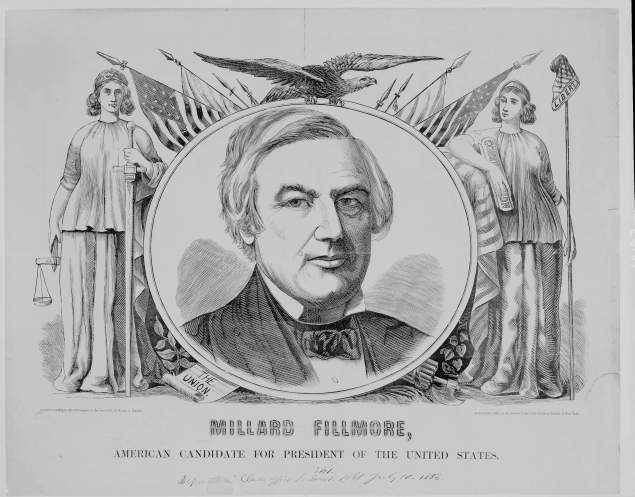
Campaign poster from the 1856 presidential election, when Fillmore ran on the American Party ticket. The American Party is better known as the Know-Nothing Party. Library of Congress image. Fillmore failed to win the nomination of the Whig Party in 1852; he lost in 1856 with the Know-Nothings, too.  Image from the Library of Congress, American Memory Collections

Campaign poster from the 1856 presidential election, when Fillmore ran on the American Party ticket. The American Party is better known as the Know-Nothing Party. Library of Congress image. Fillmore failed to win the nomination of the Whig Party in 1852; he lost in 1856 with the Know-Nothings, too. Image from the Library of Congress, American Memory Collections

Millard Fillmore, the 13th President of the United States, came into this world on January 7, 1800.

Until Barack Obama, Fillmore held the title of Most Unjustly Maligned President Ever.  (Who should be Most Justly Maligned? Comments are open.)

We awake to news that the cold weather in Buffalo, New York, led to the postponement of the annual graveside commemoration, now set to be held Thursday, when the cold isn’t quite so life-threatening.

How should we remember Fillmore?  Accurately, of course.

Check out past commemorations of Fillmore’s birthday here, at Millard Fillmore’s Bathtub.  Generally dealing with Fillmore and history, there are a total of 82 posts on this site.  Watch this site today — there will be more.

The long arc of history bends toward justice, some famously say.  How long will it take for justice to be done to the reputation of Millard Fillmore?

More, a small sampling:

Post Script:  Why 117 in the headline?  Mencken’s hoax on Fillmore, the bathtub story, was published in 1917; we date Fillmore’s reputation troubles from that time.


Texas State Sen. Kirk Watson warns state not to make ObamaCare navigators’ jobs tougher

January 6, 2014

After a convicted felon produced an edited video that appeared to show National Urban League “navigators” agreeing to allow the felon might file inaccurate information to get covered for health insurance under the Affordable Care Act, Republicans in Texas called for greater regulation of the navigators.

Such is the topsy-turvy world of GOP gotcha politics in Texas.

After committees of the U.S. House of Representatives held press conferences* damning the Affordable Care Act, the Texas Department of Insurance (TDI) is holding hearings across Texas to develop regulations to restrict actions of those people who act as navigators to enroll people into federal health insurance programs or private insurance through ACA.

In short, the Texas government is working to screw up federal law and deprive Texans of health care insurance (yes, that’s probably a felony, but who could prosecute it under the current political climate?).

Burnt Orange Report described the situation:

On January 6th the Texas Department of Insurance will hold its last public hearing regarding the state’s regulation of health care navigators. The navigators are responsible for helping individuals get enrolled through the new Healthcare.gov exchange, but in Texas Governor Rick Perry has been working to add unnecessary red tape in order to impede the success of the law. Reputable non-profit organizations in Texas like United Way received $11 million in federal grant money to help enroll individuals in local communities across the state.

In September just days before the health insurance exchange website went live Perry ordered TDI to craft new rules that included additional training and background checks for individuals who serve as navigators. Apparently even Senator Kirk Watson the author of the bill (that authorized navigators in Texas) was unaware that TDI had sent a letter to federal Health and Human Services Secretary Kathleen Sebelius, or the plan to implement rules that, “appear to both conflict with federal law and be inconsistent with SB 1795.”

In other words, TDI’s actions, on orders from Gov. Rick Perry, may violate Texas law as well.

State Sen. Kirk Watson provided this testimony at the TDI hearings today:

Texas State Sen. Kirk Watson, D-Fort Worth, wrote the law that enables Affordable Care Act Navigators to work in Texas, and testified that further state regulation would be expensive, confounding bureaucracy.  Star-Telegram photo by Ron Ennis

Texas State Sen. Kirk Watson, D-Fort Worth, wrote the law that enables Affordable Care Act Navigators to work in Texas, and testified that further state regulation would be expensive, confounding bureaucracy. Star-Telegram photo by Ron Ennis.

Posted on January 6, 2014 at 10:12 am.

State Senator Kirk Watson issued the following statement Monday regarding the Texas Department of Insurance’s hearing on proposed rules for healthcare navigators:

Texans have made themselves heard, and it’s clear what they want: fair rules that truly protect consumers without making it harder for them to find health insurance.

The vast majority of healthcare navigators are honest folks who are working hard, and in good faith, to connect their fellow Texans with health insurance. The Department of Insurance should create regulations that protect the state from bad actors without making it harder for navigators to do their jobs.

Texans support common-sense requirements such as criminal background checks for navigators. The bill I passed in the legislative session allowing for navigator regulations prohibits convicted felons from providing these services. Of course the state should enforce that provision and protect consumers. We shouldn’t have electioneering; my bill prevents that too. And we need to be sure we protect privacy.

But some other proposed rules appear designed only to make it harder for navigators to do their jobs.

The Department of Insurance has proposed requiring 40 hours of navigator training on top of the 20-30 hours that’s already mandated by law. That kind of training requires real time and costs real money. Where did the additional 40 hour requirement come from exactly? Who is it truly meant to help? How will Texans benefit if navigators are spending as much as 200 percent more time in class? So far, TDI has failed to provide any explanation although repeatedly requested to do. If the Commissioner waits until the final rules are out, she robs Texans of a transparent, accountable process and avoids a fair debate on this issue.

It’s also patently unfair to assess fees on navigators who, by law, aren’t allowed to charge Texans for their services. The fiscal note on my original bill said the Department of Insurance could implement these rules using existing resources. Why is it now proposing these costly, burdensome fees?

I thank Commissioner Rathgeber for scheduling this second public hearing in response to my request for it. And I urge her to listen to the Texans she’s heard from in this process.

It’s wrong to impose heavy-handed, politically motivated rules that primarily serve to make life harder for hard-working Texans who are simply trying to help their friends and neighbors find affordable health insurance. Common-sense regulations should strike a balance that actually protect Texans, both by protecting their privacy and by protecting their ability to find good, reliable, affordable health insurance.

Sen. Watson also contributed more detailed suggestions in writing:

Posted on January 6, 2014 at 12:16 pm.

Jan. 6th, 2014

Good morning, Commissioner Rathgeber and Assistant General Counsel, John Carter. Thank you for scheduling this second public hearing in response to my request for it. There remain a number of questions which TDI has yet to answer and the people deserve another opportunity to be heard on this important issue.

First, I want to be very clear about avoiding the political straw men in this this conversation.

Texans support common-sense requirements such as criminal background checks for navigators. The bill I authored in the legislative session allowing for navigator regulations prohibits convicted felons from providing these services. Of course the state should enforce that provision and protect consumers. We shouldn’t have electioneering; my bill prevents that too. And we need to be sure we protect privacy.

We are all in agreement that these requirements are paramount to protecting consumers – that’s why we put them in the bill.

—-

But my bill authorizes TDI to create regulations that protect the state from bad actors without making it harder for navigators to do their jobs.  Remember the purpose clause of SB 1795:  the purpose of this chapter is to provide a state solution to ensure that Texans are able to find and apply for affordable health coverage under any federally run health benefit exchange, while helping consumers in this state.

Your goal is to help ensure that Texans are able to find and apply for affordable coverage under the federally run exchange.  Remember, those in control of the capital have chosen not to have a Texas exchange, creating the need for SB 1795.

—-

The vast majority of healthcare navigators, as you can see and have seen from the testimony you received on September 30, 2013 and most recently on December 20, are honest folks who are working hard, and in good faith, to connect their fellow Texans with health insurance.

TDI has yet to provide justification for why it has gone as far as it has with these rules.

—-

On December 20, I and several other senators submitted a letter to you in which we requested explanations to very specific questions. The people of Texas deserve answers to these questions. They deserve to know why some of these proposed rules are so far-reaching.

What’s very troubling to me is that my office asked when we might expect answers to these questions. We were told that an email you sent on December 23 was a reply.  But that so-called reply reads as an acknowledgement of receiving the letter – not as a response to it. In fact, you seem to suggest you will answer these questions in the final rule order.  With all due respect, Commissioner, that’s inappropriate.  As I stressed in my September 30 testimony to you, because this issue has been so politicized, people have reason—even an obligation to be skeptical.  So process matters here.

Your process – your refusal to answer critical questions prior to the final rule order – leaves no opportunity to discuss fallacies or poor decisions before the proposed rules are final. More importantly, it robs Texans of a transparent, accountable process and avoids a fair debate on the issue.

—–

So, what are the questions that haven’t been answered?

  1. TDI has yet to explain how it arrived at the arbitrary 40 hour training requirement, in addition to the 20-30 federally required training hours.
  2. Nor has TDI explained how it arrived at the 13-13-14 hours of training in the areas of Texas Medicaid, privacy and ethics, respectively.
  3. TDI has not explained why navigators will have to pay registration fees as well as significant costs associated with additional training in light of a) the fact that navigators cannot charge a fee for their service, and b) the fiscal note for SB 1795, based on information provided by TDI, assumes any cost associated with implementation of the bill would be absorbed with existing staff and resources.
  4. TDI has yet to explain how it arrived at the proposed options for proving financial responsibility, which include surety bonds.
  5. TDI has yet to provide a detailed timeline showing each step that a navigator organization and individual navigators must accomplish to come into compliance with the proposed rule. We also haven’t seen a timeframe for which each step can reasonably be completed — an essential question for honest, hard-working Texans who are working right now to connect folks with health insurance.
  6. TDI has not explained how extending the registration requirements to almost anyone providing enrollment assistance protects Texas consumers, or how restricting the use of the term navigator outside of the federally operated insurance exchange protects Texas consumers.

—-

Under your proposed rules, navigators must comply with many of the rules’ requirements by March 1, 2014. Assuming this rule becomes effective in early February, navigators and navigator organizations will have only about a month to come into compliance.

Given that the open enrollment period for people seeking coverage in 2014 ends on March 31, I fear that many navigator entities will face significant problems in meeting your proposed rules without compromising their ability to help Texans secure health care. I respectfully request that you postpone the compliance deadline until after the open enrollment period ends.

And although the training requirements for TDI-certified courses are not applicable until May 1, 2014, I question how many companies will be able to set up the training and examination requirements precisely as you’ve laid out in the proposed rules. An open and transparent process shouldn’t result in a product that only a certain business or type of business can provide.

People have a right to question whether the timing, combined with the extremely expanded training requirement that doesn’t seem capable of justification other than because the Governor suggested it, might be to benefit a private provider of training.  Perhaps one that already has a contract with the state.  This would put public money that should be going to help people get health coverage in a private enterprise’s hands.  Again, with no justification.

I respectfully request that you delay the implementation of the state training requirements until the universe of potential providers can be better assessed.

We still have time to do this right. You still have the opportunity to strike the appropriate balance between two equally important responsibilities: protecting consumers, and ensuring Texans have access to the health insurance that’s right for them.

I urge you to provide answers to the questions raised by members of the Senate on December 20 and to do so before you finalize this rule.

In Texas, the Republicans will consort with convicted felons to hoax up stories about people trained to help enroll Texans for health insurance, and make completely unsubstantiated claims that the helpful people are felons, and Texans should worry about it.

If the GOP will take the word of felons to impugn the Affordable Care Act, why are they worried about the honesty of others who are not known to be felons, on the other side?

If it doesn’t make your head hurt, you’re not paying attention.

More:


Four freedoms really at risk in America? FDR’s January 6, 1941 speech should still inspire

January 6, 2014

Franklin Roosevelt delivered a State of the Union address to Congress on January 6, 1941, that would at least bend history, if not change it.  In the last part of the speech he mentioned four freedoms which, he said, are worth going to war to preserve, protect and extend.

Now we call it the Four Freedoms speech, and of course, this is the 72nd anniversary of his delivery.

_____________

I found a photo that reminded me of Norman Rockwell‘s “Freedom from Want,” and wrote about it.

Then I ran into a tweet from Texas educator Bonnie Lesley:

That in turn led to an Alternet post, displayed at Reader Supported News (RSN), by a guy who claims that, compared to 1941 and the progress made on the Four Freedoms, all four of them are in danger, in America, today.

Could that be right?  In was in his State of the Union address in January 1941 that Roosevelt described the four freedoms he said the U.S. should work to secure around the world — this was clearly a philosophical foundation-laying for going to war on the side of Britain, and against Germany, in the World War that was already raging, but which the U.S. had managed to stay out of for five years in Asia and two years in Europe.

Near the end of the speech on January 6, 1941, Roosevelt explained why freedom needed to be fought for, what was important to us, as Americans in the freedom of others in other nations.

Here is an excerpt of the speech, the final few paragraphs:

I have called for personal sacrifice, and I am assured of the willingness of almost all Americans to respond to that call. A part of the sacrifice means the payment of more money in taxes. In my budget message I will recommend that a greater portion of this great defense program be paid for from taxation than we are paying for today. No person should try, or be allowed to get rich out of the program, and the principle of tax payments in accordance with ability to pay should be constantly before our eyes to guide our legislation.

If the Congress maintains these principles the voters, putting patriotism ahead of pocketbooks, will give you their applause.

In the future days, which we seek to make secure, we look forward to a world founded upon four essential human freedoms.

Norman Rockwell's

Norman Rockwell’s “Freedom from Fear,” 1943 painting based on FDR’s 1941 State of the Union address, “The Four Freedoms.” This painting was used on posters urging Americans to buy War Bonds.

The first is freedom of speech and expression — everywhere in the world.

The second is freedom of every person to worship God in his own way everywhere in the world.

The third is freedom from want, which, translated into world terms, means economic under- standings which will secure to every nation a healthy peacetime life for its inhabitants — everywhere in the world.

The fourth is freedom from fear, which, translated into world terms, means a world-wide reduction of armaments to such a point and in such a thorough fashion that no nation will be in a position to commit an act of physical aggression against any neighbor — anywhere in the world.

That is no vision of a distant millennium. It is a definite basis for a kind of world attainable in our own time and generation. That kind of world is the very antithesis of the so-called “new order” of tyranny which the dictators seek to create with the crash of a bomb.
To that new order we oppose the greater conception — the moral order. A good society is able to face schemes of world domination and foreign revolutions alike without fear.

Since the beginning of our American history we have been engaged in change, in a perpetual, peaceful revolution, a revolution which goes on steadily, quietly, adjusting itself to changing conditions without the concentration camp or the quicklime in the ditch. The world order which we seek is the cooperation of free countries, working together in a friendly, civilized society.

This nation has placed its destiny in the hands and heads and hearts of its millions of free men and women, and its faith in freedom under the guidance of God. Freedom means the supremacy of human rights everywhere. Our support goes to those who struggle to gain those rights and keep them. Our strength is our unity of purpose.

To that high concept there can be no end save victory.

War Bonds poster showing all of Rockwell's

Posters showing all four of Rockwell’s paintings also were printed for the War Bonds Drive. Image from the digital collection of the libraries at the University of North Texas

This speech inspired Norman Rockwell to create a series of paintings in tribute to the four freedoms, which paintings were used as posters for War Bond drives.

Paul Bucheit argues we’re losing those four freedoms, which we as a nation fought to secure, in the Pacific, in the Atlantic, in Africa, Europe and Asia:

The 2013 version shows how our freedoms have been diminished, or corrupted into totally different forms.

  • Freedom from want? Poverty keeps getting worse. . .
  • Freedom from fear? The new Jim Crow. . .
  • Freedom of worship? Distorted by visions of the Rapture. . .
  • Freedom of speech? No, surveillance and harassment. . .

Mr. Bucheit offers longer explanations.  I don’t think I agree completely, but I’m interested in your opinion:  Are we losing the Four Freedoms we fought for?

Tip of the old scrub brush to Bonnie Lesley, @EdFocus on Twitter.

More:

Herblock cartoon, August 13, 1951, whatever happened to freedom from fear?

“Say, whatever happened to ‘Freedom from Fear?'” Herblock cartoon in the Washington Post, August 13, 1951, on McCarthyism and the hunt for communists in government jobs. CJR290 image; click image for more information.

This is mostly an encore post.