Insta-Millard: Look alive, kids, Fuego is lurking!

May 12, 2014

One way to get the kids out of their sleeping bags in the morning, no?  Just alert them to the passing California condor, looking for something that doesn’t move, to eat.

USFWS PacificSouthwest:

USFWS PacificSouthwest: “Now that is up close and personal! Melissa Galieti snapped this picture of #Condor 470 ‘Fuego,’ May 5 in Big Sur, California. pic.twitter.com/QKvURadqaV

Only way to get closer to these majestic birds is to do what our cousin Amanda Holland did, and work with the Condor recovery project.

Might be a life’s work in there somewhere.


Flying your flag for Mothers Day?

May 11, 2014

Mothers Day is one of those days designated in law as an appropriate time to fly your U.S. flag.

Are you flying yours today?

Cory Amaro's mother among flags flown in memory of military people, on Memorial Day. One of the few images I could find of a mother with U.S. flags.

Corey Amaro’s mother among flags flown in memory of military people, on Memorial Day. One of the few images I could find of a mother with U.S. flags. (Click the image to go to Amaro’s blog for a touching little story.)


Bob Reitz remembers Dallas — this afternoon!

May 10, 2014

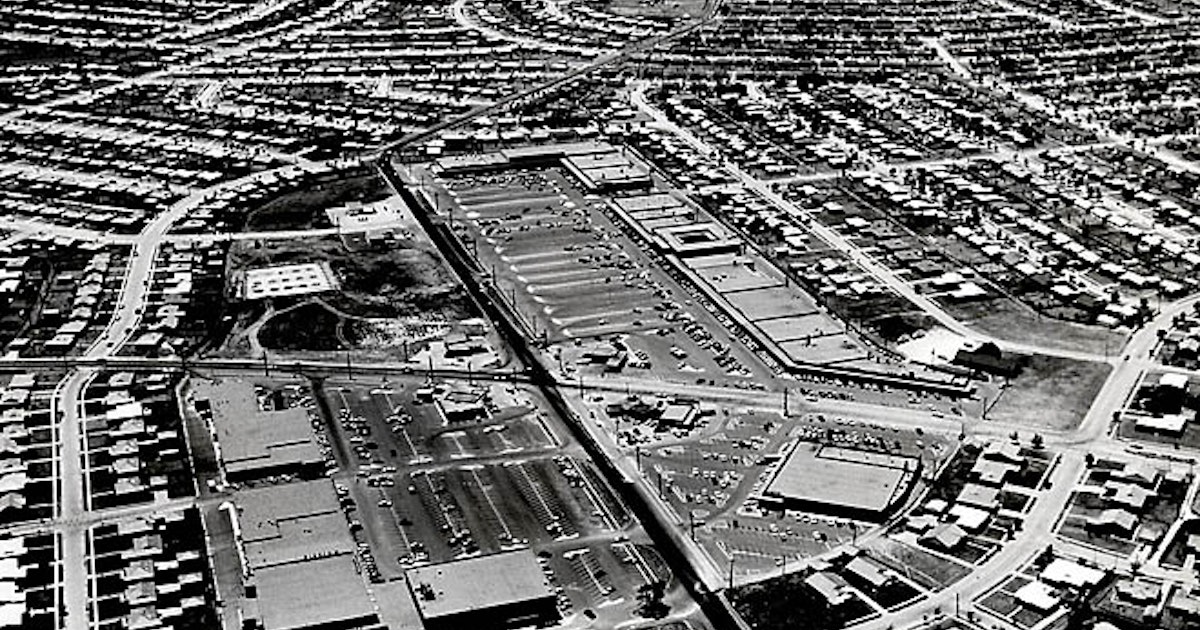
Caption from the Dallas Morning News blogs:  This aerial photo shows the Casa View shopping village and the surrounding area in 1957, three years after Bob Reitz moved into the neighborhood with his family at age 7. Reitz is presenting a talk titled

Caption from the Dallas Morning News blogs: This aerial photo shows the Casa View shopping village and the surrounding area in 1957, three years after Bob Reitz moved into the neighborhood with his family at age 7. Reitz is presenting a talk titled “A Time We Once Shared” from 2 to 4 p.m. Saturday at Dallas’ White Rock Hills Branch Library. File 1957 / Staff Photo

Steve Blow writes columns for the local section of the Dallas Morning News Wednesday he featured one of our veteran Scouters from Wisdom Trail District here in the southwest corner of Dallas County.

Dallas and Scout historian Bob Reitz - Photo by Ed Darrell

Dallas and Scout historian Bob Reitz

Bob Reitz is also the curator of the Jack Harbin Boy Scout Museum at Camp Wisdom, a surprisingly great store of Scout history.  Among many other things he does well, Bob is a historian of great stories.

This afternoon, May 10, he’s telling stories of Dallas in his growing up years in the “middle-middle class” neighborhood of Casa View, east of downtown.  Bob’s got two hours (it will seem like one or less) at the White Rock Hills Branch Library, starting at 2:00 p.m. (9150 Ferguson Rd, 75228 (map))

You ought to go.

Below the fold, Steve Blow’s column, should it disappear from the DMN site.

Read the rest of this entry »


Feynman Day comes Sunday; celebrate with your mother, and fly the flag!

May 9, 2014

No, we’re not joking.

May 11 is the anniversary of the birth of Richard Feynman (born 1918, died 1988).

Richard Feynman

Richard Feynman. Borrowed from Luciano’s Tumblr, LikeaPhysicist

In 2014, his birthday falls on Sunday, Mothers Day.  Mothers Day is one of the designated-by-law days to fly the U.S. flag — so fly your flag!  You can tell your mother it’s for her — but it’s also for Richard Feynman.

Why Feynman Day?  To celebrate invention, physics, interesting characters, and that essential, American quality of je ne sais quoi.

In addition to his winning the Nobel Prize for Quantum Electrodynamics (QED), Feynman popularized the critique of science and other enterprises with what we now call Cargo Cult science, or education, or whatever, where people follow the dance steps, but without the rhythm and music.

Those two things alone would make him a remarkable man.  But, like a product offered for $19.95 as a good buy in a 2:00 a.m. infomercial, with Feynman, there’s more.  With Feynman, there is always more.

I got alerted to Feynman in the first days of the old Quality Paperback Book Club, when they featured his new memoir, Surely You’re Joking, Mr. Feynman!  QPBC was hot on the book, and with a title like that, how could I resist?  When I got the book a week or so later, I read it within two days, while attending law school and working full time.  I remember Feynman.

Norton published the book — and their description, alone, should make you want to read it:

A New York Times bestseller—the outrageous exploits of one of this century’s greatest scientific minds and a legendary American original.

In this phenomenal national bestseller, the Nobel Prize­-winning physicist Richard P. Feynman recounts in his inimitable voice his adventures trading ideas on atomic physics with Einstein and Bohr and ideas on gambling with Nick the Greek, painting a naked female toreador, accompanying a ballet on his bongo drums and much else of an eyebrow-raising and hilarious nature.

All true, and that’s not even the half of the outrageousness, all done with great good humor, about a life lived in great good humor through what should have been a memorable age, but often was just terrifying.

I think sometimes that Feynman’s calm, alone, borne of that great good humor and insatiable curiosity,  may have gotten us through the birth of the atomic age and the Cold War.

Feynman was a giant, and we don’t revere him enough.  Consider:

  • Feynman’s high school sweetheart, Arlene, came down with tuberculosis.  He married her, and took her with him to New Mexico to make the atom bombs.  The stories of her confinement to a hospital, and the laborious trekking he had to make between Los Alamos and her bedside in Santa Fe, are touching, and heartbreaking.  It is one of the great love stories of the 20th century, certainly, and perhaps for all time.  It also provided the title for his second memoir, What Do You Care What Other People Think?
  • Every single, college-age man should read Feynman’s stories of how to date, and how to seduce women.  His approach was unique, and endeared him to women — in legend, to many women.  Feynman’s dating must have been part of the inspiration for the comedy series, “Big Bang Theory.”  Feynman’s stories are better.  (Heck, it’s even the subject of a popular, classic XKCD comic — probably only Feynman and Einstein among Nobel-winning physicists have made so much money for so many cartoonists.)
US postage stamp featuring Richard Feynman

US postage stamp featuring Richard Feynman

  • Yeah, he’s already been featured on a postage stamp, see at right.  That’s not good enough for Feynman, though — the U.S. Postal Service created a special cancellation stamp for Feynman, featuring a version of his Feynman Diagrams.

    A special postal cancel was authorized by the USPS (United States Postal Service) to honor the 80th birthday of Richard Feynman. This cancel was used in Lake Worth, Florida. For this special day the post office was renamed “Feynman Station.”

    Feynman Commemorative Cancel Feynman Diagram

    The Feynman Diagram used for the postal cancel on this envelope depicts what is known as a “bubble process.” It shows a high energy particle, for example, a cosmic ray (a) from a distant supernova, which emits a high energy photon, for example, a gamma ray (b). The photon, in turn, creates a particle (c) and an anti-particle (d) that exists for a brief moment and then recombines.

    As Feynman liked to point out, an anti-particle is the same thing as a particle with negative energy traveling backward in time (which is why the arrow at (d) points backwards, i.e. to the left). So you could say the photon created only one particle that, at first, traveled forward in time (the bottom semi-circle) and then reversed and went back in time (the top semi-circle) and annihilated itself! By inventing diagrams like this, Richard Feynman made it much easier to understand what is going on in the interactions between sub-atomic particles without getting lost in tremendous amounts of tedious math

  • Working at Los Alamos on the Manhattan Project, Feynman developed a keen appreciation for bureaucracy and all its follies.  His vexations for the security managers are also legendary.  Here’s a quick version of one story — he asked friends and family to write to him in code, but to not include a key to the code, so he’d have to crack the code to read the letter.  Feynman could do it, but the security people couldn’t.  Hilarity ensued.
  • Feynman developed a love for the still-relatively unknown, landlocked Asian nation of Tannu Tuva.  It’s just the sort of place to appeal to a character like Feynman — so obscure most atlases didn’t, and don’t, show it at all — seemingly consumed by the Soviet Union, but held in a special status.  Home of throat singing — and almost impossible to get to.  During the Cold War, Feynman struck up correspondence with people in Tuva, to the concern of Soviet and American intelligence agencies, who seemed not to understand someone might do such thing out of curiosity.  Feynman hoped to travel there to visit new friends, but his final bouts of cancer took him before it was possible.  Tuva, famous among philatelists only, perhaps, honored Feynman with postage stamps and postcards.
  • Just try to find a photo of Feynman not smiling. The man was a joy to be around, for most people, most of the time.
  • Quantum electro dynamics?  No, I can’t explain it, either — but his work had a lot to do with how particles wobble.  I remember that because, according to Feynman, he got the inspiration for the work for which he won the Nobel while spinning plates, like a Chinese acrobat on the Ed Sullivan Show, to the delight of students in the Cornell University cafeteria, and the shock and horror of the food service people.  Who else has yet confessed to such an inspiration for a Nobel?

There’s more — a lot more.  Feynman outlined our current generation of computer memory devices — in 1959.  No, he didn’t patent the idea.  He did patent an idea for a nuclear-powered spacecraft.  Another delightful story.

Feynman in an Apple ad

Feynman was featured in print and broadcast ads for Apple — not one, but two (did anyone else get that honor from Apple?). “Think Different.” This is one of Apple Computer’s most successful advertising campaigns. The theme of the campaign is one that celebrates figures in history who changed the world by thinking differently. Richard Feynman was among the chosen figures.

Feynman served on the board that approved science books for the California school system — his stories of that work will shock some, but it will make others shake their heads as they recognize the current crop of cargo-cultists and political bullies who dominate textbook approval processes, knowing nothing at all about what they are doing, or why.

No, I didn’t forget his brilliant work on the commission that studied the Challenger disaster, for NASA. There’s so much stuff to glorify!

In history, Feynman should be remembered much as we remember Thomas Jefferson, as a renaissance man in his time, a man who put great intellect to great work for his nation and all humanity.

Feynman's second Apple ad

The second Apple ad featuring Richard Feynman. An excerpt from Apple Computer’s campaign commercial: “Here’s to the crazy ones, the misfits, the rebels, the troublemakers, the round pegs in the square holes, the ones who see things differently. They’re not fond of rules and they have no respect for the status quo. You can quote them, disagree with them, glorify or vilify them… about the only thing you can’t do is ignore them, because they change things, they push the human race forward; and while some may see them as the crazy ones, we see genius, because the people who are crazy enough to think they can change the world are the ones who do.”

The sages say we shouldn’t have regrets, but I do have one.  When the Challenger Commission was meeting in Washington, D.C., I was working on another commission up the street.  I knew Feynman was ill, but our work was important, and we’d heard his disease was in remission.  I didn’t goof off a day and go to any of the hearings to see him, to get an autograph, to meet the man.  I though I’d have other opportunities to do that.  Now I regret not having met him in person.

In print, and in film, I know him well.  In our family, reading Feynman is something everybody does.  Feynman’s memoir was one of the last books I read to our son, Kenny, as he was growing up, and growing into reading on his own.  Even reading about Feynman, together, was an adventure.  Our son, James, took us into the real physics of Feynman, and though I struggle with it more than James, we still read Feynman, for humor, and physics.

What would be appropriate ways to mark Feynman’s birth?  At some future date, I hope we’ll have public readings of his books, showings of the documentaries about him, recreations of his lectures, perhaps.  And then everyone can get in a circle, beating drums and singing about getting some orange juice, before sending postcards to our friends in Tuva.

Richard Feynman, we still need you, and miss you dearly.

Tannu Tuva

Tuva’s capital is the delightfully-named Kyzyl. From this map, can you figure out where Tuva is, or how to get there — without Google, or Bing?

Tuva postcard honoring Richard Feynman

Tuva postcard, in honor of Richard Feynman — who loved to drum.

There will always be “More” about Richard Feynman, if we’re lucky:

Have a great Feynman Day!

Much of this is an encore post.


Insta-Millard: Department of Interior’s quick take on climate change report

May 9, 2014

Department of Interior’s video this week leads with climate change — and in fact, each segment deals with climate change in some way.

Published on May 9, 2014

This week: the White House releases the third annual National Climate Assessment, showing that climate change is already affecting Americans and the U.S. economy; USGS releases a Climate Change Viewer that can track water resource changes at the county, state, and watershed level; Secretary Jewell joins California leaders and first responders as the state braces for another tough wildfire season; the Secretary meets with community leaders and experts to talk about the balance between conservation and smart development; the Secretary announces the approval of a new solar energy project on tribal lands in Nevada, and attends the 69th Departmental Honor Awards Convocation in Washington, DC.


Insta-Millard: “Not available on the App Store” — real child’s play

May 9, 2014

Found on Twitter:

Deep thoughts on Twitter, about children, childhood, recess and play. https://twitter.com/IntThings/status/464766923201576960

Deep thoughts on Twitter, about children, childhood, recess and play. https://twitter.com/IntThings/status/464766923201576960


Insta-Millard: The vultures in Detroit’s bankruptcy

May 9, 2014

Maybe there’s a John Waters movie in the story.

From Metrotimes, the alternative weekly paper in Detroit:

Jerry Vile strikes again. The artist (and volunteers) stuck about 100 plastic lawn flamingos painted to look like vultures — one can imagine Vile lovingly glueing on the feathers — on the front lawn of the Detroit Institute of Arts. A banner was also erected, reading “Happy Bankruptcy: You’re Getting Flocked! Vultures by the Scads, LLC.”

It’s Vile’s latest prank that targets Detroit’s bankruptcy and the threat of selling the DIA’s artwork to appease “creditor vultures.” Within the past year the artist has put out an ad for Detroit’s liquidation in Metro Times, rolled out an oversized can of Crisco in front of the Joe Louis fist, and  placed price tags on public art throughout the city.

The only statement the artist has made so far about the vultures is a post on his Facebook page that says, “Sssssshhhhhhhh. Can’t wait to get a look at Beal’s face when he pulls up to work tomorrow.”

Negotiations are ongoing in regard to an $816 million so-called “grand bargain” — funded by numerous foundations, the state, and the DIA itself — that would spin the DIA into a new nonprofit and prevent the sale of any city-owned art. Meanwhile, Lansing is setting up a board that could oversee Detroit’s pensions and finances for 20 years, and also potentially appropriate $194.8 million from the state’s rainy day fund toward Detroit’s bankruptcy.

Plastic vultures on the lawn of the Detroit Institute of Arts - Metrotimes photo

Plastic vultures on the lawn of the Detroit Institute of Arts – Metrotimes photo


We are poorer because Farley Mowat is dead

May 9, 2014

Farley Mowat died May 7.  He was 92.

The man was such a champion of the environment that he was, at one time in the 1980s, prevented from traveling to the U.S., because he was listed with Immigration as a potential terrorist.  He may be the only person so listed, simply for urging that we stop killing animals.

Mowat was unsurpassed as a pure curmudgeon in favor of the wild, wild animals, wilderness, and environmental protection.  He was a story teller above all, understanding completely the powerful role that stories play in moving government policies — which his books frequently did.  His first works, on indigenous peoples in Canada’s far north, wrought significant changes in Canada’s policies towards those now known as First Nations.  When his signature book, Never Cry Wolf, was translated into Russian, Russia prohibited hunting wolves.

Victim of virus arcticus, Farley Mowat, probably in the 1970s; image from Econet.ca

Victim of virus arcticus, Farley Mowat, probably in the 1970s; image from Econet.ca

From the Washington Post obit notice:

“I keep my optimism alive and revitalized by accepting the fact that we are a bad species, and probably haven’t got much time here,” he told The Washington Post in 1994, “and it’s not going to break my heart when Homo sap wanders offstage.”

Then he added, “Wanna get some more coffee?”

Barry Goldwater might say that extremism in pursuit of noble conservation is no vice.  Mowat wouldn’t care what Goldwater thought.

So long, Farley Mowat.

More:


Quote goof of the moment: Tom Paine didn’t say that; Edward Abbey did.

May 7, 2014

Oy.  You’d hope that the Rabid Right would learn after a few dozen of these errors that they should try to verify stuff before they claim events of history, or sayings of famous people are gospel — especially stuff involving our patriotic founders.

But, no.

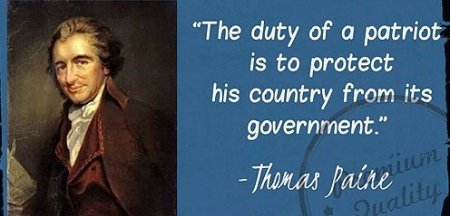
Sometimes their failure to check sources can produce amusement, though, like this one which they misattribute to Tom Paine in propaganda supporting rent scofflaw Cliven Bundy and other land management issues:

Tom Paine didn't say that. Ed Abbey said it.

Tom Paine didn’t say that. Ed Abbey said it.

“The duty of a patriot is to protect his country from its government.”

Someone mildly familiar with Tom Paine and his life and other writings might suspect the supposed attribution from the start.  Paine was a great advocate of governments to protect the rights of citizens, especially citizens like him, who were often on the outs with popular opinion and avoided the Guillotine in France and mob violence in the U.S. only through interventions of government officials who told mobs the law did not cotton their wishes to see violence on Mr. Paine.

Wikiquote notes Paine didn’t say it.  A simple check would have found that.

But other sites claim it was written by Edward Abbey, the author of Desert Solitaire and The Monkeywrench Gang.

“A patriot must always be ready to defend his country against his government.”

— Edward Abbey, A Voice Crying in the Wilderness (Vox Clamantis en Deserto) : Notes from a Secret Journal (1990) ISBN 0312064888

Why is that delicious?

The quote — the image above, for example — is being used by pro-militia groups who have defended Cliven Bundy’s trespassing on public lands in Nevada, and by Texans who, upset that they don’t have such a good target as massive Bureau of Land Management (BLM) holdings in Texas, have ginned up a faux controversy, claiming falsely that BLM is seeking to seize lands in Texas.

Edward Abbey?  He didn’t much like BLM, and he was particularly ticked off at the Bureau of Reclamation and the imposition of Glen Canyon Dam on the Colorado River with the drowning of Glen Canyon.  Abbey’s disdain of federal land managers and grand dam schemes may have been exceeded only by his contempt for developers, miners and ranchers who took advantage of the desert for profit.

Would Abbey have supported Bundy’s overgrazing on public lands, or Texas Republicans scrambling to make a false issue to mismanage lands?  Oy.  Oy.  And oy.

See this brilliant poster at Americans Who Tell The Truth:

From Americans who Tell the Truth, Edward Abbey.

From Americans who Tell the Truth, Edward Abbey. Writer, ‘Desert Anarchist’ : 1927 – 1989 “The most common form of terrorism in the U.S.A. is that carried on by bulldozers and chainsaws. It is not enough to understand the natural world; the point is to defend and preserve it. Sentiment without action is the ruin of the soul.”

Wall of Fame (people and sites who got the cite right):

Wall of Shame (people and sites who got the cite wrong):

Save


Insta-Millard: Resuscitating Liberty after climate change hit

May 7, 2014

http://twitter.com/2NewEarth/status/464074434576654336

Read the rest of this entry »


Insta-Millard: In the new Gilded Age, the rich do not share the wealth

May 6, 2014

Have the GOP and the Über-wealthy set up the whole world for another Great Depression?  Should we expect a World War to follow?

Or, do we have time to make our societies more egalitarian, and more anti-poverty, and more stable?  Graphic from BusinessWeek:

Super wealthy have concentrated the wealth of the world in their personal control.  Capitalism run riot? Graphic from BusinessWeek

Super wealthy have concentrated the wealth of the world in their personal control. Capitalism run riot? Graphic from BusinessWeek

Opportunity to move up, economically, is stifled when so much wealth blocks access to the top economic rungs.

These figures come out of a clever analysis by economists Emmanuel Saez of the University of California at Berkeley and Gabriel Zucman of the London School of Economics, who is a visiting professor at Berkeley. The Internal Revenue Service asks about income, not wealth, which is the market value of real estate, stocks, bonds, and other assets. Saez and Zucman were able to deduce wealth by exploiting IRS data going back to when the federal income tax was instituted in 1913. They figured out how much property different strata of society owned by looking at the income that was generated by that property, such as dividends and capital gains. To simplify, if a family reported $1 million in rental income one year and the market rate of return on rental properties was 10 percent, then Saez and Zucman concluded that the family must have owned property worth $10 million.

The message for strivers is that if you want to be very, very rich, start out very rich. The threshold for being in the top 0.1 percent of tax filers in 2012 was wealth of about $20 million. To be in the top 0.01 percent—that’s the 1 Percent club’s 1 Percent club—required net worth of $100 million. Of course, even $100 million is a pittance to Bill Gates, whose net worth, according to the Bloomberg Billionaires Index, is nearly 800 times that.

It will require great creativity to work our way out of this maldistribution without some sort of catastrophe.

More: 

Read the rest of this entry »


May 6, 1882: Race and immigration policy collide

May 6, 2014

Today is the anniversary* of our nation’s first** law generally governing immigration.

It’s a history we should work to change, to put behind us, to move away from.

Congress passed the Chinese Exclusion Act, which barred Chinese immigrants from the United States for 10 years.

1882 Chinese Exclusion Act, page 1 - National Archives

1882 Chinese Exclusion Act, page 1 – National Archives

1882 Chinese Exclusion Act, page 2 - National Archives

1882 Chinese Exclusion Act, page 2 – National Archives

We cannot paint over this part of history.  The Chinese Exclusion Act was racist in intent, and racist in content.

What should we learn from it?  Among justifications for the law were claims that immigrants from China were taking jobs from citizens, especially in California.  Chinese workers imported to build the Transcontinental Railroads sought new employment once the routes were built.

Reality probably differed a lot.  Chinese entrepreneurs, with money they had earned working on the railroads, established news businesses.  Yes, a lot of Chinese were getting jobs.  They were mostly new jobs, in new businesses, boosting the economy and creating more jobs.  That came to an almost-screeching halt.

Did America learn?  This law was renewed, then made permanent — not really fixed until World War II, when China was an ally in the War in the Pacific, against Japan.  Even then, it wasn’t a good fix.

The law was repealed by the Magnuson Act in 1943 during World War II, when China was an ally in the war against imperial Japan. Nevertheless, the 1943 act still allowed only 105 Chinese immigrants per year, reflecting persisting prejudice against the Chinese in American immigration policy. It was not until the Immigration Act of 1965, which eliminated previous national-origins policy, that large-scale Chinese immigration to the United States was allowed to begin again after a hiatus of over 80 years.

Can we learn from this history, for immigration reform now? Santayana’s Ghost wonders.

How much is resistance to immigration reform based on racism, the sort of racism that kills the U.S. economy?

The Chinese Exclusion Act proved to be an embarrassment for Uncle Sam:  “A Skeleton in His Closet,” by L.M. Glackens, published in Puck magazine on Jan. 3, 1912. Uncle Sam holding paper “Protest against Russian exclusion of Jewish Americans” and looking in shock at Chinese skeleton labeled “American exclusion of Chinese” in closet. Image from NorthwestAsianWeekly.com

The Chinese Exclusion Act proved to be an embarrassment for Uncle Sam: “A Skeleton in His Closet,” by L.M. Glackens, published in Puck magazine on Jan. 3, 1912. Uncle Sam holding paper “Protest against Russian exclusion of Jewish Americans” and looking in shock at Chinese skeleton labeled “American exclusion of Chinese” in closet. Image from NorthwestAsianWeekly.com

____________

*    I note the image says it was approved by President Chester Alan Arthur (who had succeeded to office after President James Garfield was assassinated a year earlier).  The New York Times calls May 6 the anniversary of Congress’s passing the law; if Arthur signed in on May 6, it was probably passed a few days earlier.  May 6 would be the anniversary of its signing into law.

**  The Chinese Exclusion Act was preceded by the Page Act of 1875, which prohibited immigration of “undesirable” people.  Who was undesirable?  “The law classified as undesirable any individual from China who was coming to America to be a contract laborer, any Asian woman who would engage in prostitution, and all people considered to be convicts in their own country.”  It was not applicable to many immigrants.  The Page Act was named after its sponsor, Rep. Horace F. Page of California.

This is based on, and borrows from, an earlier post at MFB.

More:


Birth of hydrogen phobia: May 6, 1937, the Hindenberg crash

May 6, 2014

May 6, 2014, is the 77th anniversary of the Hindenberg tragedy. Docking at its station in New Jersey, after crossing the Atlantic, a spark ignited the aluminum-based paint on the airship, and the entire craft exploded into flame.

35 people died on the airship, and one on the ground — did you know a few survived? The Associated Press interviewed a man who was 8-years old that day, and a passenger on the airship.

Werner Doehner, an 8-year-old passenger aboard the Hindenburg, saw chairs fall across the dining room door his father had walked through moments before the disaster. He would never see his father alive again.

“Just instantly, the whole place was on fire,” said Doehner, of Parachute, Colo., who is the last surviving passenger. “My mother threw me out the window. She threw my brother out. Then she threw me, but I hit something and bounced back. She caught me and threw me the second time out. My sister was just too heavy for her. My mother jumped out and fractured her pelvis. Regardless of that, she managed to walk.”

Hindenberg on fire

Hindenberg on fire, May 6, 1937.

The disaster erroneously condemned hydrogen in the public’s mind. Despite widespread use of hydrogen gas for cooking and some transportation during World War II (including in the U.S.), use of hydrogen as a fuel beyond that has always faced the hurdle of the “Hindenberg Syndrome,” the fear that the gas would explode.

Is the fear justified?  Fact is that gasoline is much more volatile, more explosive, and generally more dangerous, than hydrogen.  We move, and use, millions of gallons of gasoline in the U.S. every day, worldwide very hour, bound by laws enforcing strict liability, in relative safety.  Most people don’t think about the explosive power of the few gallons of gasoline stored under the rear seat of their car, where the children ride.

What other technologies do we fear irrationally?  What technologies do we irrationally fail to fear so much as we should?

This is mostly an encore post.


Milky Way from Joshua Tree N.P..

May 5, 2014

From the U.S Department of Interior Twitter feed:  To celebrate being named to the @TIME #Twitter140, here is an amazing photo from @JoshuaTreeNP. pic.twitter.com/F4DS5Xv9vq

From the U.S Department of Interior Twitter feed: To celebrate being named to the @TIME #Twitter140, here is an amazing photo from @JoshuaTreeNP. pic.twitter.com/F4DS5Xv9vq

Milky Way in a long exposure with a light-painted tree in Joshua Tree National Park, California.

More:


Gun nuts twisting the words of President Kennedy

May 4, 2014

Here’s the full text of President Kennedy’s statement on President Franklin D. Roosevelt’s birthday in 1961, urging Americans to join Kennedy in making things better, including enlisting in the military, from the Kennedy Library [links added here]:

January 29, 1961

This year, the celebrations of Roosevelt Day has special significance for Democrats everywhere; for we celebrate not only the triumphs of the past but the opportunities of the future.

Twenty-eight years ago Franklin Roosevelt assumed the leadership of a stricken and demoralized nation. Poverty, distress and economic stagnation blanketed the land. But it was not long before the great creative energies of the New Deal had lifted American from its despair and set us on the path to new heights of prosperity, power and greatness.

Today America is the richest nation in the history of the world. Our power and influence extend around the globe. Yet the challenges and dangers which confront us are even more awesome and difficult than those that face Roosevelt. And we too will need to summon all the energies of our people and the capacities of our leaders if America is to remain a great and free nations — if we are to master the opportunities of the New Frontier.

The dimensions of out problems overwhelm the imagination. At home millions are unemployed and the growth of our economy has come to a virtual halt. Abroad, we are faced with powerful and unrelenting pressure which threaten freedom in every corner of the globe, and with military power so formidable that it menaces the physical survival of our own nation.

To meet these problems will require the efforts not only of our leaders or of the Democratic Party–but the combined efforts of all of our people.; No one has a right to feel that, having entrusted the tasks of government to new leaders in Washington, he can continue to pursue his private comforts unconcerned with American’s challenges and dangers. For, if freedom is to survive and prosper, it will require the sacrifice, the effort and the thoughtful attention of every citizen.

In my own native state of Massachusetts, the battle for American freedom was begun by the thousands of farmers and tradesmen who made up the Minute Men — citizens who were ready to defend their liberty at a moment’s notice. Today we need a nation of minute men; citizens who are not only prepared to take up arms, but citizens who regard the preservation of freedom as a basic purpose of their daily life and who are willing to consciously work and sacrifice for that freedom. The cause of liberty, the cause of American, cannot succeed with any lesser effort.

It is this effort and concern which makes up the New Frontier. And it is this effort and concern which will determine the success or failure not only with Administration, but of our nation itself. [emphasis added]

Source: White House Central Subject Files, Box 111, “FDR”.

Other Information Sources:

“Know your Lawmakers,” Guns Magazine, April 1960.
Letter to President John F. Kennedy from the NRA,” [NRAcentral.com].
“New Minute Men Urged by Kennedy,” The New York Times, 30 January, 1961, pg. 13.
“Kennedy Says U.S. Needs Minute Men,” Los Angeles Times, 30 January, 1961, pg. 4.
“Minutemen’s Soft-Sell Leader: Robert B. DePugh,” The New York Times, 12 November 1961, pg. 76.

It seems to me that Kennedy was not asking yahoos to take up arms against the government, but was instead asking Americans to “ask not what your country can do for you; ask what you can do for your country.”  Specifically in the last paragraph, he noted his call was to join in the New Frontier efforts his administration pushed.
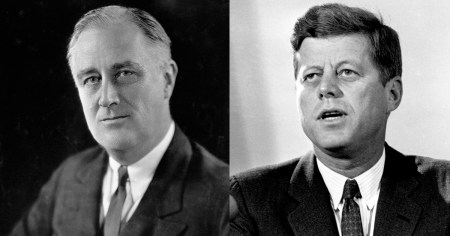
FDR, left, and JFK: Kennedy took the opportunity of Roosevelt's birth anniversary in 1961, January 29, to urge Americans to volunteer to serve the nation, to serve as the Minutemen did, voluntarily, where the nation needs help, and in support of the nation. Image from Ring of Fire Network

FDR, left, and JFK: Kennedy took the opportunity of Roosevelt’s birth anniversary in 1961, January 29, to urge Americans to volunteer to serve the nation, to serve as the Minutemen did, voluntarily, where the nation needs help, and in support of the nation. Image from Ring of Fire Network

If you’re not much a student of history, you may have forgotten about Kennedy’s New Frontier.  As presidents before him, with the Square Deal (Teddy Roosevelt, 1904), the New Deal (FDR, 1933), and the Fair Deal (Truman, 1949), Kennedy sought a shorthand term to apply to much of his program of changes.  In his speech accepting the nomination of the Democratic Party to run for president, he called this a New Frontier.

For I stand tonight facing west on what was once the last frontier. From the lands that stretch three thousand miles behind me, the pioneers of old gave up their safety, their comfort and sometimes their lives to build a new world here in the West. They were not the captives of their own doubts, the prisoners of their own price tags. Their motto was not “every man for himself” –but “all for the common cause.” They were determined to make that new world strong and free, to overcome its hazards and its hardships, to conquer the enemies that threatened from without and within.

Today some would say that those struggles are all over–that all the horizons have been explored–that all the battles have been won– that there is no longer an American frontier.

But I trust that no one in this vast assemblage will agree with those sentiments. For the problems are not all solved and the battles are not all won–and we stand today on the edge of a New Frontier–the frontier of the 1960’s–a frontier of unknown opportunities and perils– a frontier of unfulfilled hopes and threats.
[emphasis added]

Woodrow Wilson’s New Freedom promised our nation a new political and economic framework. Franklin Roosevelt’s New Deal promised security and succor to those in need. But the New Frontier of which I speak is not a set of promises–it is a set of challenges. It sums up not what I intend to offer the American people, but what I intend to ask of them. It appeals to their pride, not to their pocketbook–it holds out the promise of more sacrifice instead of more security.

But I tell you the New Frontier is here, whether we seek it or not. Beyond that frontier are the uncharted areas of science and space, unsolved problems of peace and war, unconquered pockets of ignorance and prejudice, unanswered questions of poverty and surplus. It would be easier to shrink back from that frontier, to look to the safe mediocrity of the past, to be lulled by good intentions and high rhetoric–and those who prefer that course should not cast their votes for me, regardless of party.

But I believe the times demand new invention, innovation, imagination, decision. I am asking each of you to be pioneers on that New Frontier. My call is to the young in heart, regardless of age–to all who respond to the Scriptural call: “Be strong and of a good courage; be not afraid, neither be thou dismayed.”

For courage–not complacency–is our need today–leadership–not salesmanship. And the only valid test of leadership is the ability to lead, and lead vigorously. A tired nation, said David Lloyd George, is a Tory nation–and the United States today cannot afford to be either tired or Tory.

Kennedy famously challenged Americans to stand up for service to the nation in his inaugural speech, and when he founded the Peace Corps, asking Americans to give up two or three years to work, peacefully, in other lands to promote progress there. Kennedy called Americans to share his vision, and to work for change, for a better America.

What were specifics of the New Frontier agenda?   Kennedy pushed a broad range of programs, many turned into laws in his brief term; Kennedy aimed to change America in economics, taxation, labor, education, welfare, civil rights, housing, unemployment, health, equal rights for women, environment, agriculture, crime and defense.   In each of these areas Kennedy sought to build on the legacies of Franklin D. Roosevelt and Harry Truman — in ways that conservatives today become apoplectic just thinking about.

Kennedy pushed for a higher minimum wage with built-in step increases over time not keyed to inflation.  He called for more taxcuts for the poor, coupled with targeted tax incentives to get businesses to spend their cash to create jobs.  Kennedy favored changes in law to give unions greater say in corporate expansion, tougher protection for workers from firing, and he extended collective bargaining to federal workers.  Kennedy called for expansion of federally-funded loans and scholarships for college students, and he started a program to use federal money to put technology into classrooms at the elementary and secondary levels.  Kennedy expanded unemployment and welfare benefits, and got a 20% increase in Social Security benefits.

Kennedy’s New Frontier called for sweeping changes in the way government protects the rights and welfare of all citizens.

Did Kennedy actually call for armed militias to fight government “over-reach” or expansion?

What do you think?  When a proponent of getting guns to protect himself against the U.S. government, by killing agents of the U.S. government (we must imagine), cites a part of Kennedy’s statement from 1961 as supporting arming individual citizens, is he being honest?

Please tell us what you think, in comments. Your opinion counts.

Poster from Americanfirearms.org; the quoate from Kennedy is accurate, but did Kennedy mean what this group wants us to think it means?

Poster from Americanfirearms.org; the quote from Kennedy is accurate, but did Kennedy mean what this group wants us to think it means?

Kennedy appears to have been fond of the image of the Minutemen at Lexington and Concord, trained militia from citizen volunteers, who started the path to American independence from Britain.  He invoked that image earlier, as senator from Massachusetts, in a speech honoring the Polish hero Casimir Pulaski, at a Pulaski Day Dinner in Milwaukee, Wisconsin on October 17, 1959:

We pay tribute to Casimir Pulaski tonight by honoring a great American of Polish descent, Clem Zablocki.  For he has demonstrated, in Washington and Wisconsin, the same courage and conscience, the same zeal for liberty, the same tireless patience and determination to help all who call for help.  He is a great Congressman – not only from Wisconsin – but of the United States . . .

But we also think of Casimir Pulaski tonight because his beloved Poland has once again fallen victim to a foreign power.  The independence for which he fought against the Russians at Czestochowa has been once again suppressed – and once again by the Russians.  Were he alive tonight, the hero of Savannah and Charleston would weep for his homeland – and we, inwardly or outwardly according to our custom, weep with him.

But weeping is not enough.  We know it is not enough.  And yet, while we give vent to our feelings of resentment and outrage, we are also caught up in a feeling of frustration.  What can we do about the situation in the satellites?  How can we help those liberty-loving peoples regain their liberty, without subjecting them to even more cruel repression – or subjecting the world to an even more disastrous war?  How can we let them know their fate is not forgotten – that we have not abandoned them to be – like the Irish of 1647 considered themselves when Owen Roe O’Neill was poisoned – “sheep without a shepherd when the snow shuts out the sky?”

This is the dilemma we face, as both last month and next year the President and Premier Khrushchev are pictured together in the press on both sides of the Iron Curtain.  And this is the dilemma with which this Administration has been confronted, in trying to make good on its tarnished promises of a new “liberation” policy.  For this is no longer an age when minutemen with muskets can make a revolution.  Hungary, we know, is not Cuba – and neither is Poland.  Mr. Khrushchev is not to be overthrown like Mr. Batista.  Brave bands of young men and women may be able to stop a few tanks – but street barricades and home-made hand grenades cannot long stand against a modern army and an atomic air force. [emphasis added]

The facts of the matter are that – no matter how bitter some feelings may be, or how confident some are of a victorious war for liberation – freedom behind the Iron Curtain and world peace are actually inextricably linked.  For if war should ever break out, the control and occupation of Eastern Europe would certainly be even more rigid and repressive than it is today.  That is why, in the days of upheaval in 1956, when Poland could have turned to violent rebellion as Hungary did, Cardinal Wyszynski kept advising his people that the condition of Polish freedom was peace.  Many scoffed – many thought him faint-hearted.  But by following his advice, Poland has now attained at least a measure of national independence and at least a relaxation of Communist rule.  Forced collectivization of the farmers has ceased and most of the collectives were dissolved – religious freedom has been restored in considerable degree – and freedom of speech is returning.

No one says that land of ancient freedom is once more free again.  But if Poland had not accepted this half-way house to freedom, it could have been, as Prime Minister Gomulka warned, wiped off the map of Europe.  If the present emphasis on a thaw in the Cold War should end and tensions rise again, the present good relations between Poland and the United States would undoubtedly cease, the growing contacts between the Polish people and the West would be cut off, and the present degree of freedom of speech and religion in Poland would prove to be short-lived.  On the other hand, if a real thaw develops and Soviet-American relations improve, the prospects for the continuation and perhaps the expansion of this limited degree of Polish freedom are good.  So, in a real sense, the condition for Polish freedom is peace.
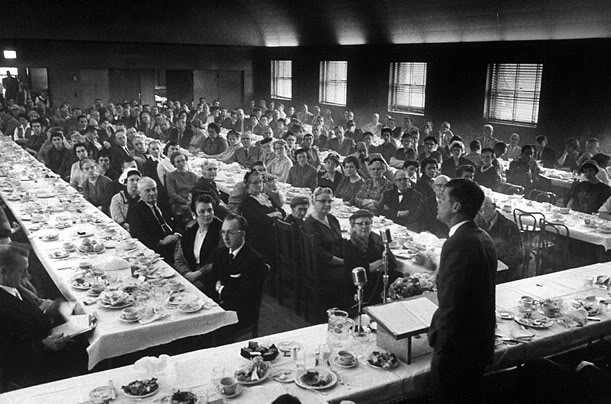
President Kennedy addressing a Wisconsin group during the 1960 presidential campaign.  (Do you have more details?)

President Kennedy addressing a Wisconsin group during the 1960 presidential campaign. (Do you have more details?) Photo by Robert W. Kelley//Time Life Pictures/Getty Images

One does not get the sense that President Kennedy was urging citizens to establish their own arsenals, contrary to the actions of the Minutemen at Lexington and Concord, nor to take up arms against the U.S. government.

Who would suggest that’s what Kennedy meant?  Oh, yeah:  AmericanFirearms.org.

More:

Page one of a speech text then-Sen. John Kennedy delivered regarding why America arms, on March 9, 1960, in Mauston, Wisconsin. JFK Library image

Page one of a speech text then-Sen. John Kennedy delivered regarding why America arms, on March 9, 1960, in Mauston, Wisconsin. JFK Library image