Beautiful Antarctica: Photos, or painting?

January 27, 2014

This one is cropping up all over the internet.

But just try to get a commitment as to its origins.  Photographic, or artist’s image?

I wagered the latter. Note general lack of thick clouds, angle of sunlight, etc.

Beautiful Antarctica from space. Photographic image, or artist's rendering?  Who deserves credit for the image?

Beautiful Antarctica from space. Photographic image, or artist’s rendering? Who deserves credit for the image?

Then, at Twisted Sifter (shout out to Annette Breedlove; and everyone outside my family will be mystified by that reference) I found this, the full image from NASA.  Notice how some selective editing, changing the perspective, makes the image above more fascinating — while stripping out the identifying credits:

Image via Twisted Sifter; NASA image of Antarctica, available at Flickr Commons

Image via Twisted Sifter; NASA image of Antarctica, available at Flickr Commons

Well, that’s a different thing, then.

Twisted Sifter’s explanation of details, excerpt:

Seen above is a view of the Earth on September 21, 2005 with the full Antarctic region visible. The composite image shows the sea ice on September 21, 2005, the date at which the sea ice was at its minimum extent in the northern hemisphere. The colour of the sea ice is derived from the AMSR-E 89 GHz brightness temperature while the extent of the sea ice was determined by the AMSR-E sea ice concentration. Over the continents, the terrain shows the average land cover for September, 2004. The global cloud cover shown was obtained from the original Blue Marble cloud data distributed in 2002. [Source]

Due to the position of Antarctica in relation to our Sun it would not look like this to the naked eye. This is a composite that shows what Antarctica looks like if the entire continent were illuminated.

Click here for the full resolution 8400×8400 pixel TIFF version (63 mb) and click here for the 8400 x 8400 px JPG version.

NASA’s details, from the Flickr file:

NASA on The Commons

Global View of the Arctic and Antarctic on September 21, 2005

Collection: NASA Scientific Visualization Studio Collection

Title: Global View of the Arctic and Antarctic on September 21, 2005

Instrument: Terra/MODIS

Instrument: Aqua/AMSR-E

Description: This image shows a view of the Earth on September 21, 2005 with the full Antarctic region visible.

Abstract: In support of International Polar Year, this matching pair of images showing a global view of the Arctic and Antarctic were generated in poster-size resolution. Both images show the sea ice on September 21, 2005, the date at which the sea ice was at its minimum extent in the northern hemisphere. The color of the sea ice is derived from the AMSR-E 89 GHz brightness temperature while the extent of the sea ice was determined by the AMSR-E sea ice concentration. Over the continents, the terrain shows the average landcover for September, 2004. (See Blue Marble Next Generation) The global cloud cover shown was obtained from the original Blue Marble cloud data distributed in 2002. (See Blue Marble:Clouds) A matching star background is provided for each view. All images include transparency, allowing them to be composited on a background.

Completed: 2007-02-08

Credit: *Please give credit for this visualization to* NASA/Goddard Space Flight Center Scientific Visualization Studio The Blue Marble data is courtesy of Reto Stockli (NASA/GSFC).

Studio: SVS

Animator: Cindy Starr (Lead)

Scientist: Ronald Weaver (University of Colorado)

Data Collected: AMSR-E Sea Ice: 2005-09-21; Blue Marble cloud layer 2002; Blue Marble Next Generation Seasonal Landcover 2004-09

UID: SPD-SCIVS-http://svs .gsfc.nasa.gov/vis/a 000000/a003400/a0034 02/NSIDCimages__SPcl ouds.2158-IMAGE

Original url: svs.gsfc.nasa.gov/vis/a000000/a003400/a003402/index.html

SOURCE: nasaimages.org/luna/servlet/detail/NSVS~3~3~7128~107128

Visit www.nasaimages.org for the most comprehensive compilation of NASA stills, film and video, created in partnership with Internet Archive.

The image, and it’s odyssey and story, are reminders that reality is often better than the made up stuff; and it’s wise to properly attribute stuff you borrow.  Is this just a cool image, or an opportunity for teachers to enrich the classroom and an argument for boosting NASA’s budget?

More:


NASA photo of the Moon, and Lincoln Memorial

January 21, 2014

This one NOT taken by the Hubble Space Telescope, though I suspect a telephoto lens was involved.

“An amazing photo of a full moon over the Lincoln Memorial.” Photo: NASA

Another photo from the Department of Interior’s Great American Outdoors Tumblr site.

It’s a rising Moon, with the photo taken from the west side of the Lincoln Memorial, perhaps from the Virginia side of the Potomac River.  The Lincoln Memorial is now part of the National Park Service’s portfolio of properties around our national capital.

Update: Jude Crook points out in comments (below) that this was a NASA Photo of the Day, originally; two federal agencies cooperating in the interest of photographic excellence . . .

Super Perigee Moon

The full moon is seen as it rises near the Lincoln Memorial, Saturday, March 19, 2011, in Washington. The full moon tonight is called a super perigee moon since it is at its closest to Earth in 2011. The last full moon so big and close to Earth occurred in March 1993.

Image Credit: NASA/Bill Ingalls


Joshua Tree National Park at night

January 19, 2014

A long exposure, you can tell by the airplane streaks near the horizon.  Walking that fine photography edge of long enough to get the exposure, but short enough not to distort the stars too much.

Long exposure of a Joshua tree, in Joshua Tree National Park. Photo: Sarah Chah (www.sharetheexperience.org)

Long exposure of a Joshua tree, in Joshua Tree National Park. Photo: Sarah Chah (www.sharetheexperience.org)

Captioned at America’s Great Outdoors Tumblr, by the U.S. Department of Interior:

Viewed from the road, this desert park only hints at its vitality. Closer examination reveals a fascinating variety of plants and animals that make their home in this land shaped by strong winds, unpredictable torrents of rain, and climatic extremes. Dark night skies, a rich cultural history, and surreal geologic features add to the attraction of this place. Come see Joshua Tree National Park for yourself!

Photo: Sarah Chah (www.sharetheexperience.org)


Photograph, or painting of Paris?

January 17, 2014

And from what was this shot, if it’s a photo?

With everyone else,

I love
Paris in the
the springtime!

But I wonder what brain bending goes on in this image.  From Fascinating Pics:

Paris at Sunset, France pic.twitter.com/QnhtkUPKLn - Fascinating Pics

Paris at Sunset, France pic.twitter.com/QnhtkUPKLn Photo by Coolbiere.

What do you think? Painting?  Photo?  Manipulated photo?

Update: J.A. Higginbotham tracked down the original Flickr photo, by a Coolbiere.  Nikon D-800, 70-200 zoom telephoto, at 122mm; claims to have taken it from Mount Parnasse. Luck and preparedness.  Wow.


Grizzly on the Snake, in the Tetons

January 15, 2014

A Grizzly Bear crossing the Snake River at sunrise in the Grand Teton National Park.   Photo: Donald Higgs (www.sharetheexperience.org)

A Grizzly Bear crossing the Snake River at sunrise in the Grand Teton National Park. Photo: Donald Higgs (www.sharetheexperience.org)

From the U.S. Department of Interior’s Great American Outdoors Tumblr:

A Grizzly Bear crossing the Snake River at sunrise in the Grand Teton National Park.
Photo: Donald Higgs (www.sharetheexperience.org)

I was born on the Snake River, farther south and west, in Burley, Idaho.  It’s a grand river, not so much in the water it moves as the way it moves through the landscape and becomes a part of grander parts of the American west.  Kathryn and I honeymooned in Yellowstone, and stayed in Grand Teton on the way out.

There is nothing grander on Earth than a sunrise in the Tetons.  Do you think a grizzly appreciates that?

Yeah, gotta get back there.


You should visit Yosemite National Park in winter

January 11, 2014

Here’s why, another video from the good people at Yosemite National Park:

Any of the National Parks is special, in winter.  What is your snow and cold experience in them?

More:

Winter photo of the Yosemite Valley, by Q T Luong -- a key photo used by the Ken Burns group in their series of films on the National Parks.

Winter photo of the Yosemite Valley, by Q T Luong — a key photo used by the Ken Burns group in their series of films on the National Parks.


January 5, 1502: A deal is a deal, with Columbus’s most prized possession

January 5, 2014

Who can you trust, if not the king and queen?

Columbus feared that King Ferdinand and Queen Isabella would not honor pledges they had made to him as recompense and honor for his great work of discovery on their behalf.  Before his final voyage, he assembled a legal document showing those promises made to him, and his work for Spain.

This illustrates, once again, the human dimension of the great drama of the age of exploration, of Columbus’s stumbling on to the America’s in his efforts to get to China.

The Library of Congress and the History Channel team up again to show off these grand snippets of history:

On January 5, 1502, prior to his fourth and final voyage to America, Columbus gathered several judges and notaries in his home in Seville. The purpose? To have them authorize copies of his archival collection of original documents through which Isabel and Fernando had granted titles, revenues, powers and privileges to Columbus and his descendants. These 36 documents are popularly called “Columbus’ Book of Privileges.” Four copies of his “Book” existed in 1502, three written on vellum and one on paper. The Library’s copy, one of the three on vellum, has a unique paper copy of the Papal Bull Dudum siquidem of September 26, 1493, which extended the Spanish claim for future explorations.

512 years ago today.

Borrowed with permission from Mr. Darrell’s Wayback Machine. This has also appeared at Millard Fillmore’s Bathtub before.


Can’t get it together; it IS together

January 2, 2014

Earth on January 1, 2014.  Looks pretty good from this angle.

Can we make it look this good down here on the ground?

NASA caption: Happy New Year! This image shows the Earth today, January 1, 2014, a few hours into the new year, as seen by the Geostationary Operational Environmental Satellites (GOES) satellite. Geostationary describes an orbit in which a satellite is always in the same position with respect to the rotating Earth. This allows GOES to hover continuously over one position on the Earth’s surface, appearing stationary. As a result, GOES provide a constant vigil for the atmospheric “triggers” for severe weather conditions such as tornadoes, flash floods, hail storms, and hurricanes. Image Credit: NASA/NOAA GOES Project #nasa #earth #space #goes #irl #today #happynewyear #planets #solarsystem #newyear #2014 #nye #home

More, perhaps related:


‘The water is awake, and alive!’ Yosemite Falls

December 30, 2013

I love the poetic descriptions, from geologists!

From Yosemite National Park’s “Nature Notes”:

Uploaded on Dec 7, 2009

Yosemite Falls is the tallest waterfall in North America, and is a powerful presence in Yosemite Valley. From winter ice to spring flood to autumn dryness, this magnificent waterfall is a dynamic force of nature.

There’s even a resurrection story for the falls. Maybe Emily Dickinson was on to something about finding religion in nature.

More:

National Park Service photo of Upper Yosemite Falls

National Park Service photo of Upper Yosemite Falls

U.S. President Theodore Roosevelt (left) and n...

U.S. President Theodore Roosevelt (left) and nature preservationist John Muir, founder of the Sierra Club , on Glacier Point in Yosemite National Park in 1903. In the background: Upper and lower Yosemite Falls. (Photo credit: Wikipedia)

73,117

A sign of some apocalypse in Dinosaur, Colorado?

December 28, 2013

It’s an interesting town, Dinosaur, Colorado 81610.  It’s on the south side of US Highway 40, a very short distance east of the Utah border.

And it touches on the Colorado part of Dinosaur National Monument.  The Wikipedia entry gives specifics:

The Town of Dinosaur is a Statutory Town located in Moffat County, Colorado, United States. The town population was 339 at the 2010 census.[5]

The town of Dinosaur was originally named Artesia; the current name was adopted in 1966, to capitalize on the town’s proximity to Dinosaur National Monument.[6] The monument headquarters is located just east of the town on U.S. Highway 40.

And:

Many streets in the town are named after dinosaurs, including Cletisaurus Circle, Tyrannosaurus Trail, and Antrodemus Alley.[8]

It’s a setup, a straight line waiting for a good comedian.

Brian Switek, the science writer now based in Salt Lake City, suggests one area ripe for comedy:

http://twitter.com/Laelaps/status/417128850762391553

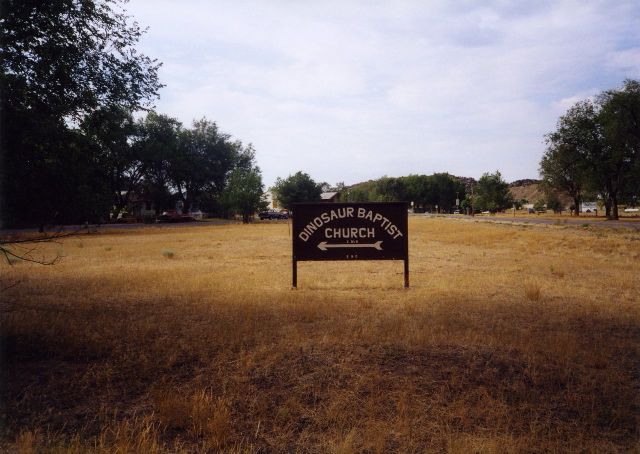
Wait. What?  Dinosaur Baptist Church?

Brian Tweeted that he wasn’t looking to ridicule, but: “I just imagined thyreophorans, maniraptorans, sauropodomorphs, and their ilk in the congregation.”

That might produce even more comedic situations.

It’s a Southern Baptist Convention-affiliated congregation.  Aren’t you curious how Sunday school goes for dinosaur-crazy kids in such a church, in such a town?

Signs of life, signs of the times, signs of something!

Another shot of the directional sign for Dinosaur Baptist Church, from earlier in 2011, I think.  From Text of the Day.

Another shot of the directional sign for Dinosaur Baptist Church, from earlier in 2011, I think. From Text of the Day.

From a different angle, one can see that the church is just a couple of blocks off of Stegosaurus Freeway.  Wow.

2007 photo of the sign showing street signs at the intersection of 6th Street and Stegosaurus Freeway.  Photo by Will Gelnaw, who has copyright to it.

2007 photo of the sign showing street signs at the intersection of 6th Street and Stegosaurus Freeway. Photo by Will Gelnaw, who has copyright to it.

Still, it’s fun to imagine a nice, small town church, with dinosaurs in the back pews singing along.  (Instead, Chris Clarke suggested, they are hiding in the Rocks of Ages . . .)

More:    

Welcome to Dinosaur, Colorado

Welcome to Dinosaur, Colorado (Photo credit: J. Stephen Conn)


Insta-Millard, photography and astronomy edition: South DakotaHenge

December 23, 2013

How much image manipulation, if any, was necessary to capture this enormous-looking Moon rising over a South Dakota “road to nowhere,” close to the 2013 Winter Solstice?

From @GlobePics:

From @GlobePics: “Road To Nowhere – Supermoon” – Supermoon rises over this road to nowhere in eastern South Dakota. pic.twitter.com/82AoFgPvWn

Who should get credit for the photo?  (I can’t quite read the name in the lower left corner.)

Buy a print here, from the photographer, Aaron J. Groen.

More:


Texas Education Agency looking for social studies books reviewers (and math and fine arts)

December 2, 2013

Last time the SBOE approved social studies books in 2010, the process was contentious.  This photo, from The Christian Science Monitor, shows protests on the books; photo by Larry Kolvoord/Austin American-Statesman

Last time the SBOE approved social studies books in 2010, the process was contentious. This photo, from The Christian Science Monitor, shows protests on the books; photo by Larry Kolvoord, Austin American-Statesman

Good news a few days ago was that the Texas State Board of Education approved science books that teach real science, for use in Texas schools.

But the Road Goes On Forever, and the Tea Party Never Ends:  Social studies books are up for review, now.

TEA is looking for nominations for reviewers for books in social studies, math and fine arts.  Here’s the notice I got in e-mail:

The Texas Education Agency is now accepting nominations to the state review panels that will evaluate instructional materials submitted for adoption under Proclamation 2015.

To nominate yourself or someone else to serve on a state review panel, please complete the form posted at http://www.tea.state.tx.us/WorkArea/linkit.aspx?LinkIdentifier=id&ItemID=25769808256&libID=25769808258 and submit it to the TEA on or before Friday, January 24, 2014.

Proclamation 2015 calls for instructional materials in the following areas:

♦   Social Studies, grades K-12

♦   Social Studies (Spanish), grades K-5

♦   Mathematics, grades 9-12

♦   Fine Arts, grades K-12

State review panels are scheduled to convene in Austin for one week during the summer of 2014 to review materials submitted under Proclamation 2015. The TEA will reserve hotel lodging and reimburse panel members for all travel expenses, as allowable by law.

  • Panel members should plan to remain on-site for five days to conduct the evaluation.
  • Panel members will be asked to complete an initial review of instructional materials prior to the in-person review.
  • Panel members will receive orientation and training both prior to the initial review and at the beginning of the in-person review.
  • Panel members might be asked to review additional content following the in-person review.
  • Because many of the samples will be delivered electronically, panel members should be comfortable reviewing materials on-screen rather than in print.
  • Panel members should also have a working knowledge of Microsoft Excel.

Upon initial contact by a representative of the TEA, state review panel nominees begin a “no-contact” period in which they may not have either direct or indirect contact with any publisher or other person having an interest in the content of instructional materials under evaluation by the panel. The “no contact” period begins with the initial communication from the Texas Education Agency and ends after the State Board of Education (SBOE) adopts the instructional materials. The SBOE is scheduled to adopt Proclamation 2015 materials at its November 2014 meeting.

Nominations are due on or before Friday, January 24, 2014.  The nomination form is posted on the TEA website at http://www.tea.state.tx.us/WorkArea/linkit.aspx?LinkIdentifier=id&ItemID=25769808256&libID=25769808258.

If you have any questions, please contact review.adoption@tea.state.tx.us.

***********************************************************

Thank you for your commitment to serving Texas students.

Social Studies Staff, Division of Curriculum, (512) 463-9581

Social Studies in Texas include history, geography, economics, government (civics), and (oddly) psychology and sociology, and “special topics.”

Please pass word along to the teachers you know in social studies, fine arts and math.

We recall that old Bette Davis line, playing Margot Channing in “All About Eve”:  “Fasten your seatbelts.  It’s going to be a bumpy night.”

More:


There’s a Milky Way in Australia?

November 26, 2013

Yes, but it’s upside down, right?

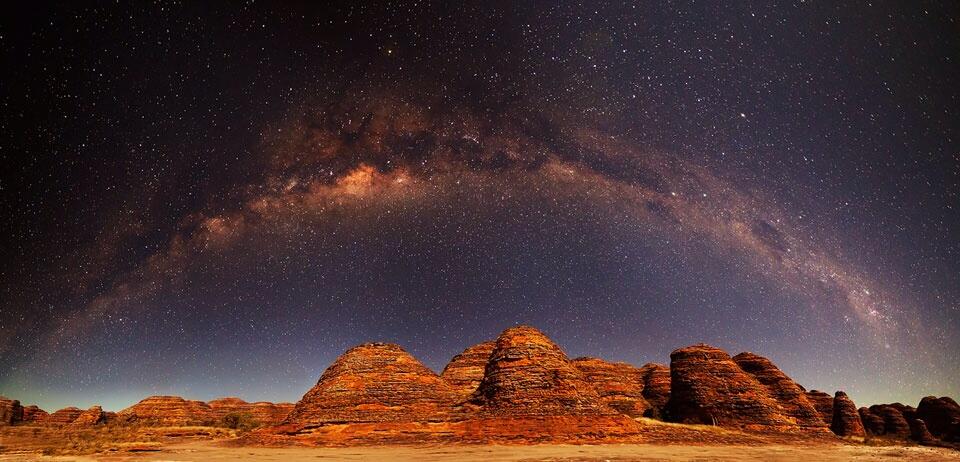
Meredith Frost Tweeted: Great shot of the Milky Way over Western Australia (Photo/Mike Salway) An Astronomy Picture of the DayMeredith Frost Tweeted: Great shot of the Milky Way over Western Australia (Photo/Mike Salway) An Astronomy Picture of the Day

Meredith Frost Tweeted: Great shot of the Milky Way over Western Australia (Photo/Mike Salway) An Astronomy Picture of the Day

Turns out this was the Astronomy Picture of the Day back in September 2012.  NASA said:

Milky Way Over the Bungle Bungles
Image Credit & Copyright: Mike Salway Explanation: Which part of this picture do you find more interesting — the land or the sky? Advocates for the land might cite the beauty of the ancient domes of the Bungle Bungle Range in Western Australia. These picturesque domes appear as huge layered beehives and are made of sandstones and conglomerates deposited over 350 million years ago. Advocates for the sky might laud the beauty of the Milky Way’s central band shown arching from horizon to horizon. The photogenic Milky Way band formed over 10 billion years ago and now includes many well-known nebulae and bright stars. Fortunately, you don’t have to decide and can enjoy both together in this beautiful 8-frame panorama taken from the dark skies of Purnululu National Park about two months ago.

Decide Anyway: Land or Sky

I’d make some remarks about silly names for land formations in Australia — but here we sit with The Grand Tetons, The Gros Ventre, and several dozen “Molly’s Nipples” in our nation.

But really:  Bungle-Bungles?

Ain’t geography grand? Ain’t nature grand? Ain’t NASA doing something right?

More:


Annals of global warming: Great Lakes need water

November 13, 2013

Does Lake Michigan's record low mark beginning of new era for Great Lakes? At least 150 years of rhythmic pulses in Lake Michigan's water levels appear to have shifted abruptly with loss of winter ice.   Photo by Mark Hoffman, Milwaukee Journal-Sentinel

Photo and caption from Milwaukee Journal-Sentinel: Does Lake Michigan’s record low mark beginning of new era for Great Lakes? At least 150 years of rhythmic pulses in Lake Michigan’s water levels appear to have shifted abruptly with loss of winter ice. Photo by Mark Hoffman, Milwaukee Journal-Sentinel

Don’t get complacent, yet.  Has enough water fallen in the Great Lakes drainage area in the past six months to change this situation at all?  From the New York Times last June:

Drought and other factors have created historically low water marks for the Great Lakes, putting the $34 billion Great Lakes-St. Lawrence Seaway shipping industry in peril, a situation that could send ominous ripples throughout the economy.

Water levels in the Great Lakes have been below their long-term averages during the past 14 years, and this winter the water in Lakes Michigan and Huron, the hardest-hit lakes, dropped to record lows, according to the Army Corps of Engineers. Keith Kompoltowicz, the chief of watershed hydrology with the corps’s Detroit district, said that in January “the monthly mean was the lowest ever recorded, going back to 1918.”

While spring rains have helped so far this year, levels in all five Great Lakes are still low by historical standards, so getting through the shallow points in harbors and channels is a tense affair.

It’s not just storms, rising sea levels, and melting glaciers, you know.

The Great Lakes as seen from space. The Great ...

The Great Lakes from space. The Great Lakes are the largest glacial lakes in the world. NASA photo via Wikipedia

More:

Great Lakes in Sunglint (NASA, International S...

Great Lakes in Sunglint (NASA, International Space Station, 06/14/12) (Photo credit: NASA’s Marshall Space Flight Center)


Aussie’s view of America; can you do as well for Australia?

November 2, 2013

An Aussie's attempt to label the state of the U.S.  Don't laugh -- how well can you do labeling a map of Australia?  From Texas Hill Country's Facebook feed, and unknown origin past that.

An Aussie’s attempt to label the state of the U.S. Don’t laugh — how well can you do labeling a map of Australia? From Texas Hill Country’s Facebook feed, and unknown origin past that.

Found this at the Facebook site of Texas Hill Country.  A little rough for high school geography, especially if it’s ninth grade geography (surely you can moderate this a bit, teachers), but a good idea for a quiz?

How well can your students do labeling the U.S.?  Will they find this person’s obvious anguish and creative non-answers amusing?  Can they do better?

Now turn the tables:  How well can your students in the U.S. do labeling a map of Australia?  Canada?  Mexico?

Ask your students:  Is it important to know such stuff?  Why?

And you, Dear Reader: What do you think?

Here you go, a map of Australia to practice with:

Unlabeled map of Australia to label!  Royalty free produce of Bruce Jones Design, Inc., copyright 2010

Unlabeled map of Australia to label! Royalty free produce of Bruce Jones Design, Inc., copyright 2010