The International Policy Network, once the most persuasive and active think tanks campaigning against climate change science, has disbanded in the UK after what appears to be a spilt between its leading members.
A document released following a Freedom of Information request shows that the charity’ s chairwoman Linda Whetstone and her brother Michael Fisher held a private meeting in which they agreed to abandon the name of IPN UK after more than a decade. The meeting, held by telephone in November 2010, was perfectly within the charity’s rules.
The minutes of the meeting, which cover a single side of an A4 sheet of paper, were obtained by The Independent this week and reveal that Whetstone also resigned from the board of the International Policy Network in the United States, despite being a leading member of the organisation.
This newspaper has also confirmed that Professor Julian Morris, the founding director of the IPN in the UK and then president, is no longer working for the sister organisation in the US where he was earning $137,000. He is now vice president for research at a rival think tank, the Reason Foundation.
Professor Morris, after speaking at a meeting on Wednesday, June 15 being held by a new think tank called the Legatum Institute, said: “The IPN is scaling down. There were two organisations, the IPN US Inc and IPN UK and now the two organisations are pursuing independent paths.”
Asked whether the IPN had split over climate change, he added: “It is a long and complex story. It is what it is. I can see where you’re going with this.”
I wish I were so omniscient. I wonder where Morris thought that line of questioning was going?
The Independent summarized some of the less savory parts of the funding issues for the organization (John Mashey surely knows all this):
The closure of the free market IPN follows years of controversy about Exxon funding, alleged links to the tobacco industry and contested claims about AIDs and the pesticide DDT.
It is possible, however, that the closure may be linked to family connections involving David Cameron that meant IPN could no longer exist as a major force of climate denial.
Whetstone is the mother-in-law of Steve Hilton, who is the director of strategy for the prime minister and was godfather to his son Ivan. Hilton is the man who persuaded the Conservative leader to adopt a robust stance on climate change and hug Huskies on the Norwegian glacier to illustrate his commitment.
Hilton’s wife, Rachel Whetstone, is a vice president at Google for communications, which has donated millions to climate change causes, including creating 21 Google Science Communication Fellows.
Linda Whetstone and her brother Michael, the trustees present at the private meeting, are the children of Sir Anthony Fisher who was an ideological disciple and former student of the father of neoliberalism, Friedrich Hayek. Fisher senior masterminded the global network of neoliberal think tanks, including setting up more than 150 organisations himself.
IPN was home to unlikely and highly-questionable science claims, and a refuge for cranks like Roger Bate, whom readers of this blog will recognize from the DDT and Rachel Carson hoax propaganda.
The launch of the International Policy Network’s first publication Adapt or Die was reported in November 2004. The charity claimed climate change was a myth, that sea levels were not rising and that global warming would benefit humans by increasing fish stocks.
At that time Dr Roger Bate was also a director of the IPN. Morris and Bate were both named in a letter asking the tobacco company RJ Reynolds for £50,000 in funding for a book about the “myth of scientific risk assessment” which would deny the effects of passive smoking.
Morris denied involvement, but a book titled What Risk? edited by Bate was later produced in which Bate acknowledged Morris for his support.
The IPN name soon became associated with ExxonMobil after the American oil giant revealed in its own publications that it granted almost £250,000 ($400,000) to the IPN in the US between 2003 and 2006. An examination of IPN UK accounts registered at Companies House revealed that from 2003 to 2005 the US think tank in turn granted £204,379 to the IPN in London.
Exxon stopped funding the IPN following a letter in 2006 from Bob Ward who was then at the Royal Society calling on the world’ s largest seller of fossil fuel to stop funding organisations that were actively spreading misinformation about the science of human forced climate change. Ward is now at the Grantham Institute at the LSE in London.
An IPN statement at the time said: “The implication that IPN is somehow being funded by Exxon to promote ‘climate change denial’ (per the Guardian’s salacious headline) is preposterous nonsense. IPN’s founder and executive director, Julian Morris, has personally been involved in the climate change debate since writing his undergraduate thesis on the subject in 1992 and neither his views nor those of IPN have ever been influenced by any financial contributor.”
It is nothing but good news when such a cloud over the bright sunshine of good science, good information, and good policy, goes out of business. One may wish there were more good news in store, or that more of the denialist groups would follow the example.
The good a non-profit may do oft dies with its disincorporation papers and is buried in some musty, dusty archive. The evil such groups do lives on long after — sometimes propogated, zombie-like, in other organizations.
Until its dissolution the IPN has been central to the climate change denial machine. While receiving funding from Exxon, the organisation launched Adapt or Die in Washington in 2004 and published two further climate change books in time for the COP-10 meeting held that year in Argentina.
The IPN also attended the inquiry into the economics of climate change held by the House of Lords economic affairs committee, which was attended by Lord Lawson. Lawson claims in his book, Memoirs of a Tory Radical, that he began to question the science of climate change during the hearings. He would then go on to form the sceptic Global Warming Policy Foundation.
The think tank also established and launched the Civil Society Coalition on Climate Change which, it claims, included 40 other organisations around the world. The IPN then “ coordinated participation of CSCCC members” at the UN climate meeting in Bali in 2008, distributing hundreds of copies of its report to delegates, participants and journalists for free.
The IPN was launched when the UK charity Atlas Economic Research Foundation, which was founded in July 1971, became part of the international network. During its existence the London office of the think tank raised more than £2.5million from donors. The organisation will continue in some form under the name Network for a Free Society.
Despite repeated attempts to contact her Linda Whetstone was unavailable for comment.
Against damaging climate change, we needed to start major pollution clean-up efforts two or three years ago. IPN’s legacy may yet lie in the destruction yet to be done to to the human race by the harmful effects of uncontrolled, and perhaps, now uncontrollable climate change. IPN shares some of the blame for the lack of anti-pollution action at the Copenhagen conference at the end of 2009, and for the lack of other coordinated international work to control pollution since then.
Spread the word; friends don't allow friends to repeat history.
The fictional but very popular memes that environmentalists hate humans, humanity and capitalism wouldn’t bother me so much if they didn’t blind their believers to larger truths and sensible policies on environmental protection.
One may argue the history of the environmental movement, how most of the originators were great capitalists and humanitarians — think Carnegie, Laurance Rockefeller, Theodore Roosevelt, Gifford Pinchot, and all the early medical doctors who warned of the dangers of pollution-caused diseases — but it falls on deaf ears on the other sides.
A shocking report prepared by Russia’s Federal Atomic Energy Agency (FAAE) on information provided to them by the International Atomic Energy Agency (IAEA) states that the Obama regime has ordered a “total and complete” news blackout relating to any information regarding the near catastrophic meltdown of the Fort Calhoun Nuclear Power Plant located in Nebraska.
According to this report, the Fort Calhoun Nuclear Plant suffered a “catastrophic loss of cooling” to one of its idle spent fuel rod pools on 7 June after this plant was deluged with water caused by the historic flooding of the Missouri River which resulted in a fire causing the Federal Aviation Agency (FAA) to issue a “no-fly ban” over the area.
Located about 20 minutes outside downtown Omaha, the largest city in Nebraska, the Fort Calhoun Nuclear Plant is owned by Omaha Public Power District (OPPD) who on their website denies their plant is at a “Level 4” emergency by stating: “This terminology is not accurate, and is not how emergencies at nuclear power plants are classified.”
So, we have some questions to deal with:
Is there a serious incident at the Fort Calhoun facility?
Has anyone ordered a news blackout, and if so, why?
Is it likely that a Pakistani newspaper relying on Russian sources can better report on a nuclear power plant in Nebraska than, say, the local Omaha newspaper?
As much as we might like to give The Nation a chance at being accurate, how likely is it that a U.S. president could order a complete revocation of emergency safety plans for a nuclear facility, when, by law and regulation, those plans are designed to protect the public? The story smells bad from the start, just on government processes in the U.S.
This is the photograph used by The Nation to illustrate its online article claiming a meltdown at the Fort Calhoun nuclear power station in Nebraska. It shows a flooded nuclear power station, Fort Calhoun we might assume. Is it? Does the photograph show any problem besides the flooding?
The Russian report is too strong, probably. First, there’s no news blackout, as evidenced by local reporting. Second, our American “be-too-conservative-by-a-factor-of-ten” safety standards make piffles sound like major problems. The story’s being filtered through a Pakistani newspaper should give us further pause in taking things at face value.
Cooper Nuclear Station near Brownville, Neb., declared a “Notification of Unusual Event” about 4 a.m. Sunday when the Missouri River there reached a height of 42.5 feet.
The declaration, which has been anticipated by the power plant’s operators, was made as part of safety and emergency preparedness plan the station follows when flooding conditions are in effect.
The plan’s procedures dictate when the Missouri River’s water level reaches 42.5 feet, or greater than 899 feet above sea level, a notification of unusual event is declared. If the river’s level increases to 45.5 feet or 902 feet above sea level, plant operators are instructed take the station offline as a safety measure.
FORT CALHOUN, Neb. — Despite the stunning sight of the Fort Calhoun nuclear reactor surrounded by water and the weeks of flooding that lie ahead, the plant is in a safe cold shutdown and can remain so indefinitely, the reactor’s owners and federal regulators say.
“We think they’ve taken adequate steps to protect the plant and to assure continued safety,” Victor Dricks, spokesman for the Nuclear Regulatory Commission, said Thursday.
Tim Burke, vice president at Omaha Public Power District, said the plant’s flood barriers are being built to a level that will protect against rain and the release of record amounts of water from upstream dams on the Missouri River.
“We don’t see any concerns around the Fort Calhoun Nuclear Station,” Burke said at a briefing in Omaha Mayor Jim Suttle’s office.
The nuclear plant, 20 miles north of Omaha, was shut down April 9 for refueling. It has not been restarted because of the imminent flooding.
Who do we believe, a Russian report issued more than 6,000 miles from Nebraska, reported in a newspaper in Pakistan, or the local reporters on the beat?
Photo caption from the Omaha World-Herald: "The Fort Calhoun Nuclear Station from the air Thursday. OPPD was putting the finishing touches on federally ordered flood-defense improvements before flooding began. MATT MILLER/THE WORLD-HERALD"
Current Reactor Status page from the U.S. Nuclear Regulatory Commission (NRC) (This page is updated daily, and includes the power output from each nuclear power generating station in the United States; as of June 20, 2011, it’s showing zero output from Fort Calhoun, and 100% from Cooper (see Region 4 listing))
Idaho Samizdat: Nuke Notes provides more coverage from a well-informed view (the writer purports to be a former nuclear industry worker and insider), for example: “Also, there are concerns because the Federal Aviation Administration (FAA) issued a ‘no fly‘ zone over the reactor. (Complete FAA NOTAM image)(large) What the FAA did is remind pilots of the ban which has been in place for all nuclear reactor sites since 2001.” [Dan Yurman is the author — see his comment, below.]
UPDATE, June 20, 2011: Let’s call it a hoax
I don’t think I’m going too far out on a limb to call the claims of a serious accident, emergency and potential disaster at the Fort Calhoun site, a hoax. The Russian report — if it exists — may not have been intended as a hoax, but coupled with filtering through the credulous and gullible foreign press (we’re looking at you, Pakistan’s The Nation), it has risen to hoax level, to be debunked. Sure, you should be concerned about safety and security at Fort Calhoun and Cooper — but you should be concerned about safety and security at every nuclear power plant around the world, all the time. This may be a good time for you to reread John McPhee’s brilliant Curve of Binding Energy. It’s dated — Ted Taylor died October 28, 2004 (was his autobiography ever published?) — but still accurate and informative, plus, any excuse to read any work of McPhee is a great one.
Spread the word; friends don't allow friends to repeat history.
According to the catalogue from Heritage Auctions, this piece of glass was formed in what is now the Libyan Sahara 29 million years ago when a meteoroid struck the sand, creating massive heat that fused sand into glass. This light lemonade colored glass comes from only a small part of the Libyan sands. Tektite is collectible by itself. Some craftsman (unidentified and unplaced in time by Heritage Auctions) carved this piece into a cephalopod.
Taking an uncommonly large and clear specimen, the master lapidarist has carved the form of a malevolent-looking octopus, with superb rugose skin texture and a mass of curling tentacles. With a gorgeous translucence and lovely delicate green/yellow color, this exceptional sculpture measures 2¾ x 2 x 1¾ inches. Estimate: $2,800 – $3,200.
Compared to the giant articulated dinosaurs about 50 feet away from the display, one could easily overlook this little gem. Still, bidding online looked to be pretty active. Is P.Z. still in the British Isles? Is he bidding by internet? Is his Trophy Wife™ planning a Father’s Day surprise?
Tektites should pique your interest, Dear Reader. Glass formed only when interplanetary objects smash into the planet, providing clues to the makeup of our solar system and universe, dating back well before recorded time, found in only a few fields around the Earth. They are the perfect marriage-merger of geology, astronomy, geography, natural history, history and, in this case, art. They are popular among collectors. Who walks away with this one this afternoon?
Spread the word; friends don't allow friends to repeat history.
Triceratops welcomes bidders and gawkers to the Heritage Auction sale of fossils, gems, meteorites, and other national history ephemera. HA estimates this nearly-complete triceratops, mounted, to be worth about $700,000; less than 24 hours before the live auction, it has an online bid of $500,000 already.
Heritage Auctions set up a bug bunch of fossils, gems, meteorites, taxidermy, and art work from natural materials, for an auction on Sunday, June 12, 2011.
I can’t afford to bid, but they let me in to get photos. Nice people.
Heritage Auctions' June special, a triceratops - photo by Ed Darrell; use permitted with attribution
The triceratops greets visitors and bidders at the display site, the Tower Building at Dallas’s art deco gem, Fair Park. (If you look at the ceiling above the triceratops, you can see where restorers have stripped away several layers of paint to reveal the original ceiling paintings — original artwork, including murals, was painted over in the years following the dramatic debut of the buildings; restoration work proceeds slowly because of lack of funding.)
Triceratops horridus Cretaceous Hell Creek formation, Harding County, South Dakota
Triceratops has enjoyed much cultural publicity ever since its discovery. It is an iconic dinosaur that has appeared in movies ranging from black and white cinema to modern movies like “Jurassic Park.” It has also been in cartoons, such as the children’s classic “The Land before Time.” Triceratops is also the official state fossil of South Dakota and the official state dinosaur of Wyoming.
The present specimen was discovered in 2004 in two parts: First, the fossil hunters came upon pieces of dinosaur bone eroding down a gully. Following these bone fragments, they eventually came upon large bones that would indicate the presence of a large Ceratopsian dinosaur. While this large mass of bones was being excavated, other members of the team followed another bone trail which led them to an amazingly well preserved skull 750 feet away from the original discovery. Over the course of months, the specimens were carefully excavated in large blocks; each specimen was covered in plaster jackets and removed from the field to the lab. It was only during preparation that they discovered the dinosaur was a Triceratops, and it happened to be a Triceratops with an incredibly complete skull. The bones and skull were carefully removed from their field jackets and prepared using hand tools. Broken bones were professionally repaired and restored while a few missing elements were cast from other Triceratops skeletons. A custom made mount was created to support the bones and the skull; innovative bracket mounts were crafted for each bone so that no bones had to be damaged in order to mount them. The bones were mounted in osteologically correct position; making it comparable to and possibly surpassing the accuracy of older mounts in museum displays. Though it is impossible to say whether or not the skull is original to the specimen, being discovered 750 feet apart, it is certainly possible that the two elements are associated for a number of reasons: first, the size of the skull is consistent with the proportional size dimensions of the skeleton, and second, the surrounding matrix (host rock) was identical in composition.
The completed skeleton is enormous; measuring 19 feet long from head to tail, 11 feet across, and towering 12 feet tall. The skull itself measures 7 feet long with 3 ½ foot long horns; placing it near the top of the size range for Triceratops skulls. The leg bones stand 10 feet tall from toes to the top of the scapula; dwarfing many other Triceratops skeletons. Given that the skull represents about 30% of a dinosaur’s entire skeleton, the present specimen is about 75% original bone, with the right leg, pelvic region, several cervical vertebrae and a few tail vertebrae being cast reproductions.
Who owns the thing? Who put it together? Who is losing the specimen, should it go to a private collection (you got a living room that big?), and which museum really wants it?
But that’s just one of the specimens up for sale at this auction, and not necessarily the best. Also up for bid: A stegosaurus, and an allosaurus, posed as a “fighting pair.”
The "fighting pair," an allosaurus (left) and stegosaurus (right) posed in combat positions. Photo by Ed Darrell, use permitted with attribution.
Am I jaded? On the one hand you can’t look at these specimens without thinking they deserve to be seen by kids, and adults, and studied by paleontologists and biologist of all stripes — and so who has the right to sell these off? On the other hand, this is a Second Gilded Age, and the search for prize fossil specimens is often financed by the proceeds from these auctions. I enjoyed an hour’s browsing and photographing — a slide presentation on the wonders of America for some sleepy class next fall.
How many of these specimens will I get a chance to see again in the future?
Or, Dear Reader, how many of these will you ever get a chance to see?
HA will sell a lot more than just a few dinosaur fossils. This same sale includes the largest shark jawbone ever found, stuffed Kodiak and polar bears (from the same hunter), gems, art from petrified wood and fossilized fish, and a large selection of meteorites, including the only meteoroid ever confirmed to have struck and killed a living creature (a cow in Argentine; you can’t toss a stone without hitting a cow in Argentina, I hear).
Requires a large wall and high ceilings to display
I don’t plan to go bid; there’s about an hour remaining for online bidding tonight, but if you’re interested and you’ve got your income tax refund burning a hole in your pocket, you can also bid by telephone and hotlink on the internet (go to the Heritage Auction site for details). Frankly, I don’t think the sale will get the attention it deserves. I hope these spectacular specimens will land where they can get a great, admiring and studious audience.
Spread the word; friends don't allow friends to repeat history.
Old Sol spoke out this week: Huge solar flare on June 7.
For scientists, it was a cool deal — especially since the flair was on the side of the Sun facing us, and there were cameras of various types trained on the action.
But just watch: The internet will light up with concerns about 2012, and those who deny warming occurs or that humans cause it, will find some reason to claim the solar flare shows that Al Gore is fat and Rachel Carson is a mass murderer, plus Darwin was the inspiration for Adolf Hitler.
If the Sun knew it would get such a reception, would it bother?
Take a look:
Still shot of the June 7, 2011 solar flare -- NASA/SDO via PopSci
Here’s a pixillated video of the event in UV at 304 Angstroms — it runs under 30 seconds, but the time covered is about two-and-a-half hours; from SOHO – SDO via TheSunToday.org:
I stumbled upon this video earlier today. It’s Isaac Asimov, famous science fiction writer and biochemist, talking about global warming — back in January 1989. If you change the coloring of the video, the facial hair style, and switch out Asimov for someone else, the video could pretty much have been made today.
Asimov was giving the keynote address at the first annual meeting of The Humanist Institute. “They wanted me to pick out the most important scientific event of 1988. And I really thought that the most important scientific event of 1988 will only be recognized sometime in the future when you get a little perspective.”
What he was talking about was the greenhouse effect, which, he goes on to explain, is “the story everyone started talking about [in 1988], just because there was a hot summer and a drought.” (Sound familiar, letting individual weather events drive talk of whether the Earth’s long-term climate is heating up or cooling down??)
The greenhouse effect explains how certain heat-trapping (a.k.a. “greenhouse”) gases in our atmosphere keep our planet warm, by trapping infrared rays that Earth would otherwise reflect back out into space. The natural greenhouse effect makes Earth habitable — without our atmosphere acting like an electric blanket, the surface of the earth would be about 30 degrees Celsius cooler than it is now.
The problem comes in when humans tinker with this natural state of affairs. Our burning of fossil fuels (coal, oil and gas) constantly pumps out carbon dioxide — a heat-trapping gas — into the atmosphere. Our cutting down of forests reduces the number of trees there are to soak up some of this extra carbon dioxide. All in all, our atmosphere and planet heats up, (by about 0.6 degrees Celsius since the Industrial Revolution) with the electric blanket getting gradually thicker around us.
“I have been talking about the greenhouse effect for 20 years at least,” says Asimov in the video. “And there are other people who have talked about it before I did. I didn’t invent it.” As we’ve stressed here recently, global warming, and the idea that humans can change the climate, is not new.
As one blogger notes, Asimov’s words are as relevant today as they were in 1989. “It’s almost like nothing has happened in all this time.” Except that Isaac Asimov has come and gone, and the climate change he spoke of is continuing.
Scientists have been on the job that long, yes. Al Gore didn’t invent global warming or climate change, contrary to the working beliefs of much of the “no human warming” crowd.
One of the commenters at Jenkins’ blog put things in perspective:
This is ultimately about regulation — its’ about the proper role of government — and what we’re seeing in Congress right now is nothing new. We saw it back in the Newt Gingrich years. It’s about gutting the regulatory structure of the federal government and the main agenda now is to gut the EPA. The Supreme Court ruled very clearly that the EPA does have legal authority — not just authority, legal responsibility — to regulate carbon dioxide under the Clean Air Act.
You know, no journalist has ever asked me why the Clean Air Act, signed in 1973, mentions climate.
Q: Why does the Clean Air Act mention climate?
Thank you. Because people already knew back in the 1960s that pollution could change the climate.
– Naomi Oreskes to Robert S. Eshelman, “The Invention of Lying,” The American Prospect, June 3, 2011
Spread the word; friends don't allow friends to repeat history.
Oddly, the great story on the Texas drought that showed up in the Dallas Morning News last week, does not show up on their website. Because this is a climate change-related issue, I think we should track it.
Which is worse: To be in the depths of a drought, or to deny drought where it exists?
I ask the question because, as one cannot tear one’s eyes away from a train wreck about to occur, I watch Steve Goddard’s blog. Occasionally Steve or one of his fellow travelers says something so contrary to reality or fact that I can’t resist pointing it out.
In some discussion over there, Goddard suggested that because there is above-average snowpack around Salt Lake City and in Northern Utah, Lake Powell’s decade-long struggle with extreme drought is over. Therefore, to Goddard, global warming does not exist.
(No, I’m not really exaggerating. Seriously. Go look. No one there seems to have ever had a course in logic, nor in English composition and essay writing. If Al Gore got svelte, one suspects half the commenters there would never be able to speak again.)
It is true that this year, contrary to the past decade, snowpack is high along the Wasatch Front and in the Uinta Mountains of Utah, and in Wyoming and Colorado areas that drain into the Green and Colorado Rivers. Consequently, forecasters say that Lake Powell may gain a few feet of depth this year. Powell is down about 50 feet, however, and even a record snowpack won’t erase the effects of drought on the lake. (Yeah, I know: The Wasatch doesn’t drain into the Colorado system — it drains to the Great Salt Lake, as indeed do many of the streams that have great snowpack in Utah — so a lot of the record snowpack won’t get within 400 miles of Lake Powell. That’s geography, and it would be one more area that commenters would embarrass themselves in. Don’t ask the pig to sing if you aren’t going to spend the time to teach it; if you need the aphorism on teaching pigs to sing, look it up yourself.)
Since Lake Powell won’t lose a lot of elevation this year, the Goddardites (Goddardians? Goddards? Goddardoons?) pronounce the U.S. free of drought.
Right.
Check it out for yourself, Dear Reader. Here’s an animation from the National Drought Center, showing drought measurements in the contiguous 48 states plus Alaska and Hawaii, over the past 12 weeks:
Drought in the U.S., 12 weeks ending May 17, 2011, National Drought Mitigation Center, U of Nebraska-Lincoln - click on map for a larger version at the Drought Monitor site.
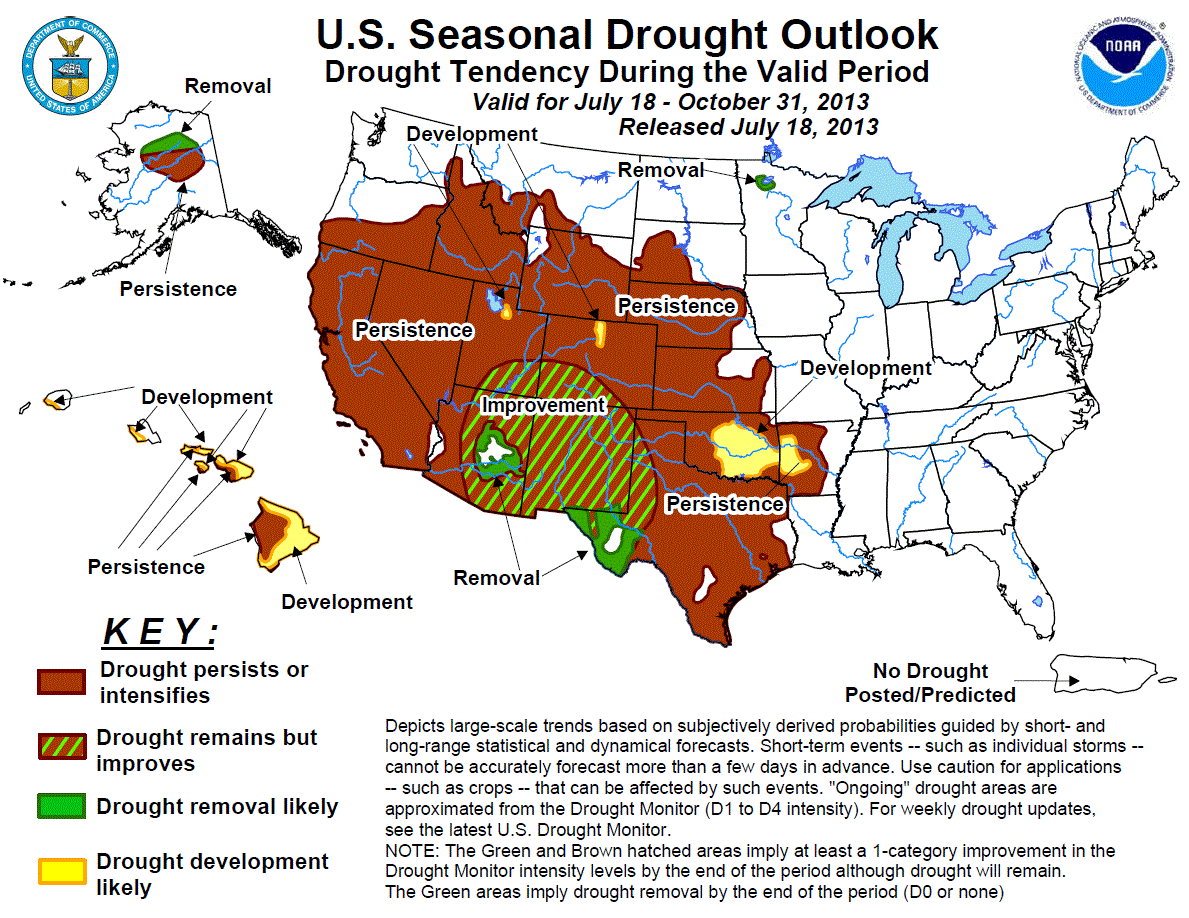
Here’s the drought outlook map from the Climate Prediction Center at NOAA:
U.S. Seasonal Drought Outlook Map, released May 19, 2011, NOAA and the Climate Prediction Center - click image for a larger version at NOAA's site.
It would be wonderful were these droughts to break soon. But that is very unlikely.
So, why would anyone deny it?
Then, just to indicate the bait-and-switch logic these guys use, Goddard came back with a claim that the 1956 drought in Texas was worse, as if that means the current drought doesn’t exist. Fore reasons apparent only to those whose heads get pinched by tinfoil hats, he also notes the CO2 levels for 1956. I think I know what point he’s trying to make, but someone should tell him that apples are not oranges, and comparing apples and oranges to pomegranates doesn’t increase the supply of tennis balls.
Let’s just stick to the facts. The experts who must operate the dams and lakes and get water to Mexico on schedule say the drought along the Colorado persists. Who are we to gainsay them?
Upper Colorado snowpack map (it looks good, if you like a surplus of snow, except for the drainage area right around Lake Powell, where the drought is still strong)
The late, great Utah Gov. Scott Matheson commented on snowmelt floods that required Salt Lake City to turn major roads into rivers: “It’s a helluva way to run a desert.”
Who blames Rachel Carson, an environmentalist icon, because her crusading writings against DDT led to the ban of this insecticide in countries around the world — followed by a resurgence of malaria that killed, and continues to kill, millions of people in tropical Third World countries?
To which I responded:
Rachel Carson Homestead painting of Ms. Carson: “Rachel Carson, a child of the Allegheny Valley, was a writer and an ecologist. There have been great writers whose descriptions of natural history and stories of the natural world charm and delight readers; and there have been scientists whose work excites the public attention. Rachel Carson rises to a heroic stature because her conscience called for action, not only words.” (Painting by Minette Bickel)
Who blames Rachel Carson?
Only someone ignorant of malaria and DDT, or someone with a real political axe to grind.
Malaria did not “resurge” when DDT was banned on cotton crops in the U.S. The U.S. ban did not extend to Africa, and DDT has never been banned in Africa nor most of Asia.
Malaria deaths have declined steadily over the past 50 years, generally as DDT use was reduced. In 1959 and 1960, the peak years of DDT use, 4 million people died from malaria, worldwide. WHO cut back on DDT use in 1965 when mosquitoes began showing serious resistance and immunity to the stuff, but by 1972, when the U.S. banned agricultural use of DDT (but continued exports), about 2 million people died annually from malaria.
Today, largely without DDT, malaria deaths are down to under 900,000 — a 75% reduction in deaths from peak DDT use.
Instead, since 2000 we’ve been using integrated vector management (IVM) to hold mosquito populations down, and we’ve been using improved medical care to treat humans who have malaria. IVM and beefed up medical care was what Rachel Carson recommended in her book, Silent Spring, in 1962.
So, there is no cause-effect relationship between Ms. Carson and the U.S. ban on DDT, nor between that ban and malaria deaths. In fact, there are fewer malaria deaths now than when DDT was used irresponsibly.
Carson was right. It’s a good thing wise people listened to her.
Who knows what comments see the light of day over there?
How many times will conservative commentators of all stripes abuse the DDT/Rachel Carson story before they start getting it right? How much does that skew their views from the accurate and wise view?
Spread the word; friends don't allow friends to repeat history.
The extreme right-wing Heritage Foundation lashed out at health care workers and scientists fighting malaria in Africa and Asia for World Malaria Day, April 25 (HF’s post showed up on May 5). If these malaria fighters really were smart, HF’s Jane Abel wrote, they’d just poison Africa with DDT instead of protecting children with bednets and working to improve medical care. According to Abel, DDT is safe for everyone but mosquitoes, and more effective than anything else malaria fighters use — so they are stupid and venal, she asserts, for not using DDT.
Here’s her post:
Environmentalists celebrated World Malaria Day last week (and Earth Day the week prior). Meanwhile, thousands of African children died of malaria.
While these activists may make themselves feel like they’re saving the world, they are ignoring the best possible solution to Africa’s malaria problem: the use of DDT to wipe out the Anopheles mosquito.
Even though the World Health Organization resumed promotion of DDT in September 2006—realizing it had the best track record for saving the lives of 500 million African children—environmentalists are still emphasizing the use of bed nets instead. DDT treatments almost completely eradicated the disease in Europe and North America 50 years ago, but today an African child dies every 45 seconds of malaria.
Providing sub-Saharan Africans with bed nets has had far from acceptable success in delivering the amount of protection needed from mosquitoes. The World Bank touts the fact that 50 percent of children in Zambia are now sleeping under nets as a good thing, but what about the other half who are left defenseless against a killer disease? The Democratic Republic of the Congo had only 38 percent of children under nets in 2010.
One would question why, in the 21st century, people should have to live inside of a net in order to be safe from malaria. The world has a better solution, and it’s not the quarantine of African infants. Dr. John Rwakimari, as head of Uganda’s national malaria program, described DDT, which is nontoxic to humans, as “the answer to our problems.”
World Malaria Day 2011 had the theme of “Achieving Progress and Impact” and aims to have zero malaria deaths by 2015. If the world really wants to make progress and increase the number of lives saved from malaria, it needs to embrace for Africans the best possible technologies available today, and that means DDT.
Here’s my response, which I predict will not show up at HF’s blog in any form*:
DDT is toxic to humans — just not greatly and acutely so. Ms. Abel should be aware of recent studies that indicate even limited, indoor use of DDT in the end produces a death toll similar to malaria. But we digress on just one of the errors assumed by Ms. Abel.
Please do not forget that malaria is a parasite disease, and that mosquitoes are only the carriers of it. To truly eradicate malaria, we need to cure the humans — and if we do that, the mosquitoes do not matter. With no infected humans, mosquitoes have no well of disease to draw from. Without infected humans, mosquitoes cannot spread malaria.
Only 38 percent of children in Congo sleep under bednets? I’ll wager that’s twice the percentage of kids that were ever protected from malaria in Congo by DDT. In actual tests in Africa over the past decade, bednets have proven to reduce malaria by 50 to 85 percent; DDT, on the other hand, reduces malaria only 25 to 50 percent under the best conditions. If we have to go with one and not the other, bednets would be the better choice. Nets are much, much cheaper than DDT, too. DDT applications must be repeated every 6 months, at a cost of about $12 per application per house. Nets cost about $10, and they last five years. Nets protect kids for $2 a year, better than DDT; DDT protects kids for $24 a year (that’s 12 times the cost), but not as effectively as nets.
Also, it’s important to remember that DDT has never been banned in Africa. DDT non-use is much more a result of the ineffectiveness of DDT in many applications — why should we expect Africans to throw away hard-earned money on a pesticide that doesn’t work?
Finally, it’s also good to understand that, largely without DDT, malaria deaths are, today, at the lowest point in human history. Fewer than 900,000 people a year die from malaria today. That’s 25% of the death toll in 1960, when DDT use was at its peak.
Ms. Abel assumes that all Africans are too stupid to use DDT, though it might save their children. He states no reason for this assumption, but we should question it. If Africans do not use DDT, it may well be because the local populations of mosquitoes are not susceptible; or it could be because other solutions, like bednets, are more effective, and cheaper.
Ms. Abel has not made a case that DDT is the best solution to use against malaria. DDT cannot improve a nation’s medical care delivery systems, to quickly diagnose and appropriately treat malaria in humans. DDT cannot make mosquitoes extinct, we know from 66 year of DDT use that mosquitoes always come roaring back. DDT cannot prevent mosquitoes from spreading malaria as effectively as bednets.
Maybe, just maybe, as evidenced by the dramatic reductions in malaria deaths, we might assume that modern Africans and health care workers know what they’re doing fighting malaria — and they do not need, want, or call for, a lot more DDT than is currently in use.
It’s too bad Heritage Foundation fell victim to so much junk science, and that the otherwise august press release operation pushes the grand DDT hoaxes. Just once, wouldn’t it be nice if these conservative echo chambers would, instead of recycling the old, wrong press releases of other conservatives, would do a little research on their own, and get the facts right?
_______________
* It’ll be fun to watch. I sent my response early, early in the morning while rushing to get a presentation ready, and I made a couple of egregious typos, including identifying Jonathan Weiner as “Stephen Weiner.” If HF wished to embarrass me, they’d publish that one out of their moderation queue — but I’ll bet that even with my typos, they can’t allow the facts through. Also, for reasons I can’t figure, some guy named Thurman showed as the author of HF’s piece on May 5. So I had referred to Mr. Thurman instead of Ms. Abel. Interesting technical glitch, or story, there.
_______________
Update, May 8: As we should have expected, Steven Milloy’s Junk Science Side Bar also went on record as favoring the poisoning of Africa rather than the fighting of malaria. Milloy makes claims that DDT will beat malaria (ostensibly before it kills all life in Africa), but his sources don’t support the claim. Milloy is always very careful to never mention that, largely without DDT, the death toll from malaria is at the lowest point in human history. Instead he notes that while malaria fighters promoted World Malaria Day, lots of African kids died of malaria. That’s true, but misleading. Because of the malaria-fighting efforts of those Milloy tries to impugn, far fewer African kids die. Contrary to Milloy’s insane and offensive claims, it’s not alright that “only people” die. Milloy asserts implicitly that, but for environmentalists, thousands or millions of children would survive that do not know. That’s not true: Because of the work that Milloy denigrates, millions fewer die. It wasn’t environmentalists who overused DDT and rendered it ineffective in the fight against malaria, it was Milloy’s funders. Follow the money.
Spread the word; friends don't allow friends to repeat history.
Jerome Corsi, that serial fictionalizer of vital issues, has a book out promoting his slimy schemes besmirch President Obama. Goddard urges people to buy it.
But they really pile on in the comments. It’s almost as if Casey Luskin had a whole family just like himself, and they got together to whine about Judge Roberts again.
Warming denialism, creationism and birthers — is it all just three minor variations on the same brain-sucking virus? Or could three different diseases produce the same sort of crazy on so many different issues?
I’m reminded of the old saw that you cannot reason a person out of a position he didn’t reach by reason. These guys will never see the light. Heaven knows, it ain’t evidence that gets ’em where they are now.
Every once in a while a factoid crosses the desk and/or mind of an otherwise badly-informed person who denies global warming is a problem, and without bothering to check the significance of the factoid, the denialist world ramps up The Crazy Rant.
Former AGW poster child Lake Powell water levels have been rising rapidly over the last few years.
Goddard’s claim is a grand example of the triumph of ignorance over experience, science, data, history and the law, in discussions of climate change.
Did Goddard read his own chart? It shows a decline in lake level from 2010.
Goddard’s own chart shows a decline in Lake Powell’s March 20 level, from 2010; did he look at the chart? Even Goddard’s source says, “Lake Powell is 89.99 feet below Full Pool (Elevation 3,700).”
“Full pool” level is 3,700 feet elevation (the height of the surface of Lake Powell above sea level). Goddard’s chart shows the lake hasn’t been at that level since 2000 (and it was declining for some time prior to that). Goddard’s chart shows four years of rise compared to seven years of decline.
In the Upper Colorado River Basin during water year 2010, the overall precipitation accumulated through September 30, 2010 was approximately 90% of average based on the 30 year average for the period from 1971 through 2000. For Water Year 2011 thus far, the estimated monthly precipitation within the Upper Colorado River Basin (above Lake Powell) as a percentage of average has been: (October – 135%, November – 95%, December – 225%, January – 50%, February – 100%, March – 90%)
The Climate Prediction Center outlook (dated March 17, 2010) for temperature over the next 3 months indicates that temperatures in the Upper Colorado River Basin are expected to be above average while precipitation over the next 3 months is projected to be near average in the northern reaches of the basin while below average in the southern reaches of the basin.
Upper Colorado River Basin Drought
The Upper Colorado River Basin continues to experience a protracted multi-year drought. Since 1999, inflow to Lake Powell has been below average in every year except water years 2005 and 2008. In the summer of 1999, Lake Powell was close to full with reservoir storage at 23.5 million acre-feet, or 97 percent of capacity. During the next 5 years (2000 through 2004) unregulated inflow to Lake Powell was well below average. This resulted in Lake Powell storage decreasing during this period to 8.0 million acre-feet (33 percent of capacity) which occurred on April 8, 2005. During 2005, 2008 and 2009, drought conditions eased somewhat with near or above average inflow conditions and net gains in storage to Lake Powell. 2011 will be another above average inflow year so drought conditions are easing somewhat in the Colorado River Basin. As of April 18, 2011 the storage in Lake Powell was approximately 12.73 million acre-feet (52.3 % of capacity) which is below desired levels. The overall reservoir storage in the Colorado River Basin as of April 18, 2011 is approximately 31.40 million acre-feet (52.8 % of capacity).
Updated: April 19, 2011
“Desert mirage,” editorial discussion of Lake Powell’s climate-change-fueled dropping levels threatening a water project for St. George, Utah, with discussion of U.S. Research Council report on future levels of Lake Powell; Salt Lake Tribune, January 6, 2010. “Lake Powell’s current water level is 59 percent of capacity. The lake level, around 20 million acre-feet in 2000, dropped to about 8 million acre-feet by 2005. Water levels rebounded a bit over the next two years, but the U.S. National Research Council predicted in 2007 that the American West could see worse droughts in the future than the one Utahns experienced from 1998 to 2005. In fact, the early 20th century, when the Colorado compact was negotiated, was an anomaly, a relatively wet period for an otherwise historically much drier area.”
BuRec says very large snow pack is enough to avert shortages in the Lower Colorado, this year — but the drought continues: “The Colorado River Basin has experienced historic drought, and while this winter’s snowpack will benefit river flows, we cannot say that the drought is over,” cautioned Commissioner Connor. “Given the potential for extended dry years, and the effects of climate change on snowpack and runoff in the Colorado Basin, we must continue to work with the states, tribes and other stakeholders in the Basin to meet the water needs in the future.”
New York Times Green Blog, “A reprieve for Western Water users”; “What if this year is an anomaly — not like the year 1983, a gusher of a rain year that was followed by four more fat years, but like the other above-normal years that came and went in the last decade without really denting the impact of the long-term drought?”
Spread the word; friends don't allow friends to repeat history.
Or, until that account is unsuspended by the forces supporting Donald Trump: Follow @FillmoreWhite, the account of the Millard Fillmore White House Library
We've been soaking in the Bathtub for several months, long enough that some of the links we've used have gone to the Great Internet in the Sky.
If you find a dead link, please leave a comment to that post, and tell us what link has expired.
Thanks!
Retired teacher of law, economics, history, AP government, psychology and science. Former speechwriter, press guy and legislative aide in U.S. Senate. Former Department of Education. Former airline real estate, telecom towers, Big 6 (that old!) consultant. Lab and field research in air pollution control.
My blog, Millard Fillmore's Bathtub, is a continuing experiment to test how to use blogs to improve and speed up learning processes for students, perhaps by making some of the courses actually interesting. It is a blog for teachers, to see if we can use blogs. It is for people interested in social studies and social studies education, to see if we can learn to get it right. It's a blog for science fans, to promote good science and good science policy. It's a blog for people interested in good government and how to achieve it.
BS in Mass Communication, University of Utah
Graduate study in Rhetoric and Speech Communication, University of Arizona
JD from the National Law Center, George Washington University


 Posted by Ed Darrell














 Millard Fillmore's Bathtub