Cute pictures of polar bears, masking tragedy

March 17, 2015

It came from @planetpics on Twitter.

A beautiful picture of a polar bear cub getting a lift across the water from its mom!  Life on Earth/@planetpics

“A beautiful picture of a polar bear cub getting a lift across the water from its mom!” Life on Earth/@planetpics

Couldn’t help but wonder if that cub will survive the next few months, let alone to adulthood.

Generally, polar bear mothers den on pack ice, and the cub would be kept on the ice while the mother hunted from that platform.  Polar bears can swim, but not well, and not far, usually.  They cannot hunt while swimming.  To eat, they wait on the ice for seals to come up for air, then grab the seals.

Lack of hard ice platforms, pack ice, means mother polar bears can’t hunt to feed their cubs.  While an adult polar bear can swim a distance to find ice, the cubs can’t. And if the adult doesn’t find hard ice, they perish.  Long swims are deadly to cubs.

It’s a cute pic, and we hope momma bear is swimming to an ice platform and can feed that cute little cub so it grows and flourishes.

We know the odds are against it.


Queenstown, New Zealand: “Why we fly,” and what most people never get to see

February 9, 2015

Old buddy Gil Brassard (from the airline days) sent me a slightly different version of this video; this is the YouTube version from “Mr. Goodviews.” It’s shot from the cockpit of a commercial airliner coming into Queenstown, New Zealand:

Details:

Published on Oct 23, 2013

…sometimes what a pilot sees in a day, people won’t see in their lifetimes..
amazing Queenstown, New Zealand.
I invite people of the world to come visit this beautiful country and its people.

It was probably shot with a camera like a GoPro stuck on the window pointing out, in robot mode so the copilot and pilot gave full attention to flying the aircraft, and were not distracted by operating a camera in a cockpit.  I mention this because US Federal Aviation Administration is looking into claims that selfies from cockpits — usually of small planes — may have contributed to accidents in the air.  We may see some bans on shooting such videos in the future.

Enjoy ’em while you can.

Noodling around YouTube, I also found these videos of airplanes in and out of Queenstown, New Zealand.

Landing without the clouds:

Published on Apr 4, 2013

ZQN Baret arrival

And a passenger’s view of take-off and climb-out (longer piece, no music edited in):

Published on Feb 7, 2014

Flying over New Zealand from south to north. Nice views of Lake Wakatipu and Queenstown. Passing over Mount Cook – the highest mountain in New Zealand. Later a landing at Auckland Airport.

Better videos of this route anywhere?

Even cooler videos of other routes?

Can’t say how often I’ve regretted not having a good video camera on my flight from Farmington, New Mexico, to Provo, Utah, in a Cessna, especially coming down Provo Canyon.  But alas, that was before video was even portable . . .


Coffee City? Population seems awfully low

February 6, 2015

Coffee City sign.

Coffee City, Texas

Our friend Jim Stanley posted this on Facebook.

Population count seems too low, doesn’t it?  Must be a pretty tight filter.

Caption these yourself. From the City of Coffee City website.

Caption these yourself. From the City of Coffee City website.

More:


Happy New Year from Yellowstone NP

January 27, 2015

(Yeah, I’m behind. Tell me news.)

New Year’s felicitations from Yellowstone National Park.

The Yellowstone in winter is best, the old timers tell me.  I agree.

Details:

Published on Jan 1, 2015

Winter landscapes in Yellowstone inspire artist and NPS employee Lynn Bickerton Chan. Produced by NPS/Neal Herbert.  600


Yosemite Park’s Dawn Wall climbers: They made it!

January 15, 2015

Tommy Caldwell and Kevin Jorgeson on January 14 completed their free-climb ascent of the 3,000-foot Dawn Wall on El Capitan in Yosemite National Park — labeled the toughest free climb in the world.

Wow. Just wow.

The path up, the Dawn Wall on El Capitan.  San Francisco Chronicle graphic by John Blanchard, on a photo by Nate Ptacek/Patagonia

The path up, the Dawn Wall on El Capitan. San Francisco Chronicle graphic by John Blanchard, on a photo by Nate Ptacek/Patagonia

This interactive piece at the New York Times should give the proper sense of awe for what they’ve done. (If you’re a climber, you may want to get some more technical reports from YosemiteBigWall.com, who contributed to that interactive presentation.)

PBS’s Newshour had among the best reports:


Yosemite Nature Notes: Ghost towns

January 13, 2015

Up on the Tioga Pass, Dana Village, Bennettville and the abandoned Golden Crown Mine tell part of the story of the 1890s gold rush in the Sierra Nevada.

Mining in California, okay. Mining at 11,000 feet in the Sierra Nevada, and staying there all winter?

Great history, geography, and explanation that every U.S. history student should know, about gold rushes, about boom towns, about mining entrepreneurs and investors, about failed enterprises and about the aftermath.

Published on Nov 19, 2014

Sitting on the crest of the Sierra Nevada, Tioga Pass is a gateway to Yosemite’s past. In 1880, a gold and silver rush erupted here, and miners flocked to Tioga Hill in droves.

Today, the ghosts of these miners work can be seen in the stone walls of Dana Village, rusty machinery at Bennettville, and the log cabins of the Golden Crown Mine. Even today’s popular Tioga Road was once a simple wagon road built to access the wealth of minerals that were never found.

It’s another great production by Steven Bumgardner, featuring two National Park Service rangers, Yenyen Chan and Greg Stock.

More:

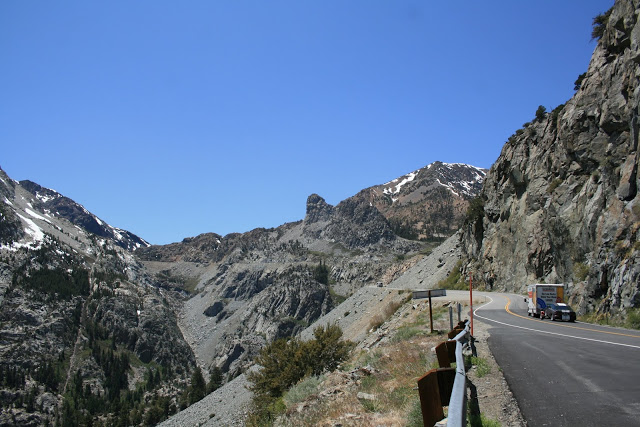
Tioga Road.  Travelers who took this photo made the drive in a large RV -- so you can do it, too.  Photo from stillhowlynntravels

Tioga Road. Travelers who took this photo made the drive in a large RV — so you can do it, too. Photo from stillhowlyntravels

Map showing how to get to Tioga Pass in Yosemite National Park (at the eastern end of the red line).  Map from Undiscovered-Yosemite.com.

Map showing how to get to Tioga Pass in Yosemite National Park (at the eastern end of the red line). Map from Undiscovered-Yosemite.com.


Texas earthquakes, 2014

January 7, 2015

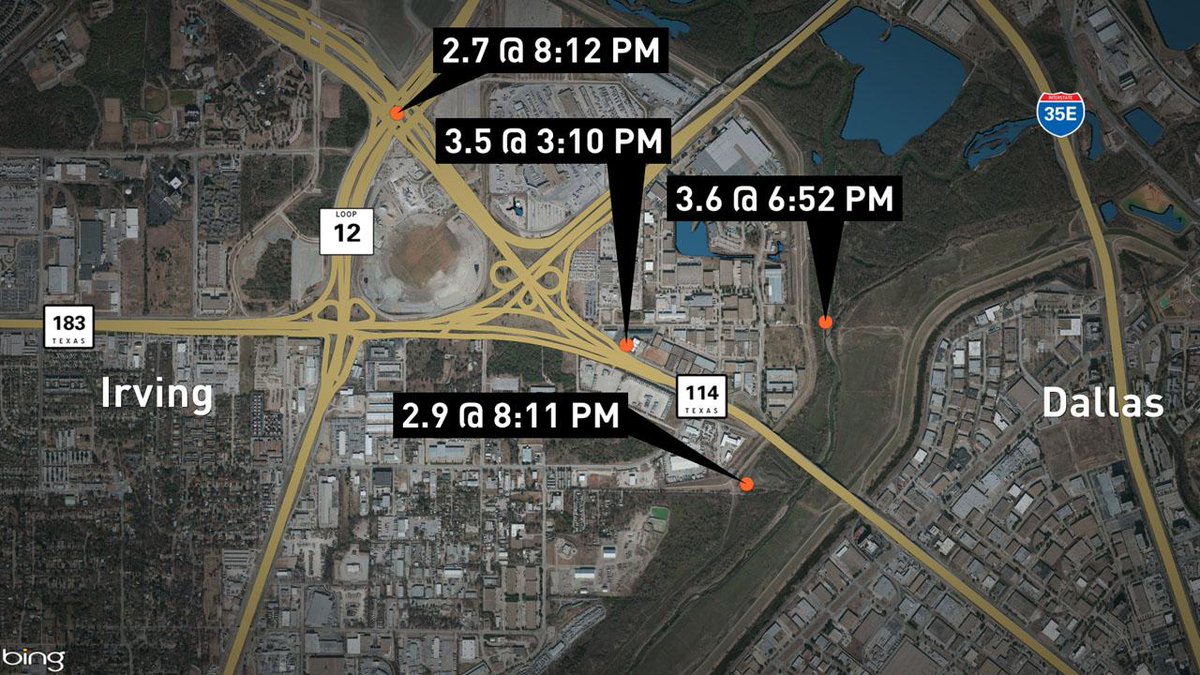
WFAA Channel 8 map of four quakes confirmed by 10:00 p.m. news casts, showing how close the quakes are in proximity to each other and the site of the old Cowboys Football Stadium.

WFAA Channel 8 map of four quakes confirmed by 10:00 p.m. news casts, showing how close the quakes are in proximity to each other and the site of the old Cowboys Football Stadium.

This Tweet from our local NBC TV affiliate sums it up nicely.

North Texas shook yesterday — not big quakes, but a bunch of ’em — and that doesn’t sit well with Texas oil executives, since it seems likely gas and oil drilling, especially hydraulic fracturing (fracking), and especially waste-water reinjection seem to be causes.

I grew up in Utah.  We had quakes you could feel, at least weekly.  Our home sat less than a mile west of the Wasatch Fault.  Many mornings my mother would stand drinking her coffee, looking over the stove and out our kitchen window at Mt. Timpanogos, remarking on the earthquakes.  Most often we couldn’t feel them, but the power and telephone lines that slashed through our $10 million view of the mountain would dance in sine waves during quakes. It was pretty cool.

Along the more famous faults, one rarely comes on more than a couple of quakes a day.

Dallas — more accurately, Irving — is far away from most major faults, and rarely has more than a couple of quakes a year in recent human history.

So this swarm of quakes makes news!

WTVT Channel 11 (CBS) reported:

DALLAS (CBSDFW.COM/AP) – Nine earthquakes, three of them with a 3-point magnitude or greater, rocked North Texas Tuesday into early Wednesday, knocking items off walls, causing cracks to appear in ceilings and generally rattling nerves across the region.

“The last one really shook,” said CBS 11 anchor and reporter Ken Molestina, who felt the the earth move in the White Rock Lake area of Dallas.

The latest quake, reported just before 1 a.m. Wednesday, measured in at a 3.1 magnitude, and was centered near the convergence of State Highway 114, Loop 12, and the Airport Freeway near the old Texas Stadium site in Irving.

Others felt the temblor in the Uptown area of Dallas and as far away as Bedford and Mesquite.

Here’s a list of the quakes in order of when they happened:

7:37 a.m.                    2.3 magnitude

3:10 p.m.                    3.5 magnitude

6:52 p.m.                    3.6 magnitude

8:11 p.m.                    2.9 magnitude

8:12 p.m.                    2.7 magnitude

9:54 p.m.                    1.7 magnitude

10:05 p.m.                  2.4 magnitude

11:02 PM                   1.6 magnitude

12:59 AM                   3.1 magnitude

Rafael Abreu, a geophysicist with the USGS, spoke with NewsRadio 1080 KRLD and said while the Irving earthquakes happened only hours apart, given the strength and intensity, “we’re not calling it an aftershock.”

At last count Tuesday night, there had been 24 or more earthquakes in the Irving area since November 1, 2014.

Jokes fly, too.  Not this much shaking since Elvis toured the area heavily in 1957, some say.

Screen capture of USGS reports of four earthquakes in or near Irving, Texas, on January 6, 2014

Screen capture of USGS reports of four earthquakes in or near Irving, Texas, on January 6, 2014

Recent studies show earthquakes in other areas linked to oil and gas drilling and extraction.  All of these quakes are in close proximity to working wells or wells being drilled.

What’s the Earth trying to tell us?

Details from USGS on biggest quake, January 6, 2014

Details from USGS on biggest quake, January 6, 2014

More:

Historically, Texas has not been a hotbed of earthquake activity, between 1973 and 2012.  Texas Seismicity Map from USGS.

Texas Seismicity, 1973-2012. USGS


Devil’s Tower, Wyoming, and stars at night

January 5, 2015

Tweet from the Wilderness Society. Devil's Tower National Monument, in Wyoming, at night.

Tweet from the Wilderness Society. Devil’s Tower National Monument, in Wyoming, at night. Photo by Alex Weimer, from his flickr feed


January 3, 1959: Welcome, Alaska, and the 49-star flag — 55 years ago

January 3, 2015

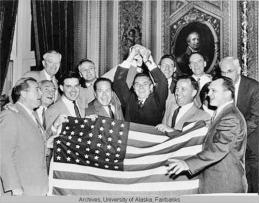
Alaska Territorial Gov. Bob Bartlett in center, with the 49-star flag (Bartlett was one of Alaska's first U.S. senators).

Alaska Territorial Gov. Bob Bartlett in center, with the 49-star flag (Bartlett was one of Alaska’s first U.S. senators).

The great service at the New York Times site, the Learning Network, notes the 1959 Dwight Eisenhower proclamation of Alaska as the 49th state, and the unveiling of the 49-star flag:

On Jan. 3, 1959, President Dwight Eisenhower signed a proclamation admitting Alaska to the Union as the 49th state. The New York Times noted that the signing included the unveiling of the new 49-star American flag.

The land that became Alaska came into U.S. possession in 1867, when William Seward, secretary of state under President Andrew Johnson, negotiated a deal to buy the 586,000-square-mile area from Russia for $7.2 million, less than 2 cents per acre. Seward’s decision was ridiculed in the American press, who saw no potential in the vast, inhospitable and sparsely populated area.

For decades after its purchase, Alaska was derided as “Seward’s folly” or “Seward’s icebox.” This opinion changed in 1896 with the discovery of gold in the neighboring Yukon Territory, which spurred tens of thousands of people to head to Alaska in search of gold. The gold rush also brought about a boom in mining, fishing and trapping.

Though the first statehood bill had been presented to Congress in 1916, there was little desire in either Alaska or Washington for Alaskan statehood until after World War II. During the war, the U.S. established multiple military bases to resist Japan’s attacks on Alaska’s Aleutian Islands and prevent a potential invasion of the mainland. The military activity, along with the completion of a major highway from Montana, led to a large population growth.

In 1946, Alaskans voted in favor of statehood in a referendum and Alaskan delegates began to lobby Congress for statehood. After years of debate, Congress voted in June 1958 to admit Alaska.

Eight months after Alaska’s admission, on Aug. 21, 1957 [should be 1959, no?], Hawaii became the 50th state. The 49-star remained in place until the following July 4, when it was replaced by the now-familiar 50-star flag.

49-star flags were produced only until August 1959, so there are few of them around.  I love this photo of the unveiling of the flag with President Eisenhower:

President Eisenhower and Quartermaster General MG Andrew T. McNamara, with 49-star flag - image from QM foundation

“Quartermaster General MG Andrew T. McNamara and President Eisenhower examine new 49 star flag” – image and caption from the Quartermaster Foundation. (Who are the other two people?  The guy on the right looks to me a bit like is Pennsylvania’s Sen. Hugh Scott.)

It had been about 47 years since the previous state admission (Arizona); people became aware that no law set what the flag should look like.  President Eisenhower issued a directive.

How did the nation survive for 170 years without firm, decisive and conclusive orders on what the flag should look like?  Isn’t it a great story that we went so long without law setting the requirements?

Alaska's state flag design came from 13-year old Benny Benson.

Alaska’s state flag design came from 13-year old Benny Benson. Benny Benson holding the Alaska flag at the Jesse Lee Home, Seward, Alaska. ASL-P01-1921, Alaska State Library-Historical Collections.


Alaska’s state flag came from the imagination of a 13-year-old Aleut, Benny Benson, winning a contest to design the state’s flag.  Alaska’s flag stands out in any display of U.S. state flags.

Yes, this is mostly an encore post.  Fighting ignorance requires patience.

Yes, this is mostly an encore post. Fighting ignorance requires patience.


Time lapse of latest eruption of Mexico’s Popocatépetl Volcano

December 30, 2014

It’s a 17-second video, a compilation of photos (over how much time?) showing the December 29, 2014 eruption of Popocatépetl.

Published on Dec 29, 2014

Eruptions are captured by webcamsdemexico, which is another indication that good, inexpensive electronic imaging devices change the way we study and experience natural events in the world today.

17 seconds of great drama. Are there other good images from this eruption?

Satellite photo of Popocatepetl, earlier. Image via CNN/Mexico

Satellite photo of Popocatepetl, earlier. Image via CNN/Mexico

More:


Vancouver painted in timelapse

December 3, 2014

Nice way to see a city.  From Daniel Chen.

Details offered from the photographer:

Lights + City + Timelapse

Enjoy!

Gear: Canon Full Frame (5D3, 6D, someolder shots on crop)
Many lenses but mostly Rokinon 14mm, Tamron 24-70mm VC
Custom timelapse MOCO

Track: Energico by AJ Hochhalter

Tip of the old scrub brush to SuperVancouver.


Star trails at the Desert View Watchtower

December 3, 2014

Wilderness Society on Twitter:  Star trails over the famous Desert View Watchtower at the Grand Canyon. Have a good night...  (Photo by Spencer Goad)

Wilderness Society on Twitter: Star trails over the famous Desert View Watchtower at the Grand Canyon. Have a good night… (Photo by Spencer Goad)

More:

  • Desert View Watchtower – South rim lookint across to the North Rim (I wonder what are those lights across the Canyon?)
  • Who is Spencer Goad?  THE Spencer Goad?

Snow brings beauty to Conway Summit, California

November 21, 2014

From our public lands, from the Twitter feed of the U.S. Department of Interior:

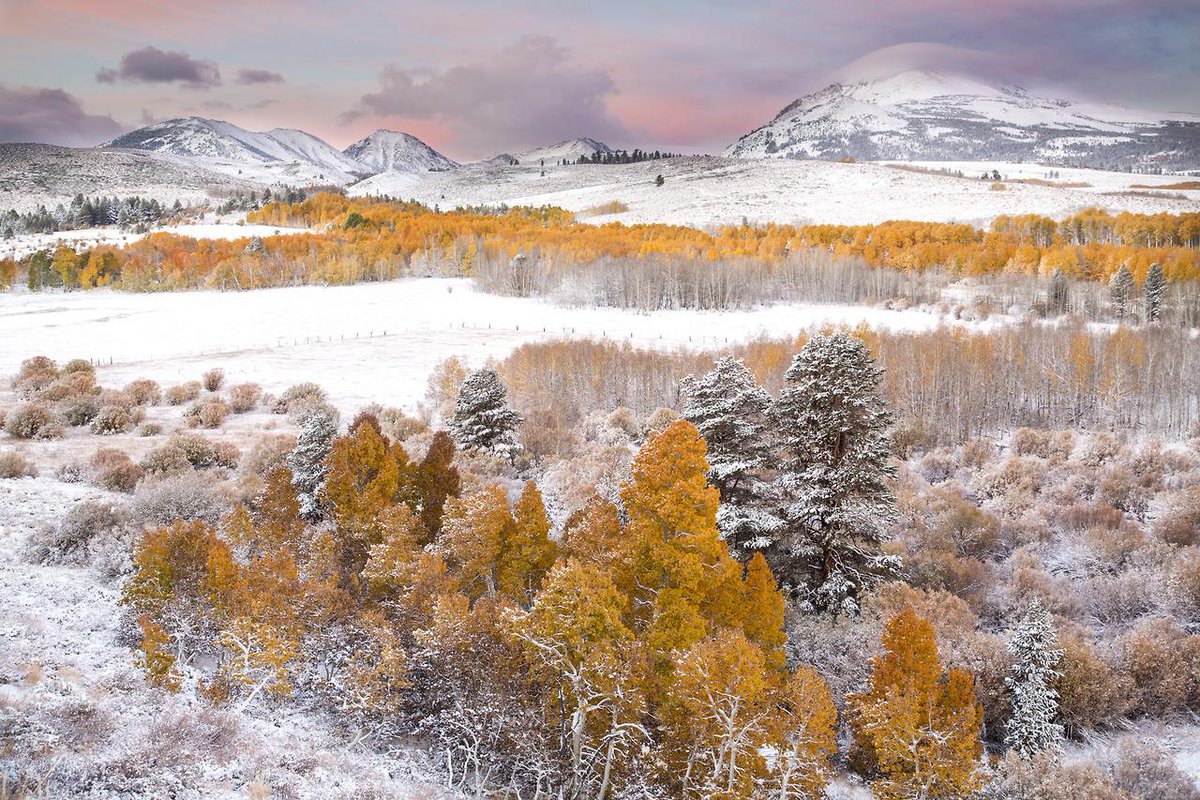
@Interior caption: Fall foliage and snow-capped peaks make for a stunning shot of Conway Summit #California @BLMca #nature

@Interior caption: Fall foliage and snow-capped peaks make for a stunning shot of Conway Summit #California @BLMca #nature

In my winter drives through the desert mountains of the Great Basin I often marveled at how a dusting of snow could turn a landscape generally painted in tones of brown with a little green into almost black and white. Then there are those black and white landscapes slashed by stunning gashes of color, or tinted subtley.

Conway Summit shows the stunning gashes of color this week. Grays, whites, blacks — and gold and pink.  It’s in the western part of California, near Nevada and Mono Lake:

Conway Summit (el. 8,143 feet (2,482 m)) is a mountain pass in Mono County, California. It is traversed by U.S. Highway 395, which connects Bridgeport and the East Walker River on the north side of the pass to Mono Lake and Lee Vining to the south.[1][2] It marks the highest point on U.S. 395, which also traverses high passes at Deadman Summit and Devil’s Gate Pass.[3]

Conway Summit is named after John Andrew Conway, a settler in the area in 1880.[3][4] Geographically, it was formed from an upland plateau by the sinking of the land in the Mono basin area.[5] The Sawtooth Ridge of the eastern Sierra Nevada, topped by 12,279-foot (3,743 m) Matterhorn Peak, rise to the west of the pass; Green Creek and Virginia Lakes, in the Sierra Nevada to the west of the pass, are two local destinations for fishing, camping and aspen trees. The Bodie Hills and the infamous Bodie ghost town lie to the east.

This scene comes from our public lands, the undifferentiated lands held in trust by the Bureau of Land Management (BLM) and managed for multiple uses.  You and I may look at this photo and marvel at the beauty of America, and say a little prayer of thanks for our public lands.  Sens. Mike Lee and Ted Cruz see potential for high-dollar vacation residences throughout this scene, if only the land could be sold off.


Does a name seal one’s geographic fate?

September 28, 2014

A site out of Utah that compiles a list of blogs based in Utah County, around Provo, lists Millard Fillmore’s Bathtub as one of the local products.

It’s tough to complain.  The site doesn’t drive much traffic my way, but there is an occasional foray.  The Bathtub can use all the traffic drivers anyone wants to provide for free, in honest linking.

There’s some good company on the list.  Jared Stein writes about education issues from Utah Valley University, and his blog is listed there.  (One must appreciate a blog that correctly uses a clip of the Black Knight sequence from Monty Python in discussing on-line education resources.)

Mount Timpanogos is based in Utah County.  It’s a beautiful, underappreciated block of ancient stone.

Mount Timpanogos at sunset.  Timpanogos is the second highest mountian in the Wasatch Front (11,752 ft/3,582 m), and forms the eastern border of Utah County.  Wikipedia image, photo by Eric Ward from Provo, UT, USA - Mount Timpanogos - 01/19/08

Mount Timpanogos at sunset. Timpanogos is the second highest mountian in the Wasatch Front (11,752 ft/3,582 m), and forms the eastern border of Utah County. Wikipedia image, photo by Eric Ward from Provo, UT, USA – Mount Timpanogos – 01/19/08.  The founder/editor of this blog has been inspired by this mountain for years, particularly in those years that it greeted him each morning from his bedroom window.

But the Bathtub is not based in Utah County, despite the reference to the mountain in the URL.

It’s great to have something of beneficial serendipity to note, in contrast with our usual observations that the “idiots” are carrying us all to hell in an uncomfortable and inadequately air-conditioned hand basket.

(Writing this reminds me that I’ve never been to the summit; anybody organizing a hike soon, and need a now-flatlander blogger along?)

Another important clue:  Amazon.com is not a company located in the Brazilian rainforest.


Scotland in time-lapse

August 30, 2014

Neat views of Scotland, as the nation steams toward a vote on independence from the United Kingdom.

A still capture from the film, Dynamic Scotland.

A still capture from the film, Dynamic Scotland.

Roger Jackaman created it:  Dynamic Scotland

Jackaman said:

Please subscribe to the channel for future films and follow me on facebook:  https://www.facebook.com/Dy…

I took more than 10,000 photos during the making of this of which 6-7000 made the final cut. Itwas filmed mainly in and around Edinburgh but also includes some scenes from the Glencoe area.Music licensed by: “Moonlight Reprise” by Kai Engel (http://kaiengelmusic.wix.co…)

Tip of the old scrub brush to CBS News Twitter feed.  Thanks to Mr. Jackaman for putting it up on YouTube, also. It deserves more than 3,196 views.