Happy birthday as a state, Texas! – 170 years old

December 29, 2015

It’s Texas Statehood day, the 170th anniversary of Texas joining the Union — or as some Texans prefer, the anniversary of Texas’s making America great.

According to the U.S. flag code, people should fly their U.S. flags on their state’s statehood day.

Not many Texans are, if any. Can you find someone honoring statehood day?

texas our texas

U.S. and Texas flags at the Texas Capitol – photo: jmtimages

170 years ago today: Rub your pet armadillo’s belly, slaughter the fatted longhorn, crank up the barbecue pit with the mesquite wood, put Willie Nelson and Bob Wills on the mp3 player, put the “Giant” DVD on the television, and raise your glass of Big Red, Dr. Pepper, or Lone Star Beer (or Pearl, or Shiner Bock, Sir Williams English Brown Ale, or Llano Wine).

U.S. Flag Code rules urge flying the U.S. flag on the anniversary of a state’s joining the Union — even as much as that will frost the tiny band of desperate Texas secessionists.  (Will the secessionists fly the Texas flag at half-staff?)

Texas was admitted to the union of the United States of America on December 29, 1845.

President Polk's authorization to affix Great Seal of the U.S. to Texas Statehood documents

President Polk’s Authorization to affix the Great Seal to Texas Statehood documents – Texas Memorial Museum, University of Texas at Austin

The text of Polk’s message:

I hereby authorize and direct the Secretary of State to affix the Seal of the United States to an authenticated copy of “an act to extend the laws of the United States over the State of Texas and for other purposes” approved Dec. 29, 1845 dated this day, and signed by me and for so doing this shall be his warrant.

James K. Polk
Washington, Dec. 29, 1845

Seal of the U.S. affixed to Texas Statehood Proclamation

Great Seal of the United States of America, affixed to the Texas Statehood Proclamation – image from State Archives Division, Texas State Library

Resources:

More:

The Texas Ranger Museum took note of the day (no, not the baseball Rangers):

Yes, this is mostly an encore post. Fighting ignorance requires patience.

Yes, this is mostly an encore post. It is an annual event, after all. And, fighting ignorance requires patience and persistence.


EPA intervenes to clean up mystery toxic dump threatening Texas county’s water

September 29, 2015

Maybe EPA should take Texas Gov. Greg Abbott’s advice, and go door to door asking who did it.

U.S. Environmental Protection Agency (EPA) announced Monday the agency will work to stop a toxic plume of tetrachloroethylene (PCE) that threatens to contaminate well waters in Burnet County.

The source of the plume, and who dumped the stuff, are unknowns.

EPA’s announcement:

EPA Adds Burnet Co., TX, Groundwater Plume to National Priorities List of Superfund Sites

Five hazardous waste sites added, seven proposed nationally

(DALLAS – Sept. 28, 2015)  The Environmental Protection Agency (EPA) added the Main Street Groundwater Plume site in Burnet Co., TX, to the National Priorities List (NPL) of Superfund sites, a list of sites that pose risks to people’s health and the environment. Superfund is the federal program that investigates and cleans up the most complex, uncontrolled or abandoned hazardous waste sites in the country and converts them into productive community resources by eliminating or reducing public health risks and environmental contamination.

The site lies about one mile south of the city of Burnet between County Road 340 and County Road 340 A. A plume of tetrachloroethylene, or PCE, was found in the groundwater in this area during monitoring of the Bertram Public Water Supply in 2010. The source of the contamination is unknown.

“Texans understand how precious water resources are for families and businesses,” said EPA Regional Administrator Ron Curry. “Addressing contamination helps alleviate the risk to the community and return property to economic use.”

The plume released into the Ellenburger-San Saba Aquifer, and contaminated two public water supply wells and seven private wells. Monitoring indicates levels in drinking water wells are below EPA’s health-based maximum contaminant level (MCL). Two wells that exceeding the MCL are used for irrigation and livestock watering. Exposure to PCE could harm the nervous system, liver, kidneys, and reproductive system, and may lead to higher risk of some types of cancer.

EPA regularly works to identify companies or people responsible for the contamination at a site, and requires them to conduct or pay for the cleanup. For the newly listed sites without viable potentially responsible parties, EPA will investigate the extent of the contamination before assessing how best to treat it.

This year marks the 35th anniversary of the enactment of the Comprehensive Environmental, Response, Compensation and Liability Act (CERCLA), the law establishing the Superfund program. Superfund’s passage was a giant step forward in cleaning up legacy industrial waste sites to help ensure human health and environmental protection. The Superfund law gives EPA the authority to clean up releases of hazardous substances and directs EPA to update the NPL at least annually. The NPL contains the nation’s most serious uncontrolled or abandoned hazardous waste sites. The list serves as the basis for prioritizing both enforcement actions and long-term EPA Superfund cleanup funding; only sites on the NPL are eligible for such funding.

Federal Register notices and supporting documents for the final and proposed sites:
http://www.epa.gov/superfund/sites/npl/current.htm

Information about how a site is listed on the NPL:
http://www.epa.gov/superfund/sites/npl/npl_hrs.htm

Superfund sites in local communities:
http://www.epa.gov/superfund/sites/index.htm

More information about the Comprehensive Environmental Response, Compensation and Liability Act (CERCLA), the law establishing the Superfund program, can be found at:
http://epa.gov/superfund/policy/cercla.htm

More about activities in EPA Region 6 is available at http://www.epa.gov/aboutepa/region6.html

# # #

Tetrachloroethylene is a commonly used solvent, often used in dry cleaning of fabrics and degreasing metal parts.  The chemical is also known as perchloroethane, or perc. It was first synthesized in 1821 by Michael Faraday. It is volatile, but highly stable and not flammable.

EPA documents say, “Effects resulting from acute (short term) high-level inhalation exposure of humans to tetrachloroethylene include irritation of the upper respiratory tract and eyes, kidney dysfunction, and neurological effects such as reversible mood and behavioral changes, impairment of coordination, dizziness, headache, sleepiness, and unconsciousness.” It is classed as a Type 2A chemical for carcinogenicity, which means it is a probable human carcinogen, but not a potent one.

x

Burnet County, outlined in red, covers parts of five different watersheds. EPA map

Burnet County, outlined in red, covers parts of five different watersheds. EPA map

Burnet County is in Central Texas, in red on this EPA map

Burnet County is in Central Texas, in red on this EPA map

x

x

x

x

x

x

x

x

x

x

x

More:


How do Texas’s voter ID laws hurt Texas voters? This film shows how

April 30, 2015

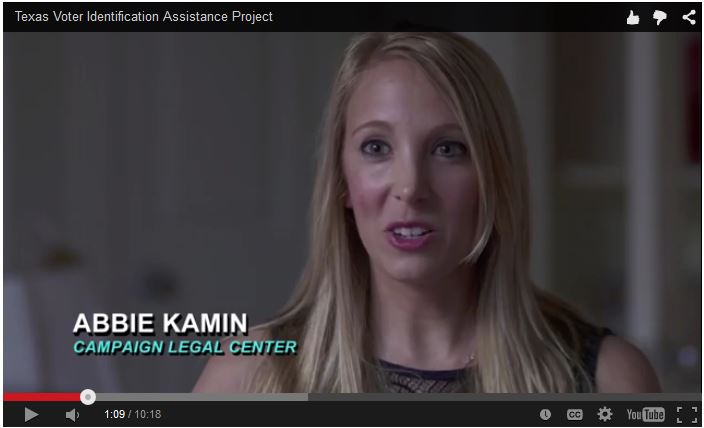
Abbie Kamin, a Houston lawyer assisting Texas voters keep their right to vote, explains how Texas's voter ID laws hurt Texans, and damage democracy in the U.S.

Abbie Kamin, a Houston lawyer assisting Texas voters keep their right to vote, explains how Texas’s voter ID laws hurt Texans, and damage democracy in the U.S.

Video you won’t see at 11.

From the Texas Voter Identification Assistance Project, at the Campaign Legal Center.

Description:
Published on Apr 24, 2015

Under Texas’ new restrictive photo/voter ID law, more than 600,000 Texans now lack sufficient identification to vote in elections, with little to no help from the State of Texas to resolve the problems. The Texas Voter Identification Assistance Project, coordinated by the Campaign Legal Center, a nonpartisan nonprofit, provided assistance to Texas voters who wished to vote but lacked the newly required identification, and thus were disenfranchised.

At the Campaign Legal Center’s site, there’s a press release on the video, released to correspond with arguments on voter identification issues at the Fifth Circuit Court of Appeals.

CLC FILM RELEASE: On Day of Fifth Circuit Oral Argument, Meet Victims of Texas Voter Photo ID Law

CLC Staff

Apr 28, 2015

Today, the Campaign Legal Center released a short film focusing on three lifelong voters disenfranchised by Texas’ voter photo ID law (SB 14), the most restrictive and burdensome voter ID law in the nation.  The ten-minute film produced by Firelight Media traces the efforts of the Campaign Legal Center’s Voter ID Project to assist registered voters to overcome the many hurdles erected by the new law in order to obtain the photo IDs required by SB 14.

Today in Veasey v. Abbott, oral arguments will be heard in a challenge to that law, in the U.S. Court of Appeals for the Fifth Circuit in New Orleans.  Attorneys at the Campaign Legal Center serve as co-counsel for plaintiffs Congressman Marc Veasey, LULAC, and a group of Texas voters.

Following a two-week trial last fall, U.S. District Court Judge Nelva Gonzales Ramos enjoined SB 14, finding that it was as an unconstitutional burden on the right to vote as well as an unconstitutional poll tax, had “an impermissible discriminatory effect against Hispanics and African-Americans, and was imposed with an unconstitutional discriminatory purpose.”  The state defendants immediately appealed Judge Ramos’ decision. In mid-October, the Fifth Circuit Court of Appeals stayed that decision solely to avoid confusion in the November 2014 elections, and the U.S. Supreme Court subsequently refused to vacate the Fifth Circuit’s stay.

The film released today traces the plight of three Texans who were victims of the Texas voter photo ID law and the massive effort required of many voters to exercise their right to vote under the new law.

“These longtime voters were had their voting rights violated because of SB 14 which the District Court found to be unconstitutional and in violation of the Voting Rights Act,” said J. Gerald Hebert, Executive Director of The Campaign Legal Center.  “The plight of these victims, who suffered a violation of their voting rights through no fault of their own, mirrors the evidence that prompted Judge Ramos to strike down Texas’ intentionally discriminatory, modern-day poll tax.”

The first challenge (Veasey v. Perry) to the Texas photo ID law was filed by the Campaign Legal Center and others in the summer of 2013 claiming that SB 14 violates the 1st, 14th, 15th and 24th Amendments to the Constitution, as well as Section 2 of the Voting Rights Act.  Several additional challenges were then brought against the Texas law (including one by the United States).  All of the cases were consolidated in the Southern District of Texas in Corpus Christi.

In addition to overseeing the Voter ID Project, the Campaign Legal Center is part of the legal team representing the Veasey-LULAC plaintiffs that includes Chad Dunn and K. Scott Brazil (Brazil & Dunn), Neil G. Baron, David Richards (Richards, Rodriguez & Skeith), Armand Derfner (Derfner & Altman), and Luis Roberto Vera, Jr. (LULAC).

To read the Legal Center’s Fifth Circuit brief, click here.

To read the District Court decision striking down the Voter ID law, click here.

Tip of Millard’s old scrub brush to Michael Li.


True story: Yellow Rose of Texas saved Texas at the Battle of San Jacinto

April 21, 2015

This is mostly an encore post, for the 179th anniversary of the Battle of San Jacinto.

After suffering crushing defeats in previous battles, and while many Texian rebels were running away from Santa Anna’s massive army — the largest and best trained in North America — Sam Houston’s ragtag band of rebels got the drop on Santa Anna at San Jacinto, on April 21, 1836. Most accounts say the routing of Santa Anna’s fighting machine took just 18 minutes.

San Jacinto Day is April 21. Texas history classes at Texas middle schools should be leading ceremonies marking the occasion — but probably won’t since it’s coming near the end of the state-mandated testing which stops education cold, in March.

Surrender of Santa Anna, Texas State Preservation Board

Surrender of Santa Anna, painting by William Henry Huddle (1890); property of Texas State Preservation Board. The painting depicts Santa Anna being brought before a wounded Sam Houston, to surrender.

San Jacinto Monument brochure, with photo of monument

The San Jacinto Monument is 15 feet taller than the Washington Monument

How could Houston’s group have been so effective against a general who modeled himself after Napoleon, with a large, well-running army? In the 1950s a story came out that Santa Anna was distracted from battle. Even as he aged he regarded himself as a great ladies’ man — and it was a woman who detained the Mexican general in his tent, until it was too late to do anything but steal an enlisted man’s uniform and run.

That woman was mulatto, a “yellow rose,” and about whom the song, “The Yellow Rose of Texas” was written, according story pieced together in the 1950s.

Could such a story be true? Many historians in the 1950s scoffed at the idea. (More below the fold.) Read the rest of this entry »


Coffee City? Population seems awfully low

February 6, 2015

Coffee City sign.

Coffee City, Texas

Our friend Jim Stanley posted this on Facebook.

Population count seems too low, doesn’t it?  Must be a pretty tight filter.

Caption these yourself. From the City of Coffee City website.

Caption these yourself. From the City of Coffee City website.

More:


Texas earthquakes, 2014

January 7, 2015

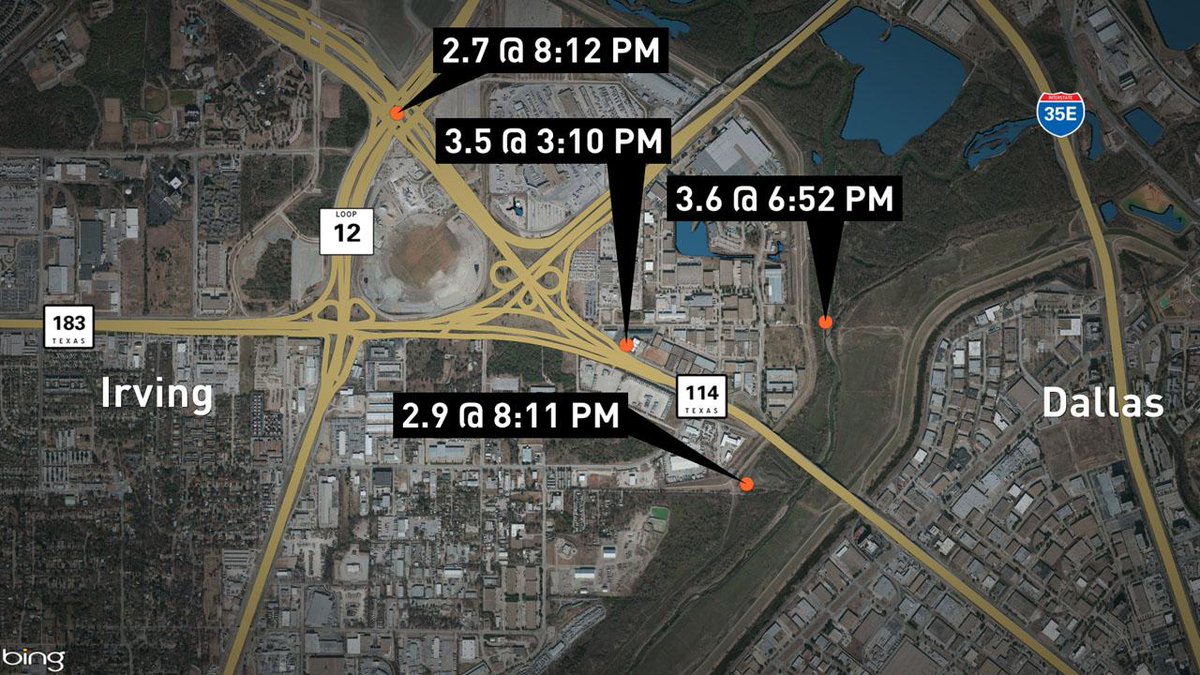
WFAA Channel 8 map of four quakes confirmed by 10:00 p.m. news casts, showing how close the quakes are in proximity to each other and the site of the old Cowboys Football Stadium.

WFAA Channel 8 map of four quakes confirmed by 10:00 p.m. news casts, showing how close the quakes are in proximity to each other and the site of the old Cowboys Football Stadium.

This Tweet from our local NBC TV affiliate sums it up nicely.

North Texas shook yesterday — not big quakes, but a bunch of ’em — and that doesn’t sit well with Texas oil executives, since it seems likely gas and oil drilling, especially hydraulic fracturing (fracking), and especially waste-water reinjection seem to be causes.

I grew up in Utah.  We had quakes you could feel, at least weekly.  Our home sat less than a mile west of the Wasatch Fault.  Many mornings my mother would stand drinking her coffee, looking over the stove and out our kitchen window at Mt. Timpanogos, remarking on the earthquakes.  Most often we couldn’t feel them, but the power and telephone lines that slashed through our $10 million view of the mountain would dance in sine waves during quakes. It was pretty cool.

Along the more famous faults, one rarely comes on more than a couple of quakes a day.

Dallas — more accurately, Irving — is far away from most major faults, and rarely has more than a couple of quakes a year in recent human history.

So this swarm of quakes makes news!

WTVT Channel 11 (CBS) reported:

DALLAS (CBSDFW.COM/AP) – Nine earthquakes, three of them with a 3-point magnitude or greater, rocked North Texas Tuesday into early Wednesday, knocking items off walls, causing cracks to appear in ceilings and generally rattling nerves across the region.

“The last one really shook,” said CBS 11 anchor and reporter Ken Molestina, who felt the the earth move in the White Rock Lake area of Dallas.

The latest quake, reported just before 1 a.m. Wednesday, measured in at a 3.1 magnitude, and was centered near the convergence of State Highway 114, Loop 12, and the Airport Freeway near the old Texas Stadium site in Irving.

Others felt the temblor in the Uptown area of Dallas and as far away as Bedford and Mesquite.

Here’s a list of the quakes in order of when they happened:

7:37 a.m.                    2.3 magnitude

3:10 p.m.                    3.5 magnitude

6:52 p.m.                    3.6 magnitude

8:11 p.m.                    2.9 magnitude

8:12 p.m.                    2.7 magnitude

9:54 p.m.                    1.7 magnitude

10:05 p.m.                  2.4 magnitude

11:02 PM                   1.6 magnitude

12:59 AM                   3.1 magnitude

Rafael Abreu, a geophysicist with the USGS, spoke with NewsRadio 1080 KRLD and said while the Irving earthquakes happened only hours apart, given the strength and intensity, “we’re not calling it an aftershock.”

At last count Tuesday night, there had been 24 or more earthquakes in the Irving area since November 1, 2014.

Jokes fly, too.  Not this much shaking since Elvis toured the area heavily in 1957, some say.

Screen capture of USGS reports of four earthquakes in or near Irving, Texas, on January 6, 2014

Screen capture of USGS reports of four earthquakes in or near Irving, Texas, on January 6, 2014

Recent studies show earthquakes in other areas linked to oil and gas drilling and extraction.  All of these quakes are in close proximity to working wells or wells being drilled.

What’s the Earth trying to tell us?

Details from USGS on biggest quake, January 6, 2014

Details from USGS on biggest quake, January 6, 2014

More:

Historically, Texas has not been a hotbed of earthquake activity, between 1973 and 2012.  Texas Seismicity Map from USGS.

Texas Seismicity, 1973-2012. USGS


Texas Statehood, December 29, 1845 – 169 years ago

December 29, 2014

It’s Texas Statehood day, the 169th anniversary of Texas joining the Union — or as some Texans prefer, the anniversary of Texas’s making America great.

According to the U.S. flag code, people should fly their U.S. flags on their state’s statehood day.

Not many Texans are, if any. Can you find someone honoring statehood day?

texas our texas

U.S. and Texas flags at the Texas Capitol – photo: jmtimages

169 years ago today: Rub your pet armadillo’s belly, slaughter the fatted longhorn, crank up the barbecue pit with the mesquite wood, put Willie Nelson and Bob Wills on the mp3 player, put the “Giant” DVD on the television, and raise your glass of Big Red, Dr. Pepper, or Lone Star Beer (or Pearl, or Shiner Bock, or Llano Wine).

U.S. Flag Code rules urge flying the U.S. flag on the anniversary of a state’s joining the Union — even as much as that will frost the tiny band of desperate Texas secessionists.  (Will the secessionists fly the Texas flag at half-staff?)

Texas was admitted to the union of the United States of America on December 29, 1845.

President Polk's authorization to affix Great Seal of the U.S. to Texas Statehood documents

President Polk’s Authorization to Affix the Great Seal to Texas Statehood documents – Texas Memorial Museum, University of Texas at Austin

The text of Polk’s message:

I hereby authorize and direct the Secretary of State to affix the Seal of the United States to an authenticated copy of “an act to extend the laws of the United States over the State of Texas and for other purposes” approved Dec. 29, 1845 dated this day, and signed by me and for so doing this shall be his warrant.

James K. Polk
Washington, Dec. 29, 1845

Seal of the U.S. affixed to Texas Statehood Proclamation

Great Seal of the United States of America, affixed to the Texas Statehood Proclamation – image from State Archives Division, Texas State Library

Resources:

More:

The Texas Ranger Museum took note of the day (no, not the baseball Rangers):

Yes, this is mostly an encore post.  Fighting ignorance requires patience.

Yes, this is mostly an encore post. It is an annual event, after all. And, fighting ignorance requires patience and persistence.


Dallas in the fog

December 10, 2014

Enough of the jokes about how nature makes Dallas beautiful by covering everything up.

There were some nice views of Dallas today, with the fog, though.

From WFAA-TV’s tower camera, just before sunrise:

Dallas in the fog, December 9, 2014; photo from WFAA-TV's tower camera.

Dallas in the fog, December 9, 2014; photo from WFAA-TV’s tower camera.

This photo produced the most stir, I think.  Terry Maxon posted it at his Aviation Blog with the Dallas Morning News:

Maxon wrote:

Maxon wrote: “Mike Alvstad was flying into Dallas/Fort Worth on Tuesday morning and took a photo as his flight from Tampa, Fla., passed south and west of downtown Dallas. He shared it with Lee Evans, who shared it with us, and we liked it a lot.”

Looking for landmarks?  Maxon explained:

In the sea of clouds, you can see the top of Reunion Tower a bit lower to the right. There’s the wedge-topped Fountain Place in the lower center of the downtown cluster. Off to the left by itself is Cityplace, we believe.

Note that even though we could barely see a block ahead of us at ground level, the skyscrapers are casting shadows on the top of the fog clouds.

You want to see what it looked like from the upper floors of those buildings?  Kathryn’s office is below the clouds.  When I worked in the high floors of the old Ling/Temco/Vought Building (now Trammell Crow Tower, I think) we didn’t have cell phones with cameras, and electronic imaging was in its commercialized infancy.  I never had the old 35mm film cameras with me on those few occasions when we rode the elevators up out of the fog, and could almost wave to someone in the tower across the way.  Justin Turveen got off a few shots today, but is being stingy with the photos at his flickr site. Check it out if you wish.

It was foggy across the area starting last night, including Denton, which is home to the University of North Texas and Texas Women’s University:

Photo by Samantha Irene Balderas, at the campus of the University of North Texas (UNT), December 8, 2014

Photo by Samantha Irene Balderas, at the campus of the University of North Texas (UNT), December 8, 2014

Jeff Rogers got a sunrise in McKinney, through the fog:

Sunrise through fog in McKinney, Texas. Photo by Jeff Rogers

Sunrise through fog in McKinney, Texas. Photo by Jeff Rogers

Angelica Villalobos Yates took her camera with her walking the dog; quintessential Texas fog shot:

Angelica Villalobos Yates surprised a tree in the Texas fog.

Angelica Villalobos Yates surprised a tree in the Texas fog.

Toni Wolff Margolis caught birds on a wire in the fog.

Toni Wolff Margolis caught birds on a wire in the fog.

From the tall buildings in downtown Dallas, a shot by Cindy Ackerson Bivins:

Photo from the Bank of America Tower of other Dallas buildings in the fog, December 9, 2014.  Photo by Cindy Ackerson Bivins

Photo from the Bank of America Tower of other Dallas buildings in the fog, December 9, 2014. Photo by Cindy Ackerson Bivins

Mike Prendergrast at Aerial DFW.com sent his DJI Phantom 2 Vision Plus Drone to work, rising above the clouds, with good results, I think. He had me when I read that he included some time-lapse in there . . .

(Yes, Prendergrast is a great guy, and a good photographer, and he followed the rules and stayed low and out of the way of aircraft.)

Do you have a nice shot of Dallas in the fog to share?  Send it to me, or post it in comments.

More:

Tip of the old scrub brush to Suzy Bangs, who I hope is joining us again this week to take a hot Christmas meal and cheer to the good people at the Pleasant Grove Senior Recreation Center (that’s Pleasant Grove, Texas). Thanks, too, for the splash from Dubious Quality (who is this Gilbert fellow?).


Babe Ruth and a Circle 10 Council, BSA, Boy Scout, 1929

November 4, 2014

1929 photo of Babe Ruth, with Robert W. Johnsey, a Dallas Boy Scout.

1929 photo of Babe Ruth, with Robert W. Johnsey, a Dallas Boy Scout.

An old library photo?

A Facebook page called Traces of Texas posted this photo, with this explanation:

Babe Ruth and a Dallas boy scout, In 1929, the era’s most famous, revered, and idolized American sportsman, George Herman “Babe” Ruth, came to Dallas to speak on behalf of the Circle Ten Council and promote scouting to local businessmen. After delivering a rousing speech to a packed house, a Dallas Morning News photographer asked him for a picture. The Babe motioned to a Scout to join him. And for young Robert W. Johnsey, that must have been the highlight of his life.

Where did Traces of Texas get those details, and the photo?

I can find data bases that list a Robert W. Johnsey from Dallas, born in 1916, and dying in Dallas in 1995.  Without paying the fat fees demanded, I learn that one database said he died having never married.  Right age, but is that the right guy?

Then I find notes for a France Ray Mead Johnsey at Find A Grave.  It says she died in 2004, preceded in death by her husband Robert, who died in 1995.

Interesting little mysteries.

Anybody Remember  a Robert W. Johnsey from Dallas, Texas?  Can you give us more details?

Babe Ruth returned to Dallas in 1947. Dallas Observer noted:  On July 6, 1947, it was announced that George Herman Ruth would be coming to Dallas on July 9. The occasion: an appearance during a double-header at Rebel Stadium in Oak Cliff on behalf of the American Legion junior baseball program. That Wednesday would be known, according to the ad that ran on Page Four of The Dallas News, as Babe Ruth Day in Dallas, featuring

Babe Ruth returned to Dallas in 1947. Dallas Observer noted: On July 6, 1947, it was announced that George Herman Ruth would be coming to Dallas on July 9. The occasion: an appearance during a double-header at Rebel Stadium in Oak Cliff on behalf of the American Legion junior baseball program. That Wednesday would be known, according to the ad that ran on Page Four of The Dallas News, as Babe Ruth Day in Dallas, featuring “the immortal and beloved” ballplayer who’d been gravely ill only six months earlier. Tickets for his appearance at the ballpark ran one dollar, 30 cents for students.


Leigh Bailey in Texas House District 108

October 31, 2014

Not my district, but if it were, I’d vote for Leigh Bailey.

The Trailblazers Blog at the Dallas Morning News described the race:

Meyer, a Republican, and Bailey, a Democrat, are competing for an open seat in House District 108. The district covers the Park Cities, Preston Hollow and central Dallas. Meyer is the heavy favorite in the GOP stronghold, but Bailey is trying to win independent voters and newcomers to Uptown, Downtown Dallas and East Dallas.

Candidates for Texas House, District 108, Republican Morgan Meyer on the left, and Democrat Leigh Bailey on the right.  Dallas Morning News photos

Candidates for Texas House, District 108, Republican Morgan Meyer on the left, and Democrat Leigh Bailey on the right. Dallas Morning News photos

In my conversations with both candidates, Republican Morgan Meyer seemed distant, stiff, and unwilling to say anything that wasn’t approved by Corporate HQ (whose? I don’t know).

Bailey took time to talk, about life in Dallas, how to make it better, what an uphill fight she has.  Dallas schools, and what it might take to make people see the improvements already there, and how to support teachers and students . . .

In short, Bailey is much more human, and for my money, much more attuned to the needs of Texas, Texas families, and making things work in Austin.

When you vote Tuesday, Dallasites, if you’re in District 108, vote for Leigh Bailey.


Early voting opens in Texas: Polling place shenanigans?

October 20, 2014

If you are confronted with voting irregularities at your polling station in Texas, call 1-844-TXVOTES (1-844-898-6837)

If you are confronted with voting irregularities at your polling station in Texas, call 1-844-TXVOTES (1-844-898-6837)

A friendly reminder from BattleGround Texas:  If you experience voting irregularities at your polling station in Texas, call 1-844-TXVOTES (1-844-898-6837).

Vote early!


Warning signs in Texas

September 7, 2014

On several Texas rivers one may rent a large tire inner tube, to float down the river on a good day.

Safety instructions sometimes are minimal, but effective.

Safety rules at a river float rental company, location unknown. Photo via Cathy Ordemann

Tip of the old scrub brush to Cathy Ordemann.


Saving the plains bison, at Caprock Canyon State Park, Texas

July 8, 2014

Few days go by that I don’t hear from some Texas yahoo about the futility of conservation, especially attempts to save sustainable populations of animals near or teetering on the brink of extinction.

American bison galloping. Photos by Eadweard Muybridge, first published in 1887 in Animal Locomotion. Wikipedia image

American bison galloping. Photos by early motion-studying photographer Eadweard Muybridge, first published in 1887 in Animal Locomotion. Wikipedia image

Conservation works.  Conservation works in Texas.  How can they ignore stories like this one, about the conservation of the plains bison, at Texas’s Caprock Canyon State Park?

This film from the Texas Parks and Wildlife Department illustrates and discusses the work going on at Caprock Canyon SP to keep a herd of bison there healthy and reproducing:

Published on Feb 1, 2013

Caprock Canyons State Park in the Texas Panhandle holds the last remnants of pure Southern Plains Bison that once numbered in the millions on this land. Watch as this historic herd is restored to its native habitat. For details on visiting the park, see http://www.tpwd.state.tx.us/state-par…

If we had a national mammal, is there much doubt the noble American buffalo would be it?

Defenders of Wildlife range map, showing where to find bison in North America. DoW said: Bison once roamed across much of North America. Today bison are ecologically extinct throughout most of their historic range, except for a few national parks and other small wildlife areas. Yellowstone National Park has the largest population of free-roaming plains bison (about 4,000), and Wood Buffalo National Park has the largest population of free-roaming wood bison (about 10,000).

Defenders of Wildlife range map, showing where to find bison in North America. DoW said: Bison once roamed across much of North America. Today bison are ecologically extinct throughout most of their historic range, except for a few national parks and other small wildlife areas. Yellowstone National Park has the largest population of free-roaming plains bison (about 4,000), and Wood Buffalo National Park has the largest population of free-roaming wood bison (about 10,000).

You can see that conservation is not easy, that serious conservation of animals takes cooperation between governments, federal, state, county and local.  Throw in migratory birds, and you’re talking international efforts.

But it’s worth it, at least to me.  Wholly apart from the direct benefits to humans — the discovery of drugs like digitalis and tamoxifen, for example — we learn so much about how the planet operates, how nature operates.  We get a view into the ideas of God, if not a direct view into the universe’s creative mind.

There are two recognized subspecies in North America: Bison bison bison and B. b. athabascae.  We have populations saved in small plots across the U.S.:  In and around Yellowstone National Park; on Antelope Island in the Great Salt Lake; in Utah’s Henry Mountains in the south central part of the state; at the LBJ Grasslands (National Forest); and at Caprock Canyons State Park.  At one time, millions of the plains subspecies migrated for hundreds, perhaps thousands of miles, harvesting grass and turning the soil to make the North American Great Plains one of the most productive habitats for plants and animals on the face of the Earth.  We screwed that up a bit.  The same area today does not produce equally to 200 years ago in fiber and meat, despite modern farming and ranching.

Maybe we can learn a lot more from these creatures, about how to keep food supplies going for that other common, though self-threatened species, Homo sapiens.

Probably can’t improve on the video, but I hope to get some good photos of these creatures for myself, this summer.  Check the map above. If your summer travels take you close to a population of bison, why not stop in and visit?

More:

World Wildlife Fund image of plains bison, mother and calf

World Wildlife Fund image of plains bison, mother and calf, and caption: Historically bison were the dominant grazer on the Northern Great Plains landscape. This dominance shaped the landscape by affecting the pattern and structure of the grasses and vegetation that grew, and it was this vegetation pattern that allowed animals to flourish.


Leticia Van De Putte will make Texans smile

July 3, 2014

As an introduction to her speech at the Texas State Democratic Party 2014 Convention last Friday, Lieutenant Governor candidate, Sen. Leticia Van De Putte produced a short video, making light of the serious issues of citizens trying to get the attention of Texas officials under the current GOP junta.

If nothing else, the Democrats offer someone with a much better sense of humor than the Republicans.

Published on Jun 28, 2014

Introducing Senator Van de Putte and family at the Texas Democratic Convention

Texas State Sen. Leticia Van De Putte; the Harvard-graduate, Texas pharmacist pushed the Texas Senate in good directions; she offers a solid record and outstanding ability for the Lieutenant Governor's office.  It Texas, the Lieutenant Governor makes the state budget, chairs the State Senate, and appoints people to several important boards and commissions, making the post more important than the Governor, in many calculations.

Texas State Sen. Leticia Van De Putte; the Harvard-graduate, Texas pharmacist pushed the Texas Senate in good directions; she offers a solid record and outstanding ability for the Lieutenant Governor’s office. It Texas, the Lieutenant Governor makes the state budget, chairs the State Senate, and appoints people to several important boards and commissions, making the post more important than the Governor, in many calculations.

Now, is there some way we can get the video of Van De Putte’s actual speech, or the text of it?  What she said of substance was even better than the video.

More:


EPA approves CO2 permit for Texas steel maker; anyone notice?

June 19, 2014

Here’s the press release from EPA’s Region 6 office:

EPA Finalizes Greenhouse Gas Permit for Voestalpine Iron Production Plant
$740M facility in San Patricio Co., TX, will bring 1,400 construction jobs and150 permanent jobs

DALLAS – (June 16, 2014) The U.S. Environmental Protection Agency (EPA) has issued a final greenhouse gas (GHG) Prevention of Significant Deterioration (PSD) construction permit to Voestalpine for an iron production plant in San Patricio County, TX. The facility’s process for producing iron will use minimal natural gas and will be 40 percent more efficient than traditional methods. The permit is another in the series of permits drafted by the Texas Commission on Environmental Quality (TCEQ) and issued by EPA under a program to facilitate timely permitting for applicants in the State of Texas.

“Voestalpine shows energy efficiency is a common-sense strategy for success, not just in business but for the environment as well,” said Regional Administrator Ron Curry. “The joint EPA and TCEQ permitting program is helping Texas business grow while building greener plants.”

The plant will reduce iron ore pellets, which will be used as raw material input at steel mills. The direct reduced iron process will use only clean-burning natural gas instead of solid fossil fuels. The estimated project cost is $740 million and will bring 1,400 construction jobs to the area. Once complete, the facility will create around 150 permanent jobs.

In June 2010, EPA finalized national GHG regulations, which specify that beginning on January 2, 2011, projects that increase GHG emissions substantially will require an air permit.

EPA believes states are best equipped to run GHG air permitting programs. Texas is working to replace a federal implementation plan with its own state program, which will eliminate the need for businesses to seek air permits from EPA. This action will increase efficiency and allow for industry to continue to grow in Texas.

EPA has finalized 43 GHG permits in Texas, proposed an additional six permits, and currently has 21 additional GHG permit applications under review and permit development in Texas.

For all of the latest information on GHG permits in Texas please visit: http://yosemite.epa.gov/r6/Apermit.nsf/AirP

Connect with EPA Region 6:
On Facebook: https://www.facebook.com/eparegion6
On Twitter: https://twitter.com/EPAregion6
Activities in EPA Region 6: http://www.epa.gov/aboutepa/region6.htm

Headquarters of Voestalpine, head-turning building by Dietmar Feichtinger Architectes, located in Linz, Austria.  Architecture News Plus image

Headquarters of Voestalpine, head-turning building by Dietmar Feichtinger Architectes, located in Linz, Austria. Architecture News Plus image. Voestalpine plans to build a $740 million steel plant near Corpus Christi, Texas.

This is big news, really.  Texas constantly complains about regulations on greenhouse gases, and regularly and constantly sues EPA to stop regulation.  Texas and it’s wacky governor Rick Perry constantly complain that EPA regulation harms jobs, and that permits never really get issued.  So this announcement should be front page news in most Texas newspapers.

How was it covered?

That’s it for Texas media.  Where are the Dallas Morning News, the Fort Worth Star-Telegram, the Houston Chronicle, the San Antonio Express, the El Paso Times?  Big market TV and radio?

National coverage was limited to low-circulation newsletters.

Seems to me that these issues of actual action on climate change, are under-reported.

More:

Groundbreaking for Voestalpine facility near Corpus Christi, Texas

Caption from Voestalpine LLC: After about a year of preparation, Wolfgang Eder, CEO of voestalpine, broke ground today for the construction of a direct reduction plant in Texas (USA). This EUR 550 million investment is the largest foreign investment in the history of the Austrian Group. The voestalpine Texas LLC plant is being constructed at the La Quinta Trade Gateway Terminal in close proximity to the City of Corpus Christi. Starting in 2016, the plant will produce two million tons of HBI (Hot Briquetted Iron) and DRI (Direct Reduced Iron) annually and will supply Austrian locations, such as Linz and Donawitz, with “sponge iron” as a premium raw material. With the new facility, voestalpine can significantly reduce production costs in Europe. The highly automated plant will create 150 jobs.