Firefall in Yosemite: Horsetail Fall’s spectacular February show

March 2, 2011

New program from Yosemite National Park’s “Nature Notes.”

This one has something to appeal to the heart of almost everybody:  Photos from Ansel Adams, photos from Galen Rowell, interviews with sons of each, discussion of the (properly) much-maligned old “firefall” of hot fire coals for tourists — and the story of the natural firefall one might see, if the conditions are right, and if one is in Yosemite in the right place, on the right days of February.

This video was produced by Steven M. Bumgardner, with extra camera help from Josh Helling.  Those guys do great work.  It features photographer Michael Frye, Michael Adams, Ansel Adams’ son, and Tony Rowell, the son of  Galen Rowell.


American Icons: Half Dome in Yosemite National Park

February 2, 2011

One of what should be an occasional series of posts on American iconic places, natural features, sights to see, etc.  For studies of U.S. history and U.S. geography, each of these posts covers subjects an educated American should know.  What is the value of these icons?  Individually and collectively, our preservation of them may do nothing at all for the defense of our nation.  But individually and collectively, they help make our nation worth defending.

This is a less-than-10-minute video you can insert into class as a bell ringer, or at the end of a class, or as part of a study of geologic formations, or in any of a number of other ways.  Yosemite Nature Notes provides glorious pictures and good information about Yosemite National Park — this video explains the modern incarnation of Half Dome, an enormous chunk of granite that captures the imagination of every living, breathing soul who ever sees it.

Potential questions for class discussion:

  • Have you put climbing Half Dome on your bucket list yet?  Why not?
  • Is it really wilderness when so many people go there?
  • How should the National Park Service, and the Forest Service and Bureau of Land Management, manage these spectacular, completely unique features, both to preserve their wild nature, and allow people to visit them?
  • What are the federalism issues involved in protecting Half Dome, or any grand feature, like the Great Smokey Mountains, Great Dismal Swamp, Big Bend, Yellowstone Falls, or Lincoln Memorial?
  • Does this feature make you wonder about how glaciers carve mountains and valleys?  (Maybe you should watch this video about glaciers in Yosemite.)
  • What is the history of the preservation of the Yosemite Valley?
  • Planning your trip to Yosemite:  Which large city airports might be convenient to fly to?  (What part of which state is this in?)
  • What other grand sights are there to see on your trip to Yosemite?
  • What does this image make you think?  Can you identify the people in it?

    John Muir and Teddy Roosevelt in Yosemite Valley

    Who are those guys? Why might it matter? (Answer below the fold)

  • How about this image? Who made this, and so what?

    Albert Bierstadt, Sunrise, Yosemite Valley, ca. 1870 - Amon Carter Museum, Fort Worth, Texas

    Photo or painting? Where could you see this work?

Read the rest of this entry »


Feeling like you’re ready to fly? Not here, Comrade!

December 30, 2010

No Walking Off Roofs!  Photo by Chris Jeffries

No Walking Off Roofs! Photo by Chris Jeffries

Some warning signs really do need an explanation.

But, what if your name is Peter Pan? What if you have some Pixie Dust?

Photo by Chris Jeffries, taken at the Peter and Paul Fortress in St. Petersburg, Russia.

No, not that one; this Chris Jeffries.


Tuba Christmas in Dallas, today at noon

December 24, 2010

Tuba Christmas!  Today, in Dallas!

DALLAS – FRIDAY, DECEMBER 24 – TIME: 12:00 noon [2010]
LOCATION: Thanks-Giving Square, corner of Bryan, Ervay & Pacific Streets, Downtown
NOTE: Local sponsorship provided by Brook Mays Music, McKay Music, Mr.E’s Music and Houghton Music.
GUEST CONDUCTOR: Donald Little

It’s cold and looking like rain — dress warmly.

Tuba Christmas, by Stephen Ferris, stephenferris-art.com

Tuba Christmas, by Stephen Ferris. You can own this print: stephenferris-art.com; click on the picture to go to his gallery

Tip of the old scrub brush for the artwork to Donald Miller.  Yes, that Donald Miller.

[Donald Miller said, at his blog, way back in 2008:

*Stephen Ferris’ artwork, “Tuba Christmas” is significant because it is a painting of the Portland site. The tent, under which the tubas are organized, is a staple. And the man in the hat is Dr. John Richards, who played in the Oregon Symphony for many years. He actually wears that hat each year because he also drives a submarine.]


As long as you’re in Nevada, see Fly Geyser

December 24, 2010

Way more than half the geysers in the world are in Yellowstone National Park.  There’s another big cluster in Iceland, and then a few in California.

But there are stragglers throughout the world, including this spectacular, nearly-man-made thing in Nevada:  Fly Geyser.

Nevada's Fly Geyser, Wikimedia image

Nevada's Fly Geyser, Wikimedia image, from Jeremy C. Munns; it's on private land, not open for tourists. Have you ever heard about it?

Lots of photos of the geyser at Kuriositas, where I learned of the thing.

It’s on private land, on Fly Ranch (from which the geyser and a nearby reservoir get their names), but visible from a public road.  You can find it about 20 miles north of Gerlach, on former State Route 34 (now County CR34) – in Washoe County in the northwest of the state.  From Interstate 80, one would need to drive west from Winnemucca on Nevada State Road 49(?), or north from Wadsworth on state highway 447, to Gerlach.

Locals drilled a well at the site in 1916.  For more than 40 years the well produced water with no problem.  But in 1960, the well blew out.  Hypothesis is that the well passed through heated rocks that contained water, and this heated, pressurized water blew out the well casing.  The geyser has been erupting since 1960, building the impressive mineral mountain seen in the photo.

More:


Stunning photo: What happened here, 795 years ago?

December 5, 2010

Runnymede, Magna Carta Isle, photo by Wyrdlight, Antony McCallum, 2008 (Wikimedia)

What event critical to western history and the development of the democratic republic in the U.S. happened here in 1215?

A teacher might use some of these photos explaining the steps to the Constitution, in English law and the heritage of U.S. laws.  Other than the Magna Carta, all the events of Runnymede get overlooked in American studies of history. Antony McCallum, working under the name Wyrdlight, took these stunning shots of this historic meadow.  (He photographs stuff for studies of history, it appears.)

Maybe it’s a geography story.

View of Runnymede Meadow from Engham Village -- Wyrdlight photo through Wikimedia

View of Runnymede Meadow from Engham Village -- Wyrdlight photo through Wikimedia

Several monuments to different events of the past millennium populate the site.  The American Bar Association dedicated a memorial to the Magna Carta there — a small thing open to the air, but with a beautiful ceiling that is probably worth the trip to see it once you get to England.

Wikipedia explains briefly, with a note that the ABA plans to meet there again in 2015, the 800th anniversary of the Great Charter:

Magna Carta Memorial


The Magna Carta Memorial & view towards the ‘medes’


Engraved stone recalling the 1985 ABA visit

Situated in a grassed enclosure on the lower slopes of Cooper’s Hill, this memorial is of a domed classical style, containing a pillar of English granite on which is inscribed “To commemorate Magna Carta, symbol of Freedom Under Law”. The memorial was created by the American Bar Association to a design by Sir Edward Maufe R.A., and was unveiled on 18 July 1957 at a ceremony attended by American and English lawyers.[5]

Since 1957 representatives of the ABA have visited and rededicated the Memorial renewing pledges to the Great Charter. In 1971 and 1985 commemorative stones were placed on the Memorial plinth. In July 2000 the ABA came:

to celebrate Magna Carta, foundation of the rule of law for ages past and for the new millennium.

In 2007 on its 50th anniversary the ABA again visited Runnymede and during the convention installed as President Charles Rhyne who devised Law Day which seeks in the USA an annual reaffirmation of faith in the forces of law for peace.

The ABA will be meeting at Runnymede in 2015 on the 800th anniversary of the sealing of the original charter.

The Magna Carta Memorial is administered by the Magna Carta Trust, which is chaired by the Master of the Rolls.[10]

In 2008, flood lights were installed to light the memorial at night, but due to vandalism they now lie smashed.

I’ll wager the lights get fixed before 2015.

Detail of ceiling of the Magna Carta Memorial, Runnymede - Wikimedia image

Detail of ceiling of the Magna Carta Memorial detailing play of light, and star pattern, Runnymede - Wikimedia image

More, resources:


Tuba Christmas near you?

November 28, 2010

Did I mention I really like a good tuba melody?  No, not the oompah back-up — I love it when tubas take the lead, when they sing as only a tuba can.

It’s that time of year I get a chance to hear organized tuba playing for Tuba Christmas.

Like here, in Dallas, at Thanksgiving Square  — the 31st annual Tuba Christmas (2008):

In Texas, the first performance I know of is in Brenham (home of Blue Bell Ice Cream!) on December 3; Amarillo is December 4.   Dallas is set for December 24, at Thanksgiving Square once again.

Is there a Tuba Christmas peformance near you?  Check the website of the Harvey Phillips Foundation, which promotes and organizes the events.

Do you play tuba, or euphonium (baritone), or Sousaphone?

Is America a great place, or what?


Butterflies are free, to move about the country

October 24, 2010

Great mysteries of science, history and spirit call to us:  How do the monarch butterflies do it?

Monarch butterflies (Danaus plexippus) fly north from their enclave in Mexico every spring, stopping to lay eggs on milkweed plants.  After a migration of several hundred miles, that first group that left Mexico dies off.  Their offspring hatch in a few days, devour the milkweed, make a chrysalis, metamorphose into butterflies, then fly farther north, where they repeat their parents’ behavior:  Lay some eggs, and die.  Within three generations, they’ve spread north into Canada.

Kathryn's butterfly plantings, October 2010 - photo by Ed Darrell

Inviting the monarchs in: You can see how Kathryn worked to attract butterflies. In this photo, you can see the butterfly weed (a milkweed), red Turk's cap, and blue ageratum especially for the monarchs.

Then the fourth generation does something so strange and wonderful people can’t stop talking about it:  They fly back to Mexico, to the same trees their great-great-great grandparents left.  There they sip some nectar, get some water, and spend a lot of time hanging in great globs, huddling over the winter, to start life for generations of monarch butterflies the next spring.

Sometimes in Texas in October, we can see clouds of monarch butterflies winging south.  If we’re lucky, they stop to visit our backyards and gardens, and we might provide some water and nectar to urge them homeward.  Kathryn, of course, plants the stuff the monarchs like, to help them, and to give us a chance to see them.

Monarch habitat in Mexico is under severe stress and threat.  Late storms and early freezes decimated monarch populations over the last decade [yes, that’s the proper use of “decimated;” look it up].  Human plantings are more critical to the monarch butterflies than ever before.

Two years ago Kathryn and I spent a September morning outside the library at Lawrence University, in Appleton, Wisconsin, watching monarchs sip nectar from local flowers for their journey.  Those same butterflies — we hope — passed through Texas a couple of weeks later.

Two weeks ago . . . well, see for yourself:

Monarch butterfly on blue porterweed, Dallas, TX October 2010 - photo by Ed Darrell IMGP5343

A monarch butterfly feeds on blue porterweed in Kathryn's garden, October 2010 - photo by Ed Darrell

Monarch butterfly on blue porterweed, Dallas, October 20101 - photo by Ed Darrell IMGP5347

. . . we're here with the camera, little guy, just open up those wings, please . . .

Monarch  butterfly on blue porterweed, Dallas, Texas October 2010 - photo by Ed Darrell IMGP5345

That's it! Beautiful! Have a safe trip, and come back next spring, will you?

Resources, more:

Conoclinium coelestinum


Cats in Crete and China, and evolution

October 23, 2010

Cretan Cat - photo by Kenny Darrell

A cat Kenny Darrell photographed in Crete -- notice each eye is a different color.

Darwin wondered about the genetic reasons behind white cats being blind deaf (though, of course, he didn’t call it “genetics” then).  Evolution in action:  White cats today usually can see hear.

Kenny found this cat in Crete, and got a good shot of its eyes, each of a different color — though of course, as soon as the focus was set, the cat leaned forward for a pet.

Kenny’s in China right now.  I wonder if China has cats and dogs on the streets like Crete?

Below the fold:  Darwin on white cats.

Read the rest of this entry »


October 14: Chuck Yeager/BOOM! Day

October 15, 2010

Rats. On October 14 I missed noting the anniversary of Chuck Yeager’s great feat, breaking the sound barrier in level flight.

BOOM! Day.

Greg Laden’s blog reminded me, “Happy Anniversary, the Breaking of the Barrier.” Below, what I wrote in 2007, mostly still accurate.

_____________

Panorama of the Mountains noted the 60th anniversary of the first known faster-than-sound flight by a human — October 14, 1947. Test pilot and all-around good guy Chuck Yeager did it.

Bell X-1, on display at National Air and Space Museum

Bell X-1 displayed at the National Air and Space Museum

This is a great post-World War II, Cold War story of technology that should pique interest in the time and the events for many students. For a 90 minute class, a solid lesson plan could be developed around the science and technology of the flight (yes, even in history — this is key stuff in the development of economics, too). The physics of sound, a brief history of flight and aircraft, the reasons for post-war development of such technologies, the political situation: There are a dozen hooks to get into the topic. Fair use would cover showing a clip from “The Right Stuff” about the flight, and there are some dramatic clips there. (The movie is 3 hours and 13 minutes; great stuff in a format too long for classroom use. Is there any possibility your kids would read the Tom Wolfe book?)

When will someone – the Air Force? NASA? an aircraft company? — put together a DVD with authorized film clips from the newsreels and the movie, and suggested warm ups and quiz questions?

Back in the bad old days one of my elementary school teachers did an entire morning on the speed of sound, aircraft engineering, and the history of faster-than-sound flight. I learned the accurate way to measure the distance to lightning by counting seconds to the thunder (it’s about a mile for every 5 seconds, not a mile for every second, as our school-yard lore had it).

Chuck Yeager at C. R. Smith Museum, 7-25-2010 - photo by Ed Darrell

Brig. Gen. Chuck Yeager at the C. R. Smith Museum at American Airlines HQ, July 25, 2010. Photo by Ed Darrell

This program, to fly at the speed of sound, at what is now Edwards Air Force Base changed the way science of flight is done in the U.S. Yeager led the group of Air Force pilots who proved that military pilots could do the testing of aircraft; the project proved the value of conducting research with experimental aircraft on military time. The methods developed for testing, evaluating, redesigning and retesting are still used today. The drive for safety for the pilots also grew out of these early efforts at supersonic flight.

Yeager’s flight came when technology was cool, not just for the virtual reality role playing games (RPGs), which were still decades in the future, but because it was new, interesting, and it opened a world of possibilities. We all wanted to fly airplanes, especially small, fast airplanes. A sonic boom over southern Idaho produced a couple dozen calls to the local police and fire departments (long before 911 emergency calling systems), and a couple of paragraphs in the local newspaper.Later, when we moved to Utah County at the foot of Mt. Timpanogos, we kids relished the flights of fighter jets at 6,000 or 7,000 feet above MSL on their way to or from Hill AFB in Ogden, only a thousand feet or so above our heads in those mountain valleys.

Whether authorized to fly them or not, the fighter jocks recruited us kids with their ground-hugging forays. And if one jet occasionally passed the speed of sound, the school bus-stop would buzz with it for a couple of days, as we tried to determine whether anybody ever really lost a window to such fun and excitement as a sonic boom. We could hardly wait to be the pilots of those airplanes, giving a start and a thrill to housewives across America who worried their replica Ming vases and picture windows would crash to smithereens.

Supersonic transport excited me then, and still does. As a lover of the environment, perhaps I should have stood firmly against supersonic flights of the British-French Concord over the U.S., but I hoped a compromise could be reached. New York to Los Angeles in two hours seemed like a good idea to me at the time, and it still does. The U.S. legislated ban on supersonic passenger flights probably doomed the idea of supersonic transport. Boeing dropped its plans to build a competitor to the Concord. The Concord itself never got the support it needed to continue production and refinement of the idea. By the time the Concord was retired in October 2004, it was 50-year-old technology.

I wondered at the time what would have happened had research on passenger supersonic flight continued. Shutting off technology is a strange thing. Steam engine technology was poised to make a great leap forward in the early 20th century, some argue. Diesel and gasoline engine sales blocked the leap, especially the creation of the Diesel-electric railroad locomotive engine.

But make no mistake about it: The Concord was fun. My friend Perry W. Buffington — as amiable and useful a traveling companion as is known in the modern world — found a fantastic fare for a Concord flight for us over the Christmas-New Year’s holidays, 1978 and 1979. We flew to London on a Delta L-1011 on Christmas night; we spent a week in London getting cheap tickets to great shows (the Royal Ballet’s Nutcracker, featuring a kid I knew from Spanish Fork, Utah; Pirates of Penzance at D’Oyly Carte; Evita in the first run, as I recall; a great revival of Oliver! Great stuff, cheap tickets). Then, to cap it off, the Concord from London to New York. Mach 2, on January 1.

It snowed record depths in all of southern England. On New Year’s Eve day, we skated the snow-packed streets to Harrod’s for last minute souvenir shopping, and bumped into Lauren Bacall. Then we sat in the bar of the hotel and watched the news reports of how the entire country was shut down by the snow, including the British Railroad. Our flight out seemed to be due a delay, at least. But we got a call from British Airways confirming the flight, later that night. So on January 1 we got a snowcat — not really, just a brave taxi — to the downtown check-in office of BA.

Then the show kicked in. The agent checking us in took our bags, reached into a drawer and pulled out a roll of pound notes. Without breaking his conversation with us, he beckoned over a woman who was helping passengers onto the shuttle bus to Heathrow, handed her the roll of bills and said simply, “Concord for these gentleman.” She sprinted to the curb outside and hailed a taxi. The agent had called the airport and informed us that while nothing else had flown, “The Concord will depart on schedule. Thank you for flying British Air — your taxi is waiting.” The woman at the curb held the door for us — no bus shuttle for Concord passengers!

The taxi rocketed to Heathrow. I don’t know how much BA paid, but the driver was extremely happy to move us at extreme speeds over slippery roads.

Concord waiting lounges provided the best amenities. Separated from even First Class lounges, the free champagne, and any other liquor, was served on the ground as well as in the air. For morning departures, a chef in the lounge created elaborate egg dishes to order, for breakfast.

Flying the Concord was always a celebrity experience. The festive feeling of our New Year’s Day flight zoomed considerably when Lauren Bacall breezed into the waiting room. (The only other time I got into a Concord lounge was at Dulles a few years later; Ray Charles checked in for the flight. He asked for a window seat.) We watched a television news report that all flights at Heathrow were delayed by the snow as we got the announcement the Concord was ready to board, on time. If our flight wasn’t the only flight leaving Heathrow that day, it was definitely the first. “Snow doesn’t bother the Concord,” one agent explained.

Supersonic flight passenger jets present special problems to air traffic control, especially with their speed. Plus, they fly better where the air is thinner. So instead of the normal 30,000 to 45,000 feet altitude of commercial airliners, Concords flew at about 70,000 feet. This becomes clear to a passenger on take off: Concords get off the ground, and then take a radically steeper climb that, from the inside, feels like going straight up. At cruising altitude, at about noon, a passenger looking out the window can look up to see the blue sky disappearing into darkness (a night flight with the Aurora Borealis must have been some great spectacle).

Concord’s cabin was not spacious. It held 100 passengers, a bit smaller than a modern 737. The food service was divine, with plenty of stewards on hand to attend to passengers. Among the best lamb chops I’ve ever had (and mind you, I come from sheep country). Complimentary champagne, wine, and cigars — “not Cuban, I’m sorry,” the steward explained. “U.S. rules.”

Sit back, sip the champagne, or puff a cigar and sip the port, and watch the Machmeter: “0.5 . . . 0.7 . . . 0.9 . . . 1.0 (Mach 1, the speed of sound).” The ride, smooth as it was, got a lot smoother. The entire aircraft was quieter. “1.3 . . . 1.7 . . . 2.0.” Twice the speed of sound is half as scary as Mach 1, once you’re already moving so fast.

Two hours from Heathrow to JFK. We flew faster than the time zones changed, landing a couple of hours earlier than our departure. Time travel!

(The week in London, airfare there, and the Concord back, was under $1,500 in 1978. Inflation affected the prices before the Concord retired.)

Two in my immediate family have flown faster than sound. My brother, Wes, flew F-4s. And champagne and steward service notwithstanding, he had the much better deal. He did it more often, and he had the stick.

Chuck Yeager did it first, in level flight (there is some conjecture that a British pilot had done it earlier, in a dive — but he didn’t recover from the dive).

How best to commemorate breaking the sound barrier? Do it again!

Photo of Astronauts Chuck Yeager and Dave Scott, with their co-pilots, prior to the 60th anniversary sound-barrier breaking flight, 2007 Edwards AFB

Astronauts Chuck Yeager and Dave Scott, with their co-pilots, prior to the 60th anniversary sound-barrier breaking flight, 2007 Edwards AFB

Edwards Air Force Base, September 21, 2007 – General Yeager flew a US Air Force F-16 to commemorate the 60th anniversary of Breaking the Sound Barrier (October 14, 2007), the 60th anniversary of the United States Air Force (September 18, 2007) and 65 years of General Yeager flying in military cockpits. Yeager was part of a flight of four planes; two F-16’s with Gen. Chuck Yeager and Maj. Gen. Joe Engle aboard, and two T-38’s carrying F-15 pilot Fitz Fulton, NASA Astronaut Col. Dave Scott, and Commander Curt Bedke. Yeager and Engle’s F-16’s broke the sound barrier high above the Base Operations Center – a double sonic boom, then the four planes executed a slow straight through pass, pitched out, landed, and taxied up to the hanger where the 2007 Air Force Ball was about to begin, attended by more than 1,000. Hundreds of ball guests, in gowns, tuxedoes, and dress blues, were assembled to greet the flyers, who snapped on black bowties and strolled into the ball wearing their flight suits. Gen. Yeager was honored at the dinner with a 60th Anniversary Sound Barrier Busting cake.

Additional resources:


One more place to lose your heart, or stir it, near San Francisco

September 20, 2010

Did I mention that San Francisco is one of my favorite cities in the world?

A lot of reasons.  My father had businesses there (1930s?).  My parents wooed in and around there.  Our Favorite Aunt Linda did well in the area (Marin County, but that just adds to the beauty).

I was accepted at Hastings College of Law.  We figured we had enough saved that we could either pay tuition at Hastings, and live on what Kathryn could earn, if she could get a job; or we could buy a house in the D.C. area, keep our jobs on Senate staff, and pay tuition.

We had a wonderful week in San Francisco getting no job interviews.  On our last night we found a Tower Record Store and stocked up (back in the days of vinyl) for the next four years at George Washington, and sadly left the city.  In a fit of irony, Tower Records opened a store across the street from GW’s law school two years later.

Earlier, after the 1976 elections, I hid out at Aunt Linda’s joint, Red Robin Catering, tending bar, washing dishes, washing a lot of lettuce, and generally trying to make a car payment and enjoy San Francisco.  She catered the opening of the Marin/San Francisco ferry, which meant more than a dozen trips overall, as I recall, serving champagne mostly.  Now I look back on how unfair it was that my youth did not include electronic cameras.

Early mornings — and there were more than a few — the city is just unsurpassed in beauty.  Cousin Steve pushed me out of bed to go see the Muir Woods at near dawn (I confess I did not go often enough).  Some nights I’d just cruise across the Golden Gate Bridge for the views.

Like this one, a composition from several shots from the same place, woven together with the wonders of electronic camera software:

Golden Gate Bridge and San Francisco, and fog, from Marin County - Wikimedia image, panorama photo stitching by Mila Zinkova

Golden Gate Bridge and San Francisco, and fog, from Marin County - Wikimedia image, panorama photo stitching by Mila Zinkova

It’s shot from Marin County, west of the Golden Gate Bridge, I think — that’s the North Tower of the bridge, with the Bay Bridge and the city of San Francisco in the background.

Discussion at Wikimedia:  Those are crepuscular rays coming through the trees.  There’s an SAT vocabulary word for you:  Crepuscular.

More crepuscular rays from Marin County, Wikimedia photo by Mila Zinkova

More crepuscular rays from Marin County, Wikimedia photo by Mila Zinkova

More:

  • More great shots of San Francisco at Heida Biddle’s Tales of 7, here, and especially here

Watermelon salad, blueberry bock pie

September 14, 2010

It was a benefit for the Arlington Master Chorale (Kathryn’s group); it sure turned pleasant to discover that Olenjack’s, at Lincoln Square in Arlington, Texas, has some stunning things on its menu.

Kathryn swears by the watermelon and onion salad, crisp, sweet watermelon and sweet onions with greens and a great dressing.

For dessert I took the blueberry bock pie.  The one slice must have contained (barely) a pint of fresh blueberries.  The crust complemented the blueberries perfectly, crisp and exploding at the fork.  The bock?  It’s made with bock beer, Shiner Bock.  I suspect chef Brian Olenjack reduces sugar considerably to add the beer, then probably simmers it down.  As a result, it’s the sweetness of the blueberries one gets, and not a sugary, syrupy, sweet goo.  With hints of nutmeg, it’s a wonderful concoction.

At $4, it’s one of the best pie buys in Texas right now.

Kathryn took a bowl of cinnamon ice cream, another steal at $2.

Blueberry bock pie and cinnamon ice cream, together?

(Also:  I stuck with appetizers — the lamb lollipops will make lamb lovers, also love Olenjacks.)

We’ll be back.  Rumor is the fruit pie changes ever few days.  There’s a strawberry rhubarb in the mix.

More:


Dan Valentine, Hosteling is a gas

September 11, 2010

By Dan Valentine

I like a hostel. More than once I’ve said I love a hostel. I’m downgrading my heartfelt affection a notch or two.

My stay here, which up to now comes to a little more than four months — twice as long as my second marriage — has been killing me from day one, or so I believe — little by little, slowly but surely, softly with its song.

“Sssssssssss!”

I don’t feel well — and haven’t for weeks. I can hardly lift a finger, take a single step. I walk around like — well, like the living dead.

For many months now — no doubt, way before I ever arrived — there has been a leak in a gas pipe just outside the kitchen door, which is left open during the daylight hours. It’s a miracle of sorts that nothing disastrous has happened despite the fact that guests have been cooking all the while on the gas stove, the leak just a short ways away.

From the online edition of The Hindu, India’s National Newspaper, 2008: “Two died as gas exploded in a hostel kitchen in Bangalore. The explosion damaged window panes of the hostel as well as those of neighboring houses.”

From BBC News: “Last September four Brits were among 13 guests at an alpine hostel in Tyrol, Austria, who were treated for carbon monoxide poisoning from a leak from a faulty heating system after some of the guests complained of dizziness, headaches, and blurred vision.”

Dizziness? I can relate to that of late.

A few weeks ago, I got up one morning, lit a cigarette on the back veranda, took a puff or two, stood up, and had to catch myself, gripping firmly onto the iron grate of a nearby Spanish gate, afraid I was going to faint.

Headaches? I can relate to that, too.

When I was younger, I suffered mightily from severe migraines. After getting the holy crap beat out of me in D.C. a few years ago, the migraines mysteriously went away. I was mugged and beaten so bad that the culprits, afraid they had killed me, ran off without taking my wallet and money. As a result of the beating, my daily migraines vanished. Poof! Some good came from bad. But, in the past few weeks, the headaches have returned.

Blurred vision? That, too I can relate to, but it’s not a recent development. In my youth, I worked for Sen. Orrin Hatch. That’s what brought me Washington, the nation’s murder capital at the time.

From “Messageboards – Bolivia: “Our first night we had carbon monoxide poisoning from the hostel we stayed in. People were passing out, being sick and we all had massive headaches.”

Being sick? That I have been. Very, very sick. Massive headaches? Not massive but, as I mentioned, headaches have become a part of my daily life once again.

I haven’t passed out, but I can barely stand at times. One morning Rodreigo, daytime receptionist/nighttime musician, happened to come out the back door to the veranda, where I was bracing myself again, one hand grasping a nearby rail. I had just had my first morning puff of a cigarette. I handed him my newly-bought pack. “Take ‘em!” I said. “They’re killing me!” I went for a long walk along the beach down the road.

From Wikipedia: “Oxygen works as an antidote as it increases the removal of carbon monoxide.”

Soon after talking in the fresh sea air I felt much better — for a short time.

From Wikipedia again: Symptoms of mild acute poisoning include headaches (check), vertigo (check), and flu-like effects.”

A few weeks back a visitor from Finland stayed here for a time. We became fast friends. He was moving to Canada for the warm weather. (That’s how cold Finland is!) He did not enjoy his time here. He was sick with the flu almost his entire stay, as I was long after he left. He thought he had caught it from two visiting Germans who had the flu. They, too, without knowing it, may well have been suffering from carbon monoxide poisoning.

From Wikipedia once again: “Chronic exposure to low levels of carbon monoxide can lead to depression.

I was sitting one day on the veranda. Two guests were sitting talking at the picnic bench — one from the mainland of Mexico, one from Switzerland. Both where jovial and happy — on vacation from worry and woe. The Mexican smiled and asked me, “Enjoying life?”

“Nope!” I replied and I was deadly serious.

Shortly after, the two rose from their seats and returned inside. I could read their thoughts: “What’s his problem? He’s no fun!”

I’m almost always “up”. I rarely, if ever, get depressed. And when I am, I try my best to hide the fact. But when you feel like you’re dying . . .

From the website “Silent shadow : silent killer”:

“Carbon monoxide, also known as CO, is a potentially deadly gas that can have devastating effects upon your life — assuming, of course, that it doesn’t kill you.”

I’ve been inhaling the fumes for months now. One day, some weeks back, I felt so sick that I strolled slowly up the street to the nearest hospital, which wasn’t that close, to the emergency entrance. Gathered outside were countless poor. Standing and sitting in the waiting room were countless more. The receptionist didn’t speak English. We tried to communicate with each other best we could. She asked one of those waiting to show me her card. It was in Spanish, but I got the gist. It was a Mexican social security card. The receptionist wanted to know if I had one. I shook my head no and went on my way.

From some internet source (I’ve misplaced my notes; I’m not thinking straight): “Exposure to carbon monoxide can lead to confusion.”

To say the least! A month or so ago, I lost my debit card. The cash machines here are in Spanish. Of course! I pressed the wrong button and it ate my card. I had to take the bus to the border an hour and half away, to the closest Chase Bank to get cash. Gabrielle/Gabby, the hostel manager, lent me money for the fare.

The bad news: Chase won’t mail me a new card until I have a U.S. address to mail it to.

The good news: When I withdrew much-needed cash, I found several hundred dollars that I didn’t know was there. My bestest best friend in the world had deposited it into my account. Who does that but a saint? She has little money to spare. She was up for tenure this year as full professor at the University of Houston-Clear Lake but was let go — only to be rehired directly afterward as an adjunct professor, teaching the same classes she’s been teaching the past five years at the same university at half or so the salary. And she’s not the only one! Class-action law-suit stuff!

In the movies. Not in real life.

Once again, from “Silent shadow : silent killer”: “The effects of carbon monoxide poisoning can and does kill thousands of people each year. Some people simply slip away into unconsciousness or a deep sleep from which they will never reawaken.”

Thank heaven for the frequent all-night drinking parties on the back veranda. Few guests if any — carbon monoxide or no — are likely to slip away into a deep sleep here.

From some source on the internet (I forget which one): “Carbon monoxide poisoning can cause memory loss.”

Memory loss. Memory loss. Hmmm. What’s that? Oh, yes, memory loss! (Check.)

Just kidding. I can well remember the night a gas leak was first suspected. Three or so weeks back, I was out on the back veranda again, chatting with a young London couple and a young backpacker from Australia.

One of them asked, “Can you smell that?”

I said, “No, what?” My nose has been broken so man times I can’t smell a thing.

“Smells like rotten eggs.”

“It’s gas,” said another. “Leaking gas.”

“Holy shit!” said a third.

From “Silent shadow : silent killer”: “Carbon monoxide has no taste, color or odor, and can be breathed in over a short or long time without you ever knowing that it is present.”

Suppliers add a rotten egg scent to signal that harmful gas vapors are loose in the air. Until that night, no one had complained about it. Except for the Danes, and they had pointed their fingers at me! Those damn Danes!

I immediately informed Gabby, who wrinkled her brow and said she had been having headaches for months.

A few days later, the owner — of the business, not the building — who lives in Switzerland, paid a short visit with his wife, whom he had met here at the hostel. He’s Mexican-born and very dashing. She’s Parisian and very lovely. They both look like movie stars. I like movie stars. But, at that present time, for this particular precarious predicament, what the place needed was a GLS — a Gas-Leak Specialist.

Hostels are wonderfully inexpensive because they’re run on the cheap. A buck saved here, a buck saved there. Some bad comes with good. Life is a two-sided coin.

Shortly after his arrival, the owner of the hostel business (not the building) smeared soap suds from a cloth on the gas pipes in and around the boiler, watching for bubbles to arise, exposing the leak. Unable to detect one, the dashing pair dashed on their way — they were on vacation — the scent of leaking gas still in the air.

The task and glory of finding the leak fell upon the shoulders of Rodreigo, the daytime receptionist/nighttime musician. Several days went by without success. Then one morning on bended knee, he leaned an ear down to listen.

“Sssssssssss!”

The sssss-hissing sound was coming from a puncture in a very thin pipe on the ground by the kitchen door. He smeared soap on it and the bubbling suds billowed up as if it were a boiling mud pot in Yellowstone National Park. You had to see it to believe it! Caught on film, it surely would have been a huge hit on YouTube. Rodreigo covered the leak with a wet towel. Ole!

A professional Gas-Leak Specialist was contracted to replace the punctured pipe. While doing so, he told Gabby a story about another leak he had recently fixed. After leaving the premises upon completion of his task, according to the specialist, the gentleman residing there had lit himself a cigar and — boom! — one of the walls exploded outward in flames, leaving a major peep-hole in his bedroom. Fumes from the gas leak had seeped into the paint on the wall.

But, anyway, back to the hostel here . . .

So all’s well, right? Perhaps, perhaps not. I can’t breathe. I can’t think. I can’t write. I can’t walk but for a few short steps at a time. When I’m not resting in my bunk, I’m resting on the one “comfortable” chair on the back veranda.

Gabby has told me more than once: Everyone else is okay! — though, she herself experienced headaches many days after the leak was fixed. (But, then again, perhaps the headaches were caused by me! That could very well be!)

I, in rebuttal, have replied: Most everyone else stays for a couple of days or so. I’ve been here for four straight months. Most everyone else takes in the sights, so they’re out and about. I’ve been staying inside, day in and day out, writing and typing away at the computer here. I rarely leave the place.

A couple of nights ago I came out from resting in my room for a bite to eat in the kitchen. “Are you okay?” she asked. She, too, now is concerned about my health.

I lied and said I was.

First thing the next morning, gazing at me with deep concern, she asked, “You want me to take you to the Red Cross?”

I told her there was a VA medical center in La Jolla and that I was going to take the bus there in the next couple of days.

“I have business to do in Tijuana,” she said. “I will drive you to the border.”

From Googling again: “In many cases, the symptoms may wear off within a short period.”

Good to hear, comforting to know!

“However, in some cases the effects are permanent, particularly in the case of brain damage.”

This, I must admit, is worrisome. When you’re down and out, you get through each day thinking to yourself that you’ll get out of the mess you’ve got yourself into — somehow, someway. There are still opportunities out there, you tell yourself, if you can just hang in there and brave it out.

But with brain damage, well, you have no options but one: being bused to Glenn Beck and Sarah Palin rallies.


Sleeping dog at the Palace at Knossos

September 10, 2010

Dog at the Palace at Knossos, Crete (Greece) - photo copyright 2010 Kenny Darrell

Sleeping Dog at the Palace at Knossos, Crete (Greece) - photo copyright 2010 Kenny Darrell (free use with attribution)

You recognize the three maidens, of course, the Ladies in Blue fresco.  Dogs wander all over Crete, Kenny discovered.  Strays?  Neighborhood dogs just not bound by a fence?

Maybe this mutt is just a lover of history, or archaeology.  Dreaming of the Knossos that was?  Who will tell the dog the fresco is a reproduction?  Do they duplicate the dog at the display in the Heraklion Museum?

Kenny got inspiration from roaming the ruins of the palace.  Some of his colleagues, he reported, were less interested, because they were ruins.  They had hoped for more of a palace to tour.  Walking through a cradle of civilization, but craving the comforts of guides and air conditioning . . .

From Kenny’s stay in Crete early in the summer.

See also:


When in Crete, watch what the Cretans do

September 9, 2010

Kenny’s course in Crete is weeks over — he’s in China, near Beijing, teaching now.

Photos are still worth looking at.

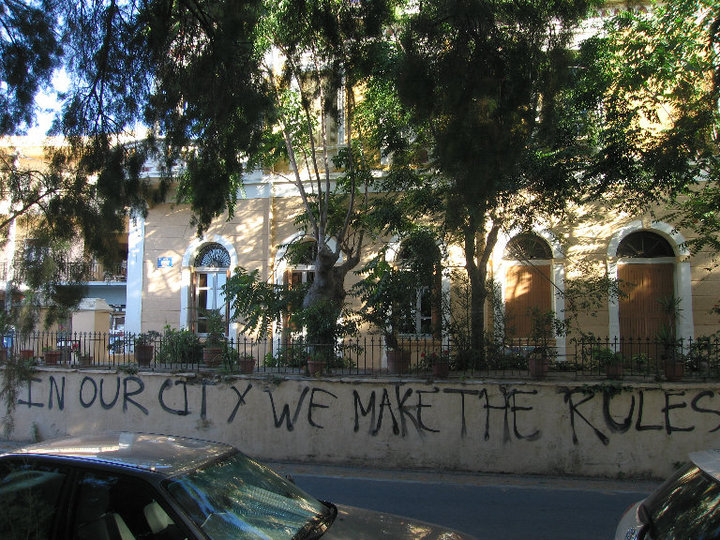
Grafitti:  In our city, we make the rules (Chania, Crete)

Graffiti in Chania, Crete: "In our city, we make the rules." Photo by Kenny Darrell

Political graffiti all too often aims just at the message, missing much of the art of some of those who tag.