Heritage Foundation urges that Africa be poisoned

May 7, 2011

Oh, not outwardly anti-Africa, but stupidly so.

The extreme right-wing Heritage Foundation lashed out at health care workers and scientists fighting malaria in Africa and Asia for World Malaria Day, April 25 (HF’s post showed up on May 5).  If these malaria fighters really were smart, HF’s Jane Abel wrote, they’d just poison Africa with DDT instead of protecting children with bednets and working to improve medical care.  According to Abel, DDT is safe for everyone but mosquitoes, and more effective than anything else malaria fighters use — so they are stupid and venal, she asserts, for not using DDT.

Here’s her post:

Environmentalists celebrated World Malaria Day last week (and Earth Day the week prior). Meanwhile, thousands of African children died of malaria.

While these activists may make themselves feel like they’re saving the world, they are ignoring the best possible solution to Africa’s malaria problem: the use of DDT to wipe out the Anopheles mosquito.

Even though the World Health Organization resumed promotion of DDT in September 2006—realizing it had the best track record for saving the lives of 500 million African children—environmentalists are still emphasizing the use of bed nets instead. DDT treatments almost completely eradicated the disease in Europe and North America 50 years ago, but today an African child dies every 45 seconds of malaria.

Providing sub-Saharan Africans with bed nets has had far from acceptable success in delivering the amount of protection needed from mosquitoes. The World Bank touts the fact that 50 percent of children in Zambia are now sleeping under nets as a good thing, but what about the other half who are left defenseless against a killer disease? The Democratic Republic of the Congo had only 38 percent of children under nets in 2010.

One would question why, in the 21st century, people should have to live inside of a net in order to be safe from malaria. The world has a better solution, and it’s not the quarantine of African infants. Dr. John Rwakimari, as head of Uganda’s national malaria program, described DDT, which is nontoxic to humans, as “the answer to our problems.”

World Malaria Day 2011 had the theme of “Achieving Progress and Impact” and aims to have zero malaria deaths by 2015. If the world really wants to make progress and increase the number of lives saved from malaria, it needs to embrace for Africans the best possible technologies available today, and that means DDT.

Here’s my response, which I predict will not show up at HF’s blog in any form*:

DDT is toxic to humans — just not greatly and acutely so.  Ms. Abel should be aware of recent studies that indicate even limited, indoor use of DDT in the end produces a death toll similar to malaria.  But we digress on just one of the errors assumed by Ms. Abel.

If DDT could wipe out malaria-carrying mosquitoes, WHO would not have slowed or stopped its use in 1965, years before anyone thought about banning the stuff.  By 1965 it was clear that overuse of DDT in agriculture had bred mosquitoes that are resistant and even immune to DDTJonathan Weiner noted in his Pulitzer Prize-winning book, The Beak of the Finch, that today every mosquito on Earth carries at least a few copies of the alleles that allow mosquitoes to digest DDT as if it were a nutrient.

DDT cannot be a panacea for malaria.

Please do not forget that malaria is a parasite disease, and that mosquitoes are only the carriers of it.  To truly eradicate malaria, we need to cure the humans — and if we do that, the mosquitoes do not matter.  With no infected humans, mosquitoes have no well of disease to draw from.  Without infected humans, mosquitoes cannot spread malaria.

Only 38 percent of children in Congo sleep under bednets?  I’ll wager that’s twice the percentage of kids that were ever protected from malaria in Congo by DDT.  In actual tests in Africa over the past decade, bednets have proven to reduce malaria by 50 to 85 percent; DDT, on the other hand, reduces malaria only 25 to 50 percent under the best conditions.  If we have to go with one and not the other, bednets would be the better choice.  Nets are much, much cheaper than DDT, too.  DDT applications must be repeated every 6 months, at a cost of about $12 per application per house.  Nets cost about $10, and they last five years.  Nets protect kids for $2 a year, better than DDT; DDT protects kids for $24 a year (that’s 12 times the cost), but not as effectively as nets.

Also, it’s important to remember that DDT has never been banned in Africa.  DDT non-use is much more a result of the ineffectiveness of DDT in many applications — why should we expect Africans to throw away hard-earned money on a pesticide that doesn’t work?

Finally, it’s also good to understand that, largely without DDT, malaria deaths are, today, at the lowest point in human history.  Fewer than 900,000 people a year die from malaria today.  That’s 25% of the death toll in 1960, when DDT use was at its peak.

Ms. Abel assumes that all Africans are too stupid to use DDT, though it might save their children.  He states no reason for this assumption, but we should question it.  If Africans do not use DDT, it may well be because the local populations of mosquitoes are not susceptible; or it could be because other solutions, like bednets, are more effective, and cheaper.

Ms. Abel has not made a case that DDT is the best solution to use against malaria.  DDT cannot improve a nation’s medical care delivery systems, to quickly diagnose and appropriately treat malaria in humans.  DDT cannot make mosquitoes extinct, we know from 66 year of DDT use that mosquitoes always come roaring back.  DDT cannot prevent mosquitoes from spreading malaria as effectively as bednets.

Maybe, just maybe, as evidenced by the dramatic reductions in malaria deaths, we might assume that modern Africans and health care workers know what they’re doing fighting malaria — and they do not need, want, or call for, a lot more DDT than is currently in use.

It’s too bad Heritage Foundation fell victim to so much junk science, and that the otherwise august press release operation pushes the grand DDT hoaxes.  Just once, wouldn’t it be nice if these conservative echo chambers would, instead of recycling the old, wrong press releases of other conservatives, would do a little research on their own, and get the facts right?

_______________

*  It’ll be fun to watch.  I sent my response early, early in the morning while rushing to get a presentation ready, and I made a couple of egregious typos, including identifying Jonathan Weiner as “Stephen Weiner.”  If HF wished to embarrass me, they’d publish that one out of their moderation queue — but I’ll bet that even with my typos, they can’t allow the facts through.  Also, for reasons I can’t figure, some guy named Thurman showed as the author of HF’s piece on May 5.  So I had referred to Mr. Thurman instead of Ms. Abel.  Interesting technical glitch, or story, there.

_______________

Update, May 8:  As we should have expected, Steven Milloy’s Junk Science Side Bar also went on record as favoring the poisoning of Africa rather than the fighting of malaria.  Milloy makes claims that DDT will beat malaria (ostensibly before it kills all life in Africa), but his sources don’t support the claim.  Milloy is always very careful to never mention that, largely without DDT, the death toll from malaria is at the lowest point in human history.  Instead he notes that while malaria fighters promoted World Malaria Day, lots of African kids died of malaria.  That’s true, but misleading.  Because of the malaria-fighting efforts of those Milloy tries to impugn, far fewer African kids die.  Contrary to Milloy’s insane and offensive claims, it’s not alright that “only people” die.  Milloy asserts implicitly that, but for environmentalists, thousands or millions of children would survive that do not know.  That’s not true:  Because of the work that Milloy denigrates, millions fewer die.  It wasn’t environmentalists who overused DDT and rendered it ineffective in the fight against malaria, it was Milloy’s funders.  Follow the money.


What sort of crazy is the warming denialist?

April 21, 2011

I’ve got to stop looking over there.

Goddard’s got a post up showing the great disregard he has for the facts, and the law, and history, etc., etc., etc.  It may be an unintentional showing, but there it sits, “like a mackerel in the moonlight, both shining and stinking.”

Jerome Corsi, that serial fictionalizer of vital issues, has a book out promoting his slimy schemes besmirch President Obama.  Goddard urges people to buy it.

But they really pile on in the comments.  It’s almost as if Casey Luskin had a whole family just like himself, and they got together to whine about Judge Roberts again.

Warming denialism, creationism and birthers — is it all just three minor variations on the same brain-sucking virus?  Or could three different diseases produce the same sort of crazy on so many different issues?

I’m reminded of the old saw that you cannot reason a person out of a position he didn’t reach by reason.  These guys will never see the light.  Heaven knows, it ain’t evidence that gets ’em where they are now.

Previous posts at Millard Fillmore’s Bathtub:

Special kind of birther crazy:


Lake Powell drought ended? Don’t trust the warming denialists’ predictions

April 20, 2011

Every once in a while a factoid crosses the desk and/or mind of an otherwise badly-informed person who denies global warming is a problem, and without bothering to check the significance of the factoid, the denialist world ramps up The Crazy Rant.

And so, Steve Goddard (who should need no introduction) seized upon a chart that shows a momentary uptick in water in drought-ravaged Lake Powell.  Ignoring more than 50 years of history of the river flows, Goddard pronounced the case for global warming dead.

Former AGW poster child Lake Powell water levels have been rising rapidly over the last few years.

Goddard’s claim is a grand example of the triumph of ignorance over experience, science, data, history and the law, in discussions of climate change.

Did Goddard read his own chart?  It shows a decline in lake level from 2010.

Lake Powell levels, charted by Steve Goddard?

Goddard’s own chart shows a decline in Lake Powell’s March 20 level, from 2010; did he look at the chart? Even Goddard’s source says, “Lake Powell is 89.99 feet below Full Pool (Elevation 3,700).”

“Full pool” level is 3,700 feet elevation (the height of the surface of Lake Powell above sea level).  Goddard’s chart shows the lake hasn’t been at that level since 2000 (and it was declining for some time prior to that).  Goddard’s chart shows four years of rise compared to seven years of decline.

The U.S. Bureau of Reclamation isn’t as optimistic as the warming deniers, noting that drought conditions continue on the Colorado Plateau.

 Upper Colorado River Basin Hydrology

In the Upper Colorado River Basin during water year 2010, the overall precipitation accumulated through September 30, 2010 was approximately 90% of average based on the 30 year average for the period from 1971 through 2000.  For Water Year 2011 thus far, the estimated monthly precipitation within the Upper Colorado River Basin (above Lake Powell) as a percentage of average has been: (October – 135%, November – 95%, December – 225%, January – 50%, February – 100%, March – 90%)

The Climate Prediction Center outlook (dated March 17, 2010) for temperature over the next 3 months indicates that temperatures in the Upper Colorado River Basin are expected to be above average while precipitation over the next 3 months is projected to be near average in the northern reaches of the basin while below average in the southern reaches of the basin.

Upper Colorado River Basin Drought

The Upper Colorado River Basin continues to experience a protracted multi-year drought.  Since 1999, inflow to Lake Powell has been below average in every year except water years 2005 and 2008.  In the summer of 1999, Lake Powell was close to full with reservoir storage at 23.5 million acre-feet, or 97 percent of capacity.  During the next 5 years (2000 through 2004) unregulated inflow to Lake Powell was well below average.  This resulted in Lake Powell storage decreasing during this period to 8.0 million acre-feet (33 percent of capacity) which occurred on April 8, 2005.  During 2005, 2008 and 2009, drought conditions eased somewhat with near or above average inflow conditions and net gains in storage to Lake Powell.  2011 will be another above average inflow year so drought conditions are easing somewhat in the Colorado River Basin. As of April 18, 2011 the storage in Lake Powell was approximately 12.73 million acre-feet (52.3 % of capacity) which is below desired levels.  The overall reservoir storage in the Colorado River Basin as of April 18, 2011 is approximately 31.40 million acre-feet (52.8 % of capacity).
Updated: April 19, 2011

Rick Clayton

Goddard isn’t the first denier to stumble down this path — but can’t they learn from the stumblings of others?  Remember Australia’s “Jo Nova,” who used a photograph of drought-stricken Glen Canyon Dam and environs to claim that warming was not posing problems?  Remember Anthony Watts claiming Lake Powell as a “good proxy” for water in the entire area, and seizing on a momentary uptick?  (Oh, yeah — Watts based his glee on a Goddard note — even repeating Goddard’s error that Lake Powell’s low levels were due to increased use of water in Los Angeles . . .)

Oy.  Do they ever learn?

More, Resources:

The sources from my earlier post on Lake Powell still edify those who bother to read them:

More current sources:


Anecdotal evidence: Malaria spreads to Tanzania highlands, warming climate blamed

April 16, 2011

Here’s one story that critics of science and scientists who study global warming will try to avoid mentioning:  Malaria’s spread in Tanzania appears to be due to deforestation plus a warming climate that altered historic rainfall patterns.

It’s anecdotal evidence, partly.  The case reinforces the point Al Gore made in An Inconvenient Truth, that climate change can smooth the path for the spread of diseases like malaria.

Via AllAfrica.com, from The Citizen in Dar es Salaam (Sunday Citizen News):

Malaria Threatens Nation’s Highlands

Felix Mwakyembe, 6 March 2011

Opinion

Mbeya — Tanzania’s southern highlanders have long worried about pneumonia and other respiratory illnesses brought on by the cool, wet weather. But as climate change contributes to warmer temperatures in the region, residents are facing a new health threat: malaria.

In Rungwe, a highland district in the south-western Mbeya region bordering Malawi and Zambia, malaria is fast replacing coughs, fever and pneumonia as the most serious local health problem. The change has taken by surprise the region’s residents, who live over 1,000 metres (3,200 feet) above sea level and outside Tanzania’s traditional malarial zones.

Ms Asha Nsasu, 32, of Isebe village, had no idea she had contracted malaria when she was sent to Makandana District Hospital in late December. “I felt weak. I thought it was pneumonia,” Nsasu said. “Then they told me it was malaria.”

In 2009, health centres in Rungwe district reported 100,966 malaria cases, a jump of 25 per cent from 2006, hospital records show.

Malaria is now the biggest public health threat facing Rungwe district, which lies about 940 kilometres (590 miles) southwest of Dar es Salaam, according to the Tukuyu Medical Research Centre, part of the National Institute for Medical Research. One third of outpatients visiting the hospital were diagnosed with the mosquito-borne illness in 2007, according to records from that year, making it the most common disease for outpatients.

Most highland areas in Tanzania are experiencing a growing burden of malaria cases, officials at the Tukuyu Centre said. Climatic changes brought on in part by local environmental degradation are contributing to the growing prevalence of malaria in the district, said Mr Gideon Ndawala, Rungwe district’s malaria coordinator.

“People have cleared the forests, rain has decreased, temperatures have risen,” Mr Ndawala said in an interview. “(When) I first reported on the district in 1983, it was very cold and it rained throughout the year except from mid-September to early November. The weather was not favourable for mosquito breeding,” he said.

Now, however, temperatures are higher and rain more erratic, he said, and mosquito populations – which thrive on warmer temperatures and breed in pools of stagnant water – are on the rise. Worst hit by the surge in malaria are Tukuyu district town, Ikuti, Rungwe Mission and Ilolo, according to district health officials.

Half a century ago, these traditionally cool areas saw no mosquitoes and did not register any malaria cases, but now the weather is warmer, said Mr Ambakisye Mwakatobe, a 76-year-old man from Bulyaga village in Rungwe.

“In the past, we never saw mosquito nets here. I saw a net for the first time at the age of 20, when I joined Butimba Teachers College in 1957,” he said, in an interview at his village home.

Mzee Mwakatobe said cases of malaria began to appear several decades ago but residents did not relate them to warming temperatures, believing the mosquitoes instead were arriving on buses from lower regions.

“It was in the 1970s when we started getting malaria here. I thought it was the buses from Kyela and Usangu that brought mosquitoes,” he admitted. But “the weather also started to change in those years,” he said.

A half-century ago, “it was very cold here and it rained throughout the year. Three things were compulsory: a sweater, pullover or heavy jacket; an umbrella or raincoat; and gumboots,” he added. “There was frost all day long and cars had to put their lights on.

“But today things have changed,” he said. “Look, now we even put on light shirts. There is no need for sweaters, gumboots or umbrellas.”

Scientists agree that the changing weather is feeding into Rungwe’s worsening malaria problem.

“Up until 1960, districts like Rungwe, Mbeya, Mufindi, Njombe, Makete and Iringa in the southern highland regions were malaria free. Today is quite different – malaria prevalence is high,” said Mr Akili Kalinga, a research scientist at Tukuyu Medical Research Centre.

Malaria accounts for 30 per cent of the burden of disease in Tanzania and is a huge drain on productivity, according to a report produced by research scientists for the Sixth Africa Malaria Day in 2006. In response to the rising malaria caseload, the government is taking steps to stem the disease’s expansion.

Measures include public health education in newly vulnerable districts on home cleanliness and water storage, how to eliminate the places of still water where mosquitoes live and breed, and the use of mosquito nets and fumigation, said Dr Sungwa Ndagabwene, Rungwe’s medical officer.

“The government is taking serious measures to fight malaria. We started with a ‘mosquito nets for all’ campaign – saying every person should sleep under bed nets,” Mr Ndagabwene said.

The government also has begun spraying the inside of homes with insecticide, first in the Kagera Region and now throughout the Lake zone, near Lake Victoria, he said. It plans to expand the spraying programme, which has helped cut malaria transmission in Zanzibar, to the rest of the Tanzania’s malaria-affected regions.

Such spraying programmes aim to kill mosquitoes that land on the inside walls of homes. Spraying can protect homes for between four to ten months depending on the insecticide, according to the World Health Organisation (WHO).

WHO has approved 12 insecticides it considers safe for such spraying programmes, including DDT – a controversial endocrine disruptor that has proved one of the most effective ways to control mosquito populations but that has also been linked to environmental damage and health problems including cancer.

Mr Ndagabwene said spraying the chemical only indoors limited its environmental impact. WHO officials have said they believe the benefits of using the pesticide outweigh its risks. The Stockholm Convention bans the use of DDT but exempts countries that choose to use the chemical to control malaria.

Tanzania is one of the world’s worst malaria-affected countries, recording 14 to 18 million clinical cases annually and 60,000 deaths, 80 per cent of them in children under five years old, according to a 2010 malaria reduction plan put together by USAID.

Children under five and pregnant women are most affected by the disease, official health figures show. (AlertNet)

The author is a freelance writer based in Dar es Salaam

More:


Alan Alda speaks about the future of science communication, for NSF

March 28, 2011

After the long-running, ever popular television series M*A*S*H ended, star Alan Alda got roped into hosting a science program on public television for Scientific American. Alda discovered he really likes science.  He discovered he has a flair for talking about science, too.

With the constant discussion among scientists about how to overcome the War on Science, and especially how to combat the fruit loops, crank scientists, junk science purveyors and others who muddy the waters of understanding science, I thought this interview at a National Science Foundation function was interesting:

Vodpod videos no longer available.

Alan Alda speaks about the future of science co…, posted with vodpod

Caption from NSF:

Alan Alda, award winning actor and Visiting Professor with the Center for Communicating Science, talks about his experiences with communicating science to the general public. Looking to close the gap between the scientific community and the public, Mr. Alda discusses what needs to be improved, and how science can be better understood.

Credit: National Science Foundation

Can Alda really do anything about saving science communication, rescuing it from the propaganda machines?


Annals of global warming: Records from Mauna Loa show continuing rise in atmospheric CO2

March 26, 2011

NOAA's Mauna Loa Observatory, NOAA photo, 1982, Cmdr. John Bortniak

NOAA's Mauna Loa Observatory, from NOAA At the Ends of the Earth Collection, 1982 NOAA photo by Commander John Bortniak

John Adams observed, and Ronald Reagan was fond of quoting, “Facts are stubborn things . . .”

Here are the facts on atmospheric carbon dioxide (CO2):


Monthly CO2 levels since 1960, Mauna Loa Observatory (Scripps Inst of Oceanography)

Mauna Loa Observatory, Scripps Institution of Oceanography, UCSD (University of Calfornia-San Diego); CO2 concentrations in parts per million (ppm)

As described at the Scripps Institution of Oceanography site:

Description:
Monthly average atmospheric carbon dioxide concentration versus time at Mauna Loa Observatory, Hawaii (20°N, 156°W) where CO2 concentration is in parts per million in the mole fraction (p.p.m.). The curve is a fit to the data based on a stiff spline plus a 4 harmonic fit to the seasonal cycle with a linear gain factor.

Data from Scripps CO2 Program.

For perspective, here’s a chart from Scripps that shows why there is concern over current levels of CO2:

CO2 over the past 420,000 years - Scripps Institution of Oceanography

CO2 over the past 420,000 years - Scripps Institution of Oceanography

Resources, More:


What’s the radiation level right now?

March 19, 2011

Concerned about radiation from Japan?

It’s highly improbable that dangerous levels of radiation would drift more than a few miles from the damaged nuclear power plants in Japan, but maybe seeing some actual readings might convince people there’s not much to worry about — other than our sympathy for Japan, the Japanese people and especially those workers who have stayed on the site of the power plant to work to secure the reactors so they do not become hazards to the population at large.  Those workers may be exposed to significant, harmful radiation, and they deserve all the thanks you can give them.

Below is a map of the contiguous 48 states of the U.S., showing live readings from about a dozen sampling sites across the nation.  The map should update about every minute (if it doesn’t, and  you want to see updates, click through to the Radiation Network site).

Normal background levels are about 25 to 75; a low-level warning might be given if readings are sustained at 100.  These numbers are Counts Per Minute (CPM), a very crude measure from a Geiger counter showing how many radioactive particles or rays hit the sensor in a minute.  It does not distinguish alpha, beta or gamma, and it may be dependent on the design of the Geiger counter, especially the size of the sensor — differently designed machines give different readings even right next to each other.

So it’s a crude count, but it’s a map of counts.

Radiation Network map of radiation in the U.S.  Read legend, use with caution

Radiation Network map of radiation in the U.S. Read legend, use with caution. Click map to go to Radiation Network site.

Here is legend information for the map:

Legend for Radiation Network map

Sampling station symbols, Radiation Network

Nuclear site, calculated by the Radiation Network

At left is a symbol used on the map to mark “nuclear sites” by the Radiation Network.  Note that a nuclear “site” is not necessarily a nuclear power station.  For example, there are nuclear sites designated near Moab, Utah; there are a couple of ore refining facilities or tailing ponds there, but no nuclear power station.  The map shows a nuclear site in the Texas Panhandle.  There is no nuclear power station there.

Instructions on how to read the map, from RadNet:

How to Read the Map:

Referring to the Map Legend at the bottom left corner of the map, locate Monitoring Stations around the country that are contributing radiation data to this map as you read this, and watch the numbers on those monitoring stations update as frequently as every minute (your browser will automatically refresh).  The numbers represent radiation Counts per Minute, abbreviated CPM, and under normal conditions, quantify the level of background radiation, i.e. environmental radiation from outer space as well as from the earth’s crust and air.  Depending on your location within the US, your elevation or altitude, and your model of Geiger counter, this background radiation level might average anywhere from 5 to 60 CPM, and while background radiation levels are random, it would be unusual for those levels to exceed 100 CPM.  Thus, the “Alert Level” for the National Radiation Map is 100 CPM, so if you see any Monitoring Stations with CPM value above 100, further indicated by an Alert symbol over those stations, it probably means that some radioactive source above and beyond background radiation is responsible.

Notice the Time and Date Stamp at the bottom center of the Map.  That is Arizona Time, from where we service the Network, and your indication of how recently the Radiation Levels have been updated to the Map.

(Please note: Any White circles on the map represent Monitoring Stations that are running Simulations, instead of using a real Geiger counter, so any Alert levels that may occur over those stations are to be ignored since they represent only momentary testing.)

Remember, “alert level” is sustained count above 100. But again, be alert that this is only counts per minute, and may be difficult to translate to an accurate radiation reading.

The Radiation Network is an all volunteer operation, no government funding or other involvement.  In fact, the network is seeking volunteers to get a Geiger counter and hook it up to the internet to provide even more real-time readings.  See “How to Participate in the Nationwide Radiation Network.”

If you’re a denier of global warming/climate change, you should use your usual denial tool, claiming that because radiation at background levels is “normal,” no level of radiation can be harmful.  In fact, if you’d make that claim and volunteer to go staff the crews trying to cool the reactors, the entire world would salute you.

Should you be concerned? MIT’s Technology Review explains that the levels of radiation at the plant site itself are quite low, though higher than normal (article by Courtney Humphries).  The article also explains that radiation levels rapidly drop the farther from the plant one is; while we may be able to detect increases in radiation attributable to the radiation from Fukushima site, it is highly unlikely that radiation will exceed safety standards:

In terms of potential health dangers from radiation from the Fukushima Daiichi Nuclear Power Station, “the people who are in the most immediate danger from acute and severe radiation doses are those people who are on site at the moment and who are desperately trying to keep the reactors under control,” says Jacqueline Williams, a radiation oncologist at the University of Rochester Medical Center.

Moving away from the immediate vicinity of the plant, radiation levels drop very rapidly. James Thrall, radiologist-in-chief at Massachusetts General Hospital, says that radiation levels are inversely proportional to the square of the distance from the source: The level at two miles from the source are one-quarter what they are at one mile, and “at 10 miles away, it’s almost an infinitesimal fraction,” he says. Individual exposure also varies widely depending on whether a person is outside or indoors, or shielded with protective clothing. Japanese authorities have evacuated the population living within a 20-kilometer radius of the plant, and have warned those living within 30 kilometers to stay indoors. Some experts say that people living beyond this range have no cause for concern at this time. “This has nothing to do with the general population,” McBride says.

The trickier question is whether lower doses of radiation—well below the threshold of acute illness—could lead to long-term health consequences for those in that area. Thrall says that epidemiological studies on survivors of nuclear attacks on Japan have found that those receiving 50 millisieverts or more had a slightly elevated cancer risk—about 5 percent higher than expected—and that risk seemed to rise with higher exposures. But scientists still vigorously debate whether that risk can be extrapolated down to even lower exposures.

After the nuclear disaster at Chernobyl, the population experienced a surge in thyroid cancers in children. However, scientists found that the culprit was not radiation in the air but radioactive contamination of the ground, which eventually found its way into cow’s milk. Thrall points out that in Japan, this is highly unlikely because the authorities are carefully monitoring the water and food supplies and keeping the public informed, which did not happen at Chernobyl.

More, resources:


Is global warming/climate change a problem? Get the facts

March 15, 2011

Want solid information on climate change (global warming) and the problems it poses?

Several opportunities present themselves, from the National Academies of Science, America’s premiere science advisory group:

America’s Climate Choices Final Report in Review

The final report of the America’s Climate Choices suite of studies is in the final stages of peer review and will be released this Spring.  An official release date will be announced as soon as possible.  The report is authored by the Committee on America’s Climate Choices, which was responsible for providing overall direction, coordination, and integration of the America’s Climate Choices activities.

Related Activities at The National Academies

warming_world_cover
Warming World, a publication from the National Academies of Science

“Warming World: Impacts by Degree” Explains Findings of NRC Report

Emissions of carbon dioxide from the burning of fossil fuels have ushered in a new epoch, beginning to be called the Anthropocene, during which human activities will largely determine the evolution of Earth’s climate. That’s one of the main conclusions from Climate Stabilization Targets: Emissions, Concentrations, and Impacts over Decades to Millennia (NRC, 2011) an expert consensus report released last July and published this year.  Now a new 36-page booklet based on the report, “Warming World: Impacts by Degree” is available to help policymakers, students, and the general public better understand the report’s important conclusions.

The report concludes that, because carbon dioxide is so long-lived in the atmosphere, increases in this gas can effectively lock the Earth and many future generations in a range of impacts, some of which could be severe. Therefore, emission reduction choices made today matter in determining impacts that will be experienced not just over the next few decades, but also into the coming centuries and millennia.  Policy choices can be informed by recent advances in climate science that show the relationships among increasing carbon dioxide, global warming, related physical changes, and resulting impacts. The report identifies (and quantifies when possible) expected impacts per degree of warming, including those on streamflow, wildfires, crop productivity, the frequency of very hot summers, and sea-level rise and its associated risks and vulnerabilities.

Order free copies of the booklet at http://dels.nas.edu/materials/booklets/warming-world.


Report Sets Research Agenda to Study Earth’s Past Climate

Without a reduction in emissions, by the end of this century atmospheric carbon dioxide could reach levels that Earth has not experienced for more than 30 million years. Critical insights into how Earth’s atmosphere, oceans, and ecosystems would function in this high carbon dioxide environment are contained in the records of Earth’s geological past, concludes Understanding Earth’s Deep Past: Lessons for Our Climate Future, a National Research Council report from the Board on Earth Sciences that was released on March 1, 2011.

“Ancient rocks and sediments hold the only records of major, and at times rapid, transitions across climate states and offer the potential for a much better understanding of the long-term impact of climate change,” said Isabel Montañez, chair of the committee that wrote the report and a professor in the department of geology at the University of California, Davis. The research could also yield information on the tipping points for climate change–the threshold of greenhouse gas accumulation in the atmosphere at which abrupt climate change will occur.

The report sets out a research agenda for an improved understanding of Earth system processes during the transition to a warmer world. High-priority research initiatives include gaining a better understanding of the sensitivity of climate to increased atmospheric carbon dioxide, the amount of sea-level rise as the ice sheets melt, and the resilience of ecosystems to climate change.


Webinar on Transportation and Climate Change

On Thursday, March 24 from 2:00-3:00 p.m., the National Academies Transportation Research Board will host the first of a 2-part webinar series that looks the threats of climate change to transportation facilities and operations and at resources for adapting. The cost of the webinar is $109 (the webinars are free to employees of TRB sponsors). To sign up and/or to learn more, please visit http://www.trb.org/ElectronicSessions/Blurbs/164935.aspx.

Also, you can always check out the website for the Board on Atmospheric Sciences and Climate (BASC), a joint project of the National Academy of Sciences, National Academy of Engineering, Institute of Medicine, and National Research Council.


March 14: Happy birthday, Albert Einstein! (b. 1879)

March 14, 2011

E=mcc - logo from AIP

E=energy; m=mass; c=speed of light

Happy Einstein Day!  Almost fitting that he was born on π Day, no?  I mean, is there an E=mc² Day?

Albert Einstein was born on March 14, 1879, in Ulm, Germany, to Hermann and Pauline Einstein.  26 years later, three days after his birthday, he sent off the paper on the photo-electric effect, the paper that would win him the Nobel Prize in Physics five years later, in 1921.  In that same year of 1905, he published three other papers, solving the mystery of Brownian motion, describing what became known as the Special Theory of Relativity and solving the mystery of why measurements of the light did not show any effects of motion as Maxwell had predicted, and a final paper that noted a particle emitting light energy loses mass.  This final paper amused Einstein because it seemed so ludicrous in its logical extension that energy and matter are really the same stuff at some fundamental point, as expressed in the equation demonstrating an enormous amount of energy stored in atoms, E=mc².

Albert Einstein as a younger man - Nobel Foundation image

Albert Einstein as a younger man - Nobel Foundation image

Any one of the papers would have been a career-capper for any physicist.  Einstein dashed them off in just a few months, forever changing the field of physics.  And, you noticed:  Einstein did not win a Nobel for the Special Theory of Relativity, nor for E=mc².  He won it for the photo electric effect.  Irony in history.

106 years later Einstein’s work affects us every day.  Relativity theory at some level I don’t understand makes possible the use Global Positioning Systems (GPS), which revolutionized navigation and mundane things like land surveying and microwave dish placement.  Development of nuclear power both gives us hope for an energy-rich future, and gives us fear of nuclear war.  Sometimes, even the hope of the energy rich future gives us fear, as we watch and hope nuclear engineers can control the piles in nuclear power plants damaged by earthquakes and tsunami in Japan.

If Albert Einstein was a genius at physics, he was more dedicated to pacifism.  He resigned his German citizenship to avoid military conscription.  His pacifism made the German Nazis nervous; Einstein fled Germany in the 1930s, eventually settling in the United States.  In the U.S., he was persuaded by Leo Szilard to write to President Franklin Roosevelt to suggest the U.S. start a program to develop an atomic weapon, because Germany most certainly was doing exactly that.  But Einstein refused to participate in the program himself, sticking to his pacifist views.  Others could, and would, design and build atomic bombs.  (Maybe it’s a virus among nuclear physicists — several of those working on the Manhattan Project were pacifists, and had great difficulty reconciling the idea that the weapon they worked on to beat Germany, was deployed on Japan, which did not have a nuclear weapons program.)

Einstein was a not-great father, and probably not  a terribly faithful husband at first — though he did think to give his first wife a share of a Nobel Prize should he win it in the divorce settlement.  Einstein was a good violinist, a competent sailor, an incompetent dresser, and a great character.  His sister suffered a paralyzing stroke.  For many months Albert spent hours a day reading to her the newspapers and books of the day, convinced that mute and appearing unconscious, she would benefit from hearing the words.  He said he did not hold to orthodox religions, but could there be a greater show of faith in human spirit?

Einstein in 1950, five years before his death

Einstein in 1950, five years before his death

When people hear clever sayings, but forget to whom the bon mots should be attributed, Einstein is one of about five candidates to whom all sorts of things are attributed, though he never said them.  (Others include Lincoln, Jefferson, Mark Twain and Will Rogers).  Einstein is the only scientist in that group.  So, for example, we can be quite sure Einstein never claimed that compound interest was the best idea of the 20th century.  This phenomenon is symbolic of the high regard people have for the man, even though so few understand what his work was, or meant.

A most interesting man.  A most important body of work.  He deserves more study and regard than he gets.

More, Resources:


March 14: π Day!

March 14, 2011

Of course you remembered that today is pi Day, right?

Pi Day Pie from Slashfood.com

Happy π Day! Pi Day Pie - Slashfood.com

Oh, or maybe better, π Day.

The good people at PiDay.org suggest a few ways you can celebrate:

Make (and Eat) a Pie – These pie recipes for Pi Day from NPR’s McCallister look incredibly tasty. But, there’s no shame in putting a frozen store-bought pie in the oven, or picking up a pie from your local bakery. Any kind of pie is great on Pi Day! If you’re making your own, get inspired by these beautifully designed Pi Day Pies. Tell us on Facebook: What’s your favorite kind of pie for Pi Day?

Hope your π Day is complete as a circle, and well-rounded!


Hoaxing Congress: Claiming DDT as pixie dust

March 9, 2011

Tuesday morning, March 8,  the Republican-controlled House of Representatives Committee on Energy and Commerce opened hearings on global warming, staging an assault on science with a series of witnesses, some of whom recently have made a career out of mau-mauing scientists.

Dr. Donald Roberts' testimony to the House Committee on Energy and Power, on March 8, 2011, presented a grand collection of Bogus History, coupled with Bogus Science.

Dr. Donald Roberts’ testimony to the House Committee on Energy and Power, on March 8, 2011, presented a grand collection of Bogus History, coupled with Bogus Science. Roberts has an unfortunate history of presenting doctored data and false claims to Congress.

One witness took after the EPA directly and Rachel Carson by implication, with a specious claim that DDT is harmless.  Donald Roberts is a former member of the uniformed public health service.  Since retiring, and perhaps for a while before, he started running with a bad crowd.  Of late he’s been working with the Merry Hoaxsters of the unrooted Astroturf organization Africa Fighting Malaria (AFM), a group dedicated to publishing editorials tearing down the reputation of Rachel Carson, the World Health Organization (WHO) and the Environmental Protection Agency (EPA).

(That would all be purple prose, were it not accurate in its description of people, organizations and their actions.)

Here’s a link to Roberts’ written testimony at the committee website.

(Here’s a link to all the other written stuff from the March 8 hearing.) [April 27, 2015: These two cites now link to the Democratic Minority record; GOP site was moved or taken down.]

Why was Roberts testifying at a hearing on global warming?  He’s carrying water for the anti-science, “please-do-nothing” corporate crowd.  It’s a tactic from the old tobacco lobbyist book:  Roberts claims that scientists got everything wrong about DDT, and that the ban on DDT done in error has wreaked havoc in the third world.  Therefore, he says, we should never trust scientists.  If scientists say “duck!” don’t bother, in other words.

Roberts is in error.  Scientists, especially Rachel Carson, were dead right about DDT.  Because corporate interests refused to listen to them, the overuse and abuse of DDT rendered it ineffective in the fight against malaria, and DDT use as part of a very ambitious campaign to eradicate malaria had to be abandoned in 1965.  The entire campaign had to be abandoned as a result, and more than 30 million kids have died since.

So don’t grant credence to Roberts now.  He’s covering up one of the greatest industrial screw-ups in history, a screw up that, by Roberts’ own count, has killed 30 million kids.  What in the world would motivate Roberts to get the story so wrong, to the detriment of so many kids?

Roberts said:

Putting issues of EPA budget aside, I want to introduce my technical comments with a quote from a recent Associated Press article with a lead statement “none of EPA’s actions is as controversial as its rules on global warming.”  In my opinion, this is wrong.

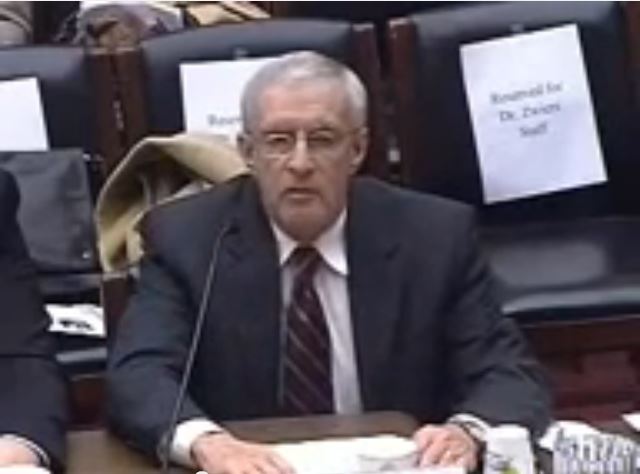
Dr. Donald Roberts testifying to the House Energy Committee, March 8, 2011. Screen capture from Committee video.

Dr. Donald Roberts testifying to the House Energy Committee, March 8, 2011. Screen capture from Committee video.

Roberts is correct here in his opinion.  It is simply wrong that EPA’s rules on global warming and controls of the pollutants that cause it should be controversial.  Among air pollution scientists the rules are not controversial.  Among climate scientists the rules are not controversial.  Roberts and his colleagues at the so-called Competitive Enterprise Institute, Africa Fighting Malaria (AFM), and American Enterprise Institute (AEI) work hard to manufacture controversy where the science does not support their case.

It is wrong.  Roberts should be ashamed.

Roberts said:

Almost forty years ago EPA banned DDT in the United States. Its action against DDT was extraordinarily controversial, and still is. As activists advanced fearful claims against DDT, the EPA was warned, over and over again, a ban would destroy critically important disease control programs and millions upon millions of poor people in developing countries would die as consequence. Leaders of the World Health and Pan American Health Organizations, and even the U.S. Surgeon General warned against the ban. The EPA banned DDT anyway, and the doomsday predictions of those public health leaders proved prescient.

Hmmm.  Roberts signed a “truth in testimony” statement — but that’s not the truth, even if no one paid him to fib.

EPA’s ban on DDT in the U.S. was limited to the United States.  Roberts doesn’t say it flat out, but he implies that the U.S. ban on spraying DDT on cotton fields in Texas and Arkansas — and cotton was about the only crop where DDT was still used — somehow caused a ban on DDT in Africa, or Asia, or South America, or other places where malaria still occurs.

Not so.

In fact, EPA Director William Ruckelshaus defied two federal courts who had ordered a complete ban on DDT use and manufacturing — and left U.S. manufacturing to continue for export markets.  This met all objections to the U.S. ban from all health officials.  DDT use could be allowed in the U.S. for health reasons, or for other emergencies (DDT was used in the Pacific Northwest against the tussock moth in 1974, after the “ban”).  Because U.S. DDT manufacturing was dedicated to export, the ban on domestic use of DDT effectively multiplied the stocks of DDT available to fight malaria, or river blindness, or any other insect vector disease.

I’m also not sure that health officials “pleaded” to stop the U.S. ban on any grounds, but certainly they did not plead with Ruckelshaus to keep spraying DDT on cotton.  Roberts is making stuff up in effect, if not in intent.

Probably more to the point, health officials had stopped significant use of DDT in Africa in 1965, seven years before EPA acted in the U.S., because overuse of DDT on crops in Africa had bred mosquitoes that were resistant and immune to the stuff. Since 1955, in close cooperation with the malaria-fighting experts from the Rockefeller Foundation including the great Fred Soper, WHO carried on a methodical, militant campaign to wipe out malaria.  The program required that public health care be beefed up to provide accurate malaria diagnoses, and complete treatment of human victims of the parasitic disease.  Then an army of house sprayers would move in, dosing the walls of houses and huts with insecticide.  Most malaria-carrying mosquitoes at the time would land on the walls of a home or hut after biting a human and getting a blood meal, pausing to squeeze out heavy, excess water to make flight easier.  If the wall were coated with an insecticide, the mosquito would die before being able to bite many more people, maybe before becoming capable of spreading malaria.

DDT was Soper’s insecticide of choice because it was long-lasting — six months or more — and astonishingly deadly to all small creatures it contacted.

But, as Malcolm Gladwell related in his 2001 paean to Soper in The New Yorker, Soper and his colleagues well understood they were racing against the day that mosquitoes became resistant enough to DDT that their program would not work.  They had hoped the day would not arrive until the late 1970s or so — but DDT is such an effective killer that it greatly speeds evolutionary processes.  In the mid-1960s, before an anti-malaria campaign could even be mounted in most of Subsaharan Africa, resistant and immune mosquitoes began to stultify the campaign.  By 1965, Soper’s crews worked hard to find a substitute, but had to switch from DDT.  By 1972 when the U.S. banned DDT use on cotton in the U.S., it was too late to stop the resistance genes from killing WHO’s anti-malaria program.  In 1969 WHO formally abandoned the goal of malaria eradication.  The fight against malaria switched to control.

Roberts claims, implicitly, that people like those who worked with Soper told EPA in 1971 that DDT was absolutely essential to their malaria-fighting efforts.  That could not be accurate.  In 1969 the committee that oversaw the work of the UN voted formally to end the malaria eradication project.  In effect, then, Roberts claims UN and other health officials lied to EPA in 1971.  It is notable that Soper is credited with eradicating malaria from Brazil by 1942, completely without DDT, since DDT was not then available.  Soper’s methods depended on discipline in medical care and pest control, and careful thought as to how to beat the disease — DDT was a help, but not necessary.

Interestingly, the only citation Roberts offers is to his own, nearly-self-published book, in which he indicts almost all serious malaria fighters as liars about DDT.

Can Roberts’ testimony be trusted on this point?  I don’t think we should trust him.

In fact, DDT and the eradication campaign had many good effects.  In 1959 and 1960, when DDT use was at its peak in the world, malaria deaths numbered about 4 million annually.  The eradication campaign ultimately was ended, but it and other malaria-fighting efforts, and general improvements in housing and sanitation, helped cut the annual death toll to 2 million a year by 1972.

After the U.S. stopped spraying DDT on cotton, mosquitoes did not migrate from Texas and Arkansas to Africa.  As noted earlier, the EPA order stopping agricultural use, left manufacturing untouched, to increase U.S. exports.  So the ban on DDT in the U.S. increased the amount of DDT available to fight malaria.

Malaria fighting, under Soper’s standards, required great discipline among the malaria fighters — the sort of discipline that governments in Subsaharan Africa could not provide.  Had WHO not slowed its use of DDT because of mosquito resistance to the stuff, WHO still would not have been able to mount eradication campaigns in nations where 80% of residences could not be sprayed regularly.

Advances in medical care, and better understanding of malaria and the vectors that spread it, helped continue the downward trend of malaria deaths.  There was a modest uptick in the 1980s when the parasites themselves developed resistance to the drugs commonly used to treat the disease.  With the advent of pharmaceuticals based on Chinese wormwood, or artemisinin-based drugs, therapy for humans has become more effective.  Today, the annual death toll to malaria has been cut to under a million, to about 900,000 per year — a 75% drop from DDT’s peak use, a 50% drop from the U.S. ban on farm use of DDT.

With the assistance of WHO, most nations who still suffer from malaria have adopted a strategy known as Integrated Vector Management, or IVM (known as integrated pest management or IPM in the U.S.).  Pesticides are used sparingly, and insect pests are monitored regularly and carefully to be sure they are not developing genetic-based resistance or immunity to the pesticides.  This is the method that Rachel Carson urged in 1962, in her book, Silent Spring.  Unfortunately, much of the malaria-suffering world didn’t come to these methods until after the turn of the century.

Progress against malaria has been good since 2001, using Rachel Carson’s methods.

Don Roberts’ blaming of science, EPA, WHO, and all other malaria fighters is not only misplaced, wrong in its history and wrong in its science, but it is also just nasty.  Is there any way Roberts could not know and understand the facts?

These are the facts Roberts works to hide from Congress:

  1. “Science” and scientists were right about DDT.  DDT is a dangerous substance, uncontrollable in the wild according to federal court findings and 40 years of subsequent research.  If we were to judge the accuracy of scientists about DDT, we would have to conclude that they were deadly accurate in their judgment that use of DDT should be stopped.
  2. If the ban on DDT was controversial in 1972, it should not be now.  All research indicates that the judgment of EPA and its director, William Ruckelshaus, was right.
  3. EPA was not warned that a ban on agricultural use of DDT would harm public health programs, in the U.S., nor anywhere else in the world.  In any case, EPA’s jurisdiction ends at U.S. borders — why would WHO say anything at all?
  4. DDT use to fight malaria had been curtailed in 1965, years before the U.S. ban on farm use, because overuse of DDT on crops had bred DDT-resistant and DDT-immune mosquitoes.  Consequently, there was not a huge nor vociferous lobby who warned that health would be put at risk if DDT were banned.  Claims that these warnings were made are either false or grossly misleading.
  5. Malaria death rates declined to less than 50% of what they were when DDT was banned from farm use in the U.S. — there was no “doomsday” because the U.S. stopped spraying DDT on cotton, and there never has been a serious shortage of DDT for use against malaria, anywhere in the world.

How much of the rest of the testimony against doing something about global warming, was complete hoax?

More:

[Editor’s note:  My apologies.  I put this together on three different machines while conducting other activities.  On proofing, I find several paragraphs simply disappeared, and edits to make up for the time of composing and fix tenses, got lost.  It should be mostly okay, now, and I’ll add in the links that disappeared shortly . . . oh, the sorry work of the part-time blogger.]

Update, 2015: Video of the hearing, from YouTube:


Form of child abuse confirmed at Creation Museum

March 6, 2011

Ken Ham’s organization, Answers in Genesis, tells the sad story of a case of child abuse at his group’s Creation Museum in Kentucky.

I don’t get the idea that Ham is sad about it, though, do you?

Destroying a child’s natural curiosity about science and the world around them damages them for life.  In the U.S., we are fighting trends that show kids in 4th grade are as scientifically adept as the other best students in the world; by 8th grade their affinity for science has begun to fade, and by 12th grade, U.S. students rank far below many other industrialized nations in science achievement.  Ken Ham’s story is one reason why that happens.

Isn’t crushing a child’s intelligence a form of child abuse?

Is this story funny, or tragic?

Update: At Digital Cuttlefish, a story from the other side.  (Thanks, George.)

Another update:  Even more from Digital Cuttlefish, The Rest of the Story.

Tip of the old scrub brush to Unreasonable Faith.


Firefall in Yosemite: Horsetail Fall’s spectacular February show

March 2, 2011

New program from Yosemite National Park’s “Nature Notes.”

This one has something to appeal to the heart of almost everybody:  Photos from Ansel Adams, photos from Galen Rowell, interviews with sons of each, discussion of the (properly) much-maligned old “firefall” of hot fire coals for tourists — and the story of the natural firefall one might see, if the conditions are right, and if one is in Yosemite in the right place, on the right days of February.

This video was produced by Steven M. Bumgardner, with extra camera help from Josh Helling.  Those guys do great work.  It features photographer Michael Frye, Michael Adams, Ansel Adams’ son, and Tony Rowell, the son of  Galen Rowell.


Education reforms working? Poverty, poor test results correlate in national study. What could it mean?

February 27, 2011

More from Greg Laden’s blog that deserves your attention, and a much wider audience.

The Science component of “The Nation’s Report Card” was released today and clearly indicates that we have moved one step closer as a nation in two of our most important goals: Building a large and complacent poorly educated low-pay labor class, and increasing the size of our science-illiterate populace in order to allow the advance of medieval morality and Iron Age Christian values.

The plan to sabotage the middle class, kill teachers unions and keep most Americans stupid, is working.

That was the plan, right?

Pay no attention to that teapot tempest in Wisconsin.  Pay no attention to the man behind the curtain.  You are getting sleepy, very, very sleepy . . .

Get the facts:

Teachers, compare your class results:


Laden’s late; but, is Yellowstone gonna blow AND TAKE US WITH IT?

February 26, 2011

The veteran reader of this blog — can there be more than one? — may recall the kerfuffle a couple of years ago when there was a “swarm” of earthquakes in the Yellowstone.  Alas for those prone to panic attacks, the swarm ran through the Hanukkah/Ramadan/Christmas/KWANZAA/New Year’s holidays, when other news is slack.

Yellowstone Caldera, Smith and Siegel 2000

What the Yellowstone Caldera might look like from space, by moonlight, on a clear night, if you can imagine the borders of Yellowstone National Park very vividly – Smith and Siegel, 2000

You might understand, then, why I say Greg Laden turns his considerable story-telling prowess to the issue late.  Still, his prowess towers over the rest of us, and he tells a great story.

Is the Yellowstone safe? he asks, rhetorically.

The answer is complex:

1) Wear a seat belt when driving around in the region;

2) Don’t feed the bears and make sure you understand bear safety; and

3) Somebody is going to get blasted by some kind of volcano in the area some day, but even if you live there the chances are it won’t be you.

The joy is in the journey — go read Laden’s explanation of the rising lava.  Heck, even those of us who think we know that stuff understand it better when he explains it.

Earlier in the Bathtub:

Also see: