Will Rogers and Wiley Post crashed in Alaska, August 15, 1935

August 15, 2013

Will Rogers, images from Will Rogers Museums, Oklahoma

Will Rogers, images from Will Rogers Museums, Oklahoma

August 15, the Ides of August, hosted several significant events through the years.  In 1935, it was a tragic day in Alaska, as an airplane crash took lives of Will Rogers and Wiley Post.  To refresh your memory, an encore post, with a few edits and additions.

After Mark Twain died, America found another great humorist, raconteur, story-teller, who tickled the nation’s funny-bone and pricked the collective social conscience at the same time. Will Rogers is most famous today for his sentiment that he never met a man he didn’t like. In 1935, he was at the height of his popularity, still performing as a lariat-twirling, Vaudeville comedian who communed with presidents, and kept his common sense. He wrote a daily newspaper column that was carried in 500 newspapers across America.  Rogers was so popular that Texas and Oklahoma have dueled over who gets the bragging rights in claiming him as a native son.

Will Rogers ready to perform.  Photo taken prior to 1900 - Wikimedia

Will Rogers ready to perform. Photo taken prior to 1900 – Wikimedia

Wiley Post was known as one of the best pilots in America. He gained fame by being the first pilot to fly solo around the world. Post was famous for his work developing new ways to fly at high altitudes. Post was born in Texas and moved to Oklahoma. He lost an eye in an oil-field accident in 1924, then used the settlement money to buy his first airplane. He befriended Will Rogers when flying Rogers to an appearance at a Rodeo, and the two kept up their friendship literally to death.

Post asked Rogers to come along on a tour of the great unknown land of Alaska, where Post was trying to map routes for mail planes to Russia. Ever adventurous, Rogers agreed — he could file his newspaper columns from Alaska by radio and telephone. On August 15, 1935, their airplane crashed near Point Barrow, Alaska, killing them both.

Wiley Post, first to fly solo around the world, in an early pressure suit for high-altitude flying - Wikimedia photo

Wiley Post, first to fly solo around the world, in an early pressure suit for high-altitude flying – Wikimedia photo

On August 15, 2008, a ceremony in Claremore, Oklahoma, honored the two men on the 73rd anniversary of their deaths. About 50 pilots from Oklahoma, Missouri, Kansas and Arkansas will fly in to the Claremore Airport for the Will Rogers-Wiley Post Fly-In Weekend. Oklahoma Lt. Gov. Jari Askins will offer a tribute.

Rogers was 56, leaving behind his wife, Betty, and four children. Post, 36, left a widow.

Rogers’ life is really quite legendary. Historian Joseph H. Carter summed it up:

Will Rogers was first an Indian, a cowboy then a national figure. He now is a legend.

Born in 1879 on a large ranch in the Cherokee Nation near what later would become Oologah, Oklahoma, Will Rogers was taught by a freed slave how to use a lasso as a tool to work Texas Longhorn cattle on the family ranch.
As he grew older, Will Rogers’ roping skills developed so special that he was listed in the Guinness Book of Records for throwing three lassos at once: One rope caught the running horse’s neck, the other would hoop around the rider and the third swooped up under the horse to loop all four legs.

Will Rogers’ unsurpassed lariat feats were recorded in the classic movie, “The Ropin’ Fool.”

His hard-earned skills won him jobs trick roping in wild west shows and on the vaudeville stages where, soon, he started telling small jokes.

Quickly, his wise cracks and folksy observations became more prized by audiences than his expert roping. He became recognized as being a very informed and smart philosopher–telling the truth in very simple words so that everyone could understand.

After the 10th grade, Will Rogers dropped out of school to become a cowboy in a cattle drive. He always regretted that he didn’t finish school, but he made sure that he never stopped learning–reading, thinking and talking to smart people. His hard work paid off.

Will Rogers was the star of Broadway and 71 movies of the 1920s and 1930s; a popular broadcaster; besides writing more than 4,000 syndicated newspaper columns and befriending Presidents, Senators and Kings.

During his lifetime, he traveled around the globe three times– meeting people, covering wars, talking about peace and learning everything possible.

He wrote six books. In fact he published more than two million words. He was the first big time radio commentator, was a guest at the White House and his opinions were sought by the leaders of the world.

Inside himself, Will Rogers remained a simple Oklahoma cowboy. “I never met a man I didn’t like,” was his credo of genuine love and respect for humanity and all people everywhere. He gave his own money to disaster victims and raised thousands for the Red Cross and Salvation Army.

Post’s legacy is significant, too. His employer, Oklahoma oil man F. C. Hall, encouraged Post to push for aviation records using Hall’s Lockheed Vega, and Post was happy to comply. Before his history-making trip around the world, he had won races and navigation contests. NASA traces the development of the space-walking suits worn by astronauts to Post’s early attempts for flight records:

For Wiley Post to achieve the altitude records he sought, he needed protection. (Pressurized aircraft cabins had not yet been developed.) Post’s solution was a suit that could be pressurized by his airplane engine’s supercharger.

First attempts at building a pressure suit failed since the suit became rigid and immobile when pressurized. Post discovered he couldn’t move inside the inflated suit, much less work airplane controls. A later version succeeded with the suit constructed already in a sitting position. This allowed Post to place his hands on the airplane controls and his feet on the rudder bars. Moving his arms and legs was difficult, but not impossible. To provide visibility, a viewing port was part of the rigid helmet placed over Post’s head. The port was small, but a larger one was unnecessary because Post had only one good eye!

Last photo of Will Rogers (in the hat) and Wiley Post, in Alaska in 1935 (from Century of Flight)

Last photo of Will Rogers (in the hat) and Wiley Post, in Alaska in 1935 (from Century of Flight)

Tip of the old scrub brush to Alaska bush advocate Pamela Bumsted.

Resources:


Signs: Pancho Villa Highway? Zapata Road?

August 15, 2013

Another from Don Knuth’s collection of diamond signs, this one collected in Mexico:

Mexico diamond warning sign, from Don Knuth's collection

Location: N16°55.642′, W96°21.618′ photo taken 2008.02.26 in Oaxaca, Mexico by Paula Darwent Near entrance of Mercado de Artesanias (Calle Reforma), San Pablo Villa de Mitla

Perhaps this sign is supposed to warn us against water on the road.  Or mirages on the road.

But when I saw it, I thought of this:

Or maybe this one:

The sign is in Oaxaca, an area that rallied around Zapata.

There’s gotta be a story behind that shotgun blast spray on the sign.  Even more appropriate to the stories of Zapata and Villa, yes?

I wonder what the sign is warning us about?

More:


Just point your cameras to the skies and shoot: Lubbock on August 14

August 14, 2013

With all the cameras around, if everybody just points their own camera to the skies and starts shooting, we’ll get some good shots.

Tonight the Texas Storm Chasers sent this one out:

Storm over Lubbock, Texas, August 14, 2013 - photo by Texas Storm Chasers

Texas Storm Chasers ‏@TxStormChasers 27m RT @TaylorKLynn: @TxStormChasers Took these from my phone of the storm heading into northern Lubbock! pic.twitter.com/5LQX1qBWsN #txwx

Looks like “Night on Storm Prairie” to me. (Where’s Disney when you need em?)

Shot with a camera phone, I’m guessing from inside a hotel (are those reflections in the window?).  Not sure who shot it, so I’ve just credited “Texas Storm Chasers.”

Weather is cool.  Photos of weather are cool, too.

More:

Read the rest of this entry »


Mountain goat nemeses everywhere!

August 12, 2013

Normally I might just let this beautiful photo slide by without comment.

In this case, I find this particularly frustrating.  See that creature?  That’s the same goat that blocked my trail in Glacier National Park.  I’m sure of it.  I’d recognize those beady eyes and horns anywhere! (See the first story linked to in the “more’ section; maybe this goat stopped in Washington on the way to Alaska.)

He’s probably in Alaska now under the Federal Goat Protection Program.

Harding Icefield Trail @KenaiFjordsNPS. #alaska pic.twitter.com/yozsSLnrcD

Interior US Dept of Interior 6h Caption from the Department of Interior: That’s quite the hike to the top. Harding Icefield Trail @KenaiFjordsNPS. #alaska pic.twitter.com/yozsSLnrcD

He probably thinks he’s safe there at Kenai Fjords National Park.  Ha!  He’s farther away, but that just means I have farther to travel to find him!

I’m taking a longer telephoto, a wide angle, and a first aid kit, next time.  I’ll be prepared!

More:


Signs: Cthulu’s return? Don’t kick jelly fish?

August 12, 2013

Don Knuth at Stanford University collects signs.

Actually he collects photos of signs, especially the diamond-shaped informational-warning signs.

What in the world is this one?

A sign photographed in Australia, in the Knuth Collection.

A sign photographed in Australia, in the Knuth Collection.

Your nominations for captions welcomed in comments.

More, sorta — or maybe, “tangentially related” is a better description:  

Donald Knuth at a reception for the Open Conte...

Donald Knuth at a reception for the Open Content Alliance, hosted by the Internet Archive. Taken October 25, 2005 by Jacob Appelbaum in San Francisco. (Wikipedia image)


Remembering Leonidas and the 300 Spartans: died August 11, 480 B.C.

August 11, 2013

300 popped up on some movie channel back in 2008 as I was preparing to teach world history again.  I did not major in history, and my high school history instruction featured no AP courses (Pleasant Grove High, in Utah, didn’t offer such things then; I assume they do now, but I don’t know).

What I knew about Sparta and the stand of the 300 at Thermopylae came from my reading encyclopedias as a child, and culture.  Never had an occasion to write a speech about the events, though had I known the history better, I might have found some opportunity.  Sen. Orrin Hatch would have loved a compare and contrast speech between the stand of the Spartans and his work against the labor law reform bill in 1977 and 1978; more likely, we could have used the simple historical facts that the stand of the 300 at the same place today would be impossible due to poor soil conservation practices of the local farmers, which has created a plain broad enough for a Persian Army to march through with impunity, never fearing drowning in the sea that no longer exists there.  Thermopylae is a grand historical metaphor for a good orator.  The simple facts of history are important, too — Churchill knew Herodotus’s stories well, and considered them when planning military actions in the area in two world wars.

The movie came up from students in the previous year; it offered, perhaps, a hook for an introduction to world history, explaining why we bother to study it at all.

I got a time delay recording to watch it, which I did, mostly.  Interesting stylization.  Cartoonish characterizations, which one should expect from a movie intended as homage to the graphic novel that directly spawned it, more than an instruction about history.  We might doubt that the Persians had trained and armored rhinoceroses in their armament.  Dialogue — well, this is Hollywood.  It would have been in some dialect of Greek, and no Hollywood scriptwriter would have been able to reproduce it.

What about the battle itself.  World history courses in U.S. high schools should pay attention to this battle, I think.

A monument to Leonidas I - Inscription, Molon Lave, which roughly translates to Come and get it!

A monument to Leonidas I – Inscription, “Molon Lave,” which roughly translates to “Come and get it!”

Several sources dated the climax of the battle as August 11, 480 B.C. — 2,493 years ago. (The battle is said to have occurred during the Olympics that year, too.)

World history classes dig through that period of history in the first semester.  Teachers, it’s time to think about how we’re going to facilitate this history this year.  As always, some bright student will wave a hand in the air and ask, “Mr. Darrell!  How do they know what happened if no one survived, and nobody had their Sony videocorder?”

At least one other student in the course of the day will be surprised to discover the movie wasn’t a filmed-on-the-spot documentary.  But apart from that, how do we know the events well enough to pin it down to one day?  And, since the Greeks surely didn’t use the Gregorian calendar, since it wasn’t invented until the 18th century — how do we know the date?

The short answer is “Herodotus.”  The longer answer may resonate better:  This is one dramatic battle in a year-long fight for the history of the world.  The Greeks were understandably and justifiably proud that they had turned back Xerxes’s armies and navy (The Battle of Salamis, a bit after Thermopylae).  So, these events were preserved in poetry, in the chronicles, in song, in sculpture, and in every other medium available to the Greeks.  Your AP English students will probably tell you the movie reminds them of The IliadThere’s an entré for discussion.

Turning points in history:  Had Xerxes succeeded in avenging his father’s, Darius’s, defeats, and subjugated the Greeks, history would be much different.  The culture the Romans built on, the trading patterns from east to west and around the Mediterranean, the technologies, the myths, and the stories of the battles, would be different. (Remember, one of Darius’s defeats was at the Battle of Marathon, from which we get the modern marathon racing event, the traditional close of the modern Olympics.)

How do we know?  How do we know?

How do you handle that question?  (Tell us in comments, please.)

I like this battle for the way it ties together many of the loose threads that vex high school sophomores.  Is history exciting?  It can be, as the Frank Miller graphic novel and and the Zack Snyder movie demonstrate.  How important is accuracy in making the story exciting?  (Do the rhinoceroses improve the story of the courage of the Spartans, or merely offer a good graphical metaphor for the overwhelming forces of the Persians?)  What happens when one nation invades another — who has the advantage?  Is knowledge of geography important — in battle, for example?  The philosopher Santayana notes that those who do not remember history are “condemned” to repeat it.  Xerxes tried to apply the lessons of the history of his father’s failed invasion; was he successful?  Remember this point:  Napoleon failed in his invasion of Russia in 1812; Adolf Hitler assigned his generals to study Napoleon’s failure, for Germany’s invasion of Russia in 1941; so convinced were the Germans that they knew the lessons, they invade Russia on the anniversary of Napoleon’s invasion.  Did it go any better?  George Washington consciously patterned his life on the great Roman warrior and leader, Cincinnatus — especially in turning over rule once the task was done, as Washington did twice.  What if Washington had, instead, patterned his life after Leonidas?  How might the American Revolution have turned out, and how might the United States have developed, had Washington sacrificed himself as Leonidas did?

The story of the Battle of Thermopylea, the bravery and cunning tactics of Leonidas and the 300, the wars between Persia and the Greek City States, form a good foundation for a study of history at any point after.  It is the stuff of great history, and the stuff of great rhetoric.  It could be the stuff of great AP essays and good writing exercises in general.   Damn the Common Core State Standards*, and damn the misguided Texas critics of CSCOPE, this is a topic I wish more world history teachers would spend some good, profitable time on

Resources and commentary on Thermopylae, Leonidas, and the 300:

More:

Livius.org map of the area where the Battle of Thermopylae was fought

Livius.org map of the area where the Battle of Thermopylae was fought. Note that, in purple, the map shows where a plain now exists, which was an ocean the Spartans could use to squeeze the Persian Army, about 25 centuries ago. What a difference 25 centuries can make.

_____________

*  Common Core State Standards in social studies actually would support what I’m asking here, if only they weren’t filtered through state school boards who do not value scholarship, but instead wish history to be a checklist of faux-patriotic bullet points to regurgitate.  Here in Texas, we are not affected by Common Core — but we are affected by meddling in history standards by people whose agenda does not include making history exciting and good.  Common Core standards — technically — do not mention Thermopylae.  However, this is the sort of material, including the original texts of Herodotus, whose study the Common Core standards encourage, especially for analysis of the sort I think Thermopylae invites.  Texas TEKS allow mention of the battle, though the Battle of Thermopylae has been purged from the actual standards; Texas lesson plans frequently suggest “watching a film on the Battle of Thermopylae,” and “Answer questions on the battle; trade and grade.”  Teachers infuse those dull words with life — we hope.  Teachers’ actual practice in the classroom is the saving grace for this important history, in Texas; Texas world history teachers face their own Xerxes.  The Texas Lege recently removed the requirement that students study world history, instead giving them a choice of either world history or world geography.  And so the dumbing down of history by (probably well-meaning, but not well-thinking) legislators continues.


Signs of Life: The bowtie on the Paul Simon Highway

August 7, 2013

Driving through Illinois around Chicago — as we had many opportunities to do while younger son James attended Lawrence University in Wisconsin — one can be delighted and amused by the signs marking parts of Interstate 55 as the Paul Simon Freeway.  Simon’s rise up through editorial ranks of small newspapers, to state legislator and U.S. Senator was fueled by his great common sense and very studious habits when it came to history and public policy.

You can’t put all that on a road sign.  But you can put a picture of his bowtie there.  Honestly, we laughed out loud when we saw one for the first time.

I never could find one of the signs where it might be safe to pull off get a good photograph.  Surely someone in Illinois would have one, right?

Just try to find a good picture of these great signs.  I finally found this one on Flickr:

Paul Simon Freeway Bowtie Sign on I-55 near Edwardsville, IL_DSCN9495c  - Flickr photo by Wampa-One

Paul Simon Freeway Bowtie Sign on I-55 near Edwardsville, IL_DSCN9495c – Flickr photo by Wampa-One

Paul Simon, the Illinois politician, was a great guy.  Search for photos of the Tom Landry Highway signs in Texas, you’ll get a boatload of close-up shots.  Come on, Illinois:  Somebody go get a photo of those “Paul Simon Freeway” signs worthy of the man, and post it on the ‘net!

U.S. Sen. Paul Simon, D-Illinois. Biographical Directory of the U.S. Congress

U.S. Sen. Paul Simon, D-Illinois. Biographical Directory of the U.S. Congress


Steens Mountain, sunrise, or sunset?

July 31, 2013

Either someone just spent a very cold night to get a photo, or they’re getting ready to spend a very cold night.

Which is it?

Steens Mountain in #Oregon

US Dept of Interior: If you haven’t seen Steens Mountain in #Oregon, you really should check out this stunning photo from @BLMOregon pic.twitter.com/H2eePMmfsX

Steens Mountain at sunrise is a very popular image for photographers — but very few get a shot from the mountain itself like this one.

Steens Mountain is a large fault-block mountain in the southeastern part of the U.S. state of Oregon. Located in Harney County, it stretches some 50 miles (80 km) long north to south, and rises from alongside the Alvord Desert at elevation of about 4,200 feet (1,300 m) to a summit elevation of 9,733 feet (2,967 m). It is sometimes confused with a mountain range, but is properly a single mountain.

More:

English: The Alvord Desert playa, looking sout...

The Alvord Desert playa, looking southeast from Steens Mountain, southeast Oregon; Wikipedia image


Geographic jokes, on the Colorado and Green Rivers?

July 29, 2013

Can the scientist appreciate the beauty of creation as much as the non-scientist religious person?

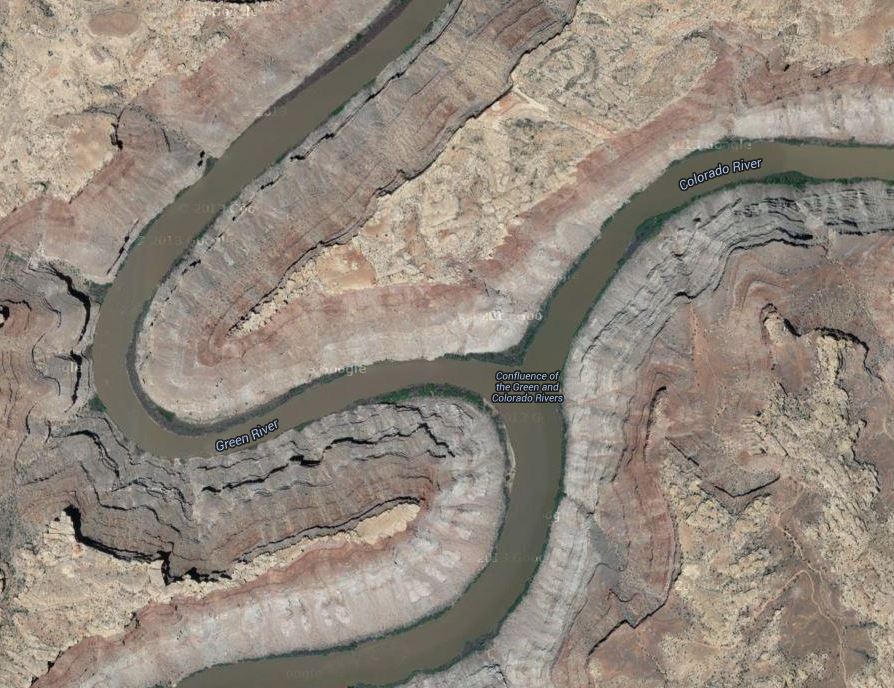
Can you get the joke in this photo, without a smattering of knowledge of geography, and languages?  Or am I looking at it wrong?

Confluence of the Green and Colorado Rivers, in Canyonlands National Park.  Photo by Jim Collins

Confluence of the Green and Colorado Rivers, in Canyonlands National Park. Photo by Jim Collins, posted on Facebook by Canyonlands National Park

It’s a joke on a planetary scale, if not a cosmic one.

(Hints:  This is a photo looking from the north, I think; “Colorado” means “red” in Spanish.)

Update: Okay, Mr. Higginbotham convinced me.  We’re looking from the west, and that’s the Colorado coming from the top of the picture, and the Green coming from the bottom left; then the conjoined streams flow away, to the bottom right.  So, in the photo, the Colorado River is, appropriately, red, while the Green River is, fittingly, green

Not a majestic joke by Mother Nature, but a poetic way to remind us of the names of these rivers.

Poetry that might make us smile, too.

(It’s rare that these rivers run such dramatically different colors, especially with the Colorado that red, that far north.)

Google Maps aerial photo of the Confluence of the Green and Colorado Rivers; match the geography with the other photo, and note the labels on this one.  Tip of the old scrub brush to Mr. Higginbotham.

Google Maps aerial photo of the Confluence of the Green and Colorado Rivers; match the geography with the other photo, and note the labels on this one. Rotate this picture 90 degrees to the left, it matches up better.   Tip of the old scrub brush to Mr. J. A. Higginbotham.

More:


Mark Twain in Fort Worth

July 29, 2013

Mark Twain statue, Trinity Park, Fort Worth, Texas Photo by Barbara Schmidt © 2010

Mark Twain statue, Trinity Park, Fort Worth, Texas Photo by Barbara Schmidt © 2010

I’m falling down in my Mark Twain fandom, obviously.  Barbara Schmidt, who keeps the fine site, TwainQuotes (www.twainquotes.com), features this photo of Mark Twain holding an open copy of The Adventures of Huckleberry Finn, on one of the main pages at her site.

I did not know such a statue of Twain existed in Texas, let alone within an hour’s travel from my home.  I’ll have to track it down.

Why is it there?  Twain never set foot in Fort Worth, that I know.

What other great statues hide around Dallas and Fort Worth?

More:

Mark Twain in Fort Worth's Trinity Park, by Amy Moore, at Everything Everywhere

Mark Twain in Fort Worth’s Trinity Park, by Amy Moore, at Everything Everywhere.  The statue was created by Gary Lee Price.


History of America, or art in America, or American art, or . . .

July 9, 2013

Brilliant piece from Grant Snider — history teachers, this should be a poster in your classroom, no?  Art teachers?

Grant Snider's

Grant Snider’s “American Art, exploring a country through its paintings”

In the course of a junior-level, high school U.S. history class, students should experience each of these works, and many others.  This is one whimsical way to work with serious and uplifting material, no?

Mr. Snider has a short essay — inspiring — and the information on each of the works he portrays, at the Modern Art site (I’ve added links below, here).

Since that formative vacation, the art museum is always one my of first stops in visiting a new city. In the comic above, I’ve curated my ideal collection of 20th-century American art. Here’s a list of works in order of appearance:

Jasper Johns, “Flag”

Edward Hopper,Morning Sun

Ellsworth Kelly, “Red Blue Green”

Wayne Thiebaud, “Refrigerator Pie”

Grant Wood, “Young Corn”

Roy Lichtenstein, “Whaam!”

Stuart Davis, “Colonial Cubism”

Andy Warhol, “Campbell’s Soup Cans”

George Bellows, “Dempsey and Firpo”

Jackson Pollock, “Autumn Rhythm”

Georgia O’Keeffe, “Sky Above Clouds III”

What are your favorite American art works, and what do they portray or demonstrate that you like?

More:


What rocks Yosemite? Granite

July 7, 2013

Yosemite’s Nature Notes #20 (I’m behind):  A short film discussing the astonishing manifestations of granite in Yosemite National Park.

English: El Capitan in Yosemite National Park ...

El Capitan in Yosemite National Park viewed from the Valley Floor — one of the more famous granite formations in the Park. Wikipedia image

The film is simply named, “Granite.”  Steven Bumgardner produced the film.

Yosemite’s chief formations are granite, an igneous rock.  Much of the terrain was carved in the granite by glaciers and glaciation — so what Yosemite shows is how fire and ice combine to make rock, to make rock formations, and to make rocks of astonishing beauty.

(This is not a place to bolster creationist ideas.  This is real science, looking at God’s handiwork first hand.)

A North Carolina university makes field trips to Yosemite?  I’d love to take that class!

Watching this film, you get a sense of how important it can be to the education of our children to travel in the summers, to take vacations to our National Parks, and to places like Yosemite.

Where are you taking your kids this summer?  Kids, where are you going?

Enjoy it.  Geology lessons are often fun, and this one, on film, is more fun than most.

More:

Close-up of granite from Yosemite National Par...

Close-up of granite from Yosemite National Park, valley of the Merced River – Wikipedia image


You didn’t believe in Ents, and then you met the redwoods

June 19, 2013

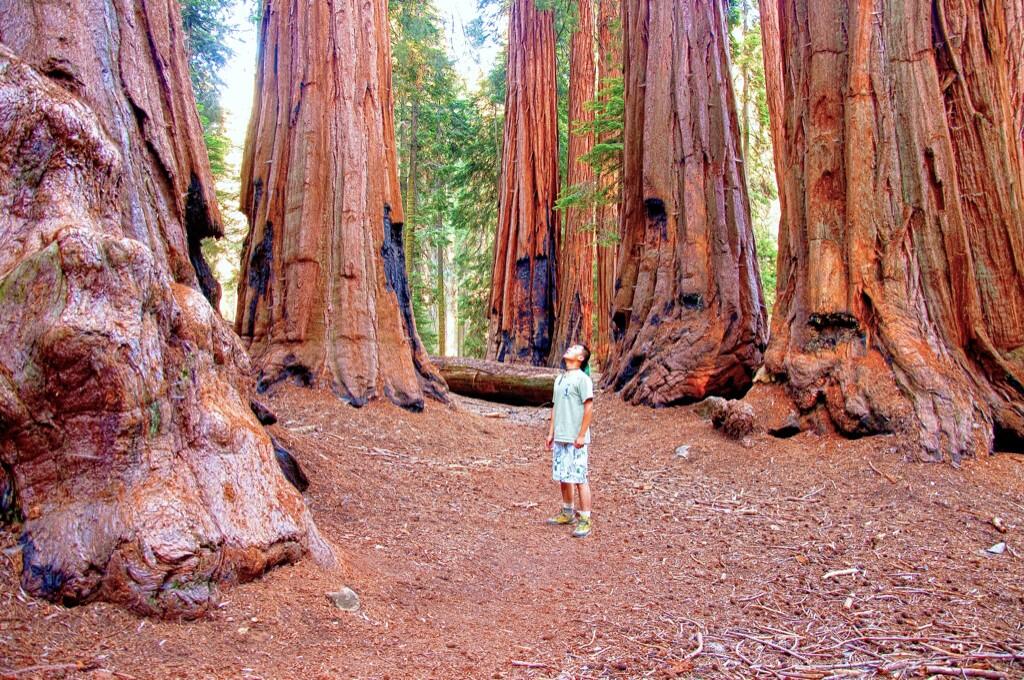
Giant redwoods in Sequoia-Kings National Parks

US Department of Interior, May 30, 2013 – Sometimes you have to look up to appreciate the beauty of America’s great outdoors. @SequoiaKingsNPS


Time lapse at Everest – Elia Saikaly

June 13, 2013

English: Mount Everest North Face as seen from...

Mount Everest North Face as seen from the path to the base camp, Tibet. Wikipedia image

A pick from the staff at Vimeo.

It’s astonishing how many people ascend Mt. Everest in our time.  Look at the tent city.

Everest’s beauty is stunning, always has been, but is now revealed by high-definition image capture unavailable just 10 years ago, now distributed by the internet.

These photos are mostly from about 25,000 feet in elevation — about where much domestic U.S. air travel occurs.  The weather up there is spectacular, if you’re not in it. It’s spectactular if you’re in it, too — but I’m viewing it from Dallas, where we’re above 90 degrees in the day, now, just 800 feet above sea level.

As these climbers risk their lives in adventure (10% of all people who attempt to summit, die), the Himalayas suffer from effects of global climate change.  Pakistan suffers from flooding today from premature and quick melting of glaciers.

What a great planet we have.  Can we keep it?

Notes from the film maker, Elia Saikaly:

eliasaikaly.com
Experience the beauty of Mt. Everest at night in time-lapse.

While most climbers slept, I attempted to capture some of the magic that the Himalayan skies have to offer while climbing to the top of the world.

Here’s a bit of what I endured at the end to make this possible: eliasaikaly.com/2013/05/into-the-death-zone/

One of the most rewarding parts of the journey was being able to share it with thousands of students on epals.com/everest

This time lapse video is comprised of thousands of photographs, processed and assembled on Mt. Everest.

Shot on a Canon 5D Mark II
-Canon 2.8 16-35mm
-Canon 2.8 24-70mm
-Canon 2.8 70-200mm (which was way to heavy to carry beyond 6400M)
-TL Remote was purchased off eBay

Edited in Final Cut Pro
Processed in Adobe LightRoom
Movies compiled in Quicktime

Music: A Heartbeat away purchased on goo.gl/AJZcM

I hope you enjoy it. If you do, please leave a comment and let me know what you think.

My stock footage, professional and charitable work can be see on my website at eliasaikaly.com
And on FB: facebook.com/elia.saikaly.adventurer

More:

2004 photo mosaic the Himalayas with Makalu an...

2004 photo mosaic the Himalayas with Makalu and Mount Everest from the International Space Station, Expedition 8. (Photo credit: Wikipedia)


Holes in the wall, Glen Canyon NRA

June 11, 2013

Ever get one of those days you just want to find a nice, warm hole and crawl inside?

Then head out to Glen Canyon National Recreation Area:

There are many unique areas within America’s public lands. Case in point this spot in Glen Canyon National Recreation Area.  Photo: Cassandra Crowley

Caption from America’s Great Outdoors: There are many unique areas within America’s public lands. Case in point this spot in Glen Canyon National Recreation Area. Photo: Cassandra Crowley

More: