Catch some falling stars (with help from NASA and USA Today)

May 20, 2014

USA Today does some great graphics from time to time.

This set comes as a preview to a special meteor shower — maybe — this weekend.

USA Today chart of meteor showers left in 2014, with star map of how to find Camelopardalid Shower this weekend.

USA Today chart of meteor showers left in 2014, with star map of how to find Camelopardalid Shower this weekend.

And just for this weekend:

Night of Shooting Stars, New meteor shower influenced by Jupiter's gravity -- USA Today starmap showing best place to look for meteoroids this weekend, the Camelopardalid Meteor Shower (first ever).

Night of Shooting Stars, New meteor shower influenced by Jupiter’s gravity — USA Today starmap showing best place to look for meteoroids this weekend, the Camelopardalid Meteor Shower (first ever).

So, early Saturday morning, or early Sunday morning, we could be in for a meteor shower display more intense than we’ve seen in a long time, experts say.

Or maybe not.

NASA’s explanation should help you find them (we found this video via Space.com):


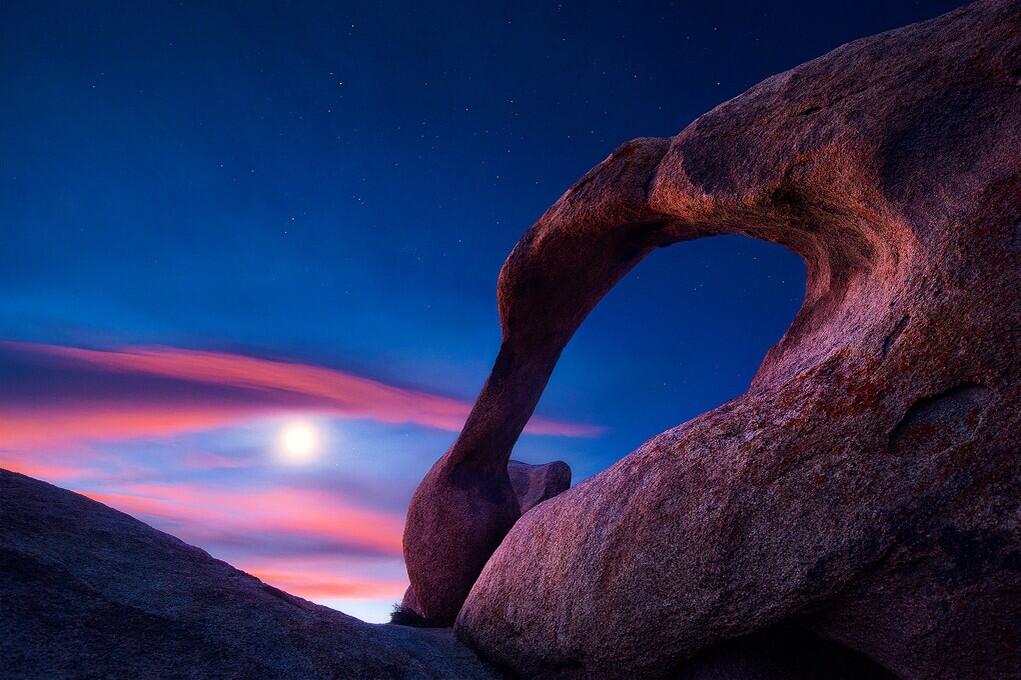
Moon and Mobius Arch, Alabama Hills, California

May 18, 2014

U.S. Department of Interior, Twitter feed: Beautiful view of the moon over Mabius Arch in the Alabama Hills Recreation Area. #California @BLMca pic.twitter.com/u0KYyJ6p0S

U.S. Department of Interior, Twitter feed: Beautiful view of the Moon over Mabius Mobius Arch in the Alabama Hills Recreation Area. #California @BLMca pic.twitter.com/u0KYyJ6p0S

Interesting points, reasons to like this image:

  1. No, that’s not the Sun.  It’s the Moon.
  2. Who knew California had natural arches?  I mean, it makes sense — but there’s one in Virginia, and a bunch of them at Arches National Park, and . . .
  3. An arch that should be in Utah, in the Alabama Hills, but not in Alabama, in California.
  4. Stars!
  5. Great photograph, obviously a long exposure.  Let’s see if we can find the name of the photographer.  Pox on Interior for failing to fit that into the caption. Photographer is Steve Perry, and you should check out his site (and buy some photos!). (Thanks, J. A. Higginbotham, for tracking that down.)
  6. America’s public lands, showing how they are unexcelled at astonishing us.
  7. What? Interior called the “Mabius Arch?” No, it’s the Mobius Arch!
  8. This place was named after the Confederate warship C.S.S. Alabama. Sympathetic miners making claims on minerals, it appears. “The unusual name Alabama Hills came about during the Civil War. In 1864 Southern sympathizers in Lone Pine discovered gold ‘in them thar hills.’ When they heard that a Confederate cruiser named the Alabama had burned, sunk or captured more than 60 Federal ships in less than two years they named their mining claims after the cruiser to celebrate. Before long the name applied to the whole area. Coincidentally, while Southerners were prospecting around Lone Pine, there were Union sympathizers 15 miles north near Independence. And when the Alabama was sunk off the coast of France by the U.S.S. Kearsarge in 1864, the Independence people struck back. They not only named their mining claims ‘Kearsarge’ but a mountain peak, a mountain pass, and a whole town as well.”
  9. More than 400 movies were shot using Alabama Hills for a backdrop, including How the West Was Won, Gunga Din (standing in for the hills of northern India) and the 1960 Audie Murphy classic, Hell Bent for Leather.
  10. Geologists will love that this area is a prime example of chemical erosion — rocks made out of the same stuff as the craggy Sierra Nevada Mountains in the distance, but eroded differently.
  11. Lichens by moonlight!  (Or is that just desert varnish?)

More:


“A day that will live in glory” — Frankfurter to Warren, on Brown v. Board

May 17, 2014

Read the rest of this entry »


Fly your flag May 17, 2014, for Armed Forces Day

May 17, 2014

Poster for Armed Forces Day 2014. Download images, here.

Poster for Armed Forces Day 2014. Download images, here.

Armed Forces Day is the third Saturday in May, May 17th in 2014.

New machines on the poster this year!

See President Obama’s proclamation of Armed Forces Day 2014 here.

A bit of history, as we’ve noted earlier:  After President Truman’s administration brought the management of the armed forces under the umbrella of one agency, the Department of Defense, Truman moved also to unite what had been a separate day of honor for each of the branches of the military, into one week capped by one day for all uniformed defense services.

On August 31, 1949, Secretary of Defense Louis Johnson announced the creation of an Armed Forces Day to replace separate Army, Navy and Air Force Days. The single-day celebration stemmed from the unification of the Armed Forces under one department — the Department of Defense. Each of the military leagues and orders was asked to drop sponsorship of its specific service day in order to celebrate the newly announced Armed Forces Day. The Army, Navy and Air Force leagues adopted the newly formed day. The Marine Corps League declined to drop support for Marine Corps Day but supports Armed Forces Day, too.

In a speech announcing the formation of the day, President Truman “praised the work of the military services at home and across the seas” and said, “it is vital to the security of the nation and to the establishment of a desirable peace.” In an excerpt from the Presidential Proclamation of Feb. 27, 1950, Mr. Truman stated:

Armed Forces Day, Saturday, May 20, 1950, marks the first combined demonstration by America’s defense team of its progress, under the National Security Act, towards the goal of readiness for any eventuality. It is the first parade of preparedness by the unified forces of our land, sea, and air defense.

Celebrations like Armed Forces Day offer good opportunities to promote history. I suspect that the day’s coming always in the middle of May suppresses some of the teaching moment value, as teachers make a final push for end of course tests, finals, and in high schools, for graduation — and as many colleges are already out for the summer. Good materials are available that can be sprinkled throughout a course.

Photograph of President Truman and other digni...

President Truman and other dignitaries on the reviewing stand during an Armed Forces Day parade, (left… – NARA – 200222 (Photo credit: Wikipedia) (Is that Eisenhower on the left?)

For example, this list of world-wide events at the first Armed Forces Day, in 1950, gives a good picture of four years into the Cold War, and would make a good warm-up exercise or even an entire lesson, or offer opportunities for projects:

The first Armed Forces Day came at a time of increased world tensions, political volatility and communist aggression. Some notable events that marked America’s first Armed Forces Week were as follows:

  • Bolivian police broke up “alleged” revolutionary communist-led general strike in LaPaz.
  • Two U. S. government buildings in Canton, China were taken over by the Chinese Communist Government. The buildings were U. S. property acquired prior to the Communist takeover.
  • The Burmese Army recaptured the city of Prome, a strategic communist-rebel stronghold.
  • Nicaraguans elect General Anastasio Somoza to a regular six-year term as president.
  • French and West German governments expected to talk shortly on the merger of the coal and steel industries of the two countries.
  • Communist China lifted the ban on daylight shipping along the Yangtze River due to the decline of Nationalist air activity.
  • Norway receives first US military aid in the form of two Dakota planes.
  • U. N. Secretary General Trygive Lie seeks West’s acceptance of Red China in the U. N.
  • Iran announced close range news broadcasts to the Soviet Union with $56,000 worth of Voice of America equipment.
  • Cuba celebrated the 48th anniversary of the establishment of its republic.
  • The Red Cross celebrated its 69th birthday.
  • Britain ended rationing of all foods except meats, butter, margarine, and cooking fat.
  • The U. S. Congress voted to extend the draft. “A Bill to extend registration and classification for the Draft until June 24, 1952 passed the House 216-11.”
  • The Allied Command announced it would “ease” the burden of occupation on Austria and would name civilian high commissioners to replace present military high commissioners.
  • Soviet authorities in Berlin withdrew travel passes of the U.S. and British military missions stationed at Potsdam in the Soviet zone of occupation.
  • The Soviets returned 23 East German industrial plants to East German authorities. The plants had been producing exclusively for the benefit of reparations to the USSR.
  • Twenty-eight Soviet vessels, consisting of tugs, trawlers, and supply ships remained in the English Channel as the Western Alliance prepared for air and naval maneuvers. Observers noted that many of them carried rollers at their sterns for trawling nets although no nets were visible.
  • Pravda denounced Armed Forces Day, calling it the militarization of the United States. “The hysterical speeches of the warmongers again show the timeliness of the appeal of the Permanent Committee of Peace Partisans that atomic weapons be forbidden.”
  • Western Powers renewed their promise to help Mid-Eastern states resist communism. They also announced an agreement to sell arms to Israel as well as to the Arabs.

Veterans Day honors veterans of wars, and those who served in the past; Memorial Day honors people who died defending the nation; Armed Forces Day honors those men and women serving today.  Service with two wars, in an “all volunteer” military, is a rough go, especially in times of federal budget cuts.  Say a good word about active duty military on Saturday, will you?

Armed Forces Day 1952, DOD Archives photo

A photo from Defense archives, of Armed Forces Day 1952 — also on May 17; DOD caption: QUOTING BENJAMIN FRANKLIN – Servicemen and women comprise this poster, which features cautionary words of Benjamin Franklin. (AFD-1952) [Franklin quote:  Let us beware of being lulled into a dangerous security, and of being weakened by internal contentions and divisions . . . of neglect in military exercises and discipline, and in providing stores of arms and munitions of war, for . . . the expenses required to prevent war are much lighter than those that will, if not prevented, be necessary to maintain it.  Benjamin Franklin, 1784.  Franklin’s words were in a letter to Charles Thomson, the Secretary of the 2nd Continental Congress, on May 13, 1784, written from his station in Passy, France.]

More:


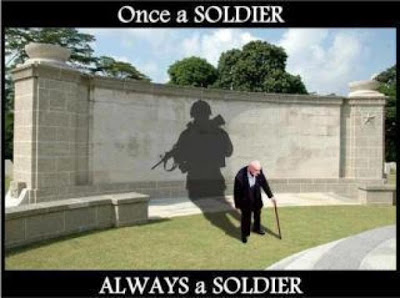
“Once a soldier . . .” — Who is the artist?

May 17, 2014

Once a soldier, always a soldier; Who created this?

Who created this?

Interesting tribute to old soldiers, quite touching — and thought provoking.

As with too much other good stuff on the internet, the attribution to the creator or creators has been stripped away in a thousand repostings.

Who created this image?  Do they have other thought-provoking stuff we should know about?


Brown vs. Topeka Board of Education, and Herblock’s cartoon

May 17, 2014

Note the inscription on the bell.  It’s the Liberty Bell.  The inscription comes from the Bible.

Cartoons like this make racists and so-called conservatives nervous, very, very nervous.


Guns to protect against U.S. government? Constitution doesn’t protect that

May 16, 2014

Today, May 16, 2014, a group of yahoos promises 10 million armed Americans will descend on Washington to force changes in government, maybe depose the President, and have other yahoo fun squealing tires, drinking beer, and scaring good folks with the guns they wave.

They’ll be lucky to have a thousand people show up and politely decline to run afoul of the District of Columbia’s gun laws and the concomitant prison time.

If they stay out of jail, it won’t be because the Constitution protects them.

Yes, the Second Amendment says they have — and you and I have — a right to “keep and bear arms.”

Yahoos, true to their yahoo ways, really don’t read the Constitution thoroughly.  Otherwise, I suspect they’d be more circumspect.

Article III, Section 3, of the Constitution defines using those arms against the government, levying war against the U.S., as “treason.”

Treason against the United States, shall consist only in levying war against them, or in adhering to their enemies, giving them aid and comfort. No person shall be convicted of treason unless on the testimony of two witnesses to the same overt act, or on confession in open court.

Neither the First Amendment nor the Second Amendment excuses treason.

How will today turn out in Washington?  There may be some traffic tie-ups.  There always are. Anything out of the ordinary, though?  Not if citizens use common sense, and stick to the Constitution that protects their protests.

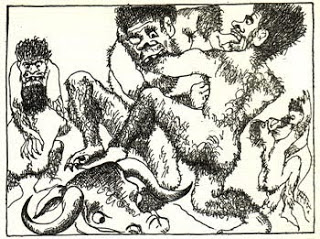
Yahoos, in one of their nicer portrayals from the 1947 edition of Gulliver's Travels.  Image from Wordmall.

Yahoos, in one of their nicer portrayals from the 1947 Crown edition of Gulliver’s Travels; drawing by Luis Quintanilla. Image from Wordmall.

Update:  As of Friday afternoon, the rally fizzled.  Organizers blamed the rain.  Proof that rain falls on the unjust, too?

More:


Spam attack; comments moderated

May 14, 2014

My apologies.

Please, no spam.  No offense to Spam, I hope.

Please, no spam. No offense to Spam, I hope.

Today the site has been hit with major spam attacks from a couple of different directions.  WordPress’s wonderful Akismet software captures a lot of the stuff, but someone has figured a way around it (temporarily, I trust), and I’ve been swatting spam down for most of the day.

To keep the comments clean, I’ve put a control that disallows comments except from known and relatively trusted accounts. If you’re new here, be patient.  It may take two or three hours tonight before I can approve a first comment.

Please don’t let that stop you from commenting.  Legitimate comments should all appear, shortly.

Thanks for visiting.


Signs of life: GPS not advised

May 14, 2014

From space, from the satellites, the route may look shorter.

But on the ground, it may not work.

State Highway Signage, US 11 and VA 56; near Steele's Tavern, Virginia.

State Highway Signage, US 11 and VA 56; near Steele’s Tavern, Virginia. “GPS Routing Not Advised” Photo by Linda Walcroft

At the View from Squirrel Ridge, comments suggest that Virginia has several places like this, where the GPS favoring the shortest route may include inclines and turns that trucks cannot make.  It’s hell to back up a big truck for several miles of twisty, narrow roads.

More:


“Go fly a kite!” Um, but not here.

May 14, 2014

I do not believe I have ever seen such a sign before:

Odd sign, until you realize it's difficult to fly a kite in a canyon and avoid the power lines.  Photo from Poky Tom's Flickr files, Thousand Springs, Idaho.

Odd sign, until you realize it’s difficult to fly a kite in a canyon and avoid the power lines. Photo from Poky Tom’s Flickr files, Thousand Springs, Idaho.

About 1982 I bought a couple of kites and string and kept them in my office on Capitol Hill.  I hoped someone would some day tell me to “go fly a kite,” whereupon I would announce that’s exactly the thing to do, grab the kites and rush to the Washington Mall to fly them. (Do they allow that stuff, there, anymore?)

Alas, none of our pitched battles over policy and press release phrasing got to that point.  The kites got lost in the move from Maryland.

I came up on this photo, and the explanation tickled.  You may see why.  Poky Tom wrote:

Grounded at Thousand Springs! 

Today, the first day of World Wide Kite Aerial Photography (KAP) Week 2011, I was excited to finally end my 3-year jinx of getting skunked during WWKW. The weather was good with reasonable wind. We knew the Thousand Springs area would be great for photography. We pulled into the parking lot, which is shared by the Thousand Springs State Park and the Idaho Power hydro power facility. I got out of the car and was immediately confronted by this sign. Curses! Move on.


I’ve never heard of kite aerial photography as something almost organized.  Poky Tom has some wonderful shots from a kite, though.  He also uses a 30 foot pole to get great results.

But, no, you can’t fly a kite there.

More:


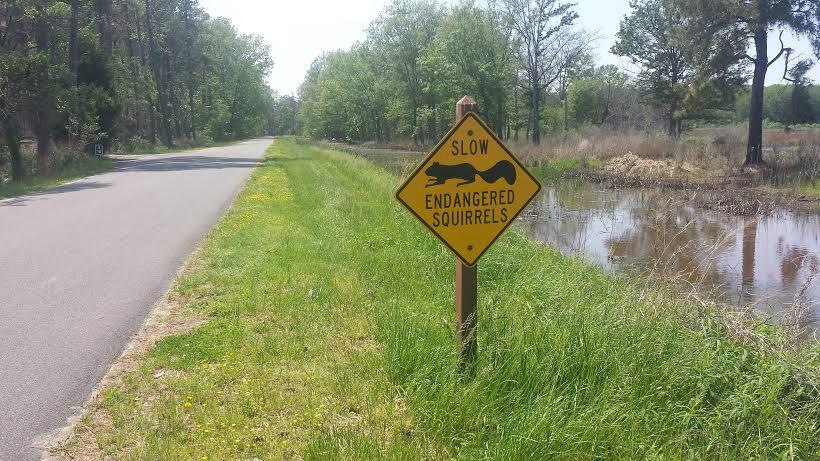
Signs of life: Endangered squirrels

May 13, 2014

From jbendery (Jennifer Bendery) --  I learned today that there are endangered squirrels, and apparently they have ginormous tails. (h/t @kate_sheppard) pic.twitter.com/Uu4QxiDa5M

From jbendery (Jennifer Bendery) — I learned today that there are endangered squirrels, and apparently they have ginormous tails. (h/t @kate_sheppard) pic.twitter.com/Uu4QxiDa5M

A lot of punchlines possible, e.g., ‘if the squirrels weren’t slow, maybe they wouldn’t be endangered.’

Still a rather unique sign, no?

I wonder where it is?  This sign marks habitat in the Blackwater National Wildlife Refuge  in Maryland for the Delmarva fox squirrel.

Update:  Well, maybe not wholly unique; World Wildlife Fund has this one — again, without a note about location.

Slow - squirrel crossing sign © Michael Mallet

© Michael Mallet


Annals of Global Warming: Significant events for U.S. April 2014.

May 13, 2014

National Overview - April 2014, from NOAA's National Climatic Data Center

National Overview – April 2014, from NOAA’s National Climatic Data Center

NOAA publishes these data monthly.  We tend to ignore them, as background noise.

But click over to NOAA’s site, look at the charts and click to follow links.  Ponder the story being told.

This is the snapshot for April 2014.

Major climate events NOAA is closely monitoring:

  • Drought in the West, Central and Southern Plains, and Midwest. Long- and short-term dryness will increase wildfire risk and continue to have impacts on water resources and agriculture.
  • El Niño development likely this summer or autumn. According to NOAA’s Climate Prediction Center, there is a greater than 65 percent chance of El Niño conditions developing later this year, which could have significant impacts on temperature and precipitation patterns across the U.S. More information is available from the Climate Prediction Center.

Supplemental April 2014 Information


  • Climate Highlights — April
  • The average temperature for the contiguous U.S. during April was 51.7°F, which was 0.7°F above the 20th century average. This was the 46th warmest April in the 120-year period of record.
  • Much of the contiguous U.S. had April temperatures near the 20th century average. Above-average temperatures were scattered along the West Coast and in the Southwest, the Southern Plains, and across parts of the Ohio Valley and the Southeast. Below-average temperatures were observed across parts of the Upper Midwest and Northern Plains. No state had April temperatures among their 10 warmest or coolest.
  • Alaska had the 12th warmest April of its 96-year period of record, with a temperature 3.8°F above the 1971-2000 average. This was the warmest April for Alaska since 2007. Much of the warmth was situated in western Alaska, where Nome had its fourth warmest April since local records began in 1907. The April precipitation total in Alaska was 23.3 percent below the 1971-2000 average, the 23rd driest April on record. Anchorage had its fifth driest April with only nine percent of normal monthly precipitation.
  • The April contiguous U.S. precipitation total of 2.83 inches was 0.31 inch above the 20th century average and the 30th wettest April on record.
  • Above-average precipitation in the Upper Midwest resulted in Wisconsin having its third wettest April and Minnesota its eighth wettest. Heavy precipitation across the Southeast, particularly near the end of the month, caused Alabama to have its fifth wettest April, Georgia its seventh wettest, and Florida its ninth wettest.
  • On April 29th and 30th, torrential rain fell across the Southeast, Mid-Atlantic and Northeast causing significant flash flooding. The Gulf Coast of Alabama and the Florida panhandle bore the brunt of the heavy rains. At the Pensacola Regional Airport, in Florida, the two-day precipitation total was 20.47 inches, with 15.55 inches of the total falling on the 29th, breaking both one-day and two-day precipitation records; local records date back to 1879. On the 29th, Mobile, Alabama received 11.24 inches of rain, the third greatest calendar day rainfall total for the city since local records began in 1871. According to the 2014 National Climate Assessment released on May 6th, the amount of heavy precipitation falling in single events has increased by 27 percent across the Southeast since 1958. This event is consistent with projections of increases in the frequency and intensity of extreme precipitation events across the U.S. as the world warms.
  • Below-average precipitation was observed across parts of the West, the central Rockies, and the Central and Southern Plains. Oklahoma had its 12th driest April on record, with 50 percent of average precipitation. Parts of Texas were also particularly dry, where San Angelo observed just 30 percent of normal monthly precipitation.
  • According to the April 29thU.S. Drought Monitor report, 38.4 percent of the contiguous U.S. was in drought, nearly the same as the beginning of April, with both improvement and degradation of drought conditions on regional scales. Beneficial rain improved drought conditions across the Upper Midwest and Southeast during the month, while drought conditions worsened in parts of the West and across portions of the Central and Southern Plains.
  • Drought conditions improved in Hawaii during April due in part to heavy rainfall at the end of March and the beginning of April. Only 0.7 percent of the state was experiencing drought conditions on April 29th, down from 14.4 percent at the beginning of the month. This was the smallest drought footprint for Hawaii since April 2008, and the first time since June 2008 that no part of the state was experiencing severe drought. Most of the drought improvement occurred across the Big Island, with central Molokai still experiencing moderate drought conditions.
  • A severe weather outbreak on April 27-29 spawned at least 38 tornadoes from Nebraska to North Carolina, according to preliminary estimates from NOAA’s Storm Prediction Center. At least 32 fatalities were blamed on the tornadoes, with Arkansas and Mississippi being the hardest hit. An EF-4 tornado in Pulaski and White counties in Arkansas resulted in 15 fatalities, while an EF-4 in Winston County, Mississippi resulted in nine fatalities.
  • Based on NOAA’s Residential Energy Demand Temperature Index (REDTI), the contiguous U.S. temperature-related energy demand during April was 28 percent below average and the 37th lowest in the 1895-2014 period of record.
  • During April, there were about 75 percent more cold daily temperature records (1,419 cold maximum temperature records, 1,380 cold minimum temperature records; 2,799 total) than warm daily temperature records (544 warm maximum temperature records, 1,039 warm minimum temperature records; 1,583 total).
  • Climate Highlights — year-to-date (January – April)
  • For the first four months of 2014, the contiguous U.S. temperature was 38.7°F, 0.4°F below the 20th century average, and the 46th coldest January-April on record. This was the coldest four-month start to a year since 1993.
  • Below-average temperatures were widespread across the eastern U.S. where 13 states had January-April temperatures among their 10 coldest on record. The coldest departures from average occurred across the Midwest. No state had its coldest January-April on record.
  • Warm conditions were observed across a large portion of the West. Arizona and California were both record warm, with four-month temperatures 4.5°F and 5.2°F above their 20th century average, respectively. Nevada, Oregon and Utah each had one of their five warmest January-April periods on record.
  • The year-to-date precipitation total for the contiguous U.S. was 8.79 inches, 0.68 inch above the 20th century average and the 33rd driest January-April on record.
  • Below-average four-month precipitation totals were widespread across the Southwest and the Central and Southern Plains. Arizona, Kansas, New Mexico, Oklahoma, and Texas each had January-April precipitation totals that ranked among their 10 driest on record. Oklahoma had its second driest January-April on record, with less than half of average precipitation; 1936 was the driest. The dry conditions across Oklahoma decimated much of the winter wheat crop in the state, with estimates of the lowest harvested yield since 1957. In west Texas, precipitation deficits that date back to 2010 have been unprecedented in the observational record, with nearly every major reservoir in the region at less than 40 percent of capacity.
  • The U.S. Climate Extremes Index (USCEI) for the year-to-date was the 14th highest on record for the period at 145 percent of average. Elements that contributed to the above-average USCEI included the spatial extent of cold maximum and minimum temperatures, warm maximum temperatures and the spatial extent of drought. The USCEI is an index that tracks extremes (falling in the upper or lower 10 percent of the record) in temperature, precipitation and drought across the contiguous U.S.
  • Based on REDTI, the contiguous U.S. temperature-related energy demand during January-April was 27 percent above average and the 29th highest in the 1895-2014 period of record.

Galileo may have put it like this:  Eppure, lei si scalda!


Milky Way in Navajoland: YIKÁÍSDÁHÁ

May 13, 2014

Milky Way over Monument Valley Navajo Park. Photo by Gavin Heffernan and Harun Mehmedinović, from the video

Milky Way over Monument Valley Navajo Tribal Park. Photo by Gavin Heffernan and Harun Mehmedinović, from the video (which also features Grand Canyon National Park)

Phil Plait’s column/blog at Slate, Bad Astronomy, put me on to this one.  Wow.

You can see it at Vimeo, and read a lot more about the making of the film.

YIKÁÍSDÁHÁ (Navajo for Milky Way or “That Which Awaits the Dawn”)

Phil wrote:

And that they do. The Milky Way is the star of the show; the galactic bulge, disk, and dark fingers of vast dust lanes as clear as if this were taken from space. Well, sort of; I was impressed by the mix of clouds and sky, to be honest. The contrast was interesting, and it’s rather amazing the Milky Way could stand out so clearly above the cloud line.

One thing I want to point out specifically: At 2:10 in, a meteor flashes and leaves behind a curling wisp of what looks like smoke. This is called a persistent train, the vaporized remains of the meteoroid itself, and can glow for several minutes. The upper level winds from 60–100 km above Earth’s surface are what blow it into those curlicues.

More details, for more films from these guys:

Shot and Produced by: Gavin Heffernan and Harun Mehmedinović
Music: A Seated Night (Ambient) by Moby. Courtesy MobyGratis.com / Unknown Native Chant
Thanks: Northern Arizona University, Grand Canyon National Park, Monument Valley Tribal Park.

See other Sunchaser Timelapses on Vimeo here: vimeo.com/album/189653
LIKE Sunchaser Pictures on Facebook! facebook.com/SunchaserPicturesPage
LIKE Bloodhoney on Facebook! facebook.com/blood.honey.by.harun.mehmedinovic

For more from the artists:

BloodHoney.com
SunchaserPictures.com


Photo of the moment: India brilliantly demonstrating the error of Mao Zedong

May 12, 2014

You remember the quote, don’t you?

Every Communist must grasp the truth; “Political power grows out of the barrel of a gun.”

Mao Zedong, “Problems of War and Strategy” (November 6, 1938), Selected Works, Vol. II, p. 224.

Here is the 21st century response from India:

A man shows off his finger, marked with ink, to show he's voted in India's elections, 2014.   WSJ image

A man shows off his finger, marked with ink, to show he’s voted in India’s elections, 2014. WSJ Tweet: India’s weeks-long federal elections come to a close. Photos from the polling place: http://trib.al/SekkQd2 (EPA)

In a democratic regime, political power grows from the finger that rings the doorbell or dials the phone to invite a neighbor to vote, and to that same finger marking the ballot in the voting place.  In the 21st century, democratic revolutions are slower, cause less bloodshed, but are more deeply rooted in the will of the people, and last longer in the deep reforms they bring to a nation.

The finger is mightier than the gun.

Mao is dead.  Even his nation turns towards capitalism, and eventually, to personal political freedom.

O, Tempora! O, Mores!

To which I would add (hoping I get the grammar correct!):  Novae viae veteres malis eius conterendos.  Spes et patientia superare tyrannidis.  (New ways crush the old bad habits. Hope and determination overcome tyranny.)

Afterthought:   When Malcolm X preached “The Ballot or the Bullet,” he advocated the ballot. He knew.


George Takei’s Mothers Day decal find, “Eat Local”

May 12, 2014

Shouldn’t be controversial in your neighborhood, should it?

Decal for your car, to support breast feeding among new mothers.  Available at Amazon.com, from Red Clay Designs.  Thanks to George Takei.

Decal for your car, to support breast feeding among new mothers. Available at Amazon.com, from Red Clay Designs. Thanks to George Takei.

More: