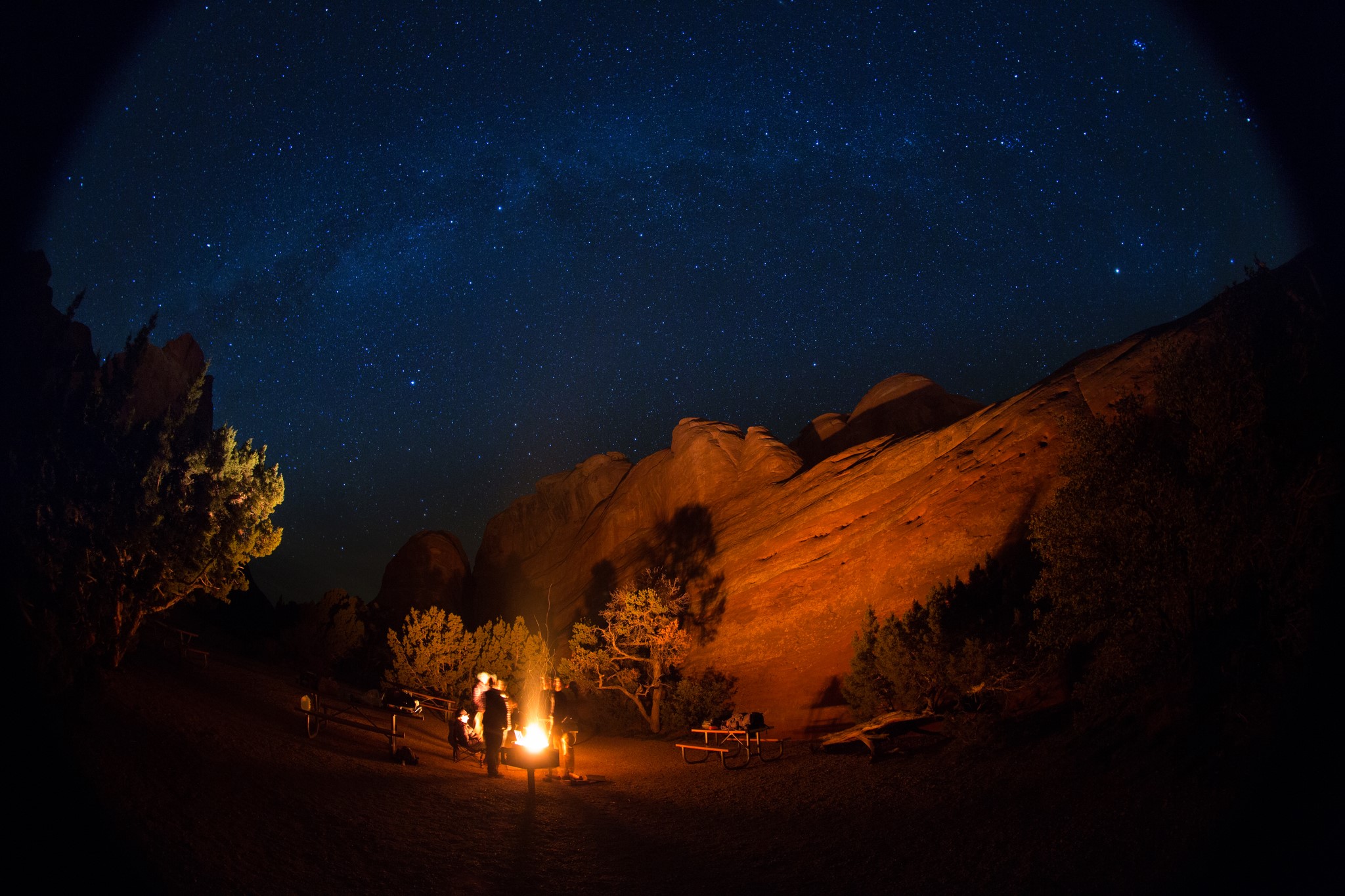
Something about a campfire, in Arches National Park

November 8, 2013

Campfire in Arches National Park, by John Dale, photographer, 2013

Photographer John Dale wrote: “We rolled in to Arches National Park to a beautiful sunset and got to our campsite just as it got dark, but that left us with a clear sky, plenty of stars, and a fire to warm up next to. Here’s a photo from the timelapse I took that night.”

From a photographer named John Dale, via Arches National Park’s Facebook page.

More:

Map of Arches National Park, Utah, United Stat...

Map of Arches National Park, Utah, United States showing predominant features such as arches, peaks, rivers and streams, mines, and roads. (Photo credit: Wikipedia)


New Mt. Rushmore coin introduced

November 7, 2013

U.S. Mint's Acting Associate Director for Manufacturing, David Croft delivers his remarks. — in Custer, SD.

U.S. Mint‘s Acting Associate Director for Manufacturing, David Croft delivers his remarks. — in Custer, SD.

Interesting view of Mt. Rushmore on the new Mt. Rushmore Quarter.

Here’s David Croft, Acting Associate Director for Manufacturing of the U.S. Mint, introducing the coin yesterday in Custer, South Dakota.

(Wow; how much history is packed in that? Too little of it in the high school texts.  Who is on Rushmore?  Who made the sculptures on Rushmore, and when?  After whom is Custer, South Dakota, named, and why?)

More:

English: Sign near Mt. Rushmore, South Dakota,...

Sign near Mt. Rushmore, South Dakota, informing travelers that the Alfred Hithcock film “North by Northwest” was partially filmed in the area (Photo credit: Wikipedia)


Moon, stars, Earth, all conspire to produce astonishing beauty in Hawaii

November 5, 2013

It’s a composite of 11 photographs to get the whole panoramic view — which just demonstrates that in photography it’s great to be lucky, but it usually takes great skill to get that amount of luck.

How much processing was involved, really?

Don’t worry, just check out the photo.

Double Moonbow, lava glow and fading Lunar Halo; 11-picture Panoramic taken on the rim of Kilauea's Caldera On the Last Super Moon. Sean King, Atmospheric Phenomena

Double Moonbow, lava glow and fading Lunar Halo; 11-picture Panoramic taken on the rim of Kilauea’s Caldera On the Last Super Moon. Sean King, Atmospheric Phenomena

See the Facebook page for Hawaii Stargazing Adventures.

Click thumbnail for a larger image.  Kilauea and double Moonbow - Sean King - 736169_10201694350153369_1176409460_o


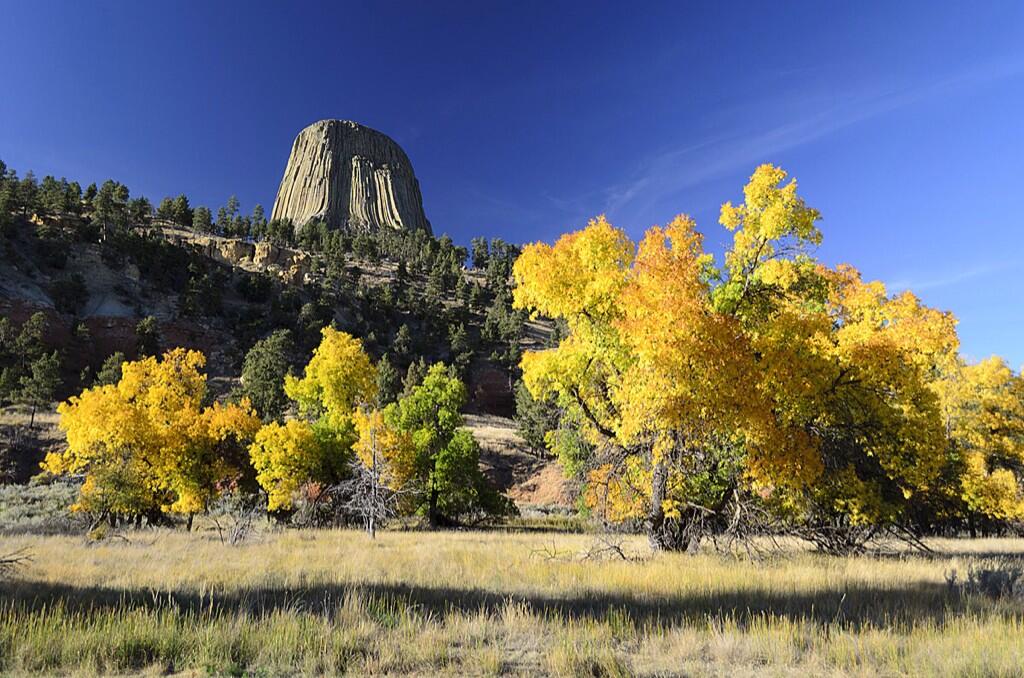
Devils Tower is beautiful in autumn

October 25, 2013

Or any other time of year.

From the Department of Interior Twitter feeds:

 Devils Tower NM. pic.twitter.com/YRo1U8DSMQ

US Dept of Interior ‏@Interior 16h Is there any doubt fall is best enjoyed in America’s great outdoors? Here’s great example from Devils Tower NM. pic.twitter.com/YRo1U8DSMQ

What do you think Richard Dreyfus thinks when he sees that?  Stephen Spielberg?

Devils Tower NM” means “National Monument,” not New Mexico.  This volcano remnant stands in Wyoming.

Old friend, painter and photographer Nancy Christensen Littlefield offers a more close-up view.

Devil's Tower on a July morning.  Photo by Nancy Christensen LIttlefield.

Devil’s Tower on a July morning. Photo by Nancy Christensen LIttlefield.

And looking even closer, you spy Richard Dreyfus never-wanna-bes:

Climbers on Devil's Tower. Photographer Nancy Littlefield

Climbers on Devils Tower. Photographer Nancy Littlefield said: “There were Native American prayer bundles along the trail around the base. It really is awe inspiring. Early morning gives you the best light to photograph it by.”

Devils Tower is the plug of an old volcano.  What’s left is the magma that hardened, and what we see is left after the softer cone eroded away.

More:


Is your science class as smart as a U-Haul truck?

October 23, 2013

We had to fight to keep this stuff in Texas science books.

Then, out on the street, I see a U-Haul truck.

U-Haul truck features geographic information, and geology information

U-Haul truck features geographic information, and geology information, about Arkansas and its Crater of Diamonds State Park.

Detail:  U-Haul truck features a graphic description of the geology and information about Arkansas's Crater of Diamonds State Park.

Detail: U-Haul truck features a graphic description of the geology and information about Arkansas’s Crater of Diamonds State Park.

Well played, U-Haul.  Can Texas catch up?

Update, October 24, 2013:  Turns out U-Haul has a website that features all of the graphics they use on their trucks.  I sense a geography or state history assignment in here, somewhere, social studies teachers.  Reminds me of the animals that used to (still do?) grace the tails of Frontier Airlines airplanes, the Native American on the tails of Alaska Airlines, and other specific destination promoting tricks businesses have used over the years.  Wish more businesses would do that.

http://twitter.com/SuperGraphic/status/393408729388834816

More:


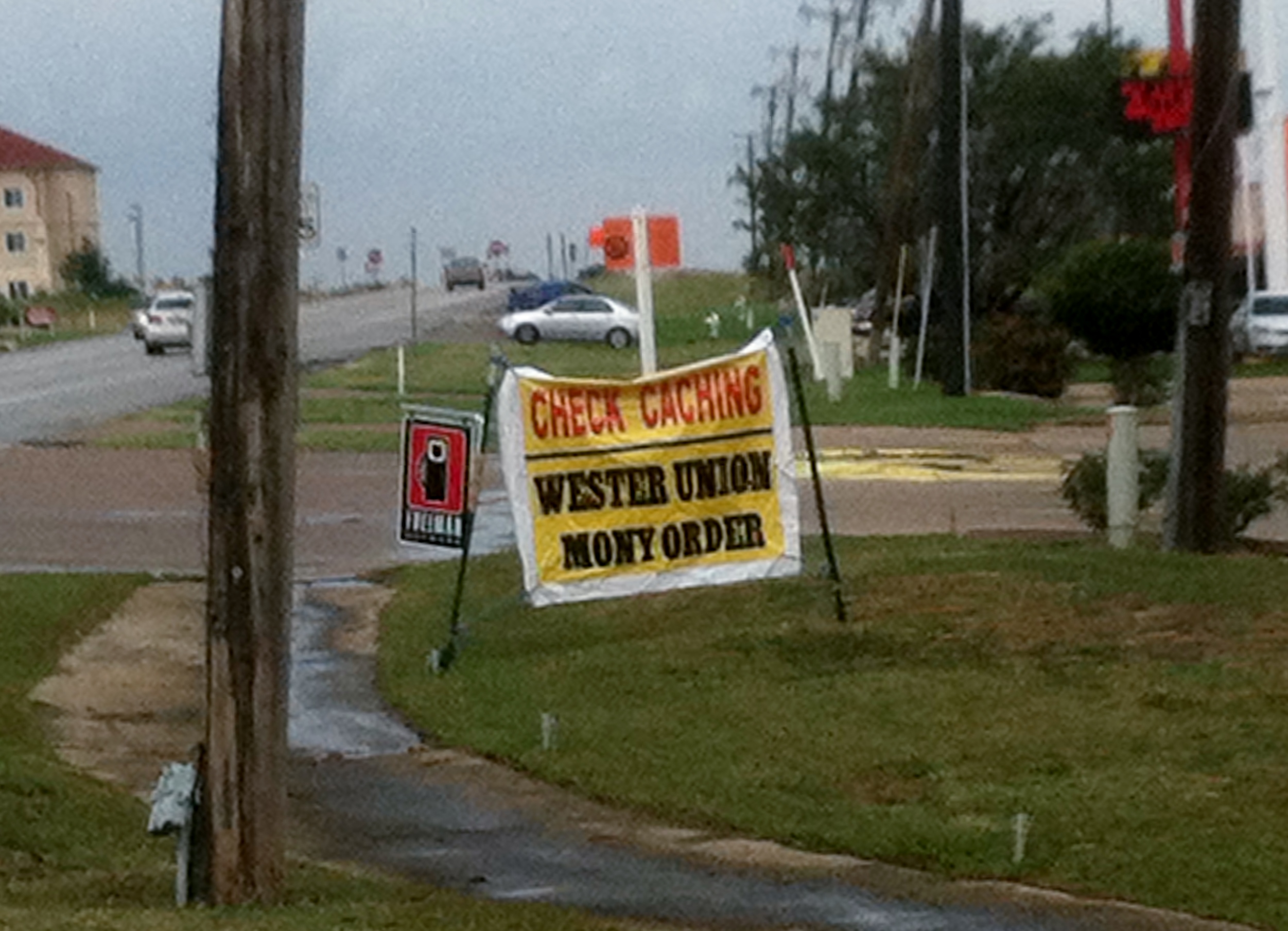
Signs: “Check caching”

October 21, 2013

Utah has a Cache County, which includes most of the Cache Valley.  In 7th grade Utah history, if not before, Utah kids learn that the name came from the old Mountain Men, French-descended fur trappers who plied the area well before the Mormon pioneers and even John C. Fremont.

A trapper could collect a half-ton of beaver pelts in a season, to sell to a large corporation to export to Europe to be made into felt.  He wouldn’t want to carry that weight around with him.  So trappers would make a place to hide their furs until trading time — a “cache” in fractured French, from the word “cacher,” which means “to hide,” in this case. (See also Colorado’s Cache la Poudre River.)

Utah’s Cache Valley at least one year hosted the grand rendezvous of fur trappers and their hosting corporate suppliers and buyers, and for much of a decade or longer was a place where fur trappers hid their furs awaiting the rendezvous — great American explorers and pioneers like Jedediah Smith, Jim Bridger, James Beckwourth, Peter Skene Ogden and Thomas Fitzpatrick.

Maybe the people who made this sign didn’t know that history.  I found it in Alvarado, Texas, after all.

There is a world of difference between “cashing a check” and “caching a check,” though.  Surely there is an Abbott and Costello-style comedy routine in this sign:

Check caching in Alvarado, Texas?

Check caching in Alvarado, Texas?

Six words on that sign.  Three of them are misspelled, 50%.

I imagine someone entering the store to cash a check, handing it to the clerk who promptly drops it into a slot in a mysterious box and says, “All cached.”  “Where’s my check?” the customer demands.  Abbott and Costello enter from the back room.

Then I got stuck with an ugly earworm for the next few miles, with Tommy James infecting my brain.  But for the want of an “e” it could have been the Beatles or Pink Floyd.

I hope the merchant got a heckuva discount from the sign maker.  At least 50% off.

Camp near the head of Cache Valley, Utah - NAR...

Cache Valley, Utah, in the late 19th or early 20th century; camp near the head of Cache Valley – NARA – 516657 via Wikipedia

Cache Valley, Utah, today, after an infusion of cash. Jim Bridger wouldn't recognize the place.  Wikipedia image

Cache Valley, Utah, today, after an infusion of cash. Jim Bridger wouldn’t recognize the place. Wikipedia image


Fall colors at Great Sand Dunes National Park? White?

October 18, 2013

Looks like snow to me.  From the Department of Interior:

Fall colors have arrived at the Great Sand Dunes National Park.  Department of Interior

Fall colors have arrived at the Great Sand Dunes National Park. #nature #autumn #colorado pic.twitter.com/34RXSkuBLe


Signs: “Church” — warning signs?

October 13, 2013

Our drive through central Texas and the Hill Country a few days ago provided some good fun and much needed break, though our destination was a memorial service for a friend who died very prematurely.

Kathryn noticed these odd signs first.  I’m not sure of the purpose.  These are in the information sign mode, the yellow diamonds used to warn drivers of hazards ahead.

The hazard?  “Church.”

"Church" warning sign in Burnet, Texas

“Church” warning sign in Burnet, Texas

One might imagine these signs are posted to warn drivers on Sunday.  About noon, when these churches’ services let out, the roads around them may be filled with people who are only too happy to go meet Jesus right now — so watch out! and drive accordingly.

Texas offers all sorts of strange things to those willing to drive the state’s highways, and see ’em.

More:


Sunrise at Hawk Mountain, Pennsylvania

October 4, 2013

Photograph posted on Facebook by the Hawk Mountain Sanctuary Association:

Sunrise at Hawk Mountain, Quelia Paulino, Hawk Mountain Sanctuary

Planning a trip to Hawk Mountain this weekend? Arrive early to enjoy great views of low-hanging fog and to see the sun peek out over the valley. It’s a great way to start any day. — with Quelia Paulino at Hawk Mountain Sanctuary Association.

More: 


Everglades National Park!

September 26, 2013

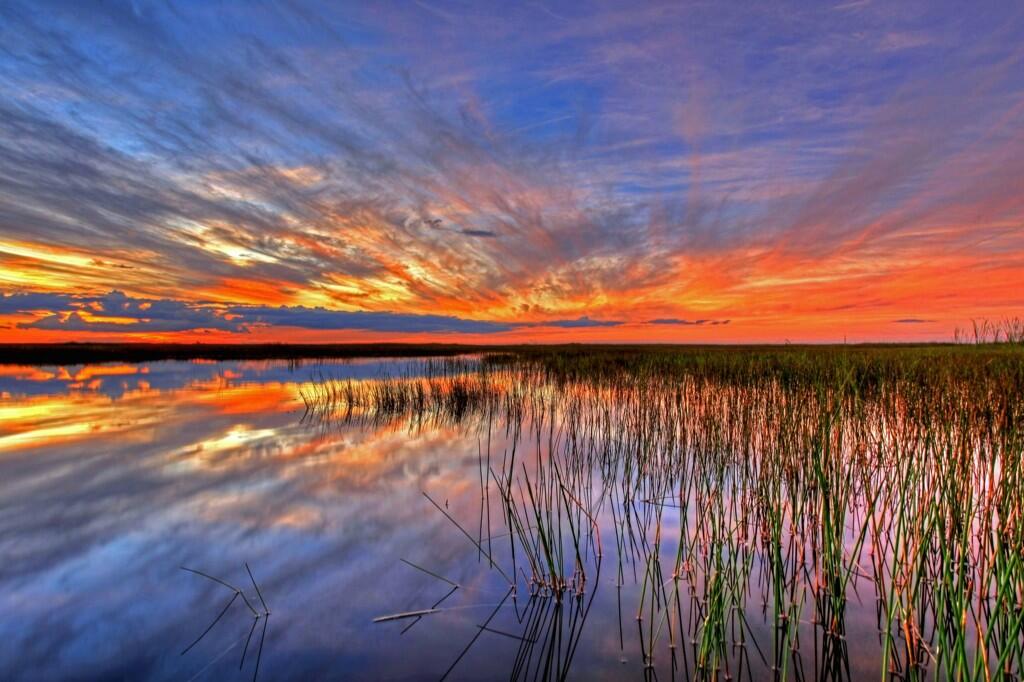
Sunset at Everglades National Park

Caption from Interior’s Tweet: Sometimes there are no words to describe America’s public lands. This photo @EvergladesNPS proves it. #Florida pic.twitter.com/3l7fnrcfsG

Everglades National Park, in Florida, is a great example of wild lands that belong to all Americans, that we almost let slip away.

I’m not sure a painter could do a more stunning version of this view.

More:

LocMap Everglades National Park

Location map: Everglades National Park in red. Wikipedia photo


Bering land bridge in autumn

September 23, 2013

World and U.S. history classes should be long past this point, but the photo just recently surfaced:

Bering Land Bridge National Preserve, Department of Interior

From America’s Outdoors: Bering Land Bridge National Preserve – Gone are the shockingly bright pinks, yellows and purples of summer, replaced by deeper and darker reds, yellows, greens and the beginnings of brown, all of equal vibrancy and beauty. And soon, as the 34 degree weather and diminishing daylight would lead us to believe, a blanket of white will fall upon the landscape. Enjoy the change of seasons wherever you may be!

Bering Land Bridge National Preserve? Did you even know there was such a thing?  Part of our public lands, your tax dollars at work.

Not a place for a Sunday drive.  There are no roads to get to the place.  For students, this site offers a lot of photos and interesting stuff for projects in history (human migrations) and geography (land forms, lava flows, migration routes, wilderness).

More:

Tors of Serpentine, in the Bering Land Bridge National Preserve, Alaska - NPS photo

Tors of Serpentine, in the Bering Land Bridge National Preserve, Alaska – NPS photo


Rio, a film study in time

September 20, 2013

Were I teaching geography this year, I think I’d work hard to find some way to sneak this time-lapse piece into the curriculum somewhere.

The film maker has advice, and information (some links added):

RIO, from Scientifantastic

BEST VIEWED IN HD, FULLSCREEN, SCALING OFF

Follow me at:
Twitter – twitter.com/scientifantasti | Instagram – instagram.com/scientifantastic | Google+ – gplus.to/scientifantastic

I was lucky enough to be sent to Rio on assignment to shoot some 4K and 10K timelapse footage for a major electronics manufacturer. This video is a compilation of some of the footage I shot there. Most of the locations are within the city of Rio De Janeiro, but I also traveled to the famous Iguazú Falls on the border of the Brazilian state of Paraná and the Argentinian province of Misiones. In 2011 Iguazú Falls was announced as one of the seven winners of the New Seven Wonders of Nature by the New Seven Wonders of the World Foundation.

RIO DE JANEIRO
No wonder the beautiful city of Rio De Janeiro was chosen to host the 2014 FIFA World Cup and the 2016 Summer Olympics. Rio de Janeiro, or simply Rio, is the capital city of the State of Rio de Janeiro, the second largest city of Brazil, and the third largest metropolitan area and agglomeration in South America, boasting approximately 6.3 million people within the city proper. Part of the city has been designated as a World Heritage Site, named “Rio de Janeiro: Carioca Landscapes between the Mountain and the Sea”, identified by UNESCO in the category Cultural Landscape.

Rio de Janeiro is one of the most visited cities in the southern hemisphere and is known for its natural settings, carnival celebrations, samba, Bossa Nova, balneario beaches such as Barra da Tijuca, Copacabana, Ipanema, and Leblon. Some of the most famous landmarks in addition to the beaches include the giant statue of Christ the Redeemer (“Cristo Redentor”) atop Corcovado mountain, named one of the New Seven Wonders of the World; Sugarloaf mountain (Pão de Açúcar) with its cable car; the Sambódromo, a permanent grandstand-lined parade avenue which is used during Carnival; and Maracanã Stadium, one of the world’s largest football stadiums.

I hope you enjoy the video!

Camera Gear:
Canon 5DIII
Canon 5DII
PhaseOne IQ180
Various Canon lenses

Music By:
Jan Baumann – baumann-musik.de

Special thanks to:
My production assistant José Olímpio ( joseolimpio.com ). Without his help this video would not have been possible. If you are ever in Rio and need a local production person I highly recommend José.

Dynamic Perception – dynamicperception.com
Division Camera – divisioncamera.com
Digital Fusion – digitalfusion.net
Jag35 – jag35.com

YOU CAN FOLLOW ME AT:
Twitter – twitter.com/scientifantasti
Instagram – instagram.com/scientifantastic
Vimeo – vimeo.com/scientifantastic
Facebook – facebook.com/pages/Scientifantastic/163137190447579
Google+ – gplus.to/scientifantastic
500px – 500px.com/scientifantastic
ProPic – propic.com/scientifantastic

Those of you who have traveled to Rio, tell us:  Does this short piece show off Rio as you would want it to be shown?

More:


Top o’ the world to you

September 3, 2013

Top of Colorado, anyway.

View from Longs Peak, yesterday:

View from Long's Peak, September 2, 2013; 14,259 ft.  Photo by Xiang Li.

View from Longs Peak, September 2, 2013; 14,259 ft. Photo by Xiang Li.

Xiang Li and James Darrell summited the mountain yesterday, a bit tougher climb than they had expected.  No view like that comes without some great effort somewhere.  They topped Grays Peak a couple of weeks ago — a slightly higher mountain (20 feet), but an easier climb.

Long’s Peak is the highest point in Rocky Mountain National Park.

Longs Peak is one of the 54 mountains with summits over 14,000 feet in Colorado.[3] It can be prominently seen from Longmont, Colorado, as well as from the rest of the Colorado Front Range. It is named after Major Stephen Long, who explored the area in the 1820s. Longs Peak is one of the most prominent mountains in Colorado, rising nearly 10,000 feet above the western edge of the Great Plains.

More:


Electricity in the air, times 2

September 1, 2013

Spectacular photo of Glen Canyon Dam, in the early morning, with a thunderstorm to the north.  This photo was taken close to the spot where Norman Rockwell painted the dam about 40 years ago.

 Electricity is in the air at Glen Canyon! Although the Glen Canyon Dam produces hydroelectric power around the clock, an early morning thunderstorm really cranked up the voltage earlier this month. Use caution when planning your upcoming outdoor activities as intense thunderstorms are common this time of year. (Photo Credit: David Bailey)

Electricity is in the air at Glen Canyon! Although the Glen Canyon Dam produces hydroelectric power around the clock, an early morning thunderstorm really cranked up the voltage earlier this month. Use caution when planning your upcoming outdoor activities as intense thunderstorms are common this time of year. (Bureau of Reclamation/Interior Facebook entry; photo Credit: David Bailey)

More:

Norman Rockwell's tribute to the Glen Canyon Dam.  Bureau of Reclamation image

Norman Rockwell’s tribute to the Glen Canyon Dam. Bureau of Reclamation image


Will Rogers and Wiley Post crashed in Alaska, August 15, 1935

August 15, 2013

Will Rogers, images from Will Rogers Museums, Oklahoma

Will Rogers, images from Will Rogers Museums, Oklahoma

August 15, the Ides of August, hosted several significant events through the years.  In 1935, it was a tragic day in Alaska, as an airplane crash took lives of Will Rogers and Wiley Post.  To refresh your memory, an encore post, with a few edits and additions.

After Mark Twain died, America found another great humorist, raconteur, story-teller, who tickled the nation’s funny-bone and pricked the collective social conscience at the same time. Will Rogers is most famous today for his sentiment that he never met a man he didn’t like. In 1935, he was at the height of his popularity, still performing as a lariat-twirling, Vaudeville comedian who communed with presidents, and kept his common sense. He wrote a daily newspaper column that was carried in 500 newspapers across America.  Rogers was so popular that Texas and Oklahoma have dueled over who gets the bragging rights in claiming him as a native son.

Will Rogers ready to perform.  Photo taken prior to 1900 - Wikimedia

Will Rogers ready to perform. Photo taken prior to 1900 – Wikimedia

Wiley Post was known as one of the best pilots in America. He gained fame by being the first pilot to fly solo around the world. Post was famous for his work developing new ways to fly at high altitudes. Post was born in Texas and moved to Oklahoma. He lost an eye in an oil-field accident in 1924, then used the settlement money to buy his first airplane. He befriended Will Rogers when flying Rogers to an appearance at a Rodeo, and the two kept up their friendship literally to death.

Post asked Rogers to come along on a tour of the great unknown land of Alaska, where Post was trying to map routes for mail planes to Russia. Ever adventurous, Rogers agreed — he could file his newspaper columns from Alaska by radio and telephone. On August 15, 1935, their airplane crashed near Point Barrow, Alaska, killing them both.

Wiley Post, first to fly solo around the world, in an early pressure suit for high-altitude flying - Wikimedia photo

Wiley Post, first to fly solo around the world, in an early pressure suit for high-altitude flying – Wikimedia photo

On August 15, 2008, a ceremony in Claremore, Oklahoma, honored the two men on the 73rd anniversary of their deaths. About 50 pilots from Oklahoma, Missouri, Kansas and Arkansas will fly in to the Claremore Airport for the Will Rogers-Wiley Post Fly-In Weekend. Oklahoma Lt. Gov. Jari Askins will offer a tribute.

Rogers was 56, leaving behind his wife, Betty, and four children. Post, 36, left a widow.

Rogers’ life is really quite legendary. Historian Joseph H. Carter summed it up:

Will Rogers was first an Indian, a cowboy then a national figure. He now is a legend.

Born in 1879 on a large ranch in the Cherokee Nation near what later would become Oologah, Oklahoma, Will Rogers was taught by a freed slave how to use a lasso as a tool to work Texas Longhorn cattle on the family ranch.
As he grew older, Will Rogers’ roping skills developed so special that he was listed in the Guinness Book of Records for throwing three lassos at once: One rope caught the running horse’s neck, the other would hoop around the rider and the third swooped up under the horse to loop all four legs.

Will Rogers’ unsurpassed lariat feats were recorded in the classic movie, “The Ropin’ Fool.”

His hard-earned skills won him jobs trick roping in wild west shows and on the vaudeville stages where, soon, he started telling small jokes.

Quickly, his wise cracks and folksy observations became more prized by audiences than his expert roping. He became recognized as being a very informed and smart philosopher–telling the truth in very simple words so that everyone could understand.

After the 10th grade, Will Rogers dropped out of school to become a cowboy in a cattle drive. He always regretted that he didn’t finish school, but he made sure that he never stopped learning–reading, thinking and talking to smart people. His hard work paid off.

Will Rogers was the star of Broadway and 71 movies of the 1920s and 1930s; a popular broadcaster; besides writing more than 4,000 syndicated newspaper columns and befriending Presidents, Senators and Kings.

During his lifetime, he traveled around the globe three times– meeting people, covering wars, talking about peace and learning everything possible.

He wrote six books. In fact he published more than two million words. He was the first big time radio commentator, was a guest at the White House and his opinions were sought by the leaders of the world.

Inside himself, Will Rogers remained a simple Oklahoma cowboy. “I never met a man I didn’t like,” was his credo of genuine love and respect for humanity and all people everywhere. He gave his own money to disaster victims and raised thousands for the Red Cross and Salvation Army.

Post’s legacy is significant, too. His employer, Oklahoma oil man F. C. Hall, encouraged Post to push for aviation records using Hall’s Lockheed Vega, and Post was happy to comply. Before his history-making trip around the world, he had won races and navigation contests. NASA traces the development of the space-walking suits worn by astronauts to Post’s early attempts for flight records:

For Wiley Post to achieve the altitude records he sought, he needed protection. (Pressurized aircraft cabins had not yet been developed.) Post’s solution was a suit that could be pressurized by his airplane engine’s supercharger.

First attempts at building a pressure suit failed since the suit became rigid and immobile when pressurized. Post discovered he couldn’t move inside the inflated suit, much less work airplane controls. A later version succeeded with the suit constructed already in a sitting position. This allowed Post to place his hands on the airplane controls and his feet on the rudder bars. Moving his arms and legs was difficult, but not impossible. To provide visibility, a viewing port was part of the rigid helmet placed over Post’s head. The port was small, but a larger one was unnecessary because Post had only one good eye!

Last photo of Will Rogers (in the hat) and Wiley Post, in Alaska in 1935 (from Century of Flight)

Last photo of Will Rogers (in the hat) and Wiley Post, in Alaska in 1935 (from Century of Flight)

Tip of the old scrub brush to Alaska bush advocate Pamela Bumsted.

Resources: